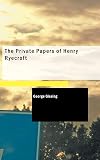
The Private Papers of Henry Ryecroft
by George Gissing
On This Page
Description
In this engaging collection of essays from George Gissing, the narrator of the fictional frame story describes himself as having been charged with the difficult task of editing a recently deceased friend's papers. The essays, sketches and observations are arranged according to a seasonal theme, and each of the four sections offers keen insights about the cycles of nature and of life..
Tags
Recommendations



















Member Recommendations

Member Reviews
Henry Ryecroft is a portrait of Gissing himself: a 60 year old writer who has been plagued by money problems and lack of real recognition during a long career devoted to literature. Towards the end of his life he comes into an inheritance allowing him, finally, to free himself from the demands of poverty. He rents a small house in Devon with a housekeeper and devotes his final years to walks in the Devonshire countryside and writing his memoirs.
This hardly sounds like a gripping read, and it's not. However, as a meditation on ageing, the intellectual life, the importance of books, the beauty of the natural world, the position of the intellectual in society, the effects on character of poverty (an overriding concern in all of Gissing's show more work), the book is unparalleled in its gentle wisdom and beauty. Who among us cannot respond to this:
Ah! the books that one will never read again! they gave delight, perchance something more; they left a perfume in the memory, but life has passed them by for ever. I have but to muse, and one after another they rise before me....
I read much less than I used to do; I think much more. Yet, what is the use of thought which can no longer serve to direct life? Better perhaps, to read and read incessantly, losing one's futile self in the activity of other minds....
To the end I shall be reading and - and forgetting. Ah! That's the worst of it! Had I at command all the knowledge I have at any time possessed, I might call myself a learned man... I cannot preserve more than a few fragments of what I read, yet read I shall, persistently, rejoicingly....
Wonderful stuff. A book to read again and again. show less
This hardly sounds like a gripping read, and it's not. However, as a meditation on ageing, the intellectual life, the importance of books, the beauty of the natural world, the position of the intellectual in society, the effects on character of poverty (an overriding concern in all of Gissing's show more work), the book is unparalleled in its gentle wisdom and beauty. Who among us cannot respond to this:
Ah! the books that one will never read again! they gave delight, perchance something more; they left a perfume in the memory, but life has passed them by for ever. I have but to muse, and one after another they rise before me....
I read much less than I used to do; I think much more. Yet, what is the use of thought which can no longer serve to direct life? Better perhaps, to read and read incessantly, losing one's futile self in the activity of other minds....
To the end I shall be reading and - and forgetting. Ah! That's the worst of it! Had I at command all the knowledge I have at any time possessed, I might call myself a learned man... I cannot preserve more than a few fragments of what I read, yet read I shall, persistently, rejoicingly....
Wonderful stuff. A book to read again and again. show less
First published in 1903 by Constable and Co., Ltd., in the last year of George Gissing’s life, this is the one work of the author that retains literary interest and any real popularity with readers. A thinly veiled self-portrait of the author himself, it casts light not only on the literary world of that time, over a century ago, but on an aspect of human life that most authors, critic V. S. Pritchett argues in his foreword, do not well understand: how people change “many times in the course of their lives.”
This book is not, Pritchett insists, “a novel ideas.” Instead, Gissing, as elsewhere, has provided us with a glimpse of “ordinary, hapless people” who send off “buds of thought and aspiration.” Like his other, show more now-neglected fiction, this book foreshadows “the kind of man who was to become the now familiar proletarian intellectual.”
“Such people become ‘unclassed,’ they hide in a limbo of self-chosen loneliness.” Such is the “difficulty of Ryecroftism” . . . as well as of the modern, intelligent reader. show less
This book is not, Pritchett insists, “a novel ideas.” Instead, Gissing, as elsewhere, has provided us with a glimpse of “ordinary, hapless people” who send off “buds of thought and aspiration.” Like his other, show more now-neglected fiction, this book foreshadows “the kind of man who was to become the now familiar proletarian intellectual.”
“Such people become ‘unclassed,’ they hide in a limbo of self-chosen loneliness.” Such is the “difficulty of Ryecroftism” . . . as well as of the modern, intelligent reader. show less
I believe this to be a fictional autobiography by the author and may be his last work, the edition I have being published a year or so following his death.
I feel I have a lot of shared sympathy for Henry Ryecroft although in some matters we differ, but I do share his love of books, solitary walks and avoidance of crowds.
Inspired my interest in classical Greek with his description of a passage from Xenophon.
A fascinating book with passages of sublime prose reflecting the changing seasons.
I feel I have a lot of shared sympathy for Henry Ryecroft although in some matters we differ, but I do share his love of books, solitary walks and avoidance of crowds.
Inspired my interest in classical Greek with his description of a passage from Xenophon.
A fascinating book with passages of sublime prose reflecting the changing seasons.
A fascinating book, written autobiographically. The author struggles with poverty, a desire for wealth, and a partial realization of a life of ease in later life.
Fiction: A book I re-read every 10 years; there's something about this deceptively simple tale of books, reading, country life and the seasons - it reflects much of what we term 'civilisation' but it also has a very personal angle for me in it as well.
Ratings
Members
- Recently Added By
Published Reviews
This is one of those classics which everyone has heard of, but which nobody should read. It is so tedious that many readers must have put it down long before reaching the end and consequently never discovered that the tedium has been broken down and categorised in Gissing's index.
added by KayCliff
George Gissing’s late work, The private papers of Henry Ryecroft (1903), is described in The Cambridge history of English literature as lying ‘in form, somewhere between the journal intime and the diary, reflection and observation being expanded to the length of brief essays’, and in the Oxford companion to English literature as ‘a mock-autobiography’. As the purported autobiographer show more is a fictitious character, the eponymous Ryecroft, the book partakes also of the nature of fiction. The first edition, from Archibald Constable in 1903, 293 pages of text, is provided with a four-page index, which remained present in all Constable’s impressions of the book until 1918, except for an indexless sixpenny reprint they published in 1908 and reprinted in 1913. ... a real shame that this curious index has apparently become even rarer than the book to which it was appended! show less
added by KayCliff
Author Information

108+ Works 4,845 Members
Some Editions
Series
Belongs to Publisher Series
Privé-domein (155)
Modern Library (46.1)
Common Knowledge
- Original publication date
- 1902
- First words
- For more than a week my pen has lain untouched.
- Quotations
- Once, on going down to the lavatory to wash my hands, I became aware of a notice newly set up above the row of basins. It ran somehow thus: "Readers are requested to bear in mind that these basins are to be used only for casu... (show all)al ablutions.
Ryecroft, his life and character, iii .; journal, vii.; pen, 3; cottage, 6; housekeeper, 6,49,88; no cosmopolite, 9; apology for his comfort, 12; life and labour in London, vid. London; library, 34, 228-9; anti-democratic tem... (show all)per, 47; memories of drill-sergeant, 57; "coaching" at Knightsbridge, 109; emotions on receiving legacy, 142;self-criticism, 165-8; retrospect of life, 217; delight in giving, 230;desire of knowledge, 262; hatred of science, 267 - Last words
- (Click to show. Warning: May contain spoilers.)May I look back on life as a long task duly completed -- a piece of biography; faulty enough, but good as I could make it -- and, with no thought but one of contentment, welcome the repose to follow when I have breathed the word "Finis".
Classifications
Statistics
- Members
- 265
- Popularity
- 121,674
- Reviews
- 6
- Rating
- (3.78)
- Languages
- 5 — Dutch, English, French, Japanese, Swedish
- Media
- Paper, Audiobook, Ebook
- ISBNs
- 39
- ASINs
- 31