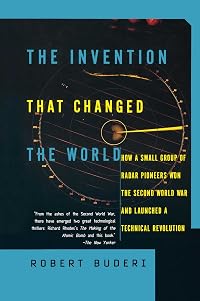
The Invention That Changed the World: How a Small Group of Radar Pioneers Won the Second World War and Launched a Technological Revolution
by Robert Buderi
On This Page
Description
"The Invention That Changed the World is the great and largely untold story of the colorful band of brilliant scientists who created the microwave radar systems that not only helped win World War II but set off a veritable explosion of scientific achievements and technological advances that have transformed our daily lives." "The story begins in September 1940 with the arrival in Washington of a team of British scientists bearing England's most closely guarded technological secrets, among show more them the cavity magnetron, a revolutionary new source of microwave energy that was to pave the way for radar systems small enough to fit on planes and ships. The magnetron's arrival triggered the most dramatic mobilization of science in history as America's top scientists enlisted in the "war within the war" to convert the British invention into a potent military weapon. Developed in a top-secret rush at the Radiation Lab on the campus of MIT, microwave radars eventually helped destroy Japanese warships in the Pacific, brought down Nazi buzz bombs over England, and enabled Allied bombers to "see" through cloud cover over Germany and Japan. Although the atomic bomb ended World War II, in many ways radar won it." "Capturing all the drama and excitement of the race to develop radar, The Invention That Changed the World then follows the postwar careers of the radar scientists as they applied the knowledge gained from their wartime work in many different fields. The Rad Lab was an incubator for science and technology on a scale perhaps unprecedented in history. Among their many achievements, radar veterans were instrumental in creating the field of radio astronomy and discovering nuclear magnetic resonance, the transistor, and the maser, breakthroughs that led to the Nobel Prizes. In the continuing push to develop early warning systems during the Cold War, other radar men helped create the basis for digital computer memories. In very practical ways, radar and its spin-offs continue to enhance our lives, whether by controlling civilian air traffic, helping to forecast the weather, or providing physicians with powerful diagnostic tools."--Jacket show lessTags
Recommendations





























Member Recommendations


Member Reviews
In "a technological thriller better than Tom Clancy's best" (Richard Rhodes, Pulitzer Price-winning author of The Making of the Atomic Bomb), Robert Buderi chronicles the previously untold story of one of the greatest scientific breakthroughs of this century -- radar. From the radar systems that enabled Allied forces in World War II to hunt down U-boats and "see" at night to such postwar achievements as the emergence of radio astronomy and the discovery of the transistor and nuclear magnetic resonance, the work at MIT's Radiation Lab has had a tremendous impact on our lives. In this remarkable book, Robert Buderi presents in-depth, completely accessible descriptions of these triumphs and technological advances and introduces the show more brilliant band of scientists, many of them Nobel Prize-winners, who carried out this revolution. show less
Cavity Magnatron explained: https://www.youtube.com/watch?v=bUsS5KUMLvw
In 1940 a team of British Scientists arrived in Washington, bearing Britain's most closely guarded technological secrets, including the cavity magnetron, a revolutionary new source of microwave energy. Its arrival triggered the most dramatic mobilisation of science in history, as America's top scientists enlisted to convert the invention into a potent military weapon. Microwave radars eventually helped destroy Japanese warships, Nazi buzz bombs and enabled Allied bombers to 'see' through cloud cover. After the war the work of radar veterans continues to affect our lives p controlling air traffic helping to forecast the weather and providing physicians with powerful show more diagnostic tools. Brimming with telling anecdotes and suprising revelations, this book brings to life the exciting, largely untold story of the scientist who not only created a winning weapon but also changed our world for ever. show less
In 1940 a team of British Scientists arrived in Washington, bearing Britain's most closely guarded technological secrets, including the cavity magnetron, a revolutionary new source of microwave energy. Its arrival triggered the most dramatic mobilisation of science in history, as America's top scientists enlisted to convert the invention into a potent military weapon. Microwave radars eventually helped destroy Japanese warships, Nazi buzz bombs and enabled Allied bombers to 'see' through cloud cover. After the war the work of radar veterans continues to affect our lives p controlling air traffic helping to forecast the weather and providing physicians with powerful show more diagnostic tools. Brimming with telling anecdotes and suprising revelations, this book brings to life the exciting, largely untold story of the scientist who not only created a winning weapon but also changed our world for ever. show less
Ratings
Members
- Recently Added By
Author Information
5 Works 412 Members
Robert Buderi is former technology editor at Business Week, writes the popular "Lab Watch" column for Upside magazine, and is a contributing editor at Technology Review.
Series
Belongs to Publisher Series
Common Knowledge
- Canonical title
- The Invention That Changed the World: How a Small Group of Radar Pioneers Won the Second World War and Launched a Technological Revolution
- Original publication date
- 1996
- Important events
- World War II (1939 | 1945)
Classifications
- Genres
- Nonfiction, History, Technology, Science & Nature, General Nonfiction
- DDC/MDS
- 621.3848 — Applied science & technology Engineering Applied physics Electronics & Computers Electronics, communications engineering Radar, Radio Radar
- LCC
- TK6574.2 .B84 — Technology Electrical engineering. Electronics. Nuclear engineering Electrical engineering. Electronics. Nuclear Telecommunication
- BISAC
Statistics
- Members
- 272
- Popularity
- 118,836
- Reviews
- 2
- Rating
- (4.35)
- Languages
- Chinese, English
- Media
- Paper
- ISBNs
- 5
- ASINs
- 3