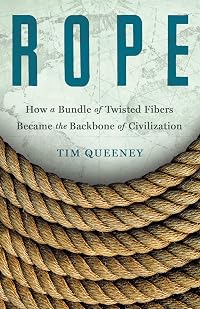
Rope: How a Bundle of Twisted Fibers Became the Backbone of Civilization
by Tim Queeney
On This Page
Description
"A unique and compelling adventure through the history of rope and its impact on civilization, in the vein of single-subject bestsellers like Salt and Cod Tim Queeney is a sailor who knows more about rope and its importance to humankind than most. In Rope, Queeney takes readers on a ride through the history of rope and the way it weaves itself through the story of civilization. From Magellan's world-circling ships, to the 15th-century fleet of Admiral Zheng He, to Polynesian multihulls with show more crab claw sails, he shows how without rope, none of their adventurous voyages and discoveries would have been possible. Time traveling, he describes the building of the pyramids, the Roman Coliseum, Hagia Sofia, Notre Dame, the Sultan Hasan Mosque, the Brooklyn Bridge, and countless other constructions that would not have been possible without rope. Not content to just look at rope's past, Queeney looks at its present and possible future and how the re-invention of rope with synthetic fibers will likely provide the strength for cables to support elevators into space. Making the story of rope real for readers, Queeney tells remarkable nautical stories of his own reliance on rope at sea. Rope is history, adventure, and the story of one of the world's most common tools that has made it possible for humans to advance throughout the centuries"-- Provided by publisher. show lessTags
Recommendations





Member Reviews
Rating: 4.5* of five
The Publisher Says: A unique and compelling adventure through the history of rope and its impact on civilization, in the vein of single subject bestsellers like Salt and Cod
Tim Queeney is a sailor who knows more about rope and its importance to humankind than most. In Rope, Queeney takes readers on a ride through the history of rope and the way it weaves itself through the story of civilization. Considering Magellan’s world-circling ships, the 15th century fleet of Admiral Zheng He, or a Polynesian multihull with crab claw sails, he shows how without rope, none of their adventurous voyages and their discoveries would have been possible. Time traveling, he describes the building of the pyramids, the Roman Coliseum, show more Hagia Sofia, Notre Dame, the Sultan Hasan Mosque, the Brooklyn Bridge and countless other constructions that would not have been possible without rope.
Not content to just look at rope’s past, Queeney looks at its future and how the re-invention of rope using steel strands to make wire rope and later synthetic fibers will likely provide the strength for cables to support elevators into space. Making the story or rope real for readers, Queeney tells remarkable nautical stories of his own reliance on rope to survive—“While approaching Buzzard’s Bay in the dark of night, we were hit by a fierce squall…The wrong line was eased, and the 200-pound hunk of wood that holds the top of the sail, went flying out of control, swaying wildly and threatening to knock us into the inky ocean. Finally, the proper ropes were located in the dark, firm hands hauled them taught and the gaff was brought under control. It was a sobering display of rope’s often unacknowledged role and uncredited importance.” Rope is history, adventure and the story of one of the world’s most common tools that has made it possible for humans to advance throughout the century.
I RECEIVED A DRC FROM THE PUBLISHER VIA NETGALLEY. THANK YOU.
My Review: Tim Queeney is treading on Mark Kurlansky's and Mary Roach's territories with this historical and sociological survey of rope, its development, its role in society, and its future uses.
He sets his sights high. The book is even organized into "strands" not chapters, which seemed cutesy to me at first...it's not, it is in fact subtle and informative. I'm happy to report he succeeds in the rope-climb to success.
Readable, relatable, illuminating, and fun to learn about, who knew rope was so culturally significant? I've reached the end of my rope more than once, and still had not thought about the rope I was running out of. I've had enough fun in my life finding the men who live by the old gay truism, "if you can rope me, you can ride me," that I ought to be far more alert to how ropey my grasp of the subject is.
I have a greatly expanded respect for how many metaphors and concepts tie back to rope and its variants, starting with "religion"...re- (back to, again)+ligare (to tie, to rope onto)= "religion." A concept hiding in plain sight, one that could not exist without that extremely early invention of humankind, the rope.
The development of rope was surprisingly technological; in fact if we had not been scientists by our very nature rope could not exist. Many aspects of its creation were impossible without trial and error based on what we today would describe as "materials science"...does grass get stronger or weaker when bundled together? is green grass more or less useful than dried grass? exactly how dried is optimal for making cordage?...a tiny, tiny peek into the huge variety of questions Author Queeney introduces us to as he explicates the scientific process as we developed it.
No tool is not also a weapon: "string him up" and its variants did not come about as a common phrase because someone was decorating a loved one in a string vest. Author Queeney does not shy away from elucidating the horrifying, evil uses humanity put its early invention the rope to. The details are stomach-churning, but the facts are incontrovertible. We love to be hatefully cruel. I'm sure some readers will skip right over these parts in order not to lose sleep. I strongly caution those highly averse to animal cruelty to pay close attention to prefatory language used as they read along.
I'm carrying on about a five-star read but there's not a whole fifth star. The half-star lost got hung up on that pesky thing, the content warning. The fact is there's not much human awfulness I haven't read about or seen in the past *mumble*ty-five years. I still felt blindsided by the overly-careful enumeration of the nasty uses we use rope for. Lingering on these unpleasantnesses slowed my roll through the story of rope. Don't get tied up in these things if you're at all squeamish; fresh strands await.
A thoroughly noted and sourced elucidation of the importance of an invisbly ubiquitous invention. Its many pleasures for the broadly curious reader require some common-sense personalization of the reading experience. Those who need chew-toys for their brains are going to batten on the trivia embedded in the long strand roping human history together. show less
The Publisher Says: A unique and compelling adventure through the history of rope and its impact on civilization, in the vein of single subject bestsellers like Salt and Cod
Tim Queeney is a sailor who knows more about rope and its importance to humankind than most. In Rope, Queeney takes readers on a ride through the history of rope and the way it weaves itself through the story of civilization. Considering Magellan’s world-circling ships, the 15th century fleet of Admiral Zheng He, or a Polynesian multihull with crab claw sails, he shows how without rope, none of their adventurous voyages and their discoveries would have been possible. Time traveling, he describes the building of the pyramids, the Roman Coliseum, show more Hagia Sofia, Notre Dame, the Sultan Hasan Mosque, the Brooklyn Bridge and countless other constructions that would not have been possible without rope.
Not content to just look at rope’s past, Queeney looks at its future and how the re-invention of rope using steel strands to make wire rope and later synthetic fibers will likely provide the strength for cables to support elevators into space. Making the story or rope real for readers, Queeney tells remarkable nautical stories of his own reliance on rope to survive—“While approaching Buzzard’s Bay in the dark of night, we were hit by a fierce squall…The wrong line was eased, and the 200-pound hunk of wood that holds the top of the sail, went flying out of control, swaying wildly and threatening to knock us into the inky ocean. Finally, the proper ropes were located in the dark, firm hands hauled them taught and the gaff was brought under control. It was a sobering display of rope’s often unacknowledged role and uncredited importance.” Rope is history, adventure and the story of one of the world’s most common tools that has made it possible for humans to advance throughout the century.
I RECEIVED A DRC FROM THE PUBLISHER VIA NETGALLEY. THANK YOU.
My Review: Tim Queeney is treading on Mark Kurlansky's and Mary Roach's territories with this historical and sociological survey of rope, its development, its role in society, and its future uses.
While many short lengths of rope helped countless individuals through the centuries, rope also was a tool of human innovation writ large through collective action. Just as many small strands come together to form a rope, so, too, did many people gather to perform the biggest of tasks. The exemplar of this from the ancient world is the Egyptian pyramids. While we don’t know exactly how these human-built mountains were assembled, we can be sure that rope was an essential tool in their construction. In this way rope stands as both a tool and a symbol of humans working together to achieve the greatest things.
He sets his sights high. The book is even organized into "strands" not chapters, which seemed cutesy to me at first...it's not, it is in fact subtle and informative. I'm happy to report he succeeds in the rope-climb to success.
Its cultural significance is revealed by a parade of expressions: “roped me in,”“rope it off,”“tied in knots,”“rope-a-dope,”“roped and branded,”“give him/ her enough rope,”“at the end of my rope,”“throw me a rope,”“give me some slack,”“on the ropes ,”“go piss up a rope,”“learn the ropes,”“a rope of sand.” This incomplete list of everyday sayings just shows how deeply into our consciousness rope has entwined itself.
Readable, relatable, illuminating, and fun to learn about, who knew rope was so culturally significant? I've reached the end of my rope more than once, and still had not thought about the rope I was running out of. I've had enough fun in my life finding the men who live by the old gay truism, "if you can rope me, you can ride me," that I ought to be far more alert to how ropey my grasp of the subject is.
I have a greatly expanded respect for how many metaphors and concepts tie back to rope and its variants, starting with "religion"...re- (back to, again)+ligare (to tie, to rope onto)= "religion." A concept hiding in plain sight, one that could not exist without that extremely early invention of humankind, the rope.
The development of rope was surprisingly technological; in fact if we had not been scientists by our very nature rope could not exist. Many aspects of its creation were impossible without trial and error based on what we today would describe as "materials science"...does grass get stronger or weaker when bundled together? is green grass more or less useful than dried grass? exactly how dried is optimal for making cordage?...a tiny, tiny peek into the huge variety of questions Author Queeney introduces us to as he explicates the scientific process as we developed it.
No tool is not also a weapon: "string him up" and its variants did not come about as a common phrase because someone was decorating a loved one in a string vest. Author Queeney does not shy away from elucidating the horrifying, evil uses humanity put its early invention the rope to. The details are stomach-churning, but the facts are incontrovertible. We love to be hatefully cruel. I'm sure some readers will skip right over these parts in order not to lose sleep. I strongly caution those highly averse to animal cruelty to pay close attention to prefatory language used as they read along.
I'm carrying on about a five-star read but there's not a whole fifth star. The half-star lost got hung up on that pesky thing, the content warning. The fact is there's not much human awfulness I haven't read about or seen in the past *mumble*ty-five years. I still felt blindsided by the overly-careful enumeration of the nasty uses we use rope for. Lingering on these unpleasantnesses slowed my roll through the story of rope. Don't get tied up in these things if you're at all squeamish; fresh strands await.
A thoroughly noted and sourced elucidation of the importance of an invisbly ubiquitous invention. Its many pleasures for the broadly curious reader require some common-sense personalization of the reading experience. Those who need chew-toys for their brains are going to batten on the trivia embedded in the long strand roping human history together. show less
Rope: How a Bundle of Twisted Fibers Became the Backbone of Civilization, by author Tim Queeney is an in-depth look at the history of rope and its impact on civilization. Well-researched and detailed, author Queeney tells the story of rope from the earliest times, how it was formed and used, what would have possibly happened if rope had not been a factor, and the consequences of its use. Fascinating to read, told both from a scientific perspective about the very nature of rope and also employing anecdotal accounts, making the history seem alive.
An enjoyable read. I received an advance copy of Rope: How a Bundle of Twisted Fibers Became the Backbone of Civilization from St. Martin’s Press via NetGalley. I voluntarily leave this review; show more all opinions are my own. show less
An enjoyable read. I received an advance copy of Rope: How a Bundle of Twisted Fibers Became the Backbone of Civilization from St. Martin’s Press via NetGalley. I voluntarily leave this review; show more all opinions are my own. show less
Some of the most interesting history books present deep dives into many common things often overlooked. One such work is Rope: How a Bundle of Twisted Fibers Became the Backbone of Civilization (galley received as part of early review program) by Tim Queeney.
The author well considered how rope has been around for as long as there has been civilization, and there’s no real telling how long it has been since people figured out what they could accomplish by twisting fibers together. The author set forth some of the mechanics of rope making and some of the science behind it, but not so much as to lose his audience.
Most of the work considered the various ways in which people have used rope over the past few thousand years: making boats show more and erecting pyramids in Egypt, as cordage in Polynesian boats, rope in ceremonial and religious contexts, the khipu of the Inca Empire, the extensive use of rope in developing sailboats in the early modern period, as nets in fishing, its use in criminal matters but also in law enforcement, the use of rope in cattle ranching and entertainment, and the significant use of rope in climbing adventures, among other such things. He also details the developments in rope making: first regarding what plant fibers were used, and then the industrialization of rope making, the creation of synthetic ropes, and even the weaving of metal into rope-like strands. The author also considers what the future of rope may entail, both in terms of material and purpose.
We may not think much or very often of rope, but a lot of aspects of modern life have been dependent on their use. They are very unlikely to go out of use or fashion. And so we will continue to have rope, and it will still be good to understand what it can be used for and to know some basic knots. show less
The author well considered how rope has been around for as long as there has been civilization, and there’s no real telling how long it has been since people figured out what they could accomplish by twisting fibers together. The author set forth some of the mechanics of rope making and some of the science behind it, but not so much as to lose his audience.
Most of the work considered the various ways in which people have used rope over the past few thousand years: making boats show more and erecting pyramids in Egypt, as cordage in Polynesian boats, rope in ceremonial and religious contexts, the khipu of the Inca Empire, the extensive use of rope in developing sailboats in the early modern period, as nets in fishing, its use in criminal matters but also in law enforcement, the use of rope in cattle ranching and entertainment, and the significant use of rope in climbing adventures, among other such things. He also details the developments in rope making: first regarding what plant fibers were used, and then the industrialization of rope making, the creation of synthetic ropes, and even the weaving of metal into rope-like strands. The author also considers what the future of rope may entail, both in terms of material and purpose.
We may not think much or very often of rope, but a lot of aspects of modern life have been dependent on their use. They are very unlikely to go out of use or fashion. And so we will continue to have rope, and it will still be good to understand what it can be used for and to know some basic knots. show less
When it comes to the study of history, it is usually people who we think of as the most important, if not the only, influences. Tim Queeny looks at the important role rope has played throughout history. He points out that we have no way of knowing when and who first twisted fibres together to make the first rope but he discusses how it enabled the construction of some of the most impressive and well-known sites throughout history like the pyramids, the Roman Coliseum, and the Cathedral of Notre Dame. As a sailor, he also points out how rope made, not only fishing and food gathering possible, but also exploration. And he talks about the essential role rope has played in such diverse occupations as ranching and entertainment.
As well as show more the uses of rope throughout history, he also discusses the many changes to the making of rope that have occurred and continue to occur in the effort to make it stronger and more durable by, for example, the addition of steel. He also adds a personal touch as he describe how essential rope has been in his life as a sailor.
Rope is a well-researched, extremely interesting, and surprisingly entertaining look at a subject I have never really thought much about except when I needed some but I have to say I found it a fascinating read and recommend it highly to anyone interested in history, sailing, or the building of civilization.
I received an eARC of this book from Netgalley and St Martin’s Press in exchange for an honest review show less
As well as show more the uses of rope throughout history, he also discusses the many changes to the making of rope that have occurred and continue to occur in the effort to make it stronger and more durable by, for example, the addition of steel. He also adds a personal touch as he describe how essential rope has been in his life as a sailor.
Rope is a well-researched, extremely interesting, and surprisingly entertaining look at a subject I have never really thought much about except when I needed some but I have to say I found it a fascinating read and recommend it highly to anyone interested in history, sailing, or the building of civilization.
I received an eARC of this book from Netgalley and St Martin’s Press in exchange for an honest review show less
Who thinks a lot about rope? Well, sailors do. So, it makes sense that this deep dive into the history of rope is written by a lifelong sailor. Tim Queeney has written for the magazine Ocean Navigator for years and has also taught celestial, coastal and radar navigation as an instructor for the Ocean Navigator School of Seamanship. Rope is a key tool for sailors, but it’s also a tool with many other uses, many of which Queeney explores in this book.
This book interested me because, as I’ve often said in my book reviews, I love books that cover the history of science, and this book is within the general ballpark. While not as scientific a topic as usually motivates me to read such a book, tools and tool use are also interests - one of show more the reasons I recently reviewed a book on axe murders.
Realistically though, rope is such a basic thing that just seems like it’s probably been around forever. So, it’s not something most people would think of as a subject for a book. But it’s that history and basic usefulness that make this book interesting. It took someone like Queeney who has spent a lot of time with this tool to really be motivated to do the research and put a book like this together.
If you are a casual user of rope, like me, you may find this book a bit uneven, as the chapters are arranged by the different uses rope has been put to. But McQueeney keeps his story pretty much in chronological order so that you get a sense not only of how rope has been used over time but also how the rope we use has itself changed. From sisal and “manila” (a plant fiber found only in the Philippines) to nylon and steel; technology has been applied to rope to further increase its usefulness. Today there are many types or rope suitable for many different purposes.
This book is the latest to take an everyday object and do a deep dive into its history. Part of the book trend called “microhistories”, these books have become a genre of their own. For the sailor in your life, for someone who tinkers with tools, and for folks who like to learn the history behind common everyday objects this book would be a good beach read for the long Labor Day weekend. show less
This book interested me because, as I’ve often said in my book reviews, I love books that cover the history of science, and this book is within the general ballpark. While not as scientific a topic as usually motivates me to read such a book, tools and tool use are also interests - one of show more the reasons I recently reviewed a book on axe murders.
Realistically though, rope is such a basic thing that just seems like it’s probably been around forever. So, it’s not something most people would think of as a subject for a book. But it’s that history and basic usefulness that make this book interesting. It took someone like Queeney who has spent a lot of time with this tool to really be motivated to do the research and put a book like this together.
If you are a casual user of rope, like me, you may find this book a bit uneven, as the chapters are arranged by the different uses rope has been put to. But McQueeney keeps his story pretty much in chronological order so that you get a sense not only of how rope has been used over time but also how the rope we use has itself changed. From sisal and “manila” (a plant fiber found only in the Philippines) to nylon and steel; technology has been applied to rope to further increase its usefulness. Today there are many types or rope suitable for many different purposes.
This book is the latest to take an everyday object and do a deep dive into its history. Part of the book trend called “microhistories”, these books have become a genre of their own. For the sailor in your life, for someone who tinkers with tools, and for folks who like to learn the history behind common everyday objects this book would be a good beach read for the long Labor Day weekend. show less
Quite good reading on the history and importance of rope. The book strolls thru human (and neanderthal) history with an eye to how rope impacted and enhanced it. Entertaining, quick read.
Rope: How a Bundle of Twisted Fibers Became the Backbone of Civilization by Tim Queeney is a very highly recommended in-depth examination of rope and its impact on civilization. For a single topic book, it is amazing and fascinating how much we have depended upon rope over the ages. This is for everyone who enjoys history, sailing, and has spent an inordinate amount of time looking for and using rope in our daily lives.
This is a comprehensive look at how rope was made and used throughout history for tools, weapons, boats, construction, in culture/mythology, fishing, crime and punishment, for tricks and adventures, and in space. There is a special extensive focus on the use of rope for sailing and the significance of sailing for show more exploration, trade, fishing, etc.
The various materials used to make rope are discussed. Everything from bark, numerous plant fibers, animal hides and hair, etc. to the use of more current metal strands and synthetic fibers have been used to make rope. Queeney, who has knot tying videos available online, also has an interesting section on the importance and use of knots for the obvious, but also past use of knotted cords for messages, record keeping, and calendars.
Rope is very well researched. There is a note at the beginning that the book is AI Free - No AI was used in the research or writing of the book. I appreciated this after reading several cases where AI made up sources. The amount of researched involved in the book is impressive. This can be seen in the extensive Bibliography, which includes books, web articles, journals, and newspapers. There is also an Index and Notes.
Rope is a good choice for those who like history, sailing, and rope. Thanks to St. Martin's Press for providing me with an advance reader's copy via NetGalley. My review is voluntary and expresses my honest opinion.
http://www.shetreadssoftly.com/2025/08/rope.html show less
This is a comprehensive look at how rope was made and used throughout history for tools, weapons, boats, construction, in culture/mythology, fishing, crime and punishment, for tricks and adventures, and in space. There is a special extensive focus on the use of rope for sailing and the significance of sailing for show more exploration, trade, fishing, etc.
The various materials used to make rope are discussed. Everything from bark, numerous plant fibers, animal hides and hair, etc. to the use of more current metal strands and synthetic fibers have been used to make rope. Queeney, who has knot tying videos available online, also has an interesting section on the importance and use of knots for the obvious, but also past use of knotted cords for messages, record keeping, and calendars.
Rope is very well researched. There is a note at the beginning that the book is AI Free - No AI was used in the research or writing of the book. I appreciated this after reading several cases where AI made up sources. The amount of researched involved in the book is impressive. This can be seen in the extensive Bibliography, which includes books, web articles, journals, and newspapers. There is also an Index and Notes.
Rope is a good choice for those who like history, sailing, and rope. Thanks to St. Martin's Press for providing me with an advance reader's copy via NetGalley. My review is voluntary and expresses my honest opinion.
http://www.shetreadssoftly.com/2025/08/rope.html show less
Members
- Recently Added By
Lists

LibraryReads, August 2025
12 works; 1 member
Author Information
5+ Works 95 Members
Classifications
Statistics
- Members
- 87
- Popularity
- 368,544
- Reviews
- 8
- Rating
- (4.16)
- Languages
- English
- Media
- Paper, Ebook
- ISBNs
- 5
- ASINs
- 1