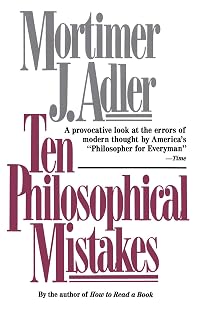
Ten Philosophical Mistakes
by Mortimer J. Adler
On This Page
Description
Examines ten errors in modern thought and shows how they have led to serious consequences in our everyday lives. Tells how they came about, how to avoid them, and how to counter their negative effects.Tags
Recommendations































Member Reviews
Adler breaks modern philosophy into ten "subjects", about which errors have been made by the "moderns" since Hobbes and Descartes. He corrects them all by adverting to Aristotle and his apologist, Aquinas, without a trace of the trifecta of irony he forges in doing so.
This book fails to accurately summarize the work of the men it derides, and then refutes them without evidence. For example he concludes his excoriations against Locke, who he mistakes as a kind of successor to Hobbes, and against Hume and Berkely, "There is no empirical evidence whatsoever that concepts, thus precisely defined, are present in animal behavior. Their intelligence is entirely sensory." [52] While none of the "moderns" he derides are actually "modern" -- they show more last spoke in a pre-Victorian age--it is doubly unfair to quote Darwin's work a century after their lives, and then find an inarticulate fault with Darwin's clinical evidence [50].
Darwin's work has repeatedly been replicated. The Bonobo Apes' cortical emotional and abstract intelligence, has been demonstrated clinically, and behaviorally. Similar work with cetaceae and pigs. Adler insists on a qualitative difference between humans and all other life forms without citing evidence, although he does cite his own book "The Angels and Us" [52]. To my knowledge he offers no clinical or empirical evidence in support of his Angels.
Adler begins with the "crucial" mistake about Consciousness, which "lies at the very foundation of modern thought". The second mistake is the failure to distinguish between perceptual and conceptual thought. Adler ignores the phenomenologists who are all about this distinction. His third set of mistakes apparently consist of the way the meaning of words has been explained. Adler accuses un-named "contemporary linguistic philosophers" [81] of believing that "Language controls thought". He amazingly claims this is an error trace-able in some unknown way to Locke and then Hobbes!
The fourth mistake, he imagines, is there is some line drawn between knowledge and opinion, in some way, that makes philosophical "truths" less important or legitimate than what we learn from science, math, and real history.[xvii]. Well. Here it least he uncovers a modern philosopher, Karl Popper, not content with rehashing Lock and Hume again and misstating Kant's critique. Adler correctly notes that Popper drew the demarcation between knowledge and speculation by the criterion of "falsifiability by empirical evidence". [101] Adler insists on adding other criteria--experience, argument, or a combination.[105]
The fifth mistake is in drawing a line which puts all moral values into the category of "mere opinion", with no absolute right or wrong. He thinks this undermines natural rights and supports a dogma of "might makes right". [xviii]
The sixth mistake consists in the identification of happiness with "getting what we want" while leaving out the "other meaning" which includes the moral quality of a whole well lived.
The seventh mistake lies with the determinists who deny a "man's freedom of choice".
The eighth mistake is the denial of "human nature".
The ninth mistake concerns the origins of human associations-- he suggests that both the primitive state and the social contract are myths.
The tenth mistake is the "metaphysical" [a word modern phllosophers avoid like the plague] one he calls the fallacy of reductionism-- assigning a greater reality to the parts of an organized whole than to the whole itself. [xix]
In his Epilogue, Adler claims to explain some of his madness. He does not. He declares that "Modern philosophy" got off to a bad start with Hobbes, Locke, Descartes, Spinoza, and Leibniz. He claims these thinkers acted as if he had no predecessors worth consulting. He does not find the "slightest trace" of a willingness to take the council of predecessors. [198] In fact, however, the contrary is true. Each of them was exceptionally well-read, hungry for learning, and repeatedly credited predecessors. The Summa Theologica broadly published the ideas of Aristotle in particular. It was written in 1265–1274, it addressed many of these issues, was one of the most influential works, and many references were made its Aristotelian derivations. show less
This book fails to accurately summarize the work of the men it derides, and then refutes them without evidence. For example he concludes his excoriations against Locke, who he mistakes as a kind of successor to Hobbes, and against Hume and Berkely, "There is no empirical evidence whatsoever that concepts, thus precisely defined, are present in animal behavior. Their intelligence is entirely sensory." [52] While none of the "moderns" he derides are actually "modern" -- they show more last spoke in a pre-Victorian age--it is doubly unfair to quote Darwin's work a century after their lives, and then find an inarticulate fault with Darwin's clinical evidence [50].
Darwin's work has repeatedly been replicated. The Bonobo Apes' cortical emotional and abstract intelligence, has been demonstrated clinically, and behaviorally. Similar work with cetaceae and pigs. Adler insists on a qualitative difference between humans and all other life forms without citing evidence, although he does cite his own book "The Angels and Us" [52]. To my knowledge he offers no clinical or empirical evidence in support of his Angels.
Adler begins with the "crucial" mistake about Consciousness, which "lies at the very foundation of modern thought". The second mistake is the failure to distinguish between perceptual and conceptual thought. Adler ignores the phenomenologists who are all about this distinction. His third set of mistakes apparently consist of the way the meaning of words has been explained. Adler accuses un-named "contemporary linguistic philosophers" [81] of believing that "Language controls thought". He amazingly claims this is an error trace-able in some unknown way to Locke and then Hobbes!
The fourth mistake, he imagines, is there is some line drawn between knowledge and opinion, in some way, that makes philosophical "truths" less important or legitimate than what we learn from science, math, and real history.[xvii]. Well. Here it least he uncovers a modern philosopher, Karl Popper, not content with rehashing Lock and Hume again and misstating Kant's critique. Adler correctly notes that Popper drew the demarcation between knowledge and speculation by the criterion of "falsifiability by empirical evidence". [101] Adler insists on adding other criteria--experience, argument, or a combination.[105]
The fifth mistake is in drawing a line which puts all moral values into the category of "mere opinion", with no absolute right or wrong. He thinks this undermines natural rights and supports a dogma of "might makes right". [xviii]
The sixth mistake consists in the identification of happiness with "getting what we want" while leaving out the "other meaning" which includes the moral quality of a whole well lived.
The seventh mistake lies with the determinists who deny a "man's freedom of choice".
The eighth mistake is the denial of "human nature".
The ninth mistake concerns the origins of human associations-- he suggests that both the primitive state and the social contract are myths.
The tenth mistake is the "metaphysical" [a word modern phllosophers avoid like the plague] one he calls the fallacy of reductionism-- assigning a greater reality to the parts of an organized whole than to the whole itself. [xix]
In his Epilogue, Adler claims to explain some of his madness. He does not. He declares that "Modern philosophy" got off to a bad start with Hobbes, Locke, Descartes, Spinoza, and Leibniz. He claims these thinkers acted as if he had no predecessors worth consulting. He does not find the "slightest trace" of a willingness to take the council of predecessors. [198] In fact, however, the contrary is true. Each of them was exceptionally well-read, hungry for learning, and repeatedly credited predecessors. The Summa Theologica broadly published the ideas of Aristotle in particular. It was written in 1265–1274, it addressed many of these issues, was one of the most influential works, and many references were made its Aristotelian derivations. show less
Required reading for anyone interested in philosophy. I docked it one star because Adler's style is a bit hard to bear at times. Before he explains something he tells you exactly why and how he's going to explain it and then says that before he does that he must explain something else; and then he proceeds to tell you why and how he's going to explain something else before he explains something. Also, I think the book is a bit skimpy on the *defense* of the proper philosophical ideas. Adler seems to sometimes just declare what the proper philosophical position is. NEVERTHELESS, this is a great book which is invaluable to any honest reader of philosophy who is searching for truth.
Where did philosophy go wrong? Why is David Hume's epistemology a wrong turn and why Aristotle is not passe?
The author is the chairman of the editorial board of Encyclopaedia Britannica, director of the Institute of Philosophical Research in Chicago, and a senior associate of the Aspen Institute for Humanistic Studies, of which he was one of the founders. He has written several bestselling books in the areas of philosophy and religion. From the dust jacket: "The philosophical mistakes Dr. Adler discusses include: The mistake of identifying happiness with having a good time (e.g., hedonism) rather than with possessing that which is good for us and fulfills our natural needs.
"The failure to understand the affirmation of free will or free choice, and the denial of it by determinists, who make the error of identifying free choice with something show more that happens entirely by chance. This leads to a rejection of moral responsibility." Even though the author quotes from such legendary philosophers as Aristotle and Thomas Aquinas, his message is very readable. show less
"The failure to understand the affirmation of free will or free choice, and the denial of it by determinists, who make the error of identifying free choice with something show more that happens entirely by chance. This leads to a rejection of moral responsibility." Even though the author quotes from such legendary philosophers as Aristotle and Thomas Aquinas, his message is very readable. show less
errors of modern thought
Ratings
Members
- Recently Added By
Author Information

336+ Works 24,660 Members
Born in New York, Mortimer Adler was educated at Columbia University. Later as a philosophy instructor there, he taught in a program focused on the intellectual foundations of Western civilization. Called to the University of Chicago in 1927 by President Robert Maynard Hutchins, Adler played a major role in renovating the undergraduate curriculum show more to center on the "great books." His philosophical interests committed to the dialectical method crystallized in a defense of neo-Thomism, but he never strayed far from concerns with education and other vital public issues. From 1942 to 1945, Adler was director of the Institute for Philosophical Research, based in San Francisco, California. Beginning in 1945 he served as associate editor of Great Books of the Western World series, and in 1952 he published Syntopicon, an analytic index of the great ideas in the great books. In 1966 he became director of the editorial planning for the fifteen edition of the Encyclopaedia Britannica, and in 1974, chairman of its editorial board. Adler has been devoted in recent years to expounding his interpretations of selected great ideas and to advocating his Paideia Proposal. That proposal would require that all students receive the same quantity and quality of education, which would concentrate on the study of the great ideas expressed in the great books, a study conducted by means of the dialectical method. Mortimer J. Adler died June 28, 2001 at his home in San Mateo, California at the age of 98. (Bowker Author Biography) show less
Common Knowledge
- Alternate titles
- 10 philosophical mistakes
- Original publication date
- 1985
- First words
- "The least initial deviation from the truth is multiplied later a thousandfold." So wrote Aristotle in the fourth century B.C.
- Quotations
- Philosophy...is everybody's business...Philosophy alone, because of its intimate connection with the common-sense knowledge of the ordinary individual, remains unspecialized--the province of the generalist, the business of ev... (show all)erybody. [106]
- Last words
- (Click to show. Warning: May contain spoilers.)To make a fresh start, it is only necessary to open the great philosophical books of the past (especially those written by Aristotle and in his tradition) and to read them with the effort of understanding that they deserve. The recovery of basic truths, long hidden from view, would eradicate errors that have had such disastrous consequences in modern times.
Classifications
Statistics
- Members
- 1,158
- Popularity
- 21,691
- Reviews
- 6
- Rating
- (3.63)
- Languages
- English, Spanish, Portuguese (Portugal)
- Media
- Paper, Audiobook, Ebook
- ISBNs
- 10
- ASINs
- 12