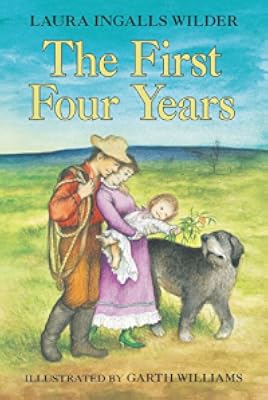
The First Four Years
by Laura Ingalls Wilder
Little House: The Laura Years (9), Little House Novels, Chronological Order (The Laura Years — book 24)
On This Page
Description
During their first four years of marriage, Laura and Almanzo Wilder have a child and fight a losing battle in their attempts to succeed at farming on the South Dakota prairie.Tags
Recommendations



Member Reviews
Well, the series ends in true Little House on the Prairie form, by which I mean this very slender volume has far more misery and disaster that feels entirely fair. It starts with the usual foibles of early married life, like Laura making a pie for a luncheon but forgetting to put sugar in it, but before long it is diphtheria, a paralysed husband, failing crops, blizzards, their first son dying in infancy, their daughter nearly drowning, and their entire house burning to the ground with all their possessions in it. And Manly feels very like Pa, with his 'oh, we'll just buy something on credit and try for another year, it will come good soon...'
First sentence: The stars hung luminous and low over the prairie.
The First Four Years was published several decades after the death of Laura Ingalls Wilder. It was published after the death of Laura and Almanzo's daughter, Rose Wilder Lane. It is based on three hand-written notebooks. The story is believed to have been written in the mid to late forties. It is also believed to have been shelved by Laura Ingalls Wilder after the death of Almanzo. She never went back to work on it again. She never polished it up. She never sent it to the publishers. It is what it is, a first draft.
It has a completely different feel than the other Little House books. It doesn't have chapters, for one thing. But more than that there is an emotional show more undertone of sadness and regret that makes it pointedly different than its predecessors. It is just very melancholy. Yes, it captures all the horrible things that happened next. Yes, it's probably accurate enough to assume that most if not all farmers experienced this many brutal hardships. The other Little House books often dealt with hard issues as well. But I suppose they felt more balanced. I think she injected enough hope and light to lift them up.
Personally, I'd rather have the "happily ever after" ending of These Happy Golden Years than the brutal hardships of The First Four Years. Not that I'm promoting the unrealistic fairy-tale ending where marriage is problem-free. But to read of all the hardships with the farm, the land, the money problems, the debt, the worries, the health problems, the weather/environment problems, etc. It's just so hard, so brutal, so depressing. show less
The First Four Years was published several decades after the death of Laura Ingalls Wilder. It was published after the death of Laura and Almanzo's daughter, Rose Wilder Lane. It is based on three hand-written notebooks. The story is believed to have been written in the mid to late forties. It is also believed to have been shelved by Laura Ingalls Wilder after the death of Almanzo. She never went back to work on it again. She never polished it up. She never sent it to the publishers. It is what it is, a first draft.
It has a completely different feel than the other Little House books. It doesn't have chapters, for one thing. But more than that there is an emotional show more undertone of sadness and regret that makes it pointedly different than its predecessors. It is just very melancholy. Yes, it captures all the horrible things that happened next. Yes, it's probably accurate enough to assume that most if not all farmers experienced this many brutal hardships. The other Little House books often dealt with hard issues as well. But I suppose they felt more balanced. I think she injected enough hope and light to lift them up.
Personally, I'd rather have the "happily ever after" ending of These Happy Golden Years than the brutal hardships of The First Four Years. Not that I'm promoting the unrealistic fairy-tale ending where marriage is problem-free. But to read of all the hardships with the farm, the land, the money problems, the debt, the worries, the health problems, the weather/environment problems, etc. It's just so hard, so brutal, so depressing. show less
There's a reason that I didn't like this when I was young, despite the fact that I loved the others. It's really too desperate for children. Otoh, if they learn not to be as reckless as these kids (and yes, though Manly is 29, he's still immature) with their finances that would be a good thing.
The thing is, Manly wants the kind of farm he grew up on in New York. Apparently he never learned just how his father built that up. And of course the dry prairie is no place for that kind of farm, either. Now we know from biographies and the supplementary/ later books that all worked out ok in the end, but the cost of learning lessons was, imo, too high.
Note that this was published posthumously, unpolished. It's excellently written, but different show more from the earlier eight books. And, I repeat, better for teens or adults. show less
The thing is, Manly wants the kind of farm he grew up on in New York. Apparently he never learned just how his father built that up. And of course the dry prairie is no place for that kind of farm, either. Now we know from biographies and the supplementary/ later books that all worked out ok in the end, but the cost of learning lessons was, imo, too high.
Note that this was published posthumously, unpolished. It's excellently written, but different show more from the earlier eight books. And, I repeat, better for teens or adults. show less
In this novel I feel like I’m reading Laura Ingalls Wilder’s pure voice for the first time. This book, as is well known, was never edited by her daughter Rose Wilder Lane and is very different from the other Little House books. The language is more plain, but the book feels more honest.
Rose Wilder Lane wanted to tell a story of self-reliant and successful pioneers, so one thing she did was to take out certain events, like the death of Laura’s baby brother, Charles Frederick. (Events that she wanted to take out but Wilder insisted on keeping include Mary’s blindness and the laborers’ riot near the Silver Lake settlement). By contrast, in “The First Four Years” we get a succession of setbacks and tragedies: the Wilder crop show more is destroyed repeatedly, their house burns down, and their infant son dies. All this is reported without sentimentality or overt drama – and certainly without uplifting lessons. There are hardly any episodes even of fun and laughter.
It’s not that Laura and Almanzo are made to seem dour here, but their life is revealed as harsh and uncertain, with little-to-no payback or progress.
It’s an unfinished work, of course, and merely a first draft. We can never know what Wilder herself would have done with future drafts.
But her voice is heavily reportorial, and intensely descriptive. Much of the gift for storytelling that you see in the other books remains in this one, such as when Almanzo gets lost in a blizzard merely on his way from the barn to the house. But there’s no overarching lesson of self-reliance that shapes this book. It’s hard to see any overarching lesson at all, actually. At the very end Laura does recommit to the life of a farming family and to the persistence that it requires, but it feels like she’s embracing this commitment not because it’s an overarching faith but simply because she can hardly do anything else except go on working and living.
This is very different from the other Little House books, and maybe this novel doesn’t come up to my favorites, but I deeply appreciate its simple honesty. show less
Rose Wilder Lane wanted to tell a story of self-reliant and successful pioneers, so one thing she did was to take out certain events, like the death of Laura’s baby brother, Charles Frederick. (Events that she wanted to take out but Wilder insisted on keeping include Mary’s blindness and the laborers’ riot near the Silver Lake settlement). By contrast, in “The First Four Years” we get a succession of setbacks and tragedies: the Wilder crop show more is destroyed repeatedly, their house burns down, and their infant son dies. All this is reported without sentimentality or overt drama – and certainly without uplifting lessons. There are hardly any episodes even of fun and laughter.
It’s not that Laura and Almanzo are made to seem dour here, but their life is revealed as harsh and uncertain, with little-to-no payback or progress.
It’s an unfinished work, of course, and merely a first draft. We can never know what Wilder herself would have done with future drafts.
But her voice is heavily reportorial, and intensely descriptive. Much of the gift for storytelling that you see in the other books remains in this one, such as when Almanzo gets lost in a blizzard merely on his way from the barn to the house. But there’s no overarching lesson of self-reliance that shapes this book. It’s hard to see any overarching lesson at all, actually. At the very end Laura does recommit to the life of a farming family and to the persistence that it requires, but it feels like she’s embracing this commitment not because it’s an overarching faith but simply because she can hardly do anything else except go on working and living.
This is very different from the other Little House books, and maybe this novel doesn’t come up to my favorites, but I deeply appreciate its simple honesty. show less
In this novel I feel like I’m reading Laura Ingalls Wilder’s pure voice for the first time. This book, as is well known, was never edited by her daughter Rose Wilder Lane and is very different from the other Little House books. The language is more plain, but the book feels more honest.
Rose Wilder Lane wanted to tell a story of self-reliant and successful pioneers, so one thing she did was to take out certain events, like the death of Laura’s baby brother, Charles Frederick. (Events that she wanted to take out but Wilder insisted on keeping include Mary’s blindness and the laborers’ riot near the Silver Lake settlement). By contrast, in “The First Four Years” we get a succession of setbacks and tragedies: the Wilder crop show more is destroyed repeatedly, their house burns down, and their infant son dies. All this is reported without sentimentality or overt drama – and certainly without uplifting lessons. There are hardly any episodes even of fun and laughter.
It’s not that Laura and Almanzo are made to seem dour here, but their life is revealed as harsh and uncertain, with little-to-no payback or progress.
It’s an unfinished work, of course, and merely a first draft. We can never know what Wilder herself would have done with future drafts.
But her voice is heavily reportorial, and intensely descriptive. Much of the gift for storytelling that you see in the other books remains in this one, such as when Almanzo gets lost in a blizzard merely on his way from the barn to the house. But there’s no overarching lesson of self-reliance that shapes this book. It’s hard to see any overarching lesson at all, actually. At the very end Laura does recommit to the life of a farming family and to the persistence that it requires, but it feels like she’s embracing this commitment not because it’s an overarching faith but simply because she can hardly do anything else except go on working and living.
This is very different from the other Little House books, and maybe this novel doesn’t come up to my favorites, but I deeply appreciate its simple honesty. show less
Rose Wilder Lane wanted to tell a story of self-reliant and successful pioneers, so one thing she did was to take out certain events, like the death of Laura’s baby brother, Charles Frederick. (Events that she wanted to take out but Wilder insisted on keeping include Mary’s blindness and the laborers’ riot near the Silver Lake settlement). By contrast, in “The First Four Years” we get a succession of setbacks and tragedies: the Wilder crop show more is destroyed repeatedly, their house burns down, and their infant son dies. All this is reported without sentimentality or overt drama – and certainly without uplifting lessons. There are hardly any episodes even of fun and laughter.
It’s not that Laura and Almanzo are made to seem dour here, but their life is revealed as harsh and uncertain, with little-to-no payback or progress.
It’s an unfinished work, of course, and merely a first draft. We can never know what Wilder herself would have done with future drafts.
But her voice is heavily reportorial, and intensely descriptive. Much of the gift for storytelling that you see in the other books remains in this one, such as when Almanzo gets lost in a blizzard merely on his way from the barn to the house. But there’s no overarching lesson of self-reliance that shapes this book. It’s hard to see any overarching lesson at all, actually. At the very end Laura does recommit to the life of a farming family and to the persistence that it requires, but it feels like she’s embracing this commitment not because it’s an overarching faith but simply because she can hardly do anything else except go on working and living.
This is very different from the other Little House books, and maybe this novel doesn’t come up to my favorites, but I deeply appreciate its simple honesty. show less
In this novel I feel like I’m reading Laura Ingalls Wilder’s pure voice for the first time. This book, as is well known, was never edited by her daughter Rose Wilder Lane and is very different from the other Little House books. The language is more plain, but the book feels more honest.
Rose Wilder Lane wanted to tell a story of self-reliant and successful pioneers, so one thing she did was to take out certain events, like the death of Laura’s baby brother, Charles Frederick. (Events that she wanted to take out but Wilder insisted on keeping include Mary’s blindness and the laborers’ riot near the Silver Lake settlement). By contrast, in “The First Four Years” we get a succession of setbacks and tragedies: the Wilder crop show more is destroyed repeatedly, their house burns down, and their infant son dies. All this is reported without sentimentality or overt drama – and certainly without uplifting lessons. There are hardly any episodes even of fun and laughter.
It’s not that Laura and Almanzo are made to seem dour here, but their life is revealed as harsh and uncertain, with little-to-no payback or progress.
It’s an unfinished work, of course, and merely a first draft. We can never know what Wilder herself would have done with future drafts.
But her voice is heavily reportorial, and intensely descriptive. Much of the gift for storytelling that you see in the other books remains in this one, such as when Almanzo gets lost in a blizzard merely on his way from the barn to the house. But there’s no overarching lesson of self-reliance that shapes this book. It’s hard to see any overarching lesson at all, actually. At the very end Laura does recommit to the life of a farming family and to the persistence that it requires, but it feels like she’s embracing this commitment not because it’s an overarching faith but simply because she can hardly do anything else except go on working and living.
This is very different from the other Little House books, and maybe this novel doesn’t come up to my favorites, but I deeply appreciate its simple honesty. show less
Rose Wilder Lane wanted to tell a story of self-reliant and successful pioneers, so one thing she did was to take out certain events, like the death of Laura’s baby brother, Charles Frederick. (Events that she wanted to take out but Wilder insisted on keeping include Mary’s blindness and the laborers’ riot near the Silver Lake settlement). By contrast, in “The First Four Years” we get a succession of setbacks and tragedies: the Wilder crop show more is destroyed repeatedly, their house burns down, and their infant son dies. All this is reported without sentimentality or overt drama – and certainly without uplifting lessons. There are hardly any episodes even of fun and laughter.
It’s not that Laura and Almanzo are made to seem dour here, but their life is revealed as harsh and uncertain, with little-to-no payback or progress.
It’s an unfinished work, of course, and merely a first draft. We can never know what Wilder herself would have done with future drafts.
But her voice is heavily reportorial, and intensely descriptive. Much of the gift for storytelling that you see in the other books remains in this one, such as when Almanzo gets lost in a blizzard merely on his way from the barn to the house. But there’s no overarching lesson of self-reliance that shapes this book. It’s hard to see any overarching lesson at all, actually. At the very end Laura does recommit to the life of a farming family and to the persistence that it requires, but it feels like she’s embracing this commitment not because it’s an overarching faith but simply because she can hardly do anything else except go on working and living.
This is very different from the other Little House books, and maybe this novel doesn’t come up to my favorites, but I deeply appreciate its simple honesty. show less
In this novel I feel like I’m reading Laura Ingalls Wilder’s pure voice for the first time. This book, as is well known, was never edited by her daughter Rose Wilder Lane and is very different from the other Little House books. The language is more plain, but the book feels more honest.
Rose Wilder Lane wanted to tell a story of self-reliant and successful pioneers, so one thing she did was to take out certain events, like the death of Laura’s baby brother, Charles Frederick. (Events that she wanted to take out but Wilder insisted on keeping include Mary’s blindness and the laborers’ riot near the Silver Lake settlement). By contrast, in “The First Four Years” we get a succession of setbacks and tragedies: the Wilder crop show more is destroyed repeatedly, their house burns down, and their infant son dies. All this is reported without sentimentality or overt drama – and certainly without uplifting lessons. There are hardly any episodes even of fun and laughter.
It’s not that Laura and Almanzo are made to seem dour here, but their life is revealed as harsh and uncertain, with little-to-no payback or progress.
It’s an unfinished work, of course, and merely a first draft. We can never know what Wilder herself would have done with future drafts.
But her voice is heavily reportorial, and intensely descriptive. Much of the gift for storytelling that you see in the other books remains in this one, such as when Almanzo gets lost in a blizzard merely on his way from the barn to the house. But there’s no overarching lesson of self-reliance that shapes this book. It’s hard to see any overarching lesson at all, actually. At the very end Laura does recommit to the life of a farming family and to the persistence that it requires, but it feels like she’s embracing this commitment not because it’s an overarching faith but simply because she can hardly do anything else except go on working and living.
This is very different from the other Little House books, and maybe this novel doesn’t come up to my favorites, but I deeply appreciate its simple honesty. show less
Rose Wilder Lane wanted to tell a story of self-reliant and successful pioneers, so one thing she did was to take out certain events, like the death of Laura’s baby brother, Charles Frederick. (Events that she wanted to take out but Wilder insisted on keeping include Mary’s blindness and the laborers’ riot near the Silver Lake settlement). By contrast, in “The First Four Years” we get a succession of setbacks and tragedies: the Wilder crop show more is destroyed repeatedly, their house burns down, and their infant son dies. All this is reported without sentimentality or overt drama – and certainly without uplifting lessons. There are hardly any episodes even of fun and laughter.
It’s not that Laura and Almanzo are made to seem dour here, but their life is revealed as harsh and uncertain, with little-to-no payback or progress.
It’s an unfinished work, of course, and merely a first draft. We can never know what Wilder herself would have done with future drafts.
But her voice is heavily reportorial, and intensely descriptive. Much of the gift for storytelling that you see in the other books remains in this one, such as when Almanzo gets lost in a blizzard merely on his way from the barn to the house. But there’s no overarching lesson of self-reliance that shapes this book. It’s hard to see any overarching lesson at all, actually. At the very end Laura does recommit to the life of a farming family and to the persistence that it requires, but it feels like she’s embracing this commitment not because it’s an overarching faith but simply because she can hardly do anything else except go on working and living.
This is very different from the other Little House books, and maybe this novel doesn’t come up to my favorites, but I deeply appreciate its simple honesty. show less
Members
- Recently Added By
Lists

Favorite Childhood Books
1,651 works; 515 members
NPRs Ultimate Backseat Bookshelf: 100 Must-Reads for kids 9-14
222 works; 30 members

Kids' Tour of the US in Books
50 works; 5 members
Honey For a Child's Heart
1,152 works; 25 members

Books about Frontier Life and Pioneers
55 works; 7 members
Ambleside Books
459 works; 18 members

Female Protagonist
1,056 works; 57 members

Bibliography for How to be a Heroine
148 works; 12 members

Literature of Honor for Boys
91 works; 3 members

Books I've Read More Than Once
602 works; 49 members

Books We Loved As Children
603 works; 253 members

Ambleside Year 5
55 works; 1 member

Our Favorite Banned Books
138 works; 122 members
Historical Fiction
889 works; 91 members

Books Read in 2024
4,727 works; 128 members

Books With Numbers in the Title
308 works; 13 members

Books Read in 2016
4,666 works; 199 members
Female Author
1,234 works; 67 members

HMS: Make Your Child a Lover of Books, Ages 7-9
52 works; 2 members
Author Information

189+ Works 152,953 Members
Wilder was born near Pepin, Wisconsin; attended school in DeSmet, South Dakota; and became a teacher before she was 16, teaching for seven years in Dakota Territory schools. She and her husband, Almanzo Wilder, farmed near DeSmet for about nine years and then moved to Mansfield, Missouri, where they lived out the rest of their days. Wilder did not show more write her first book, Little House in the Big Woods, about her early years in Wisconsin, until late in life, on the urging of her daughter, Rose Wilder Lane. It was first published in 1932. She followed this with Farmer Boy (1933), a book about her husband's childhood in New York State. She then completed a series of books about her life as she and her family moved westward along the frontier. Little House on the Prairie (1935) records the family's move to Kansas. On the Banks of Plum Creek (1937) describes the family's move to Minnesota. By the Shores of Silver Lake (1939) records the family's move to South Dakota, as do the final three books in the series: The Long Winter, Little Town on the Prairie (1941), and These Happy Golden Years (1943), which ends with her marriage to Almanzo Wilder. Three of Wilder's books were published posthumously: On the Way Home, a diary of her trip to Mansfield; The First Four Years, an unfinished book about her first four years of marriage; and West from Home, letters she wrote on a visit to her daughter in San Francisco, none of them up to the quality of her earlier books. At her best, Wilder employs a clear, simple style, a wealth of fascinating detail, and a straightforward narrative style. Her tales of a strong, traditional frontier family that endures the hardships of the late eighteenth century are seen through the eyes of a child, which endears them to young readers. Her work is possibly the best example of historical realistic fiction for children. (Bowker Author Biography) show less
All Editions
Some Editions
Awards and Honors
Series

Little House: The Laura Years
9 works (9)

Little House Novels, Chronological Order
4 works (The Laura Years — book 24)
Belongs to Publisher Series
Work Relationships
Is contained in
Common Knowledge
- Canonical title
- The First Four Years
- Original title
- The First Four Years
- Original publication date
- 1971; 1980 (1e traduction et édition français, Bibliothèque du Chat Perché, Flammarion) (1e traduction et édition français, Bibliothèque du Chat Perché, Flammarion)
- People/Characters
- Laura Ingalls Wilder; Almanzo Wilder; Rose Wilder Lane
- Important places
- De Smet, South Dakota, USA
- First words
- The stars hung luminous and low over the prairie.
- Last words
- (Click to show. Warning: May contain spoilers.)You talk of the mines of Australia,
They've wealth of red gold, without doubt;
But, ah! there is gold in the farm, boys -
If only you'll shovel it out. - Original language
- English
Classifications
- Genres
- Children's Books, Fiction and Literature, Kids
- DDC/MDS
- 813.52 — Literature & rhetoric American literature in English American fiction in English 1900-1999 1900-1945
- LCC
- PZ7 .W6461 .F — Language and Literature Fiction and juvenile belles lettres Fiction and juvenile belles lettres Juvenile belles lettres
- BISAC
Statistics
- Members
- 9,278
- Popularity
- 1,141
- Reviews
- 80
- Rating
- (3.78)
- Languages
- 10 — Danish, Dutch, English, Finnish, French, German, Indonesian, Portuguese, Spanish, Swedish
- Media
- Paper, Audiobook, Ebook
- ISBNs
- 60
- ASINs
- 38