Desert Places
by Robyn Davidson
On This Page
Description
From the author of the international bestseller Tracks comes a vivid memoir of the grueling migration season she spent with the nomads of northwestern India India's Thar Desert is a place of stark contrasts. Forming a natural border between Pakistan and India, the desert has been the home of the Rabari herders for thousands of years. In 1990, Australian travel writer Robyn Davidson spent a year with the Rabari, whose livelihood is increasingly endangered by India's rapid development. show more Enduring the daily hardships of life in the desert while immersed in the austere beauty of the arid landscape, Davidson subsisted on a diet of goat milk, roti, and parasite-infested water. She collided with India's rigid caste system and cultural idiosyncrasies, confronted extreme sleep deprivation, and fought feelings of alienation amid the nation's isolated rural peoples-finding both intense suffering and a renewed sense of beauty and belonging among the Rabari family. Rich with detail and honest in its depictions of cultural differences, Desert Places is an unforgettable story of fortitude in the face of struggle and an ode to the rapidly disappearing way of life of the herders of northwestern India. show lessTags
Recommendations















Member Reviews
Travel, as a mountaineer once described mountain climbing, is “the conquest of nothing.” It is an absurd activity, and this you fully understand after reading Robyn Davidson. Tourism is part of the commodity logic of a market system; it has a clear and circumscribed place in that scheme of things, but travel the way Davidson does it is a kind of existentialist, degree zero activity, from which, however, you can actually learn something, because she is a good, vivid writer with neither false pride nor phony self-deprecation, willing to strip away layer after layer of her own illusions to try to get at whatever truth the experience has. What you learn in this book has a lot to do with the phenomenon of privilege without power, the show more sheer freakishness, that is a white woman’s experience when she tries to insert herself into the rigid hierarchies of poor, patriarchal worlds. But you also learn something about how extreme cultural and economic difference have stretched human solidarity almost to the breaking point of a completely insane each against all, and exhausted the natural world, and yet both continue to hold, so tenuously, the possibility of repair and renewal. And, in clear and compelling detail, the very particular way this unfolds in a tiny slice of the vast, complex societies of India. Yes, all that’s in here. You should read Robyn Davidson if you want to take a trip to somewhere very real. show less
Robyn Davidson has the tendency to envisage a romantic ideal trip, like journeying in the desert with the nomadic peoples of India, only to slam up hard against a solid brick wall of reality.
Davidson thought it would be as simple as contacting a group of Ribari (one tribe of India's nomadic people) and convincing them to let her join them on one of their sojourns. She quickly learns that its easy to dream the trip, but pulling it off was a fumbling, frustrating process of continued disappointment. Many Ribari don't trust her, afraid that she might be a spy for the government and many of those who do are not making nomadic journeys at that time, either for reasons of poverty or prosperity. When she does connect with a group of Ribari, show more who do claim to trust her, who offer to take her with them, Davdison finds again and again her hopes dashed as the plan falls apart just days before she is meant to start her journey. Again and again over the course of over a year a blooming hope of finally bringing the trip to fruition is stomped into the dust, and she finds herself on numerous occasions considering giving up the plan entirely.
But Robyn Davidson has a tenacity and a courage that should astound anyone and eventually finds a tribe to take her with them. Again there is no romance in this, because the road is rough and Davidson is isolated by her inability to communicate with those who have welcomed her. The lack of communication means false starts and improper handling of gear. She doesn't sleep because of the sheep pressing against her cot and falls into helpless exhaustion. She is stared at where ever she goes, pointed out and hounded as the white stranger, the white, European alien. And despite her loneliness, she is never alone, always surrounded to the point that she longs for the open deserts of Australia, where she was allowed the solitude to reconnect with herself.
Cultural confusion abounds. As just one example, many of the Indian people she meets cannot understand why a rich person like her, who has the immeasurable wealth to afford car, would want to walk along the ground like peasant, while Davidson could not grasp the complacency of the cast system, which required her to sit idle and be served instead of doing things herself.
However, Davidson also becomes family with the group of Ribari she travels with. They bring her into their world, welcome her, and care for her. She does the same for them.
Do not yourself approach this book with your own romantic ideas of India, of bright colors. This is not an easy book to read. It a brutal journey, both physically as well as emotionally. Davidson is so beaten down by poverty and red tape and physical sickness and irritations big and small (from a horror of a camel guide to her own camels trying to kill her), that she comes to a state of alternating absolutes -- both hating and loving India with deep and virulent passion.
But just as there are moment of outrage and ugliness, Desert Places also contains moments of joy and laughter, beauty and compassion, of generosity and kindness.
If Davidson were a hair less of the fantastic writer she is, the book would not work, but fortunately she's wonderful and the book, though full of rough edges laying in wait to snare, is too. If nothing else, it will certainly make you think. show less
Davidson thought it would be as simple as contacting a group of Ribari (one tribe of India's nomadic people) and convincing them to let her join them on one of their sojourns. She quickly learns that its easy to dream the trip, but pulling it off was a fumbling, frustrating process of continued disappointment. Many Ribari don't trust her, afraid that she might be a spy for the government and many of those who do are not making nomadic journeys at that time, either for reasons of poverty or prosperity. When she does connect with a group of Ribari, show more who do claim to trust her, who offer to take her with them, Davdison finds again and again her hopes dashed as the plan falls apart just days before she is meant to start her journey. Again and again over the course of over a year a blooming hope of finally bringing the trip to fruition is stomped into the dust, and she finds herself on numerous occasions considering giving up the plan entirely.
But Robyn Davidson has a tenacity and a courage that should astound anyone and eventually finds a tribe to take her with them. Again there is no romance in this, because the road is rough and Davidson is isolated by her inability to communicate with those who have welcomed her. The lack of communication means false starts and improper handling of gear. She doesn't sleep because of the sheep pressing against her cot and falls into helpless exhaustion. She is stared at where ever she goes, pointed out and hounded as the white stranger, the white, European alien. And despite her loneliness, she is never alone, always surrounded to the point that she longs for the open deserts of Australia, where she was allowed the solitude to reconnect with herself.
Cultural confusion abounds. As just one example, many of the Indian people she meets cannot understand why a rich person like her, who has the immeasurable wealth to afford car, would want to walk along the ground like peasant, while Davidson could not grasp the complacency of the cast system, which required her to sit idle and be served instead of doing things herself.
However, Davidson also becomes family with the group of Ribari she travels with. They bring her into their world, welcome her, and care for her. She does the same for them.
Do not yourself approach this book with your own romantic ideas of India, of bright colors. This is not an easy book to read. It a brutal journey, both physically as well as emotionally. Davidson is so beaten down by poverty and red tape and physical sickness and irritations big and small (from a horror of a camel guide to her own camels trying to kill her), that she comes to a state of alternating absolutes -- both hating and loving India with deep and virulent passion.
But just as there are moment of outrage and ugliness, Desert Places also contains moments of joy and laughter, beauty and compassion, of generosity and kindness.
If Davidson were a hair less of the fantastic writer she is, the book would not work, but fortunately she's wonderful and the book, though full of rough edges laying in wait to snare, is too. If nothing else, it will certainly make you think. show less
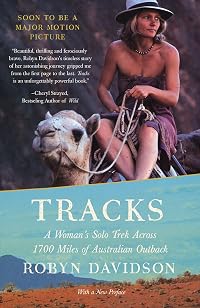
Desert Places (1996) is Australian adventurer Robyn Davidson's second major travel book, her first being the better known Tracks (1980). She repeats a camel journey through the desert, but this time in Western India in the company of a nomadic people known as the Rabari. As usual, Davidison is full of lovable contradictions, sweet one moment and ready to kill en masse the next. Likewise her approach to the book takes a consciously anti-travel literature track, just about everything we associate with travel literature Davidson turns the tables. Or, at least she tries, but in the end it is still fundamentally part of the genre. For most readers, who are not conversant with the recent scholarly debates about travel literature (in relation show more to post-colonialism, post-modernism) the overall effect may be a little off-putting, with one New York Times critic interpreting Davidson's irreverence as "bad faith". In the end I think Davidson succeeded in writing a good travel narrative, updated with politically correct concerns about the fate of traditional nomadic people under the homogenizing assault of globalization - but her overall attempt at breaking out of the genre into something greater probably did not succeed. Still it is a fascinating look into what life is like for the Rabari, stripped of romanticism and from the perspective of women, and that makes it an important, unique and worthwhile journey.
--Review by Stephen Balbach, via CoolReading (c) 2008 cc-by-nd show less
--Review by Stephen Balbach, via CoolReading (c) 2008 cc-by-nd show less
Ms Davidson is a tough woman, who for some reason sees the need to put herself into the most excrutiatingly isolating situations.
I found the book fascinating, and was overwhelmed at times by the sense of being so alone within a country where there is the most confronting closeness of human being with human being. This is an India I know i would not be equipped to deal with.
i was a bit critical of her at first that she always had her friend, the wealthy Indian upon whom to fall back, but I doubt whether she would have been able to approach completion of her task without him. The need to retreat every so often from the sheer hard grind of trying to accomplish the task she set herself. I know i would have had to find a 5 star, deep-bath show more resort long before Davidson welcomed the comfort of a barely basic hotel room with hot water!
The lives of the rabbari as presented to us through Davidson's eyes (and god knows they are hardly likely to be presented any other way!) is fascinating. I know the attraction of the 'exotic' can lead to patronising people, but davidson never does that, and does not allow her (dare I suggest, middle class, western, educated?) readership to get too comfortable with their own views of the world. show less
I found the book fascinating, and was overwhelmed at times by the sense of being so alone within a country where there is the most confronting closeness of human being with human being. This is an India I know i would not be equipped to deal with.
i was a bit critical of her at first that she always had her friend, the wealthy Indian upon whom to fall back, but I doubt whether she would have been able to approach completion of her task without him. The need to retreat every so often from the sheer hard grind of trying to accomplish the task she set herself. I know i would have had to find a 5 star, deep-bath show more resort long before Davidson welcomed the comfort of a barely basic hotel room with hot water!
The lives of the rabbari as presented to us through Davidson's eyes (and god knows they are hardly likely to be presented any other way!) is fascinating. I know the attraction of the 'exotic' can lead to patronising people, but davidson never does that, and does not allow her (dare I suggest, middle class, western, educated?) readership to get too comfortable with their own views of the world. show less
In 1992 Robyn Davidson travelled through a year's migratory cycle with the Rabari, pastoral nomads of northwest India, whose grazing lands and trading and pilgrimage routes are quickly being destroyed by new political boundaries, atomic test sites, and irrigation. Sleeping among five thousand sheep and surviving on goat's milk, flatbread, and parasite-infested water in a landscape of misery and haunting loveliness, she endured exhaustion, malnutrition and disease. But she gained an understanding and the trust of a fiercely courageous people with a disappearing way of life. Displaying a writer's acute eye for detail and a traveller's keen appreciation for the beauty to be found in the earth's most desolate landscapes, Davidson explores show more with ruthless honesty her own desert places even as she immortalizes these "keepers of the way" and a culture about to die. show less
Pretty good travel book about wandering camel tribes in India. Not quite as good as Tracks. She found India fascinating but very frustrating because of all the crowds and language barrier, etc.
I don't remember too much about this book -- I read it 10 years ago -- but I loved it at the time. Davidson has a gift for talking about people without appropriating their voice, and is a good desert traveller: she complains in small measure and wonders profusely. I'd like to have time to read it again.
Members
- Recently Added By
Lists

Adventure Travel & Exploration In Asia
31 works; 8 members
Author Information

20+ Works 1,718 Members
Some Editions
Common Knowledge
- Canonical title*
- Mes déserts : un voyage au Rajasthan
- Original title
- Desert Places
- Original publication date
- 1996
- Important places
- India
*Some information comes from Common Knowledge in other languages. Click "Edit" for more information.
Classifications
Statistics
- Members
- 222
- Popularity
- 146,795
- Reviews
- 10
- Rating
- (3.79)
- Languages
- 7 — Dutch, English, French, German, Italian, Portuguese, Spanish
- Media
- Paper, Ebook
- ISBNs
- 12
- UPCs
- 1
- ASINs
- 3