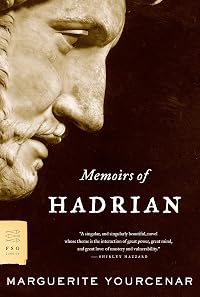
Memoirs of Hadrian ; and, Reflections on the composition of Memoirs of Hadrian
by Marguerite Yourcenar
On This Page
Description
"Both an exploration of character and a meditation on history, Marguerite Yourcenar's novel Memoirs of Hadrian has received international acclaim since its publication in France in 1951. Written in the form of a testamentary letter from the emperor Hadrian to his successor, the youthful Marcus Aurelius, the work is as extraordinary for its psychological depth as for its accurate reconstruction of the second century of our era. In it, Yourcenar reimagines Hadrian's arduous boyhood, his show more triumphs and reversals, and finally, as emperor, his reordering of a war-torn world."--Jacket. show lessTags
Recommendations




Member Reviews
"...there was a unique moment in history, between Cicero and Marcus Aurelius, when man stood alone....A great part of my life was going to be spent in trying to define, and then to portray, that man existing alone and yet closely bound with all being."
--Marguerite Yourcenar
Memoirs of Hadrian is a fictional exploration into the mind of the real and remarkable Roman emperor, Hadrian (117-138CE), considered one of the five good emperors.
It is masterfully done.
I can heartily recommend it to a wide variety of readers: those interested in the Roman Empire as history, those interested in philosophical ideas and their application, those interested in astute human observations, and those interested in divine writing with sublime insights. Some show more might even be interested in it for its tragic romance between Hadrian and Antinous, Antinous later the god object of cult worship.
Lots of props to Yourcenar for sticking with known facts, and while interpreting some, never contradicting or being wildly creative with the fainter ones. She gave herself admirable strict boundaries. And props to the English translator and love of Yourcenar's life, Grace Frick.
Reading it can be a little like herding cats, though, with so much going on at once. When we speak of the Hadrian in this novel, we often are talking about a fuzzy combination of
1 The historic Hadrian
2. The political and philosophic Hadrian personality by Yourcenar
3. The Hadrian that is a dying man looking back on his life, defending it with 20/20 hindsight and some remaining blind spots
4. And never forget, in all cases, this is Hadrian the Roman Emperor of the second century, complete with the ego of an emperor and living the acceptable sexual mores that we in our twenty first century find highly objectionable.
it is written as a letter to young Marcus Aurelius, adopted grandson of Hadrian, another future emperor, last of the "five good" ones. But the sooner you let go of that idea, the better. It is hardly ever a realistic letter. In fact, it is hardly a memoir, truth be told. It is the organized but private thoughts of man remembering his life, often dipping into a defensive mode as an emperor would even when only thinking to himself, and with himself always as the superior being. (That might be said of all of us to varying degrees.)
Definitely Hadrian alone is the protagonist, others are bit players. Thus, there is no dialogue, just Hadrian.
Now that you know some of the peculiarities, don't doubt for a minute that is not worth your time to read, especially to read slowly, taking breaks to ponder the man, his experiences, his stunning insights accessible even to plebs.
I bet you will come away thinking about Yourcenar quite a bit too, with admiration. She walked such a fascinating tightrope here. So much so that the included final chapter "Reflections on the Composition of Memoirs of Hdrian" is so edifying, so integral, I could recommend you read it first, and again last to further enjoy the rewards of this marvelous novel.
Thank you to Antiquity Buddy Readers: Mark, Lisa, and Dave, three readers who faithfully bring joy and intelligence to a joint read. When they write their reviews of this novel, I will add those links because their thoughts are sure to be uniquely insightful and illustrate other possible take-aways
this novel can have on a reader.
Lisa's review https://www.goodreads.com/review/show/7213943931
Mark's review https://www.goodreads.com/review/show/3411581580
Dave's review https://www.goodreads.com/review/show/7215613467
"I fell to making, and then re-making, this portrait of a man who was almost wise." show less
--Marguerite Yourcenar
Memoirs of Hadrian is a fictional exploration into the mind of the real and remarkable Roman emperor, Hadrian (117-138CE), considered one of the five good emperors.
It is masterfully done.
I can heartily recommend it to a wide variety of readers: those interested in the Roman Empire as history, those interested in philosophical ideas and their application, those interested in astute human observations, and those interested in divine writing with sublime insights. Some show more might even be interested in it for its tragic romance between Hadrian and Antinous, Antinous later the god object of cult worship.
Lots of props to Yourcenar for sticking with known facts, and while interpreting some, never contradicting or being wildly creative with the fainter ones. She gave herself admirable strict boundaries. And props to the English translator and love of Yourcenar's life, Grace Frick.
Reading it can be a little like herding cats, though, with so much going on at once. When we speak of the Hadrian in this novel, we often are talking about a fuzzy combination of
1 The historic Hadrian
2. The political and philosophic Hadrian personality by Yourcenar
3. The Hadrian that is a dying man looking back on his life, defending it with 20/20 hindsight and some remaining blind spots
4. And never forget, in all cases, this is Hadrian the Roman Emperor of the second century, complete with the ego of an emperor and living the acceptable sexual mores that we in our twenty first century find highly objectionable.
it is written as a letter to young Marcus Aurelius, adopted grandson of Hadrian, another future emperor, last of the "five good" ones. But the sooner you let go of that idea, the better. It is hardly ever a realistic letter. In fact, it is hardly a memoir, truth be told. It is the organized but private thoughts of man remembering his life, often dipping into a defensive mode as an emperor would even when only thinking to himself, and with himself always as the superior being. (That might be said of all of us to varying degrees.)
Definitely Hadrian alone is the protagonist, others are bit players. Thus, there is no dialogue, just Hadrian.
Now that you know some of the peculiarities, don't doubt for a minute that is not worth your time to read, especially to read slowly, taking breaks to ponder the man, his experiences, his stunning insights accessible even to plebs.
I bet you will come away thinking about Yourcenar quite a bit too, with admiration. She walked such a fascinating tightrope here. So much so that the included final chapter "Reflections on the Composition of Memoirs of Hdrian" is so edifying, so integral, I could recommend you read it first, and again last to further enjoy the rewards of this marvelous novel.
Thank you to Antiquity Buddy Readers: Mark, Lisa, and Dave, three readers who faithfully bring joy and intelligence to a joint read. When they write their reviews of this novel, I will add those links because their thoughts are sure to be uniquely insightful and illustrate other possible take-aways
this novel can have on a reader.
Lisa's review https://www.goodreads.com/review/show/7213943931
Mark's review https://www.goodreads.com/review/show/3411581580
Dave's review https://www.goodreads.com/review/show/7215613467
"I fell to making, and then re-making, this portrait of a man who was almost wise." show less
As a historical memoir, this book has to contend with the perennial pitfalls of both historical fiction and memoir — respectively, overdosing on ostentatious period detail, and self-satisfied retrospective airbrushing. I think it overcomes the first of these quite well, especially given the paucity of biographical material Yourcenar has to work with. You do feel transported to that "happy period of more than fourscore years", as Gibbon called it, without getting tangled up in togas. Tromping around the Empire with its peripatetic head honcho, leaving a trail of new towns, monuments and public works in our wake, is fun. But Yourcenar's Hadrian strikes me as more French than Spanish in his disposition; he doesn't have much of a sense of show more humour and sometimes I found myself wishing he'd loosen up a little. Like many a memoirist, self-deprecation isn't his strong suit. His grief for Antinous is very moving, though (even if Antinous himself remains a cypher), and Hadrian's (and Yourcenar's) affection for this Halcyon era with its air of optimism, general religious tolerance, and comparative lack of senseless mass slaughter is palpable. I realize it isn't cool these days to blame, pace Gibbon, the Christians for the decline and fall, but fuck it, I still do. show less
This is one of the most beautiful books I have ever read. It was a little stretch for me to read in French, but it was worth it. I read slowly, not because it was difficult, but to better savor the rich prose. And it was good practice in the passé simple.
Yourcenar clearly feels that Hadrian was a superior human, a view likely shared by the man himself. For him, as depicted here, the acclamation as god was not empty praise; what Jupiter was for the cosmos, Hadrian was for the empire —effectively, the hand of Jupiter. When, after reviewing his life’s work and his arrangements for who would continue it after his death, Yourcenar’s Hadrian writes: “Tout cela n’etait pas mal arrangé,” I listened for a possible ironic subtext, show more but didn’t hear it. Not that Hadrian is under any illusions about the future: empires rise and fall. But he had a task in his lifetime that he shouldered and carried out well. In his view (and now I mean the historical Hadrian as well as Yourcenar’s), the empire had expanded far enough. It was time to pacify the frontiers, shore up public finances, and promote culture.
The only time I sensed that the fictional Hadrian of the book might be an unreliable narrator is when he begins to reminisce about the death of his young favorite, Antinous. In the book, it is clearly a suicide, and Hadrian understands it as a noble sacrifice the youth undertook to benefit him. Only later in the account are there hints—they are no more than that—that his own treatment of Antinous may have contributed to this. The drowning happened just before Antinous’s twentieth birthday; he may have feared a time when he would no longer be the graceful adolescent Hadrian was besotted with. Hadrian’s excessive grief and his rapid divinization of the boy suggest an unacknowledged guilt.
The account of the suppression of the second Jewish revolt is painful to read, both for the recounting of the tragic events and for its depiction of a powerful man convinced of his own fairness, whose best efforts to understand the Jewish leaders fell short. There is no self-awareness that his plans to found a beautiful new, thoroughly hellenized city on the ruins of Jerusalem could spark a reaction that to him was simply fanaticism. Here, too, as with the response to the death of Antinous, there is a lack of self-awareness. But at least, he admits that he counts his handling of the situation as one of his echecs.” I notice the English translation renders it “defeat,” but I think “failure” would be better. After all, he won the war, but sometimes winning isn’t everything.
The form of the book is well-chosen; it is cast as a letter to Marcus Aurelius, whom Hadrian had arranged to succeed Antoninus Pius, his own successor. This permits an interiority that is a pleasure to read. In that way, it is a precursor to Hilary Mantel’s Thomas Cromwell trilogy. In both cases, a modern author has succeeded to an astounding extent in imagining her way into the mind of a historical figure far removed from us. I felt transported back to the golden age of the Roman Empire, except that sometimes I felt that Hadrian had read Montaigne before beginning his own account. show less
Yourcenar clearly feels that Hadrian was a superior human, a view likely shared by the man himself. For him, as depicted here, the acclamation as god was not empty praise; what Jupiter was for the cosmos, Hadrian was for the empire —effectively, the hand of Jupiter. When, after reviewing his life’s work and his arrangements for who would continue it after his death, Yourcenar’s Hadrian writes: “Tout cela n’etait pas mal arrangé,” I listened for a possible ironic subtext, show more but didn’t hear it. Not that Hadrian is under any illusions about the future: empires rise and fall. But he had a task in his lifetime that he shouldered and carried out well. In his view (and now I mean the historical Hadrian as well as Yourcenar’s), the empire had expanded far enough. It was time to pacify the frontiers, shore up public finances, and promote culture.
The only time I sensed that the fictional Hadrian of the book might be an unreliable narrator is when he begins to reminisce about the death of his young favorite, Antinous. In the book, it is clearly a suicide, and Hadrian understands it as a noble sacrifice the youth undertook to benefit him. Only later in the account are there hints—they are no more than that—that his own treatment of Antinous may have contributed to this. The drowning happened just before Antinous’s twentieth birthday; he may have feared a time when he would no longer be the graceful adolescent Hadrian was besotted with. Hadrian’s excessive grief and his rapid divinization of the boy suggest an unacknowledged guilt.
The account of the suppression of the second Jewish revolt is painful to read, both for the recounting of the tragic events and for its depiction of a powerful man convinced of his own fairness, whose best efforts to understand the Jewish leaders fell short. There is no self-awareness that his plans to found a beautiful new, thoroughly hellenized city on the ruins of Jerusalem could spark a reaction that to him was simply fanaticism. Here, too, as with the response to the death of Antinous, there is a lack of self-awareness. But at least, he admits that he counts his handling of the situation as one of his echecs.” I notice the English translation renders it “defeat,” but I think “failure” would be better. After all, he won the war, but sometimes winning isn’t everything.
The form of the book is well-chosen; it is cast as a letter to Marcus Aurelius, whom Hadrian had arranged to succeed Antoninus Pius, his own successor. This permits an interiority that is a pleasure to read. In that way, it is a precursor to Hilary Mantel’s Thomas Cromwell trilogy. In both cases, a modern author has succeeded to an astounding extent in imagining her way into the mind of a historical figure far removed from us. I felt transported back to the golden age of the Roman Empire, except that sometimes I felt that Hadrian had read Montaigne before beginning his own account. show less
Published in 1951 after more than 26 years in conception Yourcenar's book is a tour de force. It takes the form of imagining that Roman Emperor Hadrien (Hadrian) 76AD - 138AD had written a letter to his chosen successor giving him the benefit of his experiences of over 20 years in power. It therefore takes the form of an autobiography as it included his rise to power and his thoughts on the state of the Empire. It could be compared to the memoirs of a contemporary politician, especially as Yourcenar tries to put into words the thoughts of the Emperor. It is a sympathetic portrait, but not a panegyric, but the reader does see events from Hadrians point of view.
Hadrian towards the end of his reign campaigned against a Jewish rebellion in show more what is known as the Bar Kokhba revolt. He was approaching 60 and the the tribulations of living in an army encampment during a long siege had an effect on his health and by the time he got back to Rome he was an ill man. He started writing his letter and nearly finished it on his death bed: his last words are 'Tâchons d'entrer dans la mort les yeux ouverts...........' His letter tells us the story of his life in chronological sequence, starting with his early upbringing in the Roman Province of Spain, the death of his parents and his schooling in Rome. His tutor had considerable political influence and the intelligent and able Hadrian found himself conscripted into the entourage of the Emperor Trajan. He campaigned with Trajan and numbered among his chosen acolytes, forming a lasting friendship with Plotine; Trajans influential wife. When Trajan died campaigning till the last, he had not got round to publicly naming Hadrian as his successor and there was a sort of palace coup back in Rome to ensure the enemies of Hadrian were summarily despatched. Trajan had looked forward to coming back to Rome as a conquering hero, but Hadrian typically refused all honoured titles on his triumphant entry into the city.
Hadrian was a different animal to Trajan who was a man who had lived to conquer the known world. Hadrian saw the advantages of consolidation, of drawing back to defensible borders and negotiating peace with the barbarians. He wanted to celebrate the glory and the artistic achievements of the Roman world and make some improvements. He had become disgusted by the atrocities committed by both sides in the wars and wanted to achieve a lasting peace. He was secure in his position as Emperor and sought to make changes: changes that we might think progressive, for example improving the financial position of women and putting an end to some of the atrocities committed against the slaves. Writing about these to his chosen successor with his thoughts on progress for the Empire was of course an attempt at laying down a blueprint for the future.
The letter is much more than a guide to his successor because Hadrian clearly wanted to give his side to the story of his life. He was passionate about the classical civilisation of Greece, the fount of all knowledge and artistic creation; he seems to have wanted to make Rome more like Greece particularly Athenian Greece. During his 20 years as Emperor he spent eight of those outside Rome, he loved to travel mixing business with pleasure fascinated by ancient Greece and ancient Egypt. In Greece he met and fell in love with Antinous a fourteen year old Greek boy who became his lover and constant companion for six years. This was perfectly acceptable in Roman times and Yourcenar has Hadrian writing candidly about the love of his life. Antinous committed suicide when he was 20 and the idyllic relationship was over, but Hadrian never got over it. He made statues, he had the body mummified in the Egyptian tradition and even built a city in his honour. Hadrian wonders what part he played in Antinous suicide, because the pair had sought the wisdom of a soothsayer and the prognostication had not been good; so did Antinous sacrifice himself for Hadrian? did he fear that Hadrian was losing interest in him? What is clear is that Hadrian saw himself as protector of the Roman Empire and his love affair with Antinous and ancient Greece was proving a distraction, even if he could not admit to that himself. Hadrian unflinchingly sets this all out in his letter as a mixture of golden memories and some regrets. He is proud of some of his achievements and is in conflict about others. In the final short chapter on his death bed he thinks about the past and the human condition, it is a touching portrait.
Yourcenar put off writing her book until she felt mature enough to do justice to her subject. There are a series of extracts from her notebooks included at the end of the book containing information pertinent to her methods of working and notes on her research. She took pains to make the book as historically accurate as possible. Of course she did not know Hadrians thought process, but this is the art of the novelist to convince her readers that he could have thought along these lines. In my opinion she does an excellent job of creating the milieu of Rome and the empire, at the beginning of the second century; in some parts it feels like a travelogue around an ancient civilisation, however it is the characterisation of Hadrian that is the crowning achievement. We have evidence that Hadrian was a lover of the arts and a poet himself and there are other commentaries about him. Yourcenar has taken the opening line from one of his poems written at the end of his life: Animula, vagula, blandula as the title of her first chapter; her translation of the poem is:
Little soul, gentle and drifting, guest and companion of my body, now you will dwell below in pallid places, stark and bare; there you will abandon your play of yore. But one moment still, let us gaze together on these familiar shores, on these objects which doubtless we shall not see again… Let us try, if we can, to enter into death with open eyes…
A moving portrait of a grand homme and an excellent book and one in which for the most part Yourcenar avoids the trap of putting 20th century contemporary thoughts into the head of a Roman Emperor. A five star read. show less
Hadrian towards the end of his reign campaigned against a Jewish rebellion in show more what is known as the Bar Kokhba revolt. He was approaching 60 and the the tribulations of living in an army encampment during a long siege had an effect on his health and by the time he got back to Rome he was an ill man. He started writing his letter and nearly finished it on his death bed: his last words are 'Tâchons d'entrer dans la mort les yeux ouverts...........' His letter tells us the story of his life in chronological sequence, starting with his early upbringing in the Roman Province of Spain, the death of his parents and his schooling in Rome. His tutor had considerable political influence and the intelligent and able Hadrian found himself conscripted into the entourage of the Emperor Trajan. He campaigned with Trajan and numbered among his chosen acolytes, forming a lasting friendship with Plotine; Trajans influential wife. When Trajan died campaigning till the last, he had not got round to publicly naming Hadrian as his successor and there was a sort of palace coup back in Rome to ensure the enemies of Hadrian were summarily despatched. Trajan had looked forward to coming back to Rome as a conquering hero, but Hadrian typically refused all honoured titles on his triumphant entry into the city.
Hadrian was a different animal to Trajan who was a man who had lived to conquer the known world. Hadrian saw the advantages of consolidation, of drawing back to defensible borders and negotiating peace with the barbarians. He wanted to celebrate the glory and the artistic achievements of the Roman world and make some improvements. He had become disgusted by the atrocities committed by both sides in the wars and wanted to achieve a lasting peace. He was secure in his position as Emperor and sought to make changes: changes that we might think progressive, for example improving the financial position of women and putting an end to some of the atrocities committed against the slaves. Writing about these to his chosen successor with his thoughts on progress for the Empire was of course an attempt at laying down a blueprint for the future.
The letter is much more than a guide to his successor because Hadrian clearly wanted to give his side to the story of his life. He was passionate about the classical civilisation of Greece, the fount of all knowledge and artistic creation; he seems to have wanted to make Rome more like Greece particularly Athenian Greece. During his 20 years as Emperor he spent eight of those outside Rome, he loved to travel mixing business with pleasure fascinated by ancient Greece and ancient Egypt. In Greece he met and fell in love with Antinous a fourteen year old Greek boy who became his lover and constant companion for six years. This was perfectly acceptable in Roman times and Yourcenar has Hadrian writing candidly about the love of his life. Antinous committed suicide when he was 20 and the idyllic relationship was over, but Hadrian never got over it. He made statues, he had the body mummified in the Egyptian tradition and even built a city in his honour. Hadrian wonders what part he played in Antinous suicide, because the pair had sought the wisdom of a soothsayer and the prognostication had not been good; so did Antinous sacrifice himself for Hadrian? did he fear that Hadrian was losing interest in him? What is clear is that Hadrian saw himself as protector of the Roman Empire and his love affair with Antinous and ancient Greece was proving a distraction, even if he could not admit to that himself. Hadrian unflinchingly sets this all out in his letter as a mixture of golden memories and some regrets. He is proud of some of his achievements and is in conflict about others. In the final short chapter on his death bed he thinks about the past and the human condition, it is a touching portrait.
Yourcenar put off writing her book until she felt mature enough to do justice to her subject. There are a series of extracts from her notebooks included at the end of the book containing information pertinent to her methods of working and notes on her research. She took pains to make the book as historically accurate as possible. Of course she did not know Hadrians thought process, but this is the art of the novelist to convince her readers that he could have thought along these lines. In my opinion she does an excellent job of creating the milieu of Rome and the empire, at the beginning of the second century; in some parts it feels like a travelogue around an ancient civilisation, however it is the characterisation of Hadrian that is the crowning achievement. We have evidence that Hadrian was a lover of the arts and a poet himself and there are other commentaries about him. Yourcenar has taken the opening line from one of his poems written at the end of his life: Animula, vagula, blandula as the title of her first chapter; her translation of the poem is:
Little soul, gentle and drifting, guest and companion of my body, now you will dwell below in pallid places, stark and bare; there you will abandon your play of yore. But one moment still, let us gaze together on these familiar shores, on these objects which doubtless we shall not see again… Let us try, if we can, to enter into death with open eyes…
A moving portrait of a grand homme and an excellent book and one in which for the most part Yourcenar avoids the trap of putting 20th century contemporary thoughts into the head of a Roman Emperor. A five star read. show less
Prior to this, I only knew there was a wall named after him. This was surprisingly dense reading, slowing me to non-fiction speed. It's abundant with historical detail and the wall is the least of it, but it's all presented in an almost incidental way that feels very natural. There's no explanations to benefit a modern reader, because the only intended audience is his adopted grandson. Hadrian shares his views on life and death by way of introduction, so we know something of this narrator even before we're walked through his history: his childhood and military experience, his eventual rise to power, and the philosophy of his rule. Yourcenar may have been overly generous in attributing his reasoning to values approaching twentieth show more century views (e.g. on women, slavery, elder abuse, etc.) But this modern tone does not permeate all: a man found responsible for the murder of four senators was then made a senator by Hadrian, just months later.
Hadrian presents himself as level-headed and empathic, virtually a perfect ruler. He confesses to too few weaknesses for me to feel he's being entirely honest. This may be Yourcenar opting for a sympathetic portrayal, but I revelled in the few nasty instances he admits to (blinding a servant, exiling a critic he didn't agree with, etc.) As he initially sees it, he is putting to rights the wrongs of tyrannical emperors past, and he has set Rome upon a course that ought to serve it well for centuries to come. Later he is humbled somewhat through grief and disappointment. He has opportunity to elevate the dead to godhood, in this era before Christianity gripped the western world, but it's a hollow power, as he acknowledges. In a few instances I found him too prescient, a means for Hadrian to compare his time with ours so that the author can tell us what we lost along with the Roman Empire.
This does not always feel like a true memoir. Hadrian is able to remember his youth from a youth's perspective and mindset, middle age from a middle age viewpoint, etc. rather than interpret all through the lens of his final years. These are minor points. It was convincing enough that I could forget this wasn't Hadrian's real voice from the distant past, still speaking to our present. show less
Hadrian presents himself as level-headed and empathic, virtually a perfect ruler. He confesses to too few weaknesses for me to feel he's being entirely honest. This may be Yourcenar opting for a sympathetic portrayal, but I revelled in the few nasty instances he admits to (blinding a servant, exiling a critic he didn't agree with, etc.) As he initially sees it, he is putting to rights the wrongs of tyrannical emperors past, and he has set Rome upon a course that ought to serve it well for centuries to come. Later he is humbled somewhat through grief and disappointment. He has opportunity to elevate the dead to godhood, in this era before Christianity gripped the western world, but it's a hollow power, as he acknowledges. In a few instances I found him too prescient, a means for Hadrian to compare his time with ours so that the author can tell us what we lost along with the Roman Empire.
This does not always feel like a true memoir. Hadrian is able to remember his youth from a youth's perspective and mindset, middle age from a middle age viewpoint, etc. rather than interpret all through the lens of his final years. These are minor points. It was convincing enough that I could forget this wasn't Hadrian's real voice from the distant past, still speaking to our present. show less
In the form of a novel, Yourcenar does the seemingly impossible: she travels in time. Eighteen hundred years, with all that entails, separates writer from subject. And yet, throughout the span of the book, I had to remind myself that these were not, at least in a literal sense, the words of Emperor Hadrian as written for a young Marcus Aurelius. As could be expected of a project undertaken over decades, written then thrown out only to be rewritten once more, the result is something truly remarkable.
Memoirs of Hadrian takes the figure, a being whose life and legacy are undeniably significant in the history of mankind, and imbues it with the human essence of a single individual. Emperor, leader, and Roman citizen was Hadrian, and yet a show more man also. What did it mean to be Hadrian, the man and the emperor? As Hadrian himself must have felt, and what we know must be true, is that behind the public life of a leader, there lies the undeniable reality of one person, plagued and blessed as any other by the weight of a life lived.
In these pages, Hadrian relates what life looks like when you are staring at it from a place nearly removed, that precipice before death. Besides his role as leader of a vast empire, Hadrian was also a lover, a soldier, an appreciator of the arts, and a mortal striving to divine his purpose and explore the reasons for who and why he is. Through reflections on love, war, and identity, recollections of a grief all-consuming and elations nearing sublimity, as well as remembrances of old or continued passions and irritations, one finds in Hadrian the indelible mark of humanity.
Yourcenar not only managed to bring to the mind a being that is at once both his mortal and immortal figure, but to do so with such gravity and grace, such attention to the spirit of truth, that it is difficult to compare her work in any meaningful way to other books that I’ve read. What I do know is that she displays in this single work all the qualities I admire in good literature. It would be impossible to express just how profoundly some of her words spoke to me, so I won’t. You’ll just have to experience it yourself. show less
Memoirs of Hadrian takes the figure, a being whose life and legacy are undeniably significant in the history of mankind, and imbues it with the human essence of a single individual. Emperor, leader, and Roman citizen was Hadrian, and yet a show more man also. What did it mean to be Hadrian, the man and the emperor? As Hadrian himself must have felt, and what we know must be true, is that behind the public life of a leader, there lies the undeniable reality of one person, plagued and blessed as any other by the weight of a life lived.
In these pages, Hadrian relates what life looks like when you are staring at it from a place nearly removed, that precipice before death. Besides his role as leader of a vast empire, Hadrian was also a lover, a soldier, an appreciator of the arts, and a mortal striving to divine his purpose and explore the reasons for who and why he is. Through reflections on love, war, and identity, recollections of a grief all-consuming and elations nearing sublimity, as well as remembrances of old or continued passions and irritations, one finds in Hadrian the indelible mark of humanity.
Yourcenar not only managed to bring to the mind a being that is at once both his mortal and immortal figure, but to do so with such gravity and grace, such attention to the spirit of truth, that it is difficult to compare her work in any meaningful way to other books that I’ve read. What I do know is that she displays in this single work all the qualities I admire in good literature. It would be impossible to express just how profoundly some of her words spoke to me, so I won’t. You’ll just have to experience it yourself. show less
Memoirs of Hadrian is exactly what the title promises - a fictional version of Hadrian's thoughts as he reflects on his life. He is in poor health and writing to Marcus Aurelius, who will eventually also become Emperor of Rome. Hadrian is clearly considering his own legacy, but also the larger issues, such as the fate of Rome overall. His musing leads him to talk about his predecessors and what he sees as their strengths and weaknesses and to consider the path Rome is currently treading.
That might sound boring or dry but it isn't, for a couple of reasons. First off, Hadrian had an interesting life in interesting times, and he is looking at it all from the perspective of one who is coming to the end. Additionally, he is candid about his show more personal entanglements and failings, not just his public ones. He is married, but doesn't seem to have ever really liked his wife much. Instead, the great love affair of his life is with a young man, Antinous. This relationship is also the source of his deepest regrets.
Yourcenar manages to make Hadrian both relatable and larger than life, which hardly seems possible. But that's what makes this books so interesting, in my opinion - the contradictions that the author manages to balance so skillfully. Hadrian is in some ways a forward-thinker for his time (this is in large part how he kept the Empire peaceful during his reign), and in others quite in step with his contemporaries. The temptation to modernize a character's thoughts when writing historical fiction must be almost overwhelming, but Yourcenar practices restraint and creates a believable portrait of an emperor.
Much of what was enjoyable to me wasn't even about Rome specifically, though. I think we would all aspire to be as philosophical, rational and realistic as Hadrian is as he considers his life. The beauty of the book is that Yourcenar makes being so seem possible.
Recommended for: philosophers, people interested in political science, anyone feeling their mortality.
Quote: "We speak of glory, that fine word which swells the heart, but there is willful confusion between it and immortality, as if the mere trace of a person were the same thing as his presence." show less
That might sound boring or dry but it isn't, for a couple of reasons. First off, Hadrian had an interesting life in interesting times, and he is looking at it all from the perspective of one who is coming to the end. Additionally, he is candid about his show more personal entanglements and failings, not just his public ones. He is married, but doesn't seem to have ever really liked his wife much. Instead, the great love affair of his life is with a young man, Antinous. This relationship is also the source of his deepest regrets.
Yourcenar manages to make Hadrian both relatable and larger than life, which hardly seems possible. But that's what makes this books so interesting, in my opinion - the contradictions that the author manages to balance so skillfully. Hadrian is in some ways a forward-thinker for his time (this is in large part how he kept the Empire peaceful during his reign), and in others quite in step with his contemporaries. The temptation to modernize a character's thoughts when writing historical fiction must be almost overwhelming, but Yourcenar practices restraint and creates a believable portrait of an emperor.
Much of what was enjoyable to me wasn't even about Rome specifically, though. I think we would all aspire to be as philosophical, rational and realistic as Hadrian is as he considers his life. The beauty of the book is that Yourcenar makes being so seem possible.
Recommended for: philosophers, people interested in political science, anyone feeling their mortality.
Quote: "We speak of glory, that fine word which swells the heart, but there is willful confusion between it and immortality, as if the mere trace of a person were the same thing as his presence." show less
Members
- Recently Added By
Lists

1001 Books You Must Read Before You Die
1,448 works; 1,133 members

Best Historical Fiction
620 works; 261 members
501 Must-Read Books
529 works; 72 members

The 100 Best Books of All Time by Norwegian Book Club (World Library)
104 works; 23 members

Historical Fiction
889 works; 90 members

Best of French Literature
138 works; 27 members

20th Century Literature
1,161 works; 54 members

Philosophical Fiction
97 works; 27 members

Female Author
1,235 works; 67 members

Best historical fiction set in the ancient world
126 works; 40 members
Favourite Books
1,819 works; 310 members
Best Roman Empire Books
49 works; 17 members

1950s
340 works; 22 members

EU Fiction: 1950-2022
223 works; 68 members

Canon de la narrativa universal del siglo XX
254 works; 6 members
Books That Changed Me
158 works; 46 members

Harold Bloom - The Western Canon: D. The Chaotic Age
833 works; 24 members

Pre-1969 LGBTQ Literature
182 works; 69 members

Five star books
1,757 works; 108 members

Elena Ferrante's 40 favourite books by female authors
40 works; 10 members

Best LGBT Fiction
144 works; 25 members
LibraryThingers' 1001 Books You Must Read Before You Die
442 works; 30 members
1,001 BYMRBYD Concensus
723 works; 27 members

once upon a time ~ ancient world
46 works; 7 members

real people in fiction circumstances
74 works; 10 members

Julie Parson’s Old Books
52 works; 4 members

Europe
205 works; 6 members
Good LGBT fiction for LGBT folk and friends
546 works; 54 members

Books About Older People
50 works; 11 members

Favorite Books from the 1950s
33 works; 2 members

Sad Queer Stories
18 works; 1 member

Books Set in Rome
98 works; 2 members

Nifty Fifties
129 works; 14 members

Books Read in 2025
4,091 works; 97 members

Mustich's 1000 Books to Read Before You Die: A Life Changing List
1,001 works; 19 members
Les 50 meilleurs livres de langue française de 1900 à aujourd’hui
69 works; 2 members
Canon de la narrativa universal del s. XX (cicutadry)
499 works; 3 members

DigitalDreamDoor top 300
300 works; 4 members

The 150 Greatest Novels of All Time
150 works; 6 members

Fiction with Men's Given Names in the Title
302 works; 10 members

Global Reads: Books Set in Western Europe
186 works; 10 members

Recommended Literary Books
111 works; 1 member

Books Read in 2010
631 works; 10 members

Books Read in 2021
5,361 works; 113 members

le donne raccontano
116 works; 1 member

Edward Gorey Covers
150 works; 8 members

.
194 works; 2 members
Author Information

110+ Works 14,583 Members
A French novelist, playwright, and essayist born in Belgium, Marguerite Yourcenar was a resident of the United States for many years, living in isolation on a small island off the coast of Maine. Educated at home by wealthy and cultured parents, she had a strong humanistic background, translating the ancient Greek poet Pindar and the poems of the show more modern Greek Constantine Cavafy. She has translated American Negro spirituals and works of Virginia Woolf (see Vol. 1) and Henry James (see Vol. 1). Her novels include Alexis (1929) and Coup de Grace (1939). A collection of poems, Fires, was published in 1936. Yourcenar is particularly known for Hadrian's Memoirs (1951), a philosophical meditation in the form of a fictional autobiography of the second-century Roman emperor. In Germaine Bree's judgment, "With great erudition and great psychological insight, Marguerite Yourcenar constructed a body of work that is a meditation on the destiny of mankind." In 1981, she became the first woman ever elected to the French Academy. (Bowker Author Biography) show less
Some Editions
Work Relationships
Contains
Common Knowledge
- Canonical title
- Memoirs of Hadrian ; and, Reflections on the composition of Memoirs of Hadrian
- Original title
- Mémoires d'Hadrien : suivi de Carnets de notes de Mémoires d'Hadrien
- Original publication date
- 1951 (French) (French); 1954 (English - US) (English - US); 1955 (English - UK) (English - UK)
- Original language*
- Français
*Some information comes from Common Knowledge in other languages. Click "Edit" for more information.
Classifications
- Genres
- Fiction and Literature, General Fiction, Historical Fiction
- DDC/MDS
- 843.912 — Literature & rhetoric French Literature French fiction 1900- 20th Century 1900-1945
- LCC
- PQ2649 .O8 .M413 — Language and Literature French, Italian, Spanish and Portuguese literatures French literature Modern literature 1900-1960
- BISAC
Statistics
- Members
- 3,000
- Popularity
- 5,940
- Reviews
- 68
- Rating
- (4.11)
- Languages
- 12 — Catalan, Dutch, English, French, German, Galician, Hungarian, Italian, Polish, Portuguese, Romanian, Turkish
- Media
- Paper, Ebook
- ISBNs
- 23
- ASINs
- 15