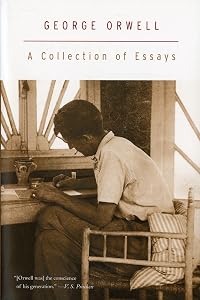
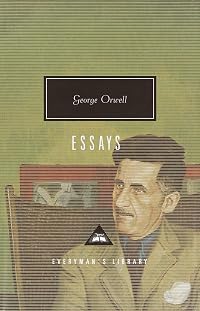
A Collection of Essays
by George Orwell 
On This Page
Description
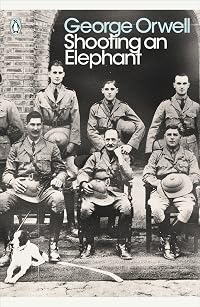
One of the most thought-provoking and vivid essayists of the twentieth century, George Orwell fought the injustices of his time with singular vigour through pen and paper. In this selection of essays, he ranges from reflections on his boyhood schooling and the profession of writing to his views on the Spanish Civil War and British imperialism. The pieces collected here include the relatively unfamiliar and the more celebrated, making it an ideal compilation for both new and dedicated readers show more of Orwell's work. (Goodreads.) show lessTags
Recommendations














Member Reviews
A collection is by nature a mixed bag. This is unexceptional. However, there are some utter gems here.
“Such, Such Were the Joys …” is a compelling record of the evil of early 20th century private schools (as we might call them now). Their primary and singular purpose was to get boys into Eton et al. Consequently, their education was narrow and irrelevant for life in the real world, and also abusive.
I also enjoyed and admired:
Shooting an Elephant
Reflections on Gandhi
England Your England
But the best are “Politics and the English Language” and “Why I Write” written as he started on “1984”. These are essential study for every aspiring writer.
“Such, Such Were the Joys …” is a compelling record of the evil of early 20th century private schools (as we might call them now). Their primary and singular purpose was to get boys into Eton et al. Consequently, their education was narrow and irrelevant for life in the real world, and also abusive.
I also enjoyed and admired:
Shooting an Elephant
Reflections on Gandhi
England Your England
But the best are “Politics and the English Language” and “Why I Write” written as he started on “1984”. These are essential study for every aspiring writer.
Definitely a worthwhile read. The topics covered by the different essays is somewhat eclectic, ranging from commentaries on authors (Charles Dickins, Rudyard Kipling), to personal experiences ("Shooting an Elephant"). Orwell's writing style is very solid, and his commentary on politics and social issues is very thought provoking. Really worth looking into.
Right up front I have to admit this book was mostly a slog. Except for a few of the essays, on Dickens, on Gandhi, on Politics and the English Language, and Why I write at the very end, my attention wobbled. Orwell was a political being from head to toe and his concerns in these essays are entirely focussed on issues of boys, men, men in power, literature by men and for men -- all with the assumption, yes, that nothing else matters much other than who wields the power and what form it takes. No mention at all of a single woman writer other than, in an essay on Henry Miller, Anais Nin of all people. It's a very inward (as in Britishly inward) turning book and the essays are mostly written in the period between 1935 and 1941. At the same show more time, Orwell is such a good writer that even when I was feeling gnawingly irritated or bored I was far too appreciative of his attempts to be clear and direct and as honest about himself and his limitations as he could be, to put it down. He writes better than almost anybody, even about subjects that I simply cannot get excited about. The final essay, short, about "Why I Write" did not disappoint. The best essay, still entirely relevant, which tells you something about humans, and which should be required reading in high schools, was the one about Politics and the English Language. ****
Quote:
"All writers are vain, selfish, and lazy, and at the very bottom of their motives there lies a mystery. Writing a book is a horrible, exhausting struggle, like a long bout of some painful illness." It goes on in that vein, but those are the two best sentences. show less
Quote:
"All writers are vain, selfish, and lazy, and at the very bottom of their motives there lies a mystery. Writing a book is a horrible, exhausting struggle, like a long bout of some painful illness." It goes on in that vein, but those are the two best sentences. show less
In his 1946 essay, “Why I Write,” George Orwell tells us how to read his work: “Every line of serious work that I have written since 1936 has been written, directly or indirectly, against totalitarianism and for democratic socialism, as I understand it.” His somewhat fictionalized memoirs, “Such Were the Joys” and “Shooting an Elephant,” like Down and Out in Paris and London, describe his growing understanding of the dangers of autocratic power. In his most famous works, Animal Farm and 1984, his target was not so much Marxist economics as its totalitarian embodiment in Stalinist Russia. In the essays in this excellent collection, he shows how autocrats from Franco to Hitler to Stalin corrupted our language and show more exacerbated the economic unfairness he also found in British imperialism. His nuanced critiques of Dickens, Kipling, Joyce, and Henry Miller are also well worth exploring. show less
Having discussions lately about the topic that keeps academics in business, I guess: what is literature as opposed to other forms of fiction, I'd like to give access to this Orwell essay as a meaningful point of departure. I feel like I keep talking and arguing without any lines/definitions/meanings in place.
Good bad books. Essay by George Orwell. First published 2 November 1945.
Not long ago a publisher commissioned me to write an introduction for a reprint of a novel by Leonard Merrick. This publishing house, it appears, is going to reissue a long series of minor and partly-forgotten novels of the twentieth century. It is a valuable service in these bookless days, and I rather envy the person whose job it will be to scout round the show more threepenny boxes, hunting down copies of his boyhood favourites.
A type of book which we hardly seem to produce in these days, but which flowered with great richness in the late nineteenth and early twentieth centuries, is what Chesterton called the "good bad book": that is, the kind of book that has no literary pretensions but which remains readable when more serious productions have perished. Obviously outstanding books in this line are RAFFLES and the Sherlock Holmes stories, which have kept their place when innumerable "problem novels", "human documents" and "terrible indictments" of this or that have fallen into deserved oblivion. (Who has worn better, Conan Doyle or Meredith?) Almost in the same class as these I, put R. Austin Freeman's earlier stories--"The Singing Bone" "The Eye of Osiris" and others--Ernest Bramah's MAX CARRADOS, and, dropping the standard a bit, Guy Boothby's Tibetan thriller, DR NIKOLA, a sort of schoolboy version of Hue's TRAVELS IN TARTARY, which would probably make a real visit to Central Asia seem a dismal anticlimax.
But apart from thrillers, there were the minor humorous writers of the period. For example, Pett Ridge-but I admit his full-length books no longer seem readable--E. Nesbit (THE TREASURE SEEKERS), George Birmingham, who was good so long as he kept off politics, the pornographic Binstead ("Pitcher" of the PINK 'UN), and, if American books can be included, Booth Tarkington's Penrod stories. A cut above most of these was Barry Pain. Some of Pain's humorous writings are, I suppose, still in print, but to anyone who comes across it I recommend what must now be a very rare book--THE OCTAVE OF CLAUDIUS, a brilliant exercise in the macabre. Somewhat later in time there was Peter Blundell, who wrote in the W.W. Jacobs vein about Far Eastern seaport towns, and who seems to be rather unaccountably forgotten, in spite of having been praised in print by H.G. Wells.
However, all the books I have been speaking of are frankly "escape" literature. They form pleasant patches in one's memory, quiet corners where the mind can browse at odd moments, but they hardly pretend to have anything to do with real life. There is another kind of good bad book which is more seriously intended, and which tells us, I think, something about the nature of the novel and the reasons for its present decadence. During the last fifty years there has been a whole series of writers--some of them are still writing--whom it is quite impossible to call "good" by any strictly literary standard, but who are natural novelists and who seem to attain sincerity partly because they are not inhibited by good taste. In this class I put Leonard Merrick himself, W.L. George, J.D. Beresford, Ernest Raymond, May Sinclair, and--at a lower level than the others but still essentially similar--A.S.M. Hutchinson.
Most of these have been prolific writers, and their output has naturally varied in quality. I am thinking in each case of one or two outstanding books: for example, Merrick's CYNTHIA, J.D. Beresford's A CANDIDATE FOR TRUTH, W.L. George's CALIBAN, May Sinclair's THE COMBINED MAZE and Ernest Raymond's WE, THE ACCUSED. In each of these books the author has been able to identify himself with his imagined characters, to feel with them and invite sympathy on their behalf. with a kind of abandonment that cleverer people would find it difficult to achieve. They bring out the fact that intellectual refinement can be a disadvantage to a story-teller, as it would be to a music-hall comedian.
Take, for example, Ernest Raymond's WE, THE ACCUSED--a peculiarly sordid and convincing murder story, probably based on the Crippen case. I think it gains a great deal from the fact that the author only partly grasps the pathetic vulgarity of the people he is writing about, and therefore does not despise them. Perhaps it even - like Theodore Dreiser's An AMERICAN TRAGEDY - gains something from the clumsy long-winded manner in which it is written; detail is piled on detail, with almost no attempt at selection, and in the process an effect of terrible, grinding cruelty is slowly built up. So also with A CANDIDATE FOR TRUTH. Here there is not the same clumsiness, but there is the same ability to take seriously the problems of commonplace people. So also with CYNTHIA and at any rate the earlier part of Caliban. The greater part of what W.L. George wrote was shoddy rubbish, but in this particular book, based on the career of Northcliffe, he achieved some memorable and truthful pictures of lower-middle-class London life. Parts of this book are probably autobiographical, and one of the advantages of good bad writers is their lack of shame in writing autobiography. Exhibitionism and self-pity are the bane of the novelist, and yet if he is too frightened of them his creative gift may suffer.
The existence of good bad literature - the fact that one can be amused or excited or even moved by a book that one's intellect simply refuses to take seriously - is a reminder that art is not the same thing as cerebration. I imagine that by any test that could be devised, Carlyle would be found to be a more intelligent man than Trollope. Yet Trollope has remained readable and Carlyle has not: with all his cleverness he had not even the wit to write in plain straightforward English. In novelists, almost as much as in poets, the connection between intelligence and creative power is hard to establish. A good novelist may be a prodigy of self-discipline like Flaubert, or he may be an intellectual sprawl like Dickens. Enough talent to set up dozens of ordinary writers has been poured into Wyndham Lewis's so-called novels, such as TARR or SNOOTY BARONET. Yet it would be a very heavy labour to read one of these books right through. Some indefinable quality, a sort of literary vitamin,
which exists even in a book like IF WINTER COMES, is absent from them.
Perhaps the supreme example of the "good bad" book is UNCLE TOM'S CABIN. It is an unintentionally ludicrous book, full of preposterous melodramatic incidents; it is also deeply moving and essentially true; it is hard to say which quality outweighs the other. But UNCLE TOM'S CABIN, after all, is trying to be serious and to deal with the real world. How about the frankly escapist writers, the purveyors of thrills and "light" humour? How about SHERLOCK HOLMES, VICE VERSA, DRACULA, HELEN'S BABIES or KING SOLOMON'S MINES? All of these are definitely absurd books, books which one is more inclined to laugh AT than WITH, and which were hardly taken seriously even by their authors; yet they have survived, and will probably continue to do so. All one can say is that, while civilisation remains such that one needs distraction
from time to time, "light" literature has its appointed place; also that there is such a thing as sheer skill, or native grace, which may have more survival value than erudition or intellectual power. There are music-hall songs which are better poems than three-quarters of the stuff that gets into the anthologies:
Come where the booze is cheaper,
Come where the pots hold more,
Come where the boss is a bit of a sport,
Come to the pub next door!
Or again:
Two lovely black eyes
Oh, what a surprise!
Only for calling another man wrong,
Two lovely black eyes!
I would far rather have written either of those than, say, "The Blessed Damozel" or "Love in the Valley". And by the same token I would back UNCLE TOM'S CABIN to outlive the complete works of Virginia Woolf or George Moore, though I know of no strictly literary test which would show where the superiority lies. show less
Good bad books. Essay by George Orwell. First published 2 November 1945.
Not long ago a publisher commissioned me to write an introduction for a reprint of a novel by Leonard Merrick. This publishing house, it appears, is going to reissue a long series of minor and partly-forgotten novels of the twentieth century. It is a valuable service in these bookless days, and I rather envy the person whose job it will be to scout round the show more threepenny boxes, hunting down copies of his boyhood favourites.
A type of book which we hardly seem to produce in these days, but which flowered with great richness in the late nineteenth and early twentieth centuries, is what Chesterton called the "good bad book": that is, the kind of book that has no literary pretensions but which remains readable when more serious productions have perished. Obviously outstanding books in this line are RAFFLES and the Sherlock Holmes stories, which have kept their place when innumerable "problem novels", "human documents" and "terrible indictments" of this or that have fallen into deserved oblivion. (Who has worn better, Conan Doyle or Meredith?) Almost in the same class as these I, put R. Austin Freeman's earlier stories--"The Singing Bone" "The Eye of Osiris" and others--Ernest Bramah's MAX CARRADOS, and, dropping the standard a bit, Guy Boothby's Tibetan thriller, DR NIKOLA, a sort of schoolboy version of Hue's TRAVELS IN TARTARY, which would probably make a real visit to Central Asia seem a dismal anticlimax.
But apart from thrillers, there were the minor humorous writers of the period. For example, Pett Ridge-but I admit his full-length books no longer seem readable--E. Nesbit (THE TREASURE SEEKERS), George Birmingham, who was good so long as he kept off politics, the pornographic Binstead ("Pitcher" of the PINK 'UN), and, if American books can be included, Booth Tarkington's Penrod stories. A cut above most of these was Barry Pain. Some of Pain's humorous writings are, I suppose, still in print, but to anyone who comes across it I recommend what must now be a very rare book--THE OCTAVE OF CLAUDIUS, a brilliant exercise in the macabre. Somewhat later in time there was Peter Blundell, who wrote in the W.W. Jacobs vein about Far Eastern seaport towns, and who seems to be rather unaccountably forgotten, in spite of having been praised in print by H.G. Wells.
However, all the books I have been speaking of are frankly "escape" literature. They form pleasant patches in one's memory, quiet corners where the mind can browse at odd moments, but they hardly pretend to have anything to do with real life. There is another kind of good bad book which is more seriously intended, and which tells us, I think, something about the nature of the novel and the reasons for its present decadence. During the last fifty years there has been a whole series of writers--some of them are still writing--whom it is quite impossible to call "good" by any strictly literary standard, but who are natural novelists and who seem to attain sincerity partly because they are not inhibited by good taste. In this class I put Leonard Merrick himself, W.L. George, J.D. Beresford, Ernest Raymond, May Sinclair, and--at a lower level than the others but still essentially similar--A.S.M. Hutchinson.
Most of these have been prolific writers, and their output has naturally varied in quality. I am thinking in each case of one or two outstanding books: for example, Merrick's CYNTHIA, J.D. Beresford's A CANDIDATE FOR TRUTH, W.L. George's CALIBAN, May Sinclair's THE COMBINED MAZE and Ernest Raymond's WE, THE ACCUSED. In each of these books the author has been able to identify himself with his imagined characters, to feel with them and invite sympathy on their behalf. with a kind of abandonment that cleverer people would find it difficult to achieve. They bring out the fact that intellectual refinement can be a disadvantage to a story-teller, as it would be to a music-hall comedian.
Take, for example, Ernest Raymond's WE, THE ACCUSED--a peculiarly sordid and convincing murder story, probably based on the Crippen case. I think it gains a great deal from the fact that the author only partly grasps the pathetic vulgarity of the people he is writing about, and therefore does not despise them. Perhaps it even - like Theodore Dreiser's An AMERICAN TRAGEDY - gains something from the clumsy long-winded manner in which it is written; detail is piled on detail, with almost no attempt at selection, and in the process an effect of terrible, grinding cruelty is slowly built up. So also with A CANDIDATE FOR TRUTH. Here there is not the same clumsiness, but there is the same ability to take seriously the problems of commonplace people. So also with CYNTHIA and at any rate the earlier part of Caliban. The greater part of what W.L. George wrote was shoddy rubbish, but in this particular book, based on the career of Northcliffe, he achieved some memorable and truthful pictures of lower-middle-class London life. Parts of this book are probably autobiographical, and one of the advantages of good bad writers is their lack of shame in writing autobiography. Exhibitionism and self-pity are the bane of the novelist, and yet if he is too frightened of them his creative gift may suffer.
The existence of good bad literature - the fact that one can be amused or excited or even moved by a book that one's intellect simply refuses to take seriously - is a reminder that art is not the same thing as cerebration. I imagine that by any test that could be devised, Carlyle would be found to be a more intelligent man than Trollope. Yet Trollope has remained readable and Carlyle has not: with all his cleverness he had not even the wit to write in plain straightforward English. In novelists, almost as much as in poets, the connection between intelligence and creative power is hard to establish. A good novelist may be a prodigy of self-discipline like Flaubert, or he may be an intellectual sprawl like Dickens. Enough talent to set up dozens of ordinary writers has been poured into Wyndham Lewis's so-called novels, such as TARR or SNOOTY BARONET. Yet it would be a very heavy labour to read one of these books right through. Some indefinable quality, a sort of literary vitamin,
which exists even in a book like IF WINTER COMES, is absent from them.
Perhaps the supreme example of the "good bad" book is UNCLE TOM'S CABIN. It is an unintentionally ludicrous book, full of preposterous melodramatic incidents; it is also deeply moving and essentially true; it is hard to say which quality outweighs the other. But UNCLE TOM'S CABIN, after all, is trying to be serious and to deal with the real world. How about the frankly escapist writers, the purveyors of thrills and "light" humour? How about SHERLOCK HOLMES, VICE VERSA, DRACULA, HELEN'S BABIES or KING SOLOMON'S MINES? All of these are definitely absurd books, books which one is more inclined to laugh AT than WITH, and which were hardly taken seriously even by their authors; yet they have survived, and will probably continue to do so. All one can say is that, while civilisation remains such that one needs distraction
from time to time, "light" literature has its appointed place; also that there is such a thing as sheer skill, or native grace, which may have more survival value than erudition or intellectual power. There are music-hall songs which are better poems than three-quarters of the stuff that gets into the anthologies:
Come where the booze is cheaper,
Come where the pots hold more,
Come where the boss is a bit of a sport,
Come to the pub next door!
Or again:
Two lovely black eyes
Oh, what a surprise!
Only for calling another man wrong,
Two lovely black eyes!
I would far rather have written either of those than, say, "The Blessed Damozel" or "Love in the Valley". And by the same token I would back UNCLE TOM'S CABIN to outlive the complete works of Virginia Woolf or George Moore, though I know of no strictly literary test which would show where the superiority lies. show less
The writing of George Orwell, specifically his foreboding novel 1984 (aren’t we now living that nightmare of doublespeak?) very much shaped my vision of the future as a teen growing up in the 60’s. It was only when the year 1984 passed and life continued to roll on that I realized to what extent his writing had cast a spell over me.
At the time I knew he was also an essayist. As a youth I started to read The Road to Wigan Pier, but soon set it aside and it was forgotten. How things have changed. I recently discovered his “A Collection of Essays” and found it all but impossible to put down. From his opening (and many today say embellished) recollections of his treatment as a young boy in and English public school to his final show more essay title “Why I Write”, I found his writing clear and insightful.
These essays were written between 1936-1949 and cover a variety of topics, from his look back on his memory of his early schooling to his tortured memory of his involvement in the Spanish civil war. He shares his views on Gandhi, Dickens and Kipling. There are also essays on some of the more mundane aspects of living in the thirties in England. Although not particularly relevant to life in the 21st century these discussions on such topics as the “Boys Weeklies” provided a fascinating insight into what was shaping some of my English ancestors as they came of age.
George Orwell was a brilliant essayist. I am very glad to have rediscovered him. 4 ½ stars. show less
At the time I knew he was also an essayist. As a youth I started to read The Road to Wigan Pier, but soon set it aside and it was forgotten. How things have changed. I recently discovered his “A Collection of Essays” and found it all but impossible to put down. From his opening (and many today say embellished) recollections of his treatment as a young boy in and English public school to his final show more essay title “Why I Write”, I found his writing clear and insightful.
These essays were written between 1936-1949 and cover a variety of topics, from his look back on his memory of his early schooling to his tortured memory of his involvement in the Spanish civil war. He shares his views on Gandhi, Dickens and Kipling. There are also essays on some of the more mundane aspects of living in the thirties in England. Although not particularly relevant to life in the 21st century these discussions on such topics as the “Boys Weeklies” provided a fascinating insight into what was shaping some of my English ancestors as they came of age.
George Orwell was a brilliant essayist. I am very glad to have rediscovered him. 4 ½ stars. show less
Having discussions lately about the topic that keeps academics in business, I guess: what is literature as opposed to other forms of fiction, I'd like to give access to this Orwell essay as a meaningful point of departure. I feel like I keep talking and arguing without any lines/definitions/meanings in place.
Good bad books. Essay by George Orwell. First published 2 November 1945.
Not long ago a publisher commissioned me to write an introduction for a reprint of a novel by Leonard Merrick. This publishing house, it appears, is going to reissue a long series of minor and partly-forgotten novels of the twentieth century. It is a valuable service in these bookless days, and I rather envy the person whose job it will be to scout round the show more threepenny boxes, hunting down copies of his boyhood favourites.
A type of book which we hardly seem to produce in these days, but which flowered with great richness in the late nineteenth and early twentieth centuries, is what Chesterton called the "good bad book": that is, the kind of book that has no literary pretensions but which remains readable when more serious productions have perished. Obviously outstanding books in this line are RAFFLES and the Sherlock Holmes stories, which have kept their place when innumerable "problem novels", "human documents" and "terrible indictments" of this or that have fallen into deserved oblivion. (Who has worn better, Conan Doyle or Meredith?) Almost in the same class as these I, put R. Austin Freeman's earlier stories--"The Singing Bone" "The Eye of Osiris" and others--Ernest Bramah's MAX CARRADOS, and, dropping the standard a bit, Guy Boothby's Tibetan thriller, DR NIKOLA, a sort of schoolboy version of Hue's TRAVELS IN TARTARY, which would probably make a real visit to Central Asia seem a dismal anticlimax.
But apart from thrillers, there were the minor humorous writers of the period. For example, Pett Ridge-but I admit his full-length books no longer seem readable--E. Nesbit (THE TREASURE SEEKERS), George Birmingham, who was good so long as he kept off politics, the pornographic Binstead ("Pitcher" of the PINK 'UN), and, if American books can be included, Booth Tarkington's Penrod stories. A cut above most of these was Barry Pain. Some of Pain's humorous writings are, I suppose, still in print, but to anyone who comes across it I recommend what must now be a very rare book--THE OCTAVE OF CLAUDIUS, a brilliant exercise in the macabre. Somewhat later in time there was Peter Blundell, who wrote in the W.W. Jacobs vein about Far Eastern seaport towns, and who seems to be rather unaccountably forgotten, in spite of having been praised in print by H.G. Wells.
However, all the books I have been speaking of are frankly "escape" literature. They form pleasant patches in one's memory, quiet corners where the mind can browse at odd moments, but they hardly pretend to have anything to do with real life. There is another kind of good bad book which is more seriously intended, and which tells us, I think, something about the nature of the novel and the reasons for its present decadence. During the last fifty years there has been a whole series of writers--some of them are still writing--whom it is quite impossible to call "good" by any strictly literary standard, but who are natural novelists and who seem to attain sincerity partly because they are not inhibited by good taste. In this class I put Leonard Merrick himself, W.L. George, J.D. Beresford, Ernest Raymond, May Sinclair, and--at a lower level than the others but still essentially similar--A.S.M. Hutchinson.
Most of these have been prolific writers, and their output has naturally varied in quality. I am thinking in each case of one or two outstanding books: for example, Merrick's CYNTHIA, J.D. Beresford's A CANDIDATE FOR TRUTH, W.L. George's CALIBAN, May Sinclair's THE COMBINED MAZE and Ernest Raymond's WE, THE ACCUSED. In each of these books the author has been able to identify himself with his imagined characters, to feel with them and invite sympathy on their behalf. with a kind of abandonment that cleverer people would find it difficult to achieve. They bring out the fact that intellectual refinement can be a disadvantage to a story-teller, as it would be to a music-hall comedian.
Take, for example, Ernest Raymond's WE, THE ACCUSED--a peculiarly sordid and convincing murder story, probably based on the Crippen case. I think it gains a great deal from the fact that the author only partly grasps the pathetic vulgarity of the people he is writing about, and therefore does not despise them. Perhaps it even - like Theodore Dreiser's An AMERICAN TRAGEDY - gains something from the clumsy long-winded manner in which it is written; detail is piled on detail, with almost no attempt at selection, and in the process an effect of terrible, grinding cruelty is slowly built up. So also with A CANDIDATE FOR TRUTH. Here there is not the same clumsiness, but there is the same ability to take seriously the problems of commonplace people. So also with CYNTHIA and at any rate the earlier part of Caliban. The greater part of what W.L. George wrote was shoddy rubbish, but in this particular book, based on the career of Northcliffe, he achieved some memorable and truthful pictures of lower-middle-class London life. Parts of this book are probably autobiographical, and one of the advantages of good bad writers is their lack of shame in writing autobiography. Exhibitionism and self-pity are the bane of the novelist, and yet if he is too frightened of them his creative gift may suffer.
The existence of good bad literature - the fact that one can be amused or excited or even moved by a book that one's intellect simply refuses to take seriously - is a reminder that art is not the same thing as cerebration. I imagine that by any test that could be devised, Carlyle would be found to be a more intelligent man than Trollope. Yet Trollope has remained readable and Carlyle has not: with all his cleverness he had not even the wit to write in plain straightforward English. In novelists, almost as much as in poets, the connection between intelligence and creative power is hard to establish. A good novelist may be a prodigy of self-discipline like Flaubert, or he may be an intellectual sprawl like Dickens. Enough talent to set up dozens of ordinary writers has been poured into Wyndham Lewis's so-called novels, such as TARR or SNOOTY BARONET. Yet it would be a very heavy labour to read one of these books right through. Some indefinable quality, a sort of literary vitamin,
which exists even in a book like IF WINTER COMES, is absent from them.
Perhaps the supreme example of the "good bad" book is UNCLE TOM'S CABIN. It is an unintentionally ludicrous book, full of preposterous melodramatic incidents; it is also deeply moving and essentially true; it is hard to say which quality outweighs the other. But UNCLE TOM'S CABIN, after all, is trying to be serious and to deal with the real world. How about the frankly escapist writers, the purveyors of thrills and "light" humour? How about SHERLOCK HOLMES, VICE VERSA, DRACULA, HELEN'S BABIES or KING SOLOMON'S MINES? All of these are definitely absurd books, books which one is more inclined to laugh AT than WITH, and which were hardly taken seriously even by their authors; yet they have survived, and will probably continue to do so. All one can say is that, while civilisation remains such that one needs distraction
from time to time, "light" literature has its appointed place; also that there is such a thing as sheer skill, or native grace, which may have more survival value than erudition or intellectual power. There are music-hall songs which are better poems than three-quarters of the stuff that gets into the anthologies:
Come where the booze is cheaper,
Come where the pots hold more,
Come where the boss is a bit of a sport,
Come to the pub next door!
Or again:
Two lovely black eyes
Oh, what a surprise!
Only for calling another man wrong,
Two lovely black eyes!
I would far rather have written either of those than, say, "The Blessed Damozel" or "Love in the Valley". And by the same token I would back UNCLE TOM'S CABIN to outlive the complete works of Virginia Woolf or George Moore, though I know of no strictly literary test which would show where the superiority lies. show less
Good bad books. Essay by George Orwell. First published 2 November 1945.
Not long ago a publisher commissioned me to write an introduction for a reprint of a novel by Leonard Merrick. This publishing house, it appears, is going to reissue a long series of minor and partly-forgotten novels of the twentieth century. It is a valuable service in these bookless days, and I rather envy the person whose job it will be to scout round the show more threepenny boxes, hunting down copies of his boyhood favourites.
A type of book which we hardly seem to produce in these days, but which flowered with great richness in the late nineteenth and early twentieth centuries, is what Chesterton called the "good bad book": that is, the kind of book that has no literary pretensions but which remains readable when more serious productions have perished. Obviously outstanding books in this line are RAFFLES and the Sherlock Holmes stories, which have kept their place when innumerable "problem novels", "human documents" and "terrible indictments" of this or that have fallen into deserved oblivion. (Who has worn better, Conan Doyle or Meredith?) Almost in the same class as these I, put R. Austin Freeman's earlier stories--"The Singing Bone" "The Eye of Osiris" and others--Ernest Bramah's MAX CARRADOS, and, dropping the standard a bit, Guy Boothby's Tibetan thriller, DR NIKOLA, a sort of schoolboy version of Hue's TRAVELS IN TARTARY, which would probably make a real visit to Central Asia seem a dismal anticlimax.
But apart from thrillers, there were the minor humorous writers of the period. For example, Pett Ridge-but I admit his full-length books no longer seem readable--E. Nesbit (THE TREASURE SEEKERS), George Birmingham, who was good so long as he kept off politics, the pornographic Binstead ("Pitcher" of the PINK 'UN), and, if American books can be included, Booth Tarkington's Penrod stories. A cut above most of these was Barry Pain. Some of Pain's humorous writings are, I suppose, still in print, but to anyone who comes across it I recommend what must now be a very rare book--THE OCTAVE OF CLAUDIUS, a brilliant exercise in the macabre. Somewhat later in time there was Peter Blundell, who wrote in the W.W. Jacobs vein about Far Eastern seaport towns, and who seems to be rather unaccountably forgotten, in spite of having been praised in print by H.G. Wells.
However, all the books I have been speaking of are frankly "escape" literature. They form pleasant patches in one's memory, quiet corners where the mind can browse at odd moments, but they hardly pretend to have anything to do with real life. There is another kind of good bad book which is more seriously intended, and which tells us, I think, something about the nature of the novel and the reasons for its present decadence. During the last fifty years there has been a whole series of writers--some of them are still writing--whom it is quite impossible to call "good" by any strictly literary standard, but who are natural novelists and who seem to attain sincerity partly because they are not inhibited by good taste. In this class I put Leonard Merrick himself, W.L. George, J.D. Beresford, Ernest Raymond, May Sinclair, and--at a lower level than the others but still essentially similar--A.S.M. Hutchinson.
Most of these have been prolific writers, and their output has naturally varied in quality. I am thinking in each case of one or two outstanding books: for example, Merrick's CYNTHIA, J.D. Beresford's A CANDIDATE FOR TRUTH, W.L. George's CALIBAN, May Sinclair's THE COMBINED MAZE and Ernest Raymond's WE, THE ACCUSED. In each of these books the author has been able to identify himself with his imagined characters, to feel with them and invite sympathy on their behalf. with a kind of abandonment that cleverer people would find it difficult to achieve. They bring out the fact that intellectual refinement can be a disadvantage to a story-teller, as it would be to a music-hall comedian.
Take, for example, Ernest Raymond's WE, THE ACCUSED--a peculiarly sordid and convincing murder story, probably based on the Crippen case. I think it gains a great deal from the fact that the author only partly grasps the pathetic vulgarity of the people he is writing about, and therefore does not despise them. Perhaps it even - like Theodore Dreiser's An AMERICAN TRAGEDY - gains something from the clumsy long-winded manner in which it is written; detail is piled on detail, with almost no attempt at selection, and in the process an effect of terrible, grinding cruelty is slowly built up. So also with A CANDIDATE FOR TRUTH. Here there is not the same clumsiness, but there is the same ability to take seriously the problems of commonplace people. So also with CYNTHIA and at any rate the earlier part of Caliban. The greater part of what W.L. George wrote was shoddy rubbish, but in this particular book, based on the career of Northcliffe, he achieved some memorable and truthful pictures of lower-middle-class London life. Parts of this book are probably autobiographical, and one of the advantages of good bad writers is their lack of shame in writing autobiography. Exhibitionism and self-pity are the bane of the novelist, and yet if he is too frightened of them his creative gift may suffer.
The existence of good bad literature - the fact that one can be amused or excited or even moved by a book that one's intellect simply refuses to take seriously - is a reminder that art is not the same thing as cerebration. I imagine that by any test that could be devised, Carlyle would be found to be a more intelligent man than Trollope. Yet Trollope has remained readable and Carlyle has not: with all his cleverness he had not even the wit to write in plain straightforward English. In novelists, almost as much as in poets, the connection between intelligence and creative power is hard to establish. A good novelist may be a prodigy of self-discipline like Flaubert, or he may be an intellectual sprawl like Dickens. Enough talent to set up dozens of ordinary writers has been poured into Wyndham Lewis's so-called novels, such as TARR or SNOOTY BARONET. Yet it would be a very heavy labour to read one of these books right through. Some indefinable quality, a sort of literary vitamin,
which exists even in a book like IF WINTER COMES, is absent from them.
Perhaps the supreme example of the "good bad" book is UNCLE TOM'S CABIN. It is an unintentionally ludicrous book, full of preposterous melodramatic incidents; it is also deeply moving and essentially true; it is hard to say which quality outweighs the other. But UNCLE TOM'S CABIN, after all, is trying to be serious and to deal with the real world. How about the frankly escapist writers, the purveyors of thrills and "light" humour? How about SHERLOCK HOLMES, VICE VERSA, DRACULA, HELEN'S BABIES or KING SOLOMON'S MINES? All of these are definitely absurd books, books which one is more inclined to laugh AT than WITH, and which were hardly taken seriously even by their authors; yet they have survived, and will probably continue to do so. All one can say is that, while civilisation remains such that one needs distraction
from time to time, "light" literature has its appointed place; also that there is such a thing as sheer skill, or native grace, which may have more survival value than erudition or intellectual power. There are music-hall songs which are better poems than three-quarters of the stuff that gets into the anthologies:
Come where the booze is cheaper,
Come where the pots hold more,
Come where the boss is a bit of a sport,
Come to the pub next door!
Or again:
Two lovely black eyes
Oh, what a surprise!
Only for calling another man wrong,
Two lovely black eyes!
I would far rather have written either of those than, say, "The Blessed Damozel" or "Love in the Valley". And by the same token I would back UNCLE TOM'S CABIN to outlive the complete works of Virginia Woolf or George Moore, though I know of no strictly literary test which would show where the superiority lies. show less
Members
- Recently Added By
Lists

Best Essay Collections
61 works; 24 members

Best of British Literature
226 works; 41 members

The Books I've Read 2018
143 works; 1 member

Books Read in 2018
4,360 works; 110 members

Recommend the 20 best books you've read in the last five years
2,168 works; 606 members
Author Information

386+ Works 220,908 Members
George Orwell was born Eric Arthur Blair on June 25, 1903 in Motihari in Bengal, India and later studied at Eton College for four years. He was an assistant superintendent with the Indian Imperial Police in Burma. He left that position after five years and moved to Paris, where he wrote his first two books: Burmese Days and Down and Out in Paris show more and London. He then moved to Spain to write but decided to join the United Workers Marxist Party Militia. After being decidedly opposed to communism, he served in the British Home Guard and with the Indian Service of the BBC during World War II. After the war, he wrote for the Observer and was literary editor for the Tribune. His best known works are Animal Farm and 1984. His other works include A Clergyman's Daughter, Keep the Aspidistra Flying, The Road to Wigan Pier, Homage to Catalonia, and Coming Up for Air. He died on January 21, 1950 at the age of 46. (Bowker Author Biography) show less
George Orwell has a Legacy Library. Legacy libraries are the personal libraries of famous readers, entered by LibraryThing members from the Legacy Libraries group.
Series
Belongs to Publisher Series
Anchor Books (29)
Common Knowledge
- Original publication date
- 1953
- People/Characters
- George Orwell
- First words
- Such, Such Were the Joys...
Soon after I arrived at Crossgates (not immediately, but after a week or two, just when I seemed to be settling into the routine of school life) I began wetting my bed. - Quotations
- I said earlier that the decadence of our language is probably curable.
- Last words
- (Click to show. Warning: May contain spoilers.)Why I Write
And looking back through my work, I see that it is invariably where I lack political purpose that I wrote lifeless books and was betrayed into purple passages, sentences without meaning, decorative adjectives and humbug generally.
Classifications
Statistics
- Members
- 1,704
- Popularity
- 12,984
- Reviews
- 21
- Rating
- (4.22)
- Languages
- 5 — English, Portuguese, Russian, Spanish, Turkish
- Media
- Paper, Ebook
- ISBNs
- 10
- ASINs
- 16