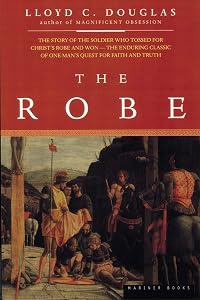
The Robe
by Lloyd C. Douglas
On This Page
Description
At the height of his popularity, Lloyd C. Douglas was receiving on average a hundred letters a week from fans. One of those fans, a department store clerk in Ohio named Hazel McCann, wrote to Douglas asking what he thought had happened to Christ's garments after the crucifixion. Douglas immediately began working on The Robe, sending each chapter to Hazel as he finished it. It is to her that Douglas dedicated this book. A Roman soldier, Marcellus, wins Christ's robe as a gambling prize. He show more then sets forth on a quest to find the truth about the Nazarene's robe, a quest that reaches to the very roots and heart of Christianity. Set against the vividly drawn background of ancient Rome, this is a timeless story of adventure, faith, and romance, a tale of spiritual longing and ultimate redemption. show lessTags
Recommendations


















Member Reviews
Lloyd C. Douglas wrote this book in 1943. It is timeless in its message and in its story. This is a story of Jesus, and it begins just before the crucifixion on the grassy knoll at Golgotha. It ends about 2 years after that in a Roman forum. Lloyd C. Douglas has created a masterpiece here, and it has some of the the most beautiful language and prose I have ever read. Yes, the story is familiar to us as Christians, but Douglas has created a wonderful meld of fiction and history in this book. We learn to love and care for the main characters as we hear about Jesus's life story. Marcellus, Demetrias and Diana were as real to me as people that I may meet on the street corner any day of the week. The amount of work that went into this novel show more is astounding, and the skill in which it was created is beyond belief. Marcellus was present at the time of the crucifixion of Christ, and his presence at this momentous occasion forever changed his life. We see how a cocky, young Roman Centurion becomes a humble citizen whose main goal in life is to educate the people about Jesus Christ and his promised Kingdom. This is not a book to begin lightly. It is a very weighty tome that will probably cause readers to re-evaluate and re-discover their life lessons It is a book that will hit you in the solar plexus. This very real entry into the first century A.D. will knock your socks off and rock your world if you let it When Lloyd Douglas's housekeeper asked the innocent question about the crucifixion, "What happened to his robe sir?" this was the beginning of Lloyd Douglas's magnum opus. He has done a masterful job of combining fiction, folklore and history in this book. It is a book that should be read in every Christian's lifetime. I had read it before when I was much younger, and did not really grasp the scope of it until I picked it up now. As difficult as it was to read this story, I do not regret a minute of it. show less
The crime of all crimes.
Wrongfully accused -
Unjustly tried -
Iniquitously put to death.
The story of Jesus.
What you have before you - A possibly life-altering reading experience that makes you realize the grammatical superfluity of the comparative for “beautiful”.
If you are an agnostic like me, or even an atheist, this is perhaps the closest we may ever get to understanding that perhaps, just perhaps there could have been a man or at some point in the future will be again a man/woman that was or will be ever so much more.
Jesus may not be the main character in The Robe 👘 but he is in the thoughts and minds of the main characters, most of all of the protagonists Marcus gallius and Dimitrius and does both control their actions and show more steer along the plot.
This is about Jesus, and that’s a dicey business.
Writing about Jesus one of the two might happen . The theme itself may have the reader love a merely average work, or hate even the most eloquent effort. After all, Jesus is virtually inseparable from religion and as such a topic of the utmost sensitivity. But that is exactly what the writer managed, to spin a story with historicity in mind yet love for the subject in his heart, separate from religious orthodoxy.
A novel about Jesus that I believe even a religious hardliner might appreciate, especially since for better or worse it is based on the books of the four evangelists with all the discrepancies and inconsistencies. show less
Wrongfully accused -
Unjustly tried -
Iniquitously put to death.
The story of Jesus.
What you have before you - A possibly life-altering reading experience that makes you realize the grammatical superfluity of the comparative for “beautiful”.
If you are an agnostic like me, or even an atheist, this is perhaps the closest we may ever get to understanding that perhaps, just perhaps there could have been a man or at some point in the future will be again a man/woman that was or will be ever so much more.
Jesus may not be the main character in The Robe 👘 but he is in the thoughts and minds of the main characters, most of all of the protagonists Marcus gallius and Dimitrius and does both control their actions and show more steer along the plot.
This is about Jesus, and that’s a dicey business.
Writing about Jesus one of the two might happen . The theme itself may have the reader love a merely average work, or hate even the most eloquent effort. After all, Jesus is virtually inseparable from religion and as such a topic of the utmost sensitivity. But that is exactly what the writer managed, to spin a story with historicity in mind yet love for the subject in his heart, separate from religious orthodoxy.
A novel about Jesus that I believe even a religious hardliner might appreciate, especially since for better or worse it is based on the books of the four evangelists with all the discrepancies and inconsistencies. show less
This book provides an insightful perspective on the crucifixion and resurrection of Jesus and the effect on Judaism and the Roman Empire. It approaches the subject by telling a story about the Roman soldier in charge of the execution. It's a little slow in spots, but the ending is powerful. The--excessive--use--of--dashes--is--entirely--unnecessary--!!!--!!
The action begins and ends with the protagonist, the young Roman Tribune Marcellus Lucan Gallio, and Jesus is almost an incidental player, who only appears on stage during the crucifixion, but his affect on the Roman (fictionally the centurian in charge of the execution) becomes life-changing, through the mystical properties of the seamless robe of Christ which fell to his lot.
The other major characters are Gallio's sweetheart Diana, his sisterLucia, her Greek slave Demetrius, their family, and assorted members of the imperial family, mostly the bad ones. There are some (fictionalized) characters from the New Testament.
Although Douglas is clearly writing for a modern (1940-1050s) audience, the has a good feel for the period and places show more that he covers (Rome, Arabia, Judea). However, his characters are clearly stereotypes that are amenable to the 20th century (all the women are strong, the men are good-looking, and the slaves are above average).
He manages quite a bit of witty badinage and humorous scenes in the otherwise somber story. show less
The other major characters are Gallio's sweetheart Diana, his sisterLucia, her Greek slave Demetrius, their family, and assorted members of the imperial family, mostly the bad ones. There are some (fictionalized) characters from the New Testament.
Although Douglas is clearly writing for a modern (1940-1050s) audience, the has a good feel for the period and places show more that he covers (Rome, Arabia, Judea). However, his characters are clearly stereotypes that are amenable to the 20th century (all the women are strong, the men are good-looking, and the slaves are above average).
He manages quite a bit of witty badinage and humorous scenes in the otherwise somber story. show less
This is a very moving novel, written in a very clear, readable style. It is based around one man, Marcellus and his growing conversion to the teachings of Christ, which start from existing disbelief and cynicism of the Roman Empire which he serves. There are very thought-provoking conversations as his conversion evolves. Different explanations are discussed for classic miracles, e.g. the feeding of the 5000, which is explained here as a miracle of sharing through the force of example, with one person offering their loaves and fishes, shaming others into sharing their food likewise with their neighbours; thus the crowd is fed not literally with 5 loaves and 2 fishes, but this is the point from which it starts.
One thing I did find show more slightly implausible was the ready and automatic cynicism of not only Marcellus but nearly every Roman character about their empire and, especially, towards their own Roman gods. The author also seems very down on Augustus, while being relatively positive towards Tiberius, who is here depicted as little more than a tyrannical "you hate him but you love him really" crusty old grandfather figure. I thought until near the end that Prince Gaius was the future emperor Caligula, until he died and the real Caligula was mentioned; this Gaius is not a real historical figure living and dying at this time. Sejanus here (just) outlives Tiberius and is an old man, rather than being a much younger man whose plotting was exposed several years before Tiberius's death.
These minor historical quibbles aside (and these are not the purpose of the story), this is a wonderful tale of redemption and hope and makes one realise the tremendous forces ranged against this tiny band of early Christians. show less
One thing I did find show more slightly implausible was the ready and automatic cynicism of not only Marcellus but nearly every Roman character about their empire and, especially, towards their own Roman gods. The author also seems very down on Augustus, while being relatively positive towards Tiberius, who is here depicted as little more than a tyrannical "you hate him but you love him really" crusty old grandfather figure. I thought until near the end that Prince Gaius was the future emperor Caligula, until he died and the real Caligula was mentioned; this Gaius is not a real historical figure living and dying at this time. Sejanus here (just) outlives Tiberius and is an old man, rather than being a much younger man whose plotting was exposed several years before Tiberius's death.
These minor historical quibbles aside (and these are not the purpose of the story), this is a wonderful tale of redemption and hope and makes one realise the tremendous forces ranged against this tiny band of early Christians. show less
I DNFed this book at 45% and skipped to skim the last chapter. This book is so slow paced and drawn out. Even though I was almost half way through practically nothing had happened. Furthermore, I looked up other reviews and discovered that there are some major historical inaccuracies (especially in the last 1/3 of the book). On top of that it sounds like the primary message of salvation is missing and instead leans towards actions/works and loving others. Not to mention that it appeared in the last chapter that Marcellus married Diana even though her salvation is debatable at the time . Even if I had finished this book, I don't believe it would have gotten any higher than 3 stars (and even that high a rating is uncertain).
The Robe by Lloyd C. Douglas
Why I picked up this book: This book was on my shelf for a long time. I put it on my self after my brother-in-law read it and really enjoyed it. It sat on my shelf because it never really grabbed me after cracking it open. I picked this book up again because somebody on a site said something about it.
Why I finished this book: I really liked other books such as The Shadow of the Galilean but I really wasn’t too into this book until I discovered more as I read. It was interesting how the historical life of an innocent man was documented in this book. That’s what made it worth reading to me.
General Thoughts: It was rather slow for me at first. If you can get past beginning and see this book for what it was, show more it’s about a skeptic that grows into belief in Jesus. It was fun for me to read.
Rating: I’d give it a 4 out of 5 star rating. I glad I read it. show less
Why I picked up this book: This book was on my shelf for a long time. I put it on my self after my brother-in-law read it and really enjoyed it. It sat on my shelf because it never really grabbed me after cracking it open. I picked this book up again because somebody on a site said something about it.
Why I finished this book: I really liked other books such as The Shadow of the Galilean but I really wasn’t too into this book until I discovered more as I read. It was interesting how the historical life of an innocent man was documented in this book. That’s what made it worth reading to me.
General Thoughts: It was rather slow for me at first. If you can get past beginning and see this book for what it was, show more it’s about a skeptic that grows into belief in Jesus. It was fun for me to read.
Rating: I’d give it a 4 out of 5 star rating. I glad I read it. show less
Members
- Recently Added By
Lists

Historical Fiction
889 works; 91 members

Christianity Books You've Read
179 works; 19 members

Publisher's Weekly Bestsellers - Part II - 1940 - 1979
355 works; 6 members

Books Set in Rome
98 works; 2 members

CCE 1000 Good Books List
1,033 works; 12 members

Armed Services Editions
150 works; 1 member

Top Five Books of 2023
767 works; 317 members
Author Information

38+ Works 5,777 Members
Some Editions
Awards and Honors
Distinctions
Series
Belongs to Publisher Series
Work Relationships
Is contained in
Contains
Has the adaptation
Common Knowledge
- Canonical title
- The Robe
- Original title
- The Robe
- Original publication date
- 1942-10
- People/Characters
- Tiberius Caesar, Roman Emperor; Marcellus Lucan Gallio; Demetrius; Diana Gallus; Simon Peter, the Apostle "Cephas"; Marcipor (show all 16); Lucia; Marcus Lucan Gallio; Stephanos; Paulus (centurion); Vobiscus; Appius Kaeso; Antonia Kaeso; Antony Kaeso; Metella; Caligula
- Important places
- Rome, Italy; Palestine; Capri, Campania, Italy
- Important events
- Reign of Tiberius Caesar (14-09-18 | 37-03-16); Reign of Caligula (37-03-18 | 41-01-24)
- Related movies
- The Robe (1953 | IMDb)
- Dedication
- Dedicated with appreciation to Hazel McCann, who wondered what became of The Robe.
- First words
- Because she was only fifteen and busy with her growing up, Lucia's periods of reflection were brief and infrequent; but this morning she felt weighted with responsibility.
- Last words
- (Click to show. Warning: May contain spoilers.)"For the Big Fisherman!" she cried.
- Original language
- English
Classifications
- Genres
- Christian Fiction, Fiction and Literature, General Fiction, Historical Fiction
- DDC/MDS
- 813.52 — Literature & rhetoric American literature in English American fiction in English 1900-1999 1900-1945
- LCC
- PS3507 .O7573 .R6 — Language and Literature American literature American literature Individual authors 1900-1960
- BISAC
Statistics
- Members
- 3,258
- Popularity
- 5,284
- Reviews
- 32
- Rating
- (4.09)
- Languages
- 12 — Danish, Dutch, English, Finnish, French, German, Hungarian, Italian, Norwegian (Bokmål), Polish, Portuguese, Romanian
- Media
- Paper, Audiobook, Ebook
- ISBNs
- 56
- UPCs
- 3
- ASINs
- 119