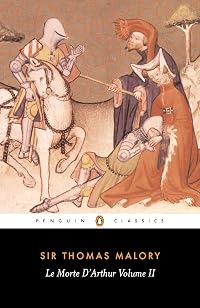
Le Morte d'Arthur, Volume 2
by Thomas Malory
On This Page
Description
The original spelling was Le Morte Darthur, which was Middle French for "the death of Arthur", and is one of the most famous works in English Literature. It is a re-working of traditional tales by Sir Thomas Malory about King Arthur, Guinevere, Lancelot, Merlin and the Knights of the Round Table though there are several original additions by him including the Gareth story. Little is known about Sir Thomas Malory and, indeed, it is only since the late nineteenth century that he has been show more identified with some certainity as Sir Thomas Malory of Newbold Revel in Warwickshire, a knight, land-owner, and Member of Parliament. In addition to his title and standing he appears to have suffered several bouts of imprisonment, mainly on charges that seem to have been politically trumped up. Le Morte d'Arthur was first published in 1485 by William Caxton, show lessTags
Recommendations











Member Reviews
Getting so bored with the constant jousting and macho showing-off (didn't T H White compare it to an obsession with cricket batting averages?) Then you come across this: "So on a day a little afore the month of May, Sir Tristram chased an hart passing eagerly, and so the hart passed by a fair well. And then Sir Tristram alit and put off his helm to drink of that burbly water. Right so he heard and saw the Questing Beast come to the well. When Sir Tristram saw that beast he put on his helm, for he deemed he should hear of Sir Palomides, for that beast was his quest"....
Love it.
Love it.
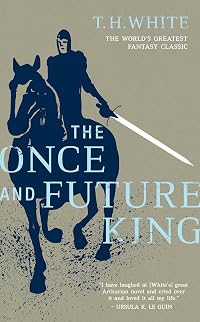
This is the second volume of Le Morte d'Arthur and shouldn't be seen as the second book of a trilogy, just a continuation, and not meant to be read alone. I agree with the reviewer who said this is not for the faint of heart, and few general readers are going to find this a great read. If you're looking for an absorbing, entertaining read with characters you can relate to and root for, you're absolutely, positively in the wrong place. Read instead Arthurian novels such as T.H. White's The Once and Future King or Mary Stewart's Merlin Trilogy. There are countless other such novels inspired by this material worth reading, and I've read a lot of them.
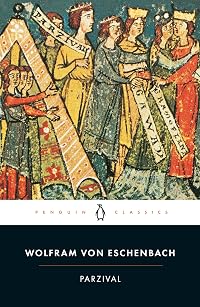
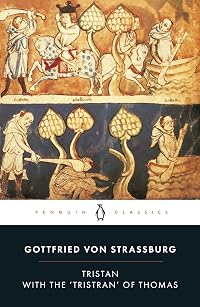
But I did find it interesting at times going through this, one of the ur-texts as it were show more of Arthurian legend. There are other, earlier works of Arthurian literature: Geoffrey of Monmouth's The History of the Kings of Britain (1136), Chrétien de Troyes's Arthurian Romances in the 12th century and Wolfram von Eschenbach's Parzival in the 13th century are among the most notable. But Malory drew from several sources, so much so he's often described more as the "compiler" than the author of the work. I own a edition in two volumes that comes close to 1,000 pages. So this is an exhaustive resource of all sorts of facets of the legend. The story of Tristram and Iseult is here, for instance.
And this is a medieval work, so it's imbued with its assumptions and attitudes. Obviously a source of outrage to some reviewers, and even by the standards of the time, comparing this to how women are treated in say Boccaccio's Decameron and Chaucer's Canterbury Tales--well, women don't come off well here. Misogyny abounds. And knights are held up as paragons who commit a lot of heinous acts and just plain WTF. A lot is repetitive and a slog--as one reviewer put it too much is "joust, joust, joust." And this was written about half-way between Chaucer and Shakespeare. With the spelling regularized it's quite readable, much more so than unmodernized Chaucer. But with those that choose to preserve the archaic words, that means wading through words such as "hight" (is called) and "mickle" (much). And there's just so much that can be excused by, well, "it's the times"--I found plenty of medieval writers who were wonderful reads, and just plain more humane: Dante, Boccaccio, Chaucer. I can't see Malory as their equal--not remotely. But as a fan of Arthurian literature and someone fascinated by the Middle Ages, this did from time to time have its fascinations. show less
But I did find it interesting at times going through this, one of the ur-texts as it were show more of Arthurian legend. There are other, earlier works of Arthurian literature: Geoffrey of Monmouth's The History of the Kings of Britain (1136), Chrétien de Troyes's Arthurian Romances in the 12th century and Wolfram von Eschenbach's Parzival in the 13th century are among the most notable. But Malory drew from several sources, so much so he's often described more as the "compiler" than the author of the work. I own a edition in two volumes that comes close to 1,000 pages. So this is an exhaustive resource of all sorts of facets of the legend. The story of Tristram and Iseult is here, for instance.
And this is a medieval work, so it's imbued with its assumptions and attitudes. Obviously a source of outrage to some reviewers, and even by the standards of the time, comparing this to how women are treated in say Boccaccio's Decameron and Chaucer's Canterbury Tales--well, women don't come off well here. Misogyny abounds. And knights are held up as paragons who commit a lot of heinous acts and just plain WTF. A lot is repetitive and a slog--as one reviewer put it too much is "joust, joust, joust." And this was written about half-way between Chaucer and Shakespeare. With the spelling regularized it's quite readable, much more so than unmodernized Chaucer. But with those that choose to preserve the archaic words, that means wading through words such as "hight" (is called) and "mickle" (much). And there's just so much that can be excused by, well, "it's the times"--I found plenty of medieval writers who were wonderful reads, and just plain more humane: Dante, Boccaccio, Chaucer. I can't see Malory as their equal--not remotely. But as a fan of Arthurian literature and someone fascinated by the Middle Ages, this did from time to time have its fascinations. show less
Thoroughly interesting read: It is often hard to find literature which fully incorporates multiple parts of the Arthurian legends. Often only the very basics are present and much of the brilliant detail is omitted. This version is one of those few works that actually bring many of the legends to light; incorporating many of the lesser known, and very interesting aspects of the legend into the commonly known main plot.It proves interesting to read about much of what is normally passed on anecdotally through families in England about one of the greatest English legends still told today. Most English people usually know the gist of the stories, but it is always interesting to find out and see people's reactions when they discover the extra show more details that they were unaware of previously.
This edition is one of the most comprehensive you will find, other than going out there and researching much of the hard going literature on the subject. show less
THE definitive version of King Aruthur and his knights. Hard getting used to spellings and word usage; but once that happened, it was enchanting and magical. I loved every bit of it.
Believe I covered it all in comments on Volume One. But the start of Book IX, La Cote Male Taile, is perhaps my favourite KA story. It later comes out that Dinadan is La Cote's brother, and that is a kind of plot twist that makes this such a lovable book.
If you took the time to read volume 1 you will take the time to read volume 2.
Este segundo tomo es más distraido que el primero. Aunque todavía siguen algunas de las monótonas andanzas de Tristán de Leonís (si bien la relación de amor/odio con el caballero sarraceno Palomides se hace más compleja), pronto se centra en las aventuras de Lanzarote, con algunos excursos, especialmente los episodios claramente simbólicos de la demanda del Santo Grial, que acabarán consiguiendo sólo Galahad (hijo de Lanzarote) y Perceval, aunque ambos morirán tras haber llegado al Grial; Lanzarote será el único que alcanzará a ver el vaso sagrado y vivir para contarlo, aunque no lo tocará por sus pecados. El resto de la obra se dedica precisamente a los "pecados" de Lanzarote y Ginebra. La personalidad del enamorado y show more casi invencible caballero es realmente compleja: modelo de virtudes tanto caballerescas como meramente humanas, casi santo en sus obligaciones cristianas, leal hasta la insensatez con su rey, sin embargo no puede evitar estar enamorado hasta las trancas de la mujer de su rey y amigo. Es conmovedor que, en el desenlace final, cuando ambos son pillados absolutamente infraganti, él sostenga contra toda evidencia la honradez de su dama incluso hasta hacerle la guerra al propio Arturo. El supermán medieval, ante cuyo mero nombre ningún mortal osa oponerse, es capaz de renunciar a todo y rebajarse hasta extremos inauditos, incluso hasta volverse loco y vivir como un pordiosero, sólo por un desprecio de su reina (en todos los sentidos de la expresión) provocado por un malentendido que ella, en un gesto de supuesta insensatez característicamente femenina, se niega a deshacer. Cuanto más lo pienso, más emocionante me parece su figura. En fin, este tomo abunda también en episodios mágicos y simbólicos, aun sin abusar, que lo hacen bastante interesante. show less
Nov 28, 2010 (Edited)Spanish
Members
- Recently Added By
Author Information

234+ Works 17,769 Members
Sir Thomas Malory, 1405 - 1471 Sir Thomas Malory's works (consisting of the legends of Sir Lancelot, Sir Gareth, Sir Tristram, and the Holy Grail, as well as the stories of King Arthur's coming to the throne, his wars with the Emperor Lucius, and his death) are the most influential expression of Arthurian material in English. The author's sources show more are principally French romances; his own contributions are substantial, however, and the result is a vigorous and resonant prose. "Le Morte d'Arthur," finished between March 1469 and March 1470, was first printed in 1485 by William Caxton, the earliest English printer. Malory is presumed to have been a knight from an old Warwickshire family, who inherited his father's estates about 1433 and spent 20 years of his later life in jail accused of various crimes. The discovery of a manuscript version of "Le Morte d'Arthur" in 1934 in the library of Winchester College, supported the identification of Malory the author with Malory the traitor, burglar, and rapist. It showed that many of the inconsistencies in the printed text were traceable to the printing house rather than to the author. The most reliable modern version, therefore, is one like Eugene Vinaver's that is based on the Winchester manuscript. (Bowker Author Biography) show less
Some Editions
Series
Belongs to Publisher Series
Work Relationships
Is contained in
Viduramžių riterių romanai (indirect)
Has as a reference guide/companion
Has as a commentary on the text
Common Knowledge
- Canonical title
- Le Morte d'Arthur, Volume 2
- Original publication date
- ms. 1450-1470 c.; 1485 Caxton
- People/Characters
- King Arthur; Guinevere (as Guenevere); Lancelot du Lac
- Important places
- Camelot
- Important events
- Pentecost
- First words
- 'And if so be ye can descrive what ye bear, ye are worthy to bear the arms.'
- Last words
- (Click to show. Warning: May contain spoilers.)And there they died upon a Good Friday for God's sake.
- Original language
- English (Middle) (Middle)
Classifications
Statistics
- Members
- 1,371
- Popularity
- 17,336
- Reviews
- 10
- Rating
- (3.93)
- Languages
- English, German, Portuguese, Spanish
- Media
- Paper, Audiobook, Ebook
- ISBNs
- 27
- ASINs
- 24