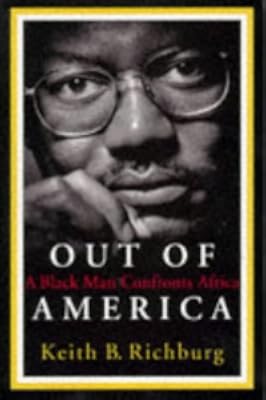
Out of America: A Black Man Confronts Africa
by Keith B. Richburg
On This Page
Description
Nothing in Keith Richburg's long and respected journalistic career at the Washington Post prepared him for what he would encounter as the paper's correspondent in Africa. At first all he could focus on was an Africa he tried his best to explain, a continent where brutal murder had become routine, where dictators and warlords silenced dissent with machine guns and machetes, where local officials sought payoffs for the most routine tasks, and where starvation had become depressingly common. show more But slowly, and with a great deal of personal anguish, this reporter asked a much more difficult question: If this is Africa, what does it mean for me to be an African American? In this provocative and unvarnished account of his three years on the continent of his ancestors, Richburg takes us on an extraordinary journey that sweeps from Somalia to Rwanda to Zaire and finally to South Africa, and shows how he was forced to confront the divide within himself between his African racial heritage and his American cultural identity. Are these really my people? he wonders. Am I truly an African American? The answer, Richburg finds after much soul-searching, is that black skin is not enough to bind him to Africa and that he is an American first, foremost, and singularly. To those who would romanticize Mother Africa as a black Valhalla, where blacks can walk with dignity and pride, he regrets to report that this is not the reality. He has been there and has witnessed the killings, the repression, the false promises, the horror. And in his darkest night of the soul, Richburg looks into his own family's past and concludes, "Thank God. Thank God my nameless ancestor, brought across the ocean in chains and leg irons, made it out alive. Thank God I am an American." show lessTags
Recommendations












Member Reviews
3.75 stars
The author is a black reporter, and in the early 1990s, represented The Washington Post in Africa. He was excited to go, to follow his “roots” in Africa. In his three years there, he experienced the civil war and famine in Somalia, the genocide in Rwanda, the many corrupt authoritarian and dictator “governments”, kids in the streets bearing AK-47s. He thought about his African-ness vs his American-ness, and came home (as many reporters in Africa do) beaten down.
The first part of the book is more about his childhood. He grew up in inner-city Detroit in the 1960s and 70s. Initially, he was a minority in his neighbourhood, but that changed. While he continued to go to school with mostly white kids and had friends there, show more he hated choosing “sides” between his white school friends, and his black neighbourhood friends.
The book included specific chapters on Somalia and Rwanda, and later on, South Africa (and the relative success of the introduction of democracy there vs the mess of it in the rest of Africa). He also has lots of examples throughout the rest of the book on the health care and AIDS in Africa, and plenty on the politics and governments of various countries.
I found the country-specific chapters more interesting, as well as the health care one, rather than the political chapters. I think it was because there are just too many names to remember and who is related to which country/city, etc. I also found the author’s own thoughts and introspection on what he encountered in Africa and his own feelings about being black and being American vs having those African roots. I also found his own biographical details quite interesting.
The edition I read came out in 2009, though it was originally published in 1997. So, this one had an additional foreword, written shortly after Obama was elected president. show less
The author is a black reporter, and in the early 1990s, represented The Washington Post in Africa. He was excited to go, to follow his “roots” in Africa. In his three years there, he experienced the civil war and famine in Somalia, the genocide in Rwanda, the many corrupt authoritarian and dictator “governments”, kids in the streets bearing AK-47s. He thought about his African-ness vs his American-ness, and came home (as many reporters in Africa do) beaten down.
The first part of the book is more about his childhood. He grew up in inner-city Detroit in the 1960s and 70s. Initially, he was a minority in his neighbourhood, but that changed. While he continued to go to school with mostly white kids and had friends there, show more he hated choosing “sides” between his white school friends, and his black neighbourhood friends.
The book included specific chapters on Somalia and Rwanda, and later on, South Africa (and the relative success of the introduction of democracy there vs the mess of it in the rest of Africa). He also has lots of examples throughout the rest of the book on the health care and AIDS in Africa, and plenty on the politics and governments of various countries.
I found the country-specific chapters more interesting, as well as the health care one, rather than the political chapters. I think it was because there are just too many names to remember and who is related to which country/city, etc. I also found the author’s own thoughts and introspection on what he encountered in Africa and his own feelings about being black and being American vs having those African roots. I also found his own biographical details quite interesting.
The edition I read came out in 2009, though it was originally published in 1997. So, this one had an additional foreword, written shortly after Obama was elected president. show less
5 stars supposedly means "I loved it." Well that's a hard thing to say about this book because that sounds too trite. It's an extraordinary work of journalism and was a real eye-opener for me. It is hard to read at times because of the violence, harshness and cruelty depicted. Yet Richburg lived through these nightmares. His perspective, as a black man, is invaluable. But I wonder if my positive reaction to his book is just a sigh of relief - a "permission" to feel racist? A very thought-provoking book. It sparked a great deal of discussion among our book club members. I highly recommend it.
3091. Out of America / A Black Man Confronts Africa, by Keith B. Richburg. The author was the Washington Post's reporter in Africa for 3 years, and while I usually am disappointed by journalists pretending to be historians, I found this well-written. Tho it tells of fearsome and hopeless things, I found it good reading. He says the best thing that ever happened to him was that his ancestor was captured in Africa and survived the trip to America. He says he has seen Africa and wants no part of it. (read July 8, 1998)
This is an outstanding book. Considering that Mr. Richburg states point-blank in the book that he now refers to himself as an American, not an "African-American," I find it rather amusing that this book is often placed in the "African-American" section of bookstores. That's a real shame because a lot of the book-reading public will miss out on his story. It is a truly fascinating read and proves, once and for all, that you really cannot go home again.
Fascinating book. It provides a unique look at the political turmoil of Africa from an American journalist's perspective. The outsider happens to be an African-American who among all the violence, suffering, and despair realizes that Africa is not home away from home. In the end, Richburg discovers that he shares nothing with African culture as he slowly becomes aware of his
"American" identity. It definitely questions the idea of the validity of race labels in American society, for after all, we are all part of the American experience.
"American" identity. It definitely questions the idea of the validity of race labels in American society, for after all, we are all part of the American experience.
Absolute and Utter Hogwash. An American (read closet conservative) trashes Africa without thinking or trying to understand WHY Africa-is-in-the-shape-that-it-is-in. No Sir, no Africa anything for me, I'm all about the Red, White, and Blue! Nativism from someone who should know better. A waste of paper by a writer who did not do his research.
A black American struggles with the harsh reality of life in sub-Saharan Africa. The "Big Man" dominates country after country and it is always the same. One dictator takes power from a former dictator and then continues in the same rapacious manner. Steal everything in the treasury and bank it in Switzerland where white people will keep it safe. Like Archer told Maddy - "TIA (" this is Africa") - it is different - it is without thought or philosophy or science or a viable eschatology and Voltaire and Marx and Jefferson and Jesus have no real place here and they are followed, if at all, by people who need food. African society is tribal and it will never change. All of sub-Saharan government and society is corrupt beyond measure.
They show more say homo sapiens have been around for 200,000 years and that they started out in Africa. Archaeology seems to indicate that people began moving out of the neighborhood about 50,000 years and for reasons apparent after reading this book. Life is cheap and the individual human being has no particular eminence in their plan of life. They blame everything on white people, but Europeans did not have control of any significant part of Africa (Portuguese excepted) until 1880 or so and they had been booted out by 1960. The same thing happened in Asia and, once the whites were gone post World War II, those people got down to the development of their own societies using knowledge brought to them by the whites and modifying it to their own beliefs and civilization.
Savagery is the order of the day in Africa - the brutalization of innocent people is de rigueur and they never rebel - they never march - they never protest. In Liberia they eat their enemies and the United Nations reports that Bantus hunt and eat Pygmies and eight Italian soldiers were killed, butchered, and sold in the meat market of an African nation as late as the 1960s. The idea of a nation state is an alien concept to these backward people and they need to be left alone to pursue the fate that awaits them without constant meddling by the USA, Europe, and now the Chinese. Band-aids like food-lifts and Doctors Without Borders only prolong a problem which just needs to move toward its natural conclusion - good or bad. The Africans might surprise everyone and, in their own way and at their own pace, they might develop a truly African society which is capable of sustaining its people.
Mr. Richburg is proof positive that some people of African descent have the intellectual capacity of any European or Asian and he is bravely honest about his observations knowing the condemnation he would suffer from racists like Jesse Jackson and Al Sharpton and the like. He is a brave man - a reporter who reports what he sees without the filter of political correctness - we need more like him - black and white. At the end of the book (1993 or so) he goes off track and expects (maybe just hopes) the newly empowered black people of South Africa and Zimbabwe to be successful following their overthrow of the hated whites - boy was he wrong - 20 years later Mugabe, one of the worst dictators in history, has just been ousted having driven out the whites and consequently sent his country into an economic tailspin from which it has never recovered and, despite the wonderful Mr. Mandela himself, South Africa is now embarked on the extermination of the Boer people as they crash what was once one of the most successful economies in human history.
Mr. Richburg addresses the so-called "The Plan" which is the belief of American blacks that whitey works actively to keep them down and to prevent their success and accomplishment, and he notes that his people need to look forward and not backward and that they are responsible for their own lives and fate. From a white guy's perspective "The Plan" is totally unnecessary because blacks are no serious threat to the other races in any meaningful way. Moreover, the blacks do such an effective job of keeping themselves down that there really is nothing white people can do to make it worse. TIA, baby. show less
They show more say homo sapiens have been around for 200,000 years and that they started out in Africa. Archaeology seems to indicate that people began moving out of the neighborhood about 50,000 years and for reasons apparent after reading this book. Life is cheap and the individual human being has no particular eminence in their plan of life. They blame everything on white people, but Europeans did not have control of any significant part of Africa (Portuguese excepted) until 1880 or so and they had been booted out by 1960. The same thing happened in Asia and, once the whites were gone post World War II, those people got down to the development of their own societies using knowledge brought to them by the whites and modifying it to their own beliefs and civilization.
Savagery is the order of the day in Africa - the brutalization of innocent people is de rigueur and they never rebel - they never march - they never protest. In Liberia they eat their enemies and the United Nations reports that Bantus hunt and eat Pygmies and eight Italian soldiers were killed, butchered, and sold in the meat market of an African nation as late as the 1960s. The idea of a nation state is an alien concept to these backward people and they need to be left alone to pursue the fate that awaits them without constant meddling by the USA, Europe, and now the Chinese. Band-aids like food-lifts and Doctors Without Borders only prolong a problem which just needs to move toward its natural conclusion - good or bad. The Africans might surprise everyone and, in their own way and at their own pace, they might develop a truly African society which is capable of sustaining its people.
Mr. Richburg is proof positive that some people of African descent have the intellectual capacity of any European or Asian and he is bravely honest about his observations knowing the condemnation he would suffer from racists like Jesse Jackson and Al Sharpton and the like. He is a brave man - a reporter who reports what he sees without the filter of political correctness - we need more like him - black and white. At the end of the book (1993 or so) he goes off track and expects (maybe just hopes) the newly empowered black people of South Africa and Zimbabwe to be successful following their overthrow of the hated whites - boy was he wrong - 20 years later Mugabe, one of the worst dictators in history, has just been ousted having driven out the whites and consequently sent his country into an economic tailspin from which it has never recovered and, despite the wonderful Mr. Mandela himself, South Africa is now embarked on the extermination of the Boer people as they crash what was once one of the most successful economies in human history.
Mr. Richburg addresses the so-called "The Plan" which is the belief of American blacks that whitey works actively to keep them down and to prevent their success and accomplishment, and he notes that his people need to look forward and not backward and that they are responsible for their own lives and fate. From a white guy's perspective "The Plan" is totally unnecessary because blacks are no serious threat to the other races in any meaningful way. Moreover, the blacks do such an effective job of keeping themselves down that there really is nothing white people can do to make it worse. TIA, baby. show less
Members
- Recently Added By
Lists

Best African Books
126 works; 46 members
Author Information
1 Work 274 Members
African American journalist Keith B. Richburg was raised in Detroit. He worked for the Foreign Service Office of the Washington Post for several years. He famous work is Out of America: A Black Man Confronts America. His controversial book suggests that African Americans should assimilate into mainstream America rather than maintaining a separate show more cultural identity. (Bowker Author Biography) show less
Common Knowledge
- Canonical title
- Out of America: A Black Man Confronts Africa
Classifications
- Genres
- Nonfiction, General Nonfiction, Biography & Memoir, Travel, History, Politics and Government
- DDC/MDS
- 306.0967 — Society, government, & culture Social sciences, sociology & anthropology Social Behavior - Dating, Marriage, Divorce Social history Africa Africa, Sub-Saharan
- LCC
- HN773.5 .R53 — Social sciences Social history and conditions. Social problems. Social reform Social history and conditions. Social problems. By region or country
- BISAC
Statistics
- Members
- 274
- Popularity
- 118,148
- Reviews
- 7
- Rating
- (4.10)
- Languages
- English, German
- Media
- Paper, Ebook
- ISBNs
- 7
- ASINs
- 5