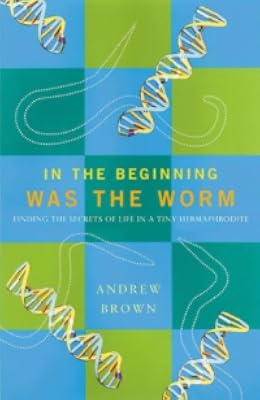
In the Beginning Was the Worm: Finding the Secrets of Life in a Tiny Hermaphrodite
by Andrew Brown 
On This Page
Description
"This is a story where the science starts with toothpicks, and ends with supercomputers: yet at the end of it, we still don't properly understand the most studied animal on Earth. Ever since Descartes, scientists have believed that animals are really complicated machines. The worm, so simple that it has no brain and every cell in its body can be counted and traced, is as basic as an animal can be. Uncountable trillions of them have been sliced, poisoned, centrifuged and frozen in fulfillment show more of the dream of understanding them as if they were made from tiny Meccano sets. The transparent worm has become a lens through which the whole of biology can be studied. Yet complete understanding constantly recedes. 'When we understand the worm, we will understand life, ' says John Sulston. Along with Horvitz he discovered the phenomenon of programmed cell death in the worm, which is essential to the way all animals grow; and Horvitz later showed that the genes which led to cell death in the worm did the same in humans." "In the Beginning Was the Worm is not just an account of the study of one small organism. It also explains why scientists believe that genes will make sense of all their understandings of biology, and how much work will be needed before that dream comes true."--Jacket. show lessTags
Recommendations




Member Reviews
I have been following (from afar) the C. Elegans story for about thirty years. Once I was even motivated enough to try to isolate the worm from some soil so I could play around with it for myself. The attempt failed--I don't know why--but I never lost my vicarious interest in it. This is the first book that I've read that covers the story in a "behind the scenes" way, and I was glad to see it published.
The worm now, is of course, one of the best understood multicellular organisms in all of biology. How it came to be a model organism rivaling the mouse, the fruit fly, and man is an interesting lesson in how science at its best really works. It was a man, Sydney Brenner, with a plan to pick just the right organism that could be used to show more attack some of the fundamental questions of genetics, development and embryogenesis. The selection of this organism took several years of hard work. It is remarkable that during this start-up of the project, the funding organization, the MRC, supported the work without complaint, even though it was something like five years before publications began to roll out.
The book is written for a general audience, though there is lots here of interest to those who are more acquainted with biology too. The politics and personalities of the effort, now almost fifty years on, are covered in quite a bit of depth and some of it is pretty entertaining. The technical aspects of the research is also explained in enough detail that the reader can follow it pretty easily, though there are a few challenging rough spots too.
This is quite a tale of heroic science getting done with a conviction that unselfish, cooperative, non-commercial, basic research is not only worthwhile, but can be a lot of fun. And these guys clearly had a lot of fun. I think that one of the main reasons, pointed out by the author, was that the researchers were crammed in together with perhaps only a meter of bench space, and often not even a desk, had a lot to do with it. No closed doors, no power point, and no email probably had a lot to do with it too.
The book could have been better organized--the jumping around in time (what decade was this?) sometimes was bothersome to me. The portraits of the scientists were nice to see, but I'd have appreciated some drawings of the worm too. Pictures of the laboratory would have been instructive, I think.
Brown has done a quite respectable job with this book, and I think it is quite worth reading if you have any interest at all in biology or the history of science. The effort described will serve to confound the deconstructionists, mystics and other quacks of the academy for a long time to come. show less
The worm now, is of course, one of the best understood multicellular organisms in all of biology. How it came to be a model organism rivaling the mouse, the fruit fly, and man is an interesting lesson in how science at its best really works. It was a man, Sydney Brenner, with a plan to pick just the right organism that could be used to show more attack some of the fundamental questions of genetics, development and embryogenesis. The selection of this organism took several years of hard work. It is remarkable that during this start-up of the project, the funding organization, the MRC, supported the work without complaint, even though it was something like five years before publications began to roll out.
The book is written for a general audience, though there is lots here of interest to those who are more acquainted with biology too. The politics and personalities of the effort, now almost fifty years on, are covered in quite a bit of depth and some of it is pretty entertaining. The technical aspects of the research is also explained in enough detail that the reader can follow it pretty easily, though there are a few challenging rough spots too.
This is quite a tale of heroic science getting done with a conviction that unselfish, cooperative, non-commercial, basic research is not only worthwhile, but can be a lot of fun. And these guys clearly had a lot of fun. I think that one of the main reasons, pointed out by the author, was that the researchers were crammed in together with perhaps only a meter of bench space, and often not even a desk, had a lot to do with it. No closed doors, no power point, and no email probably had a lot to do with it too.
The book could have been better organized--the jumping around in time (what decade was this?) sometimes was bothersome to me. The portraits of the scientists were nice to see, but I'd have appreciated some drawings of the worm too. Pictures of the laboratory would have been instructive, I think.
Brown has done a quite respectable job with this book, and I think it is quite worth reading if you have any interest at all in biology or the history of science. The effort described will serve to confound the deconstructionists, mystics and other quacks of the academy for a long time to come. show less
Anyone who reads modern biology soon learns that C. elegans is a major player, but I've never known why it was chosen as a model organism, or what was learned from it. It was for this reason that I picked up this book.
It's not perfect, a little too simple-minded, but it does a good job of explaining the stories behind why the worm was chosen and who worked on it, and an OK job of explaining the science learned along the way.
If one wants to learn something about so obscure a subject, one generally doesn't have much choice; we're lucky the one book on this subject is not bad.
It's not perfect, a little too simple-minded, but it does a good job of explaining the stories behind why the worm was chosen and who worked on it, and an OK job of explaining the science learned along the way.
If one wants to learn something about so obscure a subject, one generally doesn't have much choice; we're lucky the one book on this subject is not bad.
Ratings
Members
- Recently Added By
Author Information

6+ Works 341 Members
Andrew Brown is a journalist who writes extensively for the Guardian, the Independent, and the Daily Mail
Andrew Brown is a LibraryThing Author, an author who lists their personal library on LibraryThing.
Awards and Honors
Awards
Classifications
Statistics
- Members
- 70
- Popularity
- 447,574
- Reviews
- 2
- Rating
- (3.71)
- Languages
- English
- Media
- Paper
- ISBNs
- 4