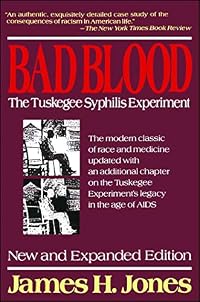
Bad Blood: The Tuskegee Syphilis Experiment, New and Expanded Edition
by James H. Jones
On This Page
Description
The modern classic of race and medicine updated with an additional chapter on the Tuskegee experiment's legacy in the age of AIDS.Tags
Recommendations





























Member Reviews
What a terrible story!! I don't mean terrible in the sense that the book was bad but in the sense that I can't believe this actually happened. For 40 years black men with syphilis in Alabama were a part of an experiment in which they were seen by doctors but not treated for their disease, even after penicillin became widely available as a treatment for syphilis. The worst part of the entire thing: no one ever told these men that they had the disease; they thought they were being monitored because they had "bad blood."
The requisite stuff: would I recommend it? Yes, definitely. Who should read it? Well, personally I think anyone with a conscience, but it is at times very difficult going reading wise. It is a history, not only of the show more experiment at Tuskeegee, but the author sets it all up with a history of the disease & of the Public Health Service, and most interestingly, a history of medical care for African-Americans going back to slavery days. So it may not be everyone's cup of tea.
This would have been outrageous on a basic scale if the originators of this experiment were working alone, but as the author shows, it seems that the work was well known in medical circles. The work was documented over the 40-year period in medical journals, discussed at medical conferences and was not simply the product of the Public Health Service but had the backing of Tuskegee Institute (and you have to ask yourself WHY?, especially during the 1950s and 1960s when Alabama was a hot spot in the civil rights movement), the Veteran's Hospital, multiple medical practitioners (both African-American and White) throughout the state who signed death certficates and let the principals know when a certain subject was hospitalized or died, and the list goes on and on. The author also discusses the "ethical" question and shows clearly that beginning in the 1930s, physicians covered each other & basically made up their own ethics as they went along. Even after it was discovered that Nazi scientists were doing human experimentation at the concentration camps, and after the Trials at Nuremberg when human experimentation was brought into public view, the scientists conducting the Tuskegee experiment didn't have any qualms about continuing the project. Alabama passed several laws requiring the reporting of infectious disease and still somehow through all of the revisions of these laws, the Tuskegee people were not held accountable nor were they required to follow the law.
I would have to add that this study was completely racist: some of the justifications given in the course of the study just floored me. For example, on page 23, the author notes that physicians realized that it would be only natural for African-Americans to have the highest incidence of syphilis since "personal restraints on self-indulgence did not exist...the smaller brain of the Negro had failed to develop a center for inhibiting sexual behavior," and on 24, "the Negro man will not abstain from sexual intercourse if thre is the opportunity for indulgence." On page 48, re the white image of black sexuality: "Blacks suffered from venereal diseases because they would not, or could not, refrain from sexual promiscuity." One further justification for the experiment was as a comparison between untreated syphillis in African-American people and untreated syphilis in Whites; there had been some sort of experiment done prior to this in Norway with white people.
I could go on and on, but suffice it to say that I was totally outraged after reading this book. And I think that is a good thing.
If you want to add another chapter to your knowledge of African-American history, PICK UP THIS BOOK! show less
The requisite stuff: would I recommend it? Yes, definitely. Who should read it? Well, personally I think anyone with a conscience, but it is at times very difficult going reading wise. It is a history, not only of the show more experiment at Tuskeegee, but the author sets it all up with a history of the disease & of the Public Health Service, and most interestingly, a history of medical care for African-Americans going back to slavery days. So it may not be everyone's cup of tea.
This would have been outrageous on a basic scale if the originators of this experiment were working alone, but as the author shows, it seems that the work was well known in medical circles. The work was documented over the 40-year period in medical journals, discussed at medical conferences and was not simply the product of the Public Health Service but had the backing of Tuskegee Institute (and you have to ask yourself WHY?, especially during the 1950s and 1960s when Alabama was a hot spot in the civil rights movement), the Veteran's Hospital, multiple medical practitioners (both African-American and White) throughout the state who signed death certficates and let the principals know when a certain subject was hospitalized or died, and the list goes on and on. The author also discusses the "ethical" question and shows clearly that beginning in the 1930s, physicians covered each other & basically made up their own ethics as they went along. Even after it was discovered that Nazi scientists were doing human experimentation at the concentration camps, and after the Trials at Nuremberg when human experimentation was brought into public view, the scientists conducting the Tuskegee experiment didn't have any qualms about continuing the project. Alabama passed several laws requiring the reporting of infectious disease and still somehow through all of the revisions of these laws, the Tuskegee people were not held accountable nor were they required to follow the law.
I would have to add that this study was completely racist: some of the justifications given in the course of the study just floored me. For example, on page 23, the author notes that physicians realized that it would be only natural for African-Americans to have the highest incidence of syphilis since "personal restraints on self-indulgence did not exist...the smaller brain of the Negro had failed to develop a center for inhibiting sexual behavior," and on 24, "the Negro man will not abstain from sexual intercourse if thre is the opportunity for indulgence." On page 48, re the white image of black sexuality: "Blacks suffered from venereal diseases because they would not, or could not, refrain from sexual promiscuity." One further justification for the experiment was as a comparison between untreated syphillis in African-American people and untreated syphilis in Whites; there had been some sort of experiment done prior to this in Norway with white people.
I could go on and on, but suffice it to say that I was totally outraged after reading this book. And I think that is a good thing.
If you want to add another chapter to your knowledge of African-American history, PICK UP THIS BOOK! show less
1 star short of the perfect score, because I missed more direct accounts (interviews with the victims of the Tuskegee experiment)
Ratings
Members
- Recently Added By
Lists

Best Medical Nonfiction
79 works; 29 members

So you want to get into medicine
29 works; 6 members
Author Information

9 Works 553 Members
Awards and Honors
Distinctions
Common Knowledge
- Original publication date
- 1981
- Important places
- Alabama, USA; Macon County, Alabama, USA; Tuskegee, Alabama, USA
Classifications
Statistics
- Members
- 384
- Popularity
- 80,861
- Reviews
- 3
- Rating
- (3.78)
- Languages
- English
- Media
- Paper
- ISBNs
- 5
- ASINs
- 2