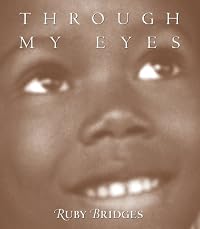
Through My Eyes
by Ruby Bridges
On This Page
Description
Ruby Bridges recounts the story of her involvement, as a six-year-old, in the integration of her school in New Orleans in 1960.Tags
Recommendations


Member Reviews
This short book chronicles the hardships of school integration from the point of view of Ruby Bridges, the only black child to attend first grade at William Frantz public elementary school as a six-year-old in New Orleans in 1960. Told from Ruby's point of view, with the insights of adulthood, the book is also filled with quotes from other people involved in this story including her teacher and parents. The black and white photographs are powerful.
People surrounded the school in protest throughout the year. Teens chanted "Two, four, six, eight, we don't want to integrate. Eight, six, four, two, we don't want a chigeroo." White parents pulled their children from the school and at one point only three white children attended Frantz, show more which normally taught 576 pupils. Ruby wound up being the only child in her classroom for the entire school year and actually didn't know there were any other students for most of the year.
There are so many other details and small background stories, but I don't want to ruin the impact of this book. Just read it. I was angry, sad and proud all at the same time. What a courageous, amazing child/woman. I cried. I am crying again as I write this. And I cannot believe that F-ing racism still exists. show less
People surrounded the school in protest throughout the year. Teens chanted "Two, four, six, eight, we don't want to integrate. Eight, six, four, two, we don't want a chigeroo." White parents pulled their children from the school and at one point only three white children attended Frantz, show more which normally taught 576 pupils. Ruby wound up being the only child in her classroom for the entire school year and actually didn't know there were any other students for most of the year.
There are so many other details and small background stories, but I don't want to ruin the impact of this book. Just read it. I was angry, sad and proud all at the same time. What a courageous, amazing child/woman. I cried. I am crying again as I write this. And I cannot believe that F-ing racism still exists. show less
On November 14, 1960, a tiny six-year-old black child, surrounded by federal marshals, walked through a mob of screaming segregationists and into her school. From where she sat in the office, Ruby Bridges could see parents marching through the halls and taking their children out of classrooms. The next day, Ruby walked through the angry mob once again and into a school where she saw no other students. The white children did not go to school that day, and they wouldn't go to school for many days to come. Surrounded by racial turmoil, Ruby, the only student in a classroom with one wonderful teacher, learned to read and add.
This is the story of a pivotal event in history as Ruby Bridges saw it unfold around her. Ruby's poignant words, show more quotations from writers and from other adults who observed her, and dramatic photographs recreate an amazing story of innocence, courage, and forgiveness. Ruby Bridges' story is an inspiration to us all. show less
This is the story of a pivotal event in history as Ruby Bridges saw it unfold around her. Ruby's poignant words, show more quotations from writers and from other adults who observed her, and dramatic photographs recreate an amazing story of innocence, courage, and forgiveness. Ruby Bridges' story is an inspiration to us all. show less
At the young age of six years old, Ruby Bridges was the lone black child who entered elementary school in Lousiana. This was 1960 and an age of extreme racism. White parents refused to allow their child to go to school with a black student. The government employees who were hired to escort Ruby felt sad for her.
In this book, she credits her wonderful teacher who taught her as a lone person in the class room. Ruby did not go out on the playground. Originally her teacher had lunch with other teachers, but soon did not think it right for Ruby to be alone and lonely.
In the later chapters, Ruby mentioned that her parents marriage did not survive this experience. They argued regarding the safety of Ruby and her emotional development.
Well show more worth the read. A very brave little girl entered that building wearing her shined patent shoes. Her white dress was crisply ironed. Reading this book, the reader cannot help but admire the brave little girl who held her head high and walked through a group who called her a "little N. I hate the word that begins with N. To think that grown women harrassed an innocent girl makes me sick.
Four Stars!!! show less
In this book, she credits her wonderful teacher who taught her as a lone person in the class room. Ruby did not go out on the playground. Originally her teacher had lunch with other teachers, but soon did not think it right for Ruby to be alone and lonely.
In the later chapters, Ruby mentioned that her parents marriage did not survive this experience. They argued regarding the safety of Ruby and her emotional development.
Well show more worth the read. A very brave little girl entered that building wearing her shined patent shoes. Her white dress was crisply ironed. Reading this book, the reader cannot help but admire the brave little girl who held her head high and walked through a group who called her a "little N. I hate the word that begins with N. To think that grown women harrassed an innocent girl makes me sick.
Four Stars!!! show less
Through My Eyes, the self-told story of Ruby Bridges, is a masterpiece of composition and assembly. More, even, than just the moving story of the little girl who integrated the first school in New Orleans, it is a collage of a book including relevant and affecting photographs which articulate better than words the violent rage of the white population of the city with regard to the particular events of 1960. As Ruby tells us her story from the perspective of the innocent child, we simultaneously view the scenes of the angry mobs, the signs, the Ku Klux Klan--all of it. Also,on almost every other page in the book there are Quotes from Ruby's mother, teacher, and psychiatrist,relating their own perspectives of the situation, and newspaper show more and magazine quotes of the day. The combination of first hand story, photographs, comments from those who knew Ruby, and snippets of what was being printed in newspapers and magazines serves to offer a rounded story, with a multifaceted, believable perspective. The photographs and quotes also correspond in some way with what Ruby is describing. On page 20-21, Ruby is describing leaving from school the first day, and how she did know understand what all of the chanting meant. She was protected to some degree, as only residents were allowed on her block at that time, and she remembers her father calling her "brave," but does not seem to completely appreciate what she has been through. But on the opposite page we are given a chilling crowd photo in which people are standing there holding signs, and a coffin. Ruby says that a coffin was the only thing that made her afraid, but the reader appreciates the full reality when viewing it. One little girl is standing there holding a cross as tall as herself with a strange smile on her face. The inserted bit of interview with Barbara Henry, Ruby's teacher, describes just how scary those days were, from the perspective of an adult. All of the elements of this text work together to tell a compelling story, one which may haunt the reader for quite some time.This is a great historical text which would work for middle school and older. show less
This is an outstanding book that portrays the harsh realities of Ruby Bridges as she traversed the difficult path of integration. The photos depict the ugly scenes of humanity that felt it was okay to threaten a small child. The text magnificently describes the experiences, naivety of childhood, and reality of this time in civil rights. A must read.
I love this book! It shows a child's perspective of a hugely dangerous and complicated adult world. So much of what she wasn't understanding seemed to be because she wasn't full of hate and hadn't experienced it the way it really was out there in the world. The story of a child making history and beginning the steps to changing the world yet, just wanting friends and to go to school. The perspective of a brave child in a viscious adult world.
For intermediate readers. This book is the story of Ruby Bridges, one of the first African Americans to be integrated into an all white school in New Orleans. It shows her struggles, friendships, and her thoughts during the whole process. This book is a great window and mirror for children. It can help children to develop empathy and compassion towards others. The story is told by Ruby Bridges herself, making it very touching and authentic.
Members
- Recently Added By
Author Information

All Editions
Some Editions
Awards and Honors
Awards
Distinctions
Notable Lists
Common Knowledge
- Original publication date
- 1999
- People/Characters
- Ruby Bridges
- Important places
- New Orleans, Louisiana, USA; Louisiana, USA
- Important events
- African-American Civil Rights Movement; Brown v. Board of Education (1954)
- First words
- When I was six years old, the civil rights movement came knocking at the door.
- Original language
- English
Classifications
Statistics
- Members
- 2,390
- Popularity
- 8,137
- Reviews
- 134
- Rating
- (4.52)
- Languages
- English
- Media
- Paper, Audiobook, Ebook
- ISBNs
- 9
- ASINs
- 6