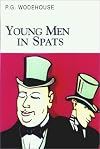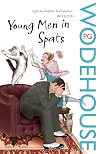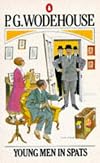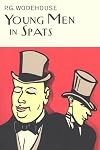
On This Page
Description
From the author whom the Times called "a comic genius" and "an old master of farce" come eleven further stories featuring such eccentric characters as Freddie Widgeon, Cyril (Barmy) Fotheringay Phipps, Percy Wimbolt, and Pongo. This collection includes the stories "Fate," "Tried in the Furnace," "Trouble Down at Tudsleigh," "The Amazing Hat Mystery," "Goodbye to All Cats," "The Luck of the Stiffhams," "Noblesse Oblige," "Uncle Fred Flits By," "Archibald and the Masses," "The Code of the show more Mulliners," and "The Fiery Wooing of Mordred.". show lessTags
Recommendations















Member Reviews
Wodehouse, P. G. Young Men in Spats. 1935. Norton, 2013.
Sentence by sentence, P. G. Wodehouse is the wittiest of writers. In Young Men in Spats, he creates a fantasy upper-class England that blends seamlessly with an equally fantasy Damon Runyon America. Consider this bit of dialogue between Drones Club member Freddie Widgeon (the names say it all) and an inebriated woman talking about her husband, a palooka who “[s]lice him where you like is still baloney.” Hearing her sad tale, Freddie comments:
“I never herd anything so dashed monstrous in my life. May I pat your hand?”
“You bet your lavender spats you many pat my hand.”
“I will,” said Freddie, and did so.
Most of the stories in this collection feature the fatuous members show more of the Drones Club, whose personalities or lack thereof are epitomized in the descriptors “crumpets, beans, and eggs.” A few are set at a bar called the Angler’s Rest, where the widely traveled Mr. Mulliner, whose auditors are referred to only by their drinks (Small Bass, Pint of Bitter). The best of the stories is “Uncle Fred Flits By,” a Drone’s Club tale that introduces Pongo Twistleton’s Uncle Fred, an old earl who comes to town once or twice a year to spread “sweetness and light,” by which he means, meddle in someone’s romance and get his dependent nephew in trouble. Wodehouse was at the top of his form in the 1930s, and these stories are as funny as ever. show less
Sentence by sentence, P. G. Wodehouse is the wittiest of writers. In Young Men in Spats, he creates a fantasy upper-class England that blends seamlessly with an equally fantasy Damon Runyon America. Consider this bit of dialogue between Drones Club member Freddie Widgeon (the names say it all) and an inebriated woman talking about her husband, a palooka who “[s]lice him where you like is still baloney.” Hearing her sad tale, Freddie comments:
“I never herd anything so dashed monstrous in my life. May I pat your hand?”
“You bet your lavender spats you many pat my hand.”
“I will,” said Freddie, and did so.
Most of the stories in this collection feature the fatuous members show more of the Drones Club, whose personalities or lack thereof are epitomized in the descriptors “crumpets, beans, and eggs.” A few are set at a bar called the Angler’s Rest, where the widely traveled Mr. Mulliner, whose auditors are referred to only by their drinks (Small Bass, Pint of Bitter). The best of the stories is “Uncle Fred Flits By,” a Drone’s Club tale that introduces Pongo Twistleton’s Uncle Fred, an old earl who comes to town once or twice a year to spread “sweetness and light,” by which he means, meddle in someone’s romance and get his dependent nephew in trouble. Wodehouse was at the top of his form in the 1930s, and these stories are as funny as ever. show less
Not a bad collection of Wodehouse stories, but it would be easily forgettable if not for the brilliant “Uncle Fred Flits By”. Unlike almost all of Wodehouse’s protagonists, Uncle Fred is an instigator. He does not cower at nonsensical threats, or suffer to be lead by the nose from one farcical engagement to another. He charges head-first into trouble, and gleefully emerges unscathed at the other end. This story is an entire screwball comedy condensed into a few short pages, and Wodehouse manages to execute it without a single loose end. So much of English humor, Waugh and Wodehouse included, comes from the protagonists (often weak-willed and colorless young men) finding themselves in hot water. This can be frustrating to those show more accustomed to American-style humor, in which the protagonist is far more active and tends to lead his enemies around by the nose. Daffy Duck is a British protagonist; Bugs Bunny is American. I only wish Uncle Fred had been more widely featured—after a while one longs for someone to put Constance Keeble, or Aunt Agatha, in their places! show less
Note: The contents of the US and UK collections with this title differ quite significantly (as is the case for most Wodehouse story collections): this review relates only to the UK version.
One of Wodehouse's finest collections of short stories, including the one many people (me included!) cite as their favourite, the immortal "Uncle Fred flits by", which first introduced Lord Ickenham, later to appear as central character in several novels. As a senior mischief-maker already in possession of wife, title and fortune, he provides an interesting contrast from the usual Wodehouse plot in which a young man tries to win the girl of his dreams. We get quite a few of those in this collection, but mostly in the "tall tales" framework allowed by show more the Mulliner and Egg/Bean/Crumpet formulae. "Goodbye to all cats" and "The fiery wooing of Mordred" give us two of Wodehouse's funniest country-house weekends; "Trouble down at Tudsleigh" sends up the poetic enthusiasms of Wodehouse's youth; "The amazing hat mystery" successfully plays the very difficult literary trick of presenting a childishly simple story as though it is fearsomely complicated; and "Tried in the furnace" delivers in a couple of pages the most gloriously awful parish outing you could wish for. Needless to say, as this is Wodehouse in the 1930s, there is linguistic treasure on practically every page. show less
One of Wodehouse's finest collections of short stories, including the one many people (me included!) cite as their favourite, the immortal "Uncle Fred flits by", which first introduced Lord Ickenham, later to appear as central character in several novels. As a senior mischief-maker already in possession of wife, title and fortune, he provides an interesting contrast from the usual Wodehouse plot in which a young man tries to win the girl of his dreams. We get quite a few of those in this collection, but mostly in the "tall tales" framework allowed by show more the Mulliner and Egg/Bean/Crumpet formulae. "Goodbye to all cats" and "The fiery wooing of Mordred" give us two of Wodehouse's funniest country-house weekends; "Trouble down at Tudsleigh" sends up the poetic enthusiasms of Wodehouse's youth; "The amazing hat mystery" successfully plays the very difficult literary trick of presenting a childishly simple story as though it is fearsomely complicated; and "Tried in the furnace" delivers in a couple of pages the most gloriously awful parish outing you could wish for. Needless to say, as this is Wodehouse in the 1930s, there is linguistic treasure on practically every page. show less
Some familiar and some less-recognized stories as told by the denizens of The Drones Club and Angler's Rest. Some characters are known by their preferred drink. All the usual good-natured bumblers are involved in the usual misunderstandings, mix-ups and confusion, resulting in several broken engagements. Love is sealed amid arson in one case. The humor is clever and abundant.
Stories of young men and women and the travails of love and romance. A man in love instructs his butler to carve his love object's initials into trees in the park with a heart drawn around them, and that's just a throwaway line in one story.
P. G. Wodehouse is a welcome balm anytime, but especially in troubling times.
Stories of young men and women and the travails of love and romance. A man in love instructs his butler to carve his love object's initials into trees in the park with a heart drawn around them, and that's just a throwaway line in one story.
P. G. Wodehouse is a welcome balm anytime, but especially in troubling times.
I tend to find P. G. Wodehouse’s short story collections a bit hit and miss. This one’s a sure hit. Would’ve rated it five stars but the Mr Mulliner stories, like in other collections, didn’t quite reach the spot.
The one Uncle Fred story and the several that follow Freddie Widgeon are among the author’s finest compositions. This is light fiction that induces heavy laughter.
A dashed good read, what?
The one Uncle Fred story and the several that follow Freddie Widgeon are among the author’s finest compositions. This is light fiction that induces heavy laughter.
A dashed good read, what?
The reader must be warned before reading Wodehouse, ANY Wodehouse. The reader should not be in area where out burst of laughter are frowned upon and the reader should be careful as to what they are doing while reading. For example: I would not attempt to eat, operate electrical or mechanical equipment, or shave while reading. It would be best to find a comfortable chair, sit down and prepare to enjoy one of the greatest writers of the 20th century.
A collection of short stories featuring the romantic misadventures of various young men of the Drones Club (or, in several cases, the Angler's Rest). It's all pretty typical Wodehouse: it's frothy and silly, all the stories feel much the same, and ten minutes later it's hard to remember the details of any of them. But while you're reading them, it's impossible to keep the smile off your face.
Good old Wodehouse. Always such a reliable way to combat the dreaded book slump.
Good old Wodehouse. Always such a reliable way to combat the dreaded book slump.
Members
- Recently Added By
Lists

Books Read in 2015
3,299 works; 126 members
Author Information

657+ Works 111,068 Members
P. G. Wodehouse was born in Guildford, United Kingdom on October 15, 1881. After completing school, he spent two years as a banker at the Hong Kong and Shanghai Bank in London and then took a job as a sports reporter and columnist for the Globe newspaper. His first novel, The Pothunters, was published in 1902. He wrote over 100 novels and short show more story collections during his lifetime including A Perfect Uncle, Love Among the Chickens, The Swoop, P. Smith in the City, Meet Mr. Milliner, Doctor Sally, Quick Service, The Old Reliable, Uneasy Money, A Damsel in Distress, Jill the Reckless, The Adventures of Sally, A Pelican at Blandings, The Girl in Blue, and Aunts Aren't Gentlemen. His most famous characters, Bertie Wooster and his manservant, Jeeves, appeared in books such as Much Obliged, Jeeves. He also wrote lyrics for musical comedies and worked as screenwriter in Hollywood in the 1930s. In 1939, he bought a villa in Le Touquet on the coast of France. He remained there when World War II started in 1939. The following year, the Germans appropriated the villa, confiscated property, and arrested him. He was detained in various German camps for almost one year before being released in 1941. He went to Berlin and spoke of his experience in five radio talks to be broadcast to America and England. The talks themselves were completely innocuous, but he was charged with treason in England. He was cleared, but settled permanently in the United States. He became a citizen in 1955. He was made a Knight Commander of the Order of the British Empire in 1975. He died from a heart attack after a long illness on February 14, 1975 at the age of 93. (Bowker Author Biography) show less
Some Editions
Series

Belongs to Publisher Series
Work Relationships
Is contained in
Common Knowledge
- Canonical title
- Young Men in Spats
- Original title
- Young Men in Spats
- Original publication date
- 1931-1935; 1936: Collection
- People/Characters
- Freddie Widgeon; Pongo Twistleton; Mr Mulliner; Barmy Fotheringay-Phipps; Percy Wimbolt; Nelson Cork (show all 9); Frederick Altamont Cornwallis Twistleton (5th Earl of Ickenham); Archibald Mulliner; Aurelia Cammarleigh
- Important places
- London, England, UK
- First words
- It was the hour of the morning snifter, and a little group of Eggs and Beans and Crumpets had assembled in the smoking-room of the Drones Club to do a bit of inhaling.
- Original language
- English
Classifications
Statistics
- Members
- 857
- Popularity
- 32,024
- Reviews
- 24
- Rating
- (4.14)
- Languages
- English, French, Italian, Spanish
- Media
- Paper, Audiobook, Ebook
- ISBNs
- 24
- ASINs
- 18