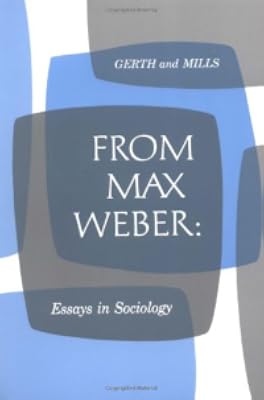
From Max Weber: Essays in Sociology
by Hans H. Gerth (Editor), C. Wright Mills (Editor), Max Weber
International Library of Sociology and Social Reconstruction
On This Page
Description
Max Weber (1864-1920) was one of the most prolific and influential sociologists of the twentieth century. This classic collection draws together his key papers. This edition contains a new preface by Professor Bryan S. Turner.Tags
Recommendations



















Member Reviews
An important selection of Weber's work.
Members
- Recently Added By
Lists

Shaykh Hamza's Book Recommendations
439 works; 3 members

Books in the Bibliography of The Dawn of Everything by Graeber & Wengrow
478 works; 2 members

In Our Time books
4,934 works; 2 members

Books Cited in Blueprint by Nicholas Christakis
261 works; 1 member
Author Information


C. Wright Mills, an American sociologist, was one of the most controversial social scientists of the mid-twentieth century. He considered himself a rebel against both the academic establishment and American society in general, and he rarely tried to separate his radical ideas from his teaching and writing. Irving Louis Horowitz summarized much of show more Mills's ideas in the subtitle of his biography of him: An American Utopian. Mill's most traditional sociological study is The Puerto Rican Journey. His most direct attack on his colleagues in sociology is The Sociological Imagination (1959) (which he found left much to be desired). His most ideological work is The Power Elite (1956), an attempt to explain the overall power structure of the United States. Mills thought that the dominant "value-free" methodology of American sociology was an ideological mask, hiding values that he did not share. According to his younger colleague Immanuel Wallerstein, Mills was essentially a utopian reformer who thought that knowledge properly used could bring about a better society. (Bowker Author Biography) show less

342+ Works 11,402 Members
Max Weber, a German political economist, legal historian, and sociologist, had an impact on the social sciences that is difficult to overestimate. According to a widely held view, he was the founder of the modern way of conceptualizing society and thus the modern social sciences. His major interest was the process of rationalization, which show more characterizes Western civilization---what he called the "demystification of the world." This interest led him to examine the three types of domination or authority that characterize hierarchical relationships: charismatic, traditional, and legal. It also led him to the study of bureaucracy; all of the world's major religions; and capitalism, which he viewed as a productof the Protestant ethic. With his contemporary, the French sociologist Emile Durkheim---they seem not to have known each other's work---he created modern sociology. (Bowker Author Biography) show less
Series

Belongs to Publisher Series
Work Relationships
Common Knowledge
- People/Characters
- Max Weber
Classifications
Statistics
- Members
- 1,002
- Popularity
- 26,204
- Reviews
- 1
- Rating
- (3.89)
- Languages
- English, German, Turkish
- Media
- Paper, Ebook
- ISBNs
- 22
- ASINs
- 30