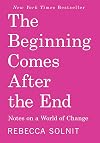
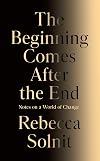
The Beginning Comes After the End: Notes on a World of Change
by Rebecca Solnit
On This Page
Description
Rebecca Solnit offers a thrilling account of the sheer breadth and scale of social, political, scientific, and cultural change over the past three quarters of a century. In this sequel to her enduring bestseller Hope in the Dark, Solnit surveys a world that has changed dramatically since the year 1960. Despite the forces seeking to turn back the clock on history, change is not a possibility; it is an inevitability. The changes amount to nothing less than dismantling an old civilization and show more building a new one, whose newness is often the return of the old ways and wisdoms. In this rising worldview, interconnection is a core idea and value. But because the transformation is obscured within a longer arc of history, its scale is seldom recognized. While the white nationalist and authoritarian backlash drives individualism and isolation, this new world embraces antiracism, feminism, a more expansive understanding of gender, environmental thinking, scientific breakthroughs, and Indigenous and non-Western ideas, pointing toward a more interconnected, relational world. show lessTags
Recommendations




































Member Reviews
Rating: 4* of five
The Publisher Says: Rebecca Solnit offers a thrilling survey of the sheer breadth and scale of social, political, scientific, and cultural change over the past three quarters of a century.
In this sequel to her enduring bestseller Hope in the Dark, Solnit surveys a world that has changed dramatically since the year 1960. She argues that, despite the forces seeking to turn back the clock on history, change is not a possibility, it is an inevitability, and the nature of that change is determined by who participates and how.
The changes amount to nothing less than dismantling an old civilization and building a new one, whose newness is often the return of the old ways and wisdoms. In this rising worldview, interconnection show more is a core idea and value. But because the transformation has happened in so many disparate arenas, and within a longer arc of history, the scale of that change is seldom recognized.
While the backlash of white nationalist authoritarianism, Manosphere misogyny, and justifications for callousness, selfishness, economic inequality, and environmental destruction collectively drive individualism and isolation, the elements of this new world are related in their vision of more inclusion, equality, interconnection. This new vision embraces antiracism, feminism, a more expansive understanding of gender, environmental thinking, and indigenous and non-Western ideas, particularly Buddhism, as well as breakthroughs in the life sciences and neuroscience, pointing toward a more interconnected, relational world.
I RECEIVED A DRC FROM THE PUBLISHER VIA EDELWEISS+. THANK YOU.
My Review: Collections often draw from existing bodies of work. Author Solnit began drawing acclaim for her robust, tendentious writing in the early Aughts, and has never fallen out of the cultural conversation. She won't stop telling the truth, though, so her honesty wins her detractors and even enemies across the political spectrum.
One knows a thinker is doing it right when everybody is mad at them for something.
This essay collection breaks no new ground in her public thinking. It is, if I'm honest, a highlight reel with a bit more sameness than I wanted to read. It is also a collection drawn from decades of work. I found myself thinking, "I remember this, move on," and finding it necessary to recall in the moment that it's collected not commissioned to be written anew or afresh. Not every essay chosen was necessarily up to the highest standards in the book. Again, it's a function of a collection...it's not possible to be perfect, but it's possible, like Author Solnit, to be trenchant and to add value to the consideration of organizing theme of this particular project.
Progress is relative. In any consideration of the societal norms prevailing now that has even a modest degree of perspective, things are hugely better for women, queers, trans folk, and people of color. We're always being bombarded with messaging to the contrary, for reasons y'all need to read Paul Linebarger's book to really connect with. A collection of work like this one is a good corrective to the easy-to-internalize message of the world sucks always has always will. It's true; it's also wrong; both these things can and do coexist because, faithless to your entire life's training, almost nothing in the observable universe is a binary. All physical systems are spectrums and there's mounting evidence literally everything is in fact spectrum...look into quantum physics and certainty vanishes to be replaced by probabilities (aka spectra). Author Solnit stressing that each ending is also a beginning is very much in line with this mode of thinking.
It's new enough to most of her audience that repetition is probably a good idea to deploy in examining the topic. Like any new-to-you theory, perspective, or fact, it's going to need some hammering home to become part of one's mental structural supports. I'm ahead of this curve so it wore on my nerve a bit more than it will for others. I hope you'll pick it up and give it a try if you're sinking under the wight of the world's idiocies and evils.
We need the perspective of one who has been decades in the trenches, struggling against the dying order's loud and lousy distractions, to remind us we've come far. We need to keep moving ahead. It's easier to find the will to do that if we've got a stedy hand and an encouraging voice like Author solnit's telling us to remember it can be done.
Because it has been done. It's not finished, this work; it never really is. Now, get back to it! show less
The Publisher Says: Rebecca Solnit offers a thrilling survey of the sheer breadth and scale of social, political, scientific, and cultural change over the past three quarters of a century.
In this sequel to her enduring bestseller Hope in the Dark, Solnit surveys a world that has changed dramatically since the year 1960. She argues that, despite the forces seeking to turn back the clock on history, change is not a possibility, it is an inevitability, and the nature of that change is determined by who participates and how.
The changes amount to nothing less than dismantling an old civilization and building a new one, whose newness is often the return of the old ways and wisdoms. In this rising worldview, interconnection show more is a core idea and value. But because the transformation has happened in so many disparate arenas, and within a longer arc of history, the scale of that change is seldom recognized.
While the backlash of white nationalist authoritarianism, Manosphere misogyny, and justifications for callousness, selfishness, economic inequality, and environmental destruction collectively drive individualism and isolation, the elements of this new world are related in their vision of more inclusion, equality, interconnection. This new vision embraces antiracism, feminism, a more expansive understanding of gender, environmental thinking, and indigenous and non-Western ideas, particularly Buddhism, as well as breakthroughs in the life sciences and neuroscience, pointing toward a more interconnected, relational world.
I RECEIVED A DRC FROM THE PUBLISHER VIA EDELWEISS+. THANK YOU.
My Review: Collections often draw from existing bodies of work. Author Solnit began drawing acclaim for her robust, tendentious writing in the early Aughts, and has never fallen out of the cultural conversation. She won't stop telling the truth, though, so her honesty wins her detractors and even enemies across the political spectrum.
One knows a thinker is doing it right when everybody is mad at them for something.
This essay collection breaks no new ground in her public thinking. It is, if I'm honest, a highlight reel with a bit more sameness than I wanted to read. It is also a collection drawn from decades of work. I found myself thinking, "I remember this, move on," and finding it necessary to recall in the moment that it's collected not commissioned to be written anew or afresh. Not every essay chosen was necessarily up to the highest standards in the book. Again, it's a function of a collection...it's not possible to be perfect, but it's possible, like Author Solnit, to be trenchant and to add value to the consideration of organizing theme of this particular project.
Progress is relative. In any consideration of the societal norms prevailing now that has even a modest degree of perspective, things are hugely better for women, queers, trans folk, and people of color. We're always being bombarded with messaging to the contrary, for reasons y'all need to read Paul Linebarger's book to really connect with. A collection of work like this one is a good corrective to the easy-to-internalize message of the world sucks always has always will. It's true; it's also wrong; both these things can and do coexist because, faithless to your entire life's training, almost nothing in the observable universe is a binary. All physical systems are spectrums and there's mounting evidence literally everything is in fact spectrum...look into quantum physics and certainty vanishes to be replaced by probabilities (aka spectra). Author Solnit stressing that each ending is also a beginning is very much in line with this mode of thinking.
It's new enough to most of her audience that repetition is probably a good idea to deploy in examining the topic. Like any new-to-you theory, perspective, or fact, it's going to need some hammering home to become part of one's mental structural supports. I'm ahead of this curve so it wore on my nerve a bit more than it will for others. I hope you'll pick it up and give it a try if you're sinking under the wight of the world's idiocies and evils.
We need the perspective of one who has been decades in the trenches, struggling against the dying order's loud and lousy distractions, to remind us we've come far. We need to keep moving ahead. It's easier to find the will to do that if we've got a stedy hand and an encouraging voice like Author solnit's telling us to remember it can be done.
Because it has been done. It's not finished, this work; it never really is. Now, get back to it! show less
My sense of this book: It’s designed to inspire hope in people trying to enact progressive change, leaning especially on historical examples to show that seemingly unyielding conditions can be endured, patiently transformed, and eventually overcome. That’s a broader way of stating the case than Solnit uses, to be fair—she employs a number of analogous and overlapping examples to demonstrate her specific social and political points, but she tends to focus sharply on the small areas of greatest connection. I think the project succeeds, as far as it goes. It is not a book that radically changed how I think about history or political struggle, but it definitely offered a corrective to despair, which is really the point. And there were show more a few eye-opening ideas along the way.
Solnit’s central strength, one which I admire and always find myself drawn to, is broad historical perspective.
At a structural level, the book did sometimes seem a bit squishy. There were moments when it felt vaguely inspirational, more than convincingly hopeful. There were also revelatory moments of insight, though—the notion at the end of the book, for example, that everything is fundamentally a process, rather than an object. “We are not nouns: we are verbs.” For me that’s quite a different way of viewing the world, and though it might seem just pithy, I think it connects to the deeper notion that all things are in flux. Nothing is finished. Not only does that give us some reason to hope for positive change, it also reminds us to stay alert to the ways things can come undone. show less
Solnit’s central strength, one which I admire and always find myself drawn to, is broad historical perspective.
Only in the long view can you see the patterns emerging, the way the present builds on the past, the way past surprises guarantee more surprises are coming, the ingredients of change over years, decades, centuries. If you don’t see time on the scale of change, you don’t see change.It’s a crucial thing to remember, as a defense against the despair that can follow when a threat seems insurmountable.
At a structural level, the book did sometimes seem a bit squishy. There were moments when it felt vaguely inspirational, more than convincingly hopeful. There were also revelatory moments of insight, though—the notion at the end of the book, for example, that everything is fundamentally a process, rather than an object. “We are not nouns: we are verbs.” For me that’s quite a different way of viewing the world, and though it might seem just pithy, I think it connects to the deeper notion that all things are in flux. Nothing is finished. Not only does that give us some reason to hope for positive change, it also reminds us to stay alert to the ways things can come undone. show less
Solnit is a sharp critic, especially of patriarchy, and is trying to write about hope for what comes after: “A butterfly is the end of a caterpillar. The beginning—the next era—comes after the end of the last one, and in between comes a lot of falling apart.” So we take the steps that we see in front of us towards the better world we are trying to imagine. We don’t pay as much attention to the development of renewable energy sources, despite the incredible improvements in them, because they’re taking place slowly and incrementally, which makes for a boring news story. We’re just bad at noticing incremental change: “I remember how the economic policies of Ronald Reagan created mass homelessness, but if you forget that, show more you can imagine homelessness is inevitable or the result of personal failings or local conditions, not primarily a creation of the radical rearrangement of the national economy in pursuit of a return to the old inequality (and similar cuts to social services in other countries produced similar forms of desperation and displacement).” But it’s in the interrelatedness of everything that there’s hope. Indeed, she thinks the right-wing backlash is against so many groups and causes because it’s against acknowledging interconnections. “At some level, the fact of climate change is offensive to isolationists, since the climate is the great overarching system within which all life on earth exists, and climate science and climate activism both announce that everything we do has consequences because everything is connected.” show less
Rebecca Solnit’s latest addition to her shelf is nine quick chapters of thought dump. In The Beginning Comes after The End, Solnit gets to reminisce about her past encounters with environmentalists, native Americans, scientists and leaders who espoused various words of wisdom to her. The result is a disjointed collection of chapters that, if they didn’t make reference to each other, could have been standalone essays. (And maybe they were.)
The book’s title opens a vast opportunity to tell these kinds of stories. I think we all know about the circle of life, the circle being unbroken and what goes around comes around. This book goes no deeper than that. Solnit has a varied and active life, constantly meeting people whose opinions show more matter. So what they told her can be meaningful. But for me, it didn’t really hold together as a book with a beginning, middle and end. I’m not at all sure what readers are meant to take away from it. Nonetheless, there is lots of interesting stuff here.
It opens with a chapter on salmon and how they immediately took to the de-damming of the Klamath River. Then there is a chapter on seeds and the various strategies of plants to get them spread far and wide. There is a chapter on the wisdom of past generations, on the communities built and managed by bees (they are specifically not monarchies), and of course, the excellent co-operation with nature that natives had and which Americans have since destroyed. Everything is connected, everything is alive, and the cycling is endless. There is always a new beginning ahead.
In the chapter called Shadows of the Past, Solnit revisits corporal punishment, which was unexpected. It is a gift from America’s European heritage. Schoolteachers thought nothing of beating students, to death if desired. Catholic schools are surrounded by graveyards of students who displeased them. Two Florida boys sued – and lost – because the Supreme Court ruled this practice was longstanding and accepted in American society and so did not infringe on any of their constitutional rights.
It was also normal for grown men to punch each other in the face to stop arguments, much as Treasury Secretary Scott Bessent gave Elon Musk a black eye at a White House cabinet meeting of Donald Trump’s. Employers could beat employees with no repercussions. This is the greatness voters want to return to. But I digress.
Something I did not know is that most of the country was raised on the 1987 textbook American History: A Survey. It turns out to be pivotal, because its “three well-known historians”, Solnit says: “described the Americas before Columbus as ‘empty of mankind and its works.’ The story of Europeans in the New World, the book explained, ‘is the story of the creation of a civilization where none existed.’” She says that well into the 1980s “white men were still regularly claiming to be the first to set foot in a place, using the language of terra nullius, of no-man’s land, that had justified Europeans’ grabbing land across America.” The erasure of the natives has been firmly and unapologetically institutionalized, the whole time. And Americans have been inculcating their children to it in schools.
In a discussion of the politicizing of everything, Solnit shows various groups that were conscious of the effect of charismatics, who could and do ruin democratically structured organizations, easily and often fatally. About as complex as the book gets is when she explains it as “prefigurative politics”:
“The idea that if you embodied in your actions and relationships the values you sought to establish more broadly, you succeeded at the immediate level, whether or not your campaign was successful. “
And near the end, Solnit quotes author/journalist Anand Giridharadas: “We are living through a revolt against the future. The future will prevail.”
That sums it all up quite succinctly. And keeps it unsatisfying, at least for me.
David Wineberg show less
The book’s title opens a vast opportunity to tell these kinds of stories. I think we all know about the circle of life, the circle being unbroken and what goes around comes around. This book goes no deeper than that. Solnit has a varied and active life, constantly meeting people whose opinions show more matter. So what they told her can be meaningful. But for me, it didn’t really hold together as a book with a beginning, middle and end. I’m not at all sure what readers are meant to take away from it. Nonetheless, there is lots of interesting stuff here.
It opens with a chapter on salmon and how they immediately took to the de-damming of the Klamath River. Then there is a chapter on seeds and the various strategies of plants to get them spread far and wide. There is a chapter on the wisdom of past generations, on the communities built and managed by bees (they are specifically not monarchies), and of course, the excellent co-operation with nature that natives had and which Americans have since destroyed. Everything is connected, everything is alive, and the cycling is endless. There is always a new beginning ahead.
In the chapter called Shadows of the Past, Solnit revisits corporal punishment, which was unexpected. It is a gift from America’s European heritage. Schoolteachers thought nothing of beating students, to death if desired. Catholic schools are surrounded by graveyards of students who displeased them. Two Florida boys sued – and lost – because the Supreme Court ruled this practice was longstanding and accepted in American society and so did not infringe on any of their constitutional rights.
It was also normal for grown men to punch each other in the face to stop arguments, much as Treasury Secretary Scott Bessent gave Elon Musk a black eye at a White House cabinet meeting of Donald Trump’s. Employers could beat employees with no repercussions. This is the greatness voters want to return to. But I digress.
Something I did not know is that most of the country was raised on the 1987 textbook American History: A Survey. It turns out to be pivotal, because its “three well-known historians”, Solnit says: “described the Americas before Columbus as ‘empty of mankind and its works.’ The story of Europeans in the New World, the book explained, ‘is the story of the creation of a civilization where none existed.’” She says that well into the 1980s “white men were still regularly claiming to be the first to set foot in a place, using the language of terra nullius, of no-man’s land, that had justified Europeans’ grabbing land across America.” The erasure of the natives has been firmly and unapologetically institutionalized, the whole time. And Americans have been inculcating their children to it in schools.
In a discussion of the politicizing of everything, Solnit shows various groups that were conscious of the effect of charismatics, who could and do ruin democratically structured organizations, easily and often fatally. About as complex as the book gets is when she explains it as “prefigurative politics”:
“The idea that if you embodied in your actions and relationships the values you sought to establish more broadly, you succeeded at the immediate level, whether or not your campaign was successful. “
And near the end, Solnit quotes author/journalist Anand Giridharadas: “We are living through a revolt against the future. The future will prevail.”
That sums it all up quite succinctly. And keeps it unsatisfying, at least for me.
David Wineberg show less
I didn’t finish this (read about half), as I found it uninteresting, and I was disappointed as I had really enjoyed Solnit’ Orwell’s Roses a couple of years ago.
Jun 5, 2026English (UK)
Ratings
Members
- Recently Added By
Lists

The Wainwright Prizes 2026
24 works; 1 member
Author Information

47+ Works 17,250 Members
Rebecca Solnit writes extensively on photography and landscape. She is a contributing editor to Art Issues and Creative Camera and is the author of three books. She has contributed essays to several museum catalogues including Crimes and Splendors: The Desert Cantos of Richard Misrach and the Whitney Museum's Beat Culture and the New America. She show more was a 1993 recipient of a National Endowment for the Arts Fellowship. (Bowker Author Biography) show less
Common Knowledge
- Original publication date
- 2026-03-03
Classifications
Statistics
- Members
- 155
- Popularity
- 212,164
- Reviews
- 5
- Rating
- (3.74)
- Languages
- English
- Media
- Paper, Audiobook, Ebook
- ISBNs
- 6
- ASINs
- 3