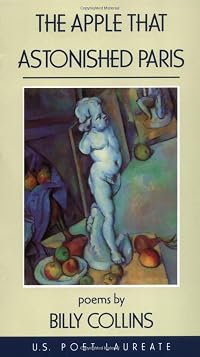
The Apple That Astonished Paris: Poems by Billy Collins
by Billy Collins
On This Page
Description
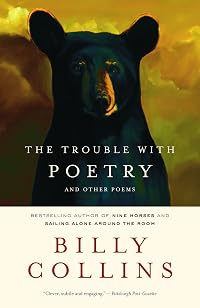
Billy Collins is Distinguished professor of English at Lehman College of the City University of New York. He was appointed poet laureate of the United States for 2001-2003 and is currently the poet laureate of New York State. He is the author of eight collections of poetry including his latest, The Trouble with Poetry.
Tags
Recommendations





Member Reviews
Such a slim, unassuming little book of poetry! Who knew it would pack a punch of powerful words neatly disguised in short and sweet poems? I have decided Billy Collins is one of my favorite poets. His poetry is not pretentious. It's within reach; a drinking buddy; a lovable troublemaker disguised in a string of words. There is wild imagination (walking across water and thinking of what the fish below see), seriousness (a former teacher looks back on the "community" of students he has taught), nostalgic (remembering a Tuscany vacation), clever (questioning Basque language), humorous (Smokey the Bear is fed up with warning tourists about forest fires) and moving (how cancer is a bad word). Each poem is about a page long or less. Short show more enough to read again and again. Let the words soak in and open your mind to fun poetry. show less
Originally posted on Tales to Tide You Over
I rarely read a book of poetry, and my taste runs more to Rudyard Kipling than most modern poetry. However, when I learned this book included a poem on etymology (something of a pleasure for me), I undertook to explore Billy Collins’ poetry.
What I discovered was articulate and evocative description to delight and surprise me. His ability to capture a place, time, or mood is significant, and I believe I enjoyed every one of the poems in the first section “Away,” though some connected with me more than others.
The second section, “Home,” frustrated me though.
Again, the description is written with a talented hand, the moments firmly captured so they unfold in front of me. And yet, in this show more same section is a dismissal of every reader’s experience, every moment of connection or understanding, as over-thinking. The poem, titled “Introduction to Poetry,” rails against the look for deeper meaning in poetry, a common refrain, and one I can sympathize with even as I reject the premise. But then, this is me finding meaning, so would most likely be dismissed as “beating it with a hose.” Or perhaps he’d consider I understood this poem perfectly, while rejecting the other meanings that tore me from his description and broke the connection I’d found.
My issue with several of the poems in “Home” is how they reveal him a result of rather than a commentator on society. “Child Development” is a wonderful, perceptive understanding of both childhood and the strictures put on people in the name of maturity that deny our actual experience or bury it deep where it springs forth in unreasoned anger or self-destructive behavior.
Then, having built that expectation, I get to “Earthling” where, in a few, short stanzas, Collins manages to connect with shared experience and then reject that experience and every person who does not fall into the “norm” who can revel in being perfectly adapted. Sure, it can be interpreted as him saying to be happy with who you are. However, he makes a point of establishing the personal happiness in the context of someone who is “average” while using those descriptive skills to point out the “other than average” nature of those who are not well suited, in his opinion of their opinion, for Earth.
There’s no apparent awareness of the underlying message that is weighed down with social convention and denying anyone who stands outside that norm. There are other poems in the collection with the same type of message, so disappointing when so much of the poetry is communal with shared experiences presented vividly.
Ultimately, I’d recommend reading Billy Collins’ poetry for his clear understanding of the English language and his ability to paint pictures in so few words by choosing the one detail that the majority of readers will have experienced, if not in the place where Collins’ refers to it. That is the strength of his poetry, and well worth experiencing. However, be aware that he is a product of his society, and when not directly intending a commentary, the commentary he offers is one of conformity. show less
I rarely read a book of poetry, and my taste runs more to Rudyard Kipling than most modern poetry. However, when I learned this book included a poem on etymology (something of a pleasure for me), I undertook to explore Billy Collins’ poetry.
What I discovered was articulate and evocative description to delight and surprise me. His ability to capture a place, time, or mood is significant, and I believe I enjoyed every one of the poems in the first section “Away,” though some connected with me more than others.
The second section, “Home,” frustrated me though.
Again, the description is written with a talented hand, the moments firmly captured so they unfold in front of me. And yet, in this show more same section is a dismissal of every reader’s experience, every moment of connection or understanding, as over-thinking. The poem, titled “Introduction to Poetry,” rails against the look for deeper meaning in poetry, a common refrain, and one I can sympathize with even as I reject the premise. But then, this is me finding meaning, so would most likely be dismissed as “beating it with a hose.” Or perhaps he’d consider I understood this poem perfectly, while rejecting the other meanings that tore me from his description and broke the connection I’d found.
My issue with several of the poems in “Home” is how they reveal him a result of rather than a commentator on society. “Child Development” is a wonderful, perceptive understanding of both childhood and the strictures put on people in the name of maturity that deny our actual experience or bury it deep where it springs forth in unreasoned anger or self-destructive behavior.
Then, having built that expectation, I get to “Earthling” where, in a few, short stanzas, Collins manages to connect with shared experience and then reject that experience and every person who does not fall into the “norm” who can revel in being perfectly adapted. Sure, it can be interpreted as him saying to be happy with who you are. However, he makes a point of establishing the personal happiness in the context of someone who is “average” while using those descriptive skills to point out the “other than average” nature of those who are not well suited, in his opinion of their opinion, for Earth.
There’s no apparent awareness of the underlying message that is weighed down with social convention and denying anyone who stands outside that norm. There are other poems in the collection with the same type of message, so disappointing when so much of the poetry is communal with shared experiences presented vividly.
Ultimately, I’d recommend reading Billy Collins’ poetry for his clear understanding of the English language and his ability to paint pictures in so few words by choosing the one detail that the majority of readers will have experienced, if not in the place where Collins’ refers to it. That is the strength of his poetry, and well worth experiencing. However, be aware that he is a product of his society, and when not directly intending a commentary, the commentary he offers is one of conformity. show less
I was looking for language and wry humor and Billy Collins fit the bill. This time and every time, he delivers the sublime and the ridiculous.
Ratings
Members
- Recently Added By
Lists

Poetry volumes by single author
121 works; 8 members
Author Information

42+ Works 12,843 Members
Billy Collins has published six collections of poetry, including Questions About Angels and The Art of Drowning, Picnic, Lightning, his latest, sold more than 25,000 copies in its first year. He teaches at Lehman College of the City University of New York and at Sarah Lawrence College. He was named U.S. Poet Laureate in June 2000. (Bowker Author show more Biography) Billy Collins was born in New York City in 1941. He earned a BA from the College of the Holy Cross, and both an MA and PhD from the University of California-Riverside. Collins conducted summer poetry workshops at University College Galway and is the Poet in Residence at Burren College of Art in Ireland. He is also a professor of English at Lehman College (CUNY). In 1992, Collins was chosen to be the Literary Lion of the New York Public Library. He was named U.S. Poet Laureate in 2001 and held the title until 2003. Collins then served as Poet Laureate for the State of New York from 2004 until 2006. His poetry has appeared in anthologies, textbooks and periodicals including Poetry, The American Poetry Review, The American scholar, Harper's, The Paris Review and The New Yorker. He is the author of six books of poetry including "The Art of Drowning." His poems have also been selected to appear in The Best American Poetry of 1992, 1993 and 1997. His works have won various awards including the Bess Hokin Prize, the Frederick Bock Prize, the Oscar Blumenthal Prize and the Levinson Prize, all awarded by Poetry. He has received fellowships from the New York Foundation for the Arts, the National Endowment for the Arts and the Guggenheim Foundation. His collection of poems entitled Aimless Love made numerous best-seller lists in 2013. (Bowker Author Biography) show less
Common Knowledge
- Original publication date
- 1988
Classifications
Statistics
- Members
- 293
- Popularity
- 110,059
- Reviews
- 3
- Rating
- (4.14)
- Languages
- English
- Media
- Paper, Ebook
- ISBNs
- 6
- ASINs
- 2