On This Page
Description
"John Milton holds an impressive place within the rich tradition of neo-Latin epistolography. His 'Epistolae Familiares' and uncollected letters paint an invigorating portrait of the artist as a young man, offering insight into his reading programme, his views on education, friendship, poetry, his relations with continental literati, his blindness, and his role as Latin Secretary. This edition presents a modernised Latin text and a facing English translation, complemented by a detailed show more introduction and a comprehensive commentary. Situating Milton's letters in relation to the classical, pedagogical, neo-Latin, and vernacular contexts at the heart of their composition, it presents fresh evidence in regard to Milton's relationships with the Italian philologist Benedetto Buonmattei, the Greek humanist Leonard Philaras, the radical pastor Jean de Labadie, and the German diplomat Peter Heimbach. It also announces several new discoveries, most notably a manuscript of Henry Oldenburg's transcription of 'Ep. Fam. 25'. This volume fills an important gap in Milton scholarship, and will prove of particular use to Milton scholars, students, philologists, neo-Latinists, and those interested in the humanist reinvention of the epistolographic tradition."--Publisher's website show lessTags
Recommendations







Member Reviews
Recently, I read PL during my morning walks. Often aloud, it went surprisingly fast--about half a book per day, completed in a month. Of course, so many of the allusions, even with good footnotes and a lifetime of reading and a Ph.D. in 17C English lit, remain solidly beyond me, in a sempiternal world of classical and biblical allusion. But I read with the recognition that such allusions function as validating linkages, rather like real links online, or like Mercedes for the insecure.
This may be my fifth time through it in entirety, and I have taught principally Book 9, Adam and Eve, maybe two dozen times. Everytime through I discover a few lines that surprise me. This time, just after my retirement, I found a line I've been quoting to show more my still-working colleagues: "To sit in hateful Office, here confined...." This is Sin at the gates of Hell, early on in the poem, in the first three books.
I have in my memory perhaps 15 minutes of Paradise Lost, maybe my fave passage,
"Men called him Mulciber, and how he fell
From heav'n was fabled, thrown by angry Jove
Sheer o'er the crystal battlements. From morn
To noon he fell, from noon to dewy eve
A summer's day, and with the setting sun
Dropped from the zenith like a falling star
On Lemnos and the Aegean isle: thus they report,
Erring."(late in Bk 1)
Here we have the grand sweep and forward motion of the verse, like a chase scene.
And also, the added learned footnote and correction, so Puritanical, so Miltonic.
Wish I had memorized much more, as I do with Yeats, Dylan Thomas, Shakespeare, and Dickinson (about an hour each). The organ voice of Milton's verse. The reserved parodic Andrew Marvell, my doctoral subject, Milton's assistant secretary of state, Latin Secretary--for all European countries and Russia then wrote in Latin.* The stone incisions of Yeats and Dickinson. (Marvell's verse critiques other poets, so my thesis, "This Critical Age," which ushered me into Larry Lipking's Princeton NEH post-doc, "The Poet Critics.")
My new book, out at the end of 2016, takes off on Milton's title, Parodies Lost. It's the growth of a poet's mind via parodying Angelou, Dylan Thomas, Ashbery, Herrick, R Wilbur, even Dickinson. And the central figure is partly my great undergrad friend, the brilliant parodist (esp of prose), Tom Weiskel, known principally for his book The Romantic Sublime--though I only hear his unique voice in a half-dozen spots in it; I have heard him parody both criticism and poetry. We lost him at age 29, like Shelley. (Harold Bloom, Tom's mentor, invited my book to his home on Linden St, New Haven, saying, "I think of Tom every day. I still grieve him.")
* Some of the funniest parts of Giordano Bruno's commedia "Candelaio" are in Latin, by and about the Latin teacher Manfurio, who admires himself, and his boy pupils who thwart him. For ex, Manny (in my trans.) refuses to use the word "Robber," insists on "Surreptor" so no-one knows he's been robbed. For the scene acted at London's Bridewell theater, see Youtube: "Candelaio Final Edit." show less
This may be my fifth time through it in entirety, and I have taught principally Book 9, Adam and Eve, maybe two dozen times. Everytime through I discover a few lines that surprise me. This time, just after my retirement, I found a line I've been quoting to show more my still-working colleagues: "To sit in hateful Office, here confined...." This is Sin at the gates of Hell, early on in the poem, in the first three books.
I have in my memory perhaps 15 minutes of Paradise Lost, maybe my fave passage,
"Men called him Mulciber, and how he fell
From heav'n was fabled, thrown by angry Jove
Sheer o'er the crystal battlements. From morn
To noon he fell, from noon to dewy eve
A summer's day, and with the setting sun
Dropped from the zenith like a falling star
On Lemnos and the Aegean isle: thus they report,
Erring."(late in Bk 1)
Here we have the grand sweep and forward motion of the verse, like a chase scene.
And also, the added learned footnote and correction, so Puritanical, so Miltonic.
Wish I had memorized much more, as I do with Yeats, Dylan Thomas, Shakespeare, and Dickinson (about an hour each). The organ voice of Milton's verse. The reserved parodic Andrew Marvell, my doctoral subject, Milton's assistant secretary of state, Latin Secretary--for all European countries and Russia then wrote in Latin.* The stone incisions of Yeats and Dickinson. (Marvell's verse critiques other poets, so my thesis, "This Critical Age," which ushered me into Larry Lipking's Princeton NEH post-doc, "The Poet Critics.")
My new book, out at the end of 2016, takes off on Milton's title, Parodies Lost. It's the growth of a poet's mind via parodying Angelou, Dylan Thomas, Ashbery, Herrick, R Wilbur, even Dickinson. And the central figure is partly my great undergrad friend, the brilliant parodist (esp of prose), Tom Weiskel, known principally for his book The Romantic Sublime--though I only hear his unique voice in a half-dozen spots in it; I have heard him parody both criticism and poetry. We lost him at age 29, like Shelley. (Harold Bloom, Tom's mentor, invited my book to his home on Linden St, New Haven, saying, "I think of Tom every day. I still grieve him.")
* Some of the funniest parts of Giordano Bruno's commedia "Candelaio" are in Latin, by and about the Latin teacher Manfurio, who admires himself, and his boy pupils who thwart him. For ex, Manny (in my trans.) refuses to use the word "Robber," insists on "Surreptor" so no-one knows he's been robbed. For the scene acted at London's Bridewell theater, see Youtube: "Candelaio Final Edit." show less
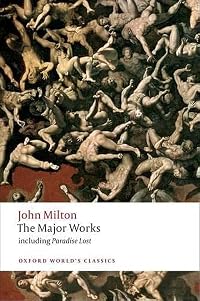
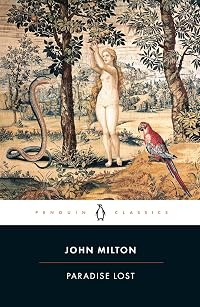
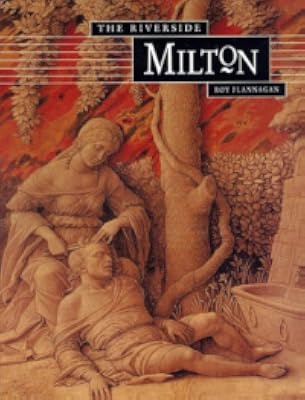
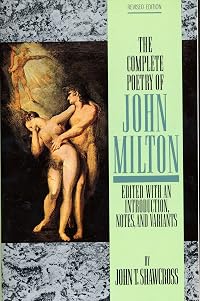
The texts in this book form a central part of my dissertation so my copy is very well-thumbed! It's great for students like myself as there's room for annotations etc. and has informative footnotes and a critical introduction summing up his life. It gives a fairly comprehensive overview of Milton's work: his most famous prose works, early poems, Samson Agonistes, Paradise Lost & Regained are all present, as well as a few selections from lesser-known works such as Christian Doctrine (which would have made for a larger and duller tome if included so I'm glad I had to look elsewhere for that!) The cover illustration as you can see is very appropriate to the feel of Paradise Lost and it looks nice on a bookshelf, as Oxford Classics do. A show more good all-round introduction to his work. show less
I was not the best Milton student by any stretch of the imagination, but I survived total immersion fairly well. Oh, "Comus." Oh, Areopagitica. Really, Paradise Lost is what saves it all.
This edition contains all of Milton's English and Italian poetry in chronological order, including Paradise Lost and Paradise Regained, and most of his Latin and Greek verse. In addition, the text offers a generous sampling of the prose, including the complete text of Areopagitica, Of Education, The Tenure of Kings and Magistrates, The Doctrine and Discipline of Divorce, The Ready and Easy Way, and selections from the Second Defense of the English People, An Apology for Smectymnuus, and Christian Doctrine. Freshly edited, the book has been modernized and annotated to clarify difficulties in syntax and vocabulary and identify historical, classical, and biblical allusions, while the Introduction traces both Milton's changing conception of show more his vocation and the critical fortunes of his work over the past three centuries. show less
Ratings
Members
- Recently Added By
Author Information

764+ Works 35,355 Members
John Milton, English scholar and classical poet, is one of the major figures of Western literature. He was born in 1608 into a prosperous London family. By the age of 17, he was proficient in Latin, Greek, and Hebrew. Milton attended Cambridge University, earning a B.A. and an M.A. before secluding himself for five years to read, write and study show more on his own. It is believed that Milton read evertything that had been published in Latin, Greek, and English. He was considered one of the most educated men of his time. Milton also had a reputation as a radical. After his own wife left him early in their marriage, Milton published an unpopular treatise supporting divorce in the case of incompatibility. Milton was also a vocal supporter of Oliver Cromwell and worked for him. Milton's first work, Lycidas, an elegy on the death of a classmate, was published in 1632, and he had numerous works published in the ensuing years, including Pastoral and Areopagitica. His Christian epic poem, Paradise Lost, which traced humanity's fall from divine grace, appeared in 1667, assuring his place as one of the finest non-dramatic poet of the Renaissance Age. Milton went blind at the age of 43 from the incredible strain he placed on his eyes. Amazingly, Paradise Lost and his other major works, Paradise Regained and Samson Agonistes, were composed after the lost of his sight. These major works were painstakingly and slowly dictated to secretaries. John Milton died in 1674. (Bowker Author Biography) show less
Series

Common Knowledge
- Canonical title
- The Major Works
- Disambiguation notice
- This selection, edited by Stephen Orgel and Jonathan Goldberg, was first published as John Milton (1991) in the series "The Oxford authors". It was reissued in the "Oxford world's classics" series as The major works... (show all) (2003).
Classifications
Statistics
- Members
- 495
- Popularity
- 61,166
- Reviews
- 4
- Rating
- (4.14)
- Languages
- English, Latin
- Media
- Paper, Audiobook, Ebook
- ISBNs
- 13
- ASINs
- 2