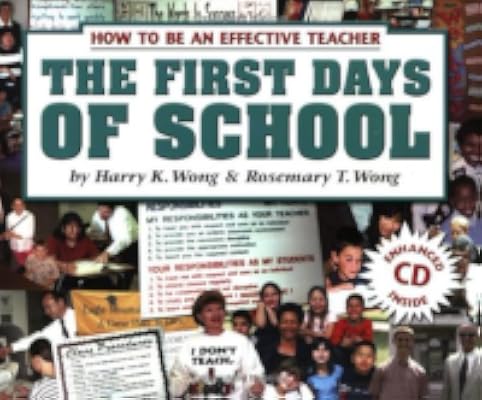
The First Days of School
by Harry K. Wong, Rosemary T. Wong
On This Page
Description
Offers advice on how to become an effective teacher through the development of three characteristics--positive expectations, classroom management, and lesson mastery--and discusses the need for teachers to continue in personal learning and growth to become a professional educator.Tags
Recommendations
Member Reviews
Gutless, bloodless, gormless, sophistry. Honestly, I am amazed that a book that describes itself (relentlessly) in such helpful (some might even say arrogant or dogmatic) terms can (and does) offer so little in tangible help for new teachers. Really, this book almost doesn't require me to be impressed with it as it seems to be ineluctably self-satisfied with itself, almost daring you to see a flaw in its perfect pedagogical methods...of which there are MANY. I will say that there is merit in some of this nonsense, namely the bromides to consistency....but the complete disregard for students (that border on the sociopathic) who flip their nose (and other body parts) at any school, teacher, authority and simply enjoining teachers to use show more more procedures or (I'll just preface with some vomiting) more LOVE, are nothing short of laughable. And the book refusing to give teachers the authority or, God help us all, the ability to use discipline (IN ALMOST ANY CIRCUMSTANCE) while simultaneously shifting any and all blame away from parents, students or the poor put upon administrators (the most obviously useless of the bunch though heaven for-fend you question why THEY earn more) is, honestly, disgusting and the proceeds are more than a little Orwellian concerning language (the digression between DECIDING and CHOOSING is at once hilarious and chilling as someone with title 'Doctor' actually helped to conceive this and some of the gullible are actually buying this...).
So, as someone who more than likely will lose his teaching position let me just say that this book is in service to exactly NO ONE but its authors and their coruscating circle of yes men and yes women. The fact that this paean to conformity actually has the balls to bring up Rosa Parks and Jim Crow as as a 'pre'-example to its own methods....well, presumptuous comes to mind as does laugh and vomit inducing...
Read this for laughs and then bemoan the state of American education, in that order. show less
So, as someone who more than likely will lose his teaching position let me just say that this book is in service to exactly NO ONE but its authors and their coruscating circle of yes men and yes women. The fact that this paean to conformity actually has the balls to bring up Rosa Parks and Jim Crow as as a 'pre'-example to its own methods....well, presumptuous comes to mind as does laugh and vomit inducing...
Read this for laughs and then bemoan the state of American education, in that order. show less
The First Days of School is a manual for teachers, oriented towards primary school teachers, but with useful advice for educators at other levels as well. The Wongs have a clear idea of what they want teachers to be: dedicated, enthusiastic professionals who impact student's lives. The first and last chapters are exhortations towards this ideal (although I wonder what they'd say for cynical, disorganized, and unfriendly people. "Don't teach", maybe?).
The middle three chapters have useful advice. The first step is to set create a positive context for students, by being a friendly and professional dressed person who makes an effort to greet students as individual, and set expectations of success. Second, have an orderly classroom, with show more procedures for everything from turning in homework to getting the instructor's permission to evacuating from a fire. Third, focus on student learning through an Understanding by Design adjacent learning practice, rather than mere coverage of the curriculum. Oh, and never argue with students, because by doing so you've already lost precious time for teaching the rest of the class.
For college students, who have a lot of implicit knowledge about how school should work, and less structured classes, this book is less useful. I will take going forward what to do in the opening minutes of class, those dead minutes before class actually starts, setting procedures so that students know what to expect every day and start learning, and a list of "learning verbs" to use in assignments. There seems to be some strong disagreement about how structured a classroom should be, and if students can see through these ploys, but I agree with the Wongs: a structured classroom encourages learning. Chasing those moments of synchronicity from a more improvisational teaching style is a mistake. show less
The middle three chapters have useful advice. The first step is to set create a positive context for students, by being a friendly and professional dressed person who makes an effort to greet students as individual, and set expectations of success. Second, have an orderly classroom, with show more procedures for everything from turning in homework to getting the instructor's permission to evacuating from a fire. Third, focus on student learning through an Understanding by Design adjacent learning practice, rather than mere coverage of the curriculum. Oh, and never argue with students, because by doing so you've already lost precious time for teaching the rest of the class.
For college students, who have a lot of implicit knowledge about how school should work, and less structured classes, this book is less useful. I will take going forward what to do in the opening minutes of class, those dead minutes before class actually starts, setting procedures so that students know what to expect every day and start learning, and a list of "learning verbs" to use in assignments. There seems to be some strong disagreement about how structured a classroom should be, and if students can see through these ploys, but I agree with the Wongs: a structured classroom encourages learning. Chasing those moments of synchronicity from a more improvisational teaching style is a mistake. show less
Eh. While Wong makes a lot of lucid points about what it takes to be a successful teacher, I found his self-aggrandizing writing style and veiled condescension grating. He reiterates the importance of professionalism as a teacher, but then writes a book whose layout looks like it was designed for five year olds. Teachers aren't idiots, Harry. You can write a book that isn't larded with cliches and ridiculous clip art, and people will read it.
What a disappointment this book was! Fully one half of the book is devoted to metaphores of good teaching. The target readers are teachers - We get it! The other half of the book tells us the general differences between great teachers and horribly incompetent teachers. We get that, too! What's lacking in this book are realistic scenarios with detailed suggestions for making the best of them. This book was recommended by a colleague and I was looking forward to some insights on making my classroom better. All I got were platitudes.
When I taught in Utah, this was required reading before the 1st day. I remember certain parts of it giving me focus and direction. After a really rough 1st year back after grad school, I pulled this out again and re-read it. Much of it is second nature to me at this point--which is great--but there were some things that I'd been forgetting to do. It was nice to be reminded. This next year should be better for many reasons, including that I re-read this book.
If you ever know anyone who is going to be a teacher, this is a perfect, perfect gift.
If you ever know anyone who is going to be a teacher, this is a perfect, perfect gift.
Every few years I like to re-read this book. It really renews my passion for teaching. It's a great reminder of why I use certain practices as well as reminds me of practices I may have forgotten. I received this book as a graduation present from college for my first year of teaching, but twelve years later I still find it practical and useful. I especially appreciated the epilogue and love its comment that our children are becoming an endangered species". Unfortunately that is so true. I do think it might be time to get an updated edition though. It is a few years old."
Recommended by several friends and my mother, I'm finding this book a very succinct and quick guide to really simple and easy success tools. Me gusta!
Members
- Recently Added By
Lists

You Couldn't Pay Me to Read That (Take 2)
213 works; 87 members
Author Information

20 Works 2,204 Members
Harry K. Wong is an educator, an acknowledged expert on instructional methods, and a best-selling author. His The First Days of School: How to be an Effective Teacher has sold over 750,000 copies to prospective, new, and veteran teachers. For this book, Dr. Wong draws on his background as a well-known presenter at workshops and conferences for show more teachers, as well as his own classroom experience as a science teacher. The book is acclaimed for being both a theoretical and practical guide and Wong presents an integrated philosophy based on three characteristics of effective teachers: classroom management, teaching for mastery, and creating positive expectations. It also includes everyday, practical, classroom tested techniques. Wong's expertise is also available in videos designed to be used for teacher training and staff development in-services. The Effective Teacher (1991), a series of eight videocassettes, features common-sense, research-based, noncontroversial information and techniques. He has also used the video format in Inducting New Teachers Into the Profession (1991). How You Can Be a Super Successful Teacher (1984) can be found on audiocassette. Dr. Harry K. Wong is married to Rosemary (Tripi) Wong, his co-author, collaborator, and co-founder of the Harry K. Wong Publishing Co. of Sunnyvale, Calif. (Bowker Author Biography) show less
1 Work 1,958 Members
All Editions
Common Knowledge
- Canonical title
- The First Days of School
- Original publication date
- 1991
Classifications
- Genre
- Nonfiction
- DDC/MDS
- 371.1020973 — Society, government, & culture Education Schools and their activities; special education Teachers; Teaching personnel; Professors, masters instructors Personal influence
- LCC
- LB1775.2 .W64 — Education Theory and practice of education Theory and practice of education Education and training of teachers and Professional aspects of teaching and school
- BISAC
Statistics
- Members
- 1,959
- Popularity
- 10,884
- Reviews
- 16
- Rating
- (3.95)
- Languages
- English, Spanish
- Media
- Paper, Audiobook, Ebook
- ISBNs
- 12
- UPCs
- 1
- ASINs
- 14
