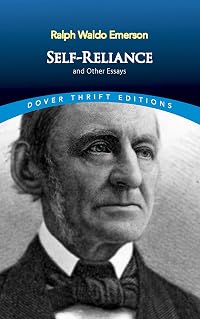
Self-Reliance and Other Essays
by Ralph Waldo Emerson 
On This Page
Description
Essayist, poet, and philosopher, Ralph Waldo Emerson (1803-1882) propounded a transcendental idealism emphasizing self-reliance, self-culture, and individual expression. The six essays and one address included in this volume, selected from Essays, First Series (1841) and Essays, Second Series (1844), offer a representative sampling of his views outlining that moral idealism as well as a hint of the later skepticism that colored his thought. In addition to the celebrated title essay, the show more others included here are "History," "Friendship," "The Over-Soul," "The Poet," and "Experience," plus the well-known and frequently read Harvard Divinity School Address. show lessTags
Recommendations

















Member Recommendations
Member Reviews
Goodreads' star system is annoying. Having 5 as "it was amazing" might as well read "it was totally awesome" or "literally the best" or some other idiotic way of dumbing down that which should not be dumbed down. All such contemporary things are rather pedestrian. Nevertheless, there is not really anywhere else to capture my readings, so here it is for now. Emerson's essays are like reading a religious text: every sentence has something that works just for you (or, more accurately, me). It is profound, yet moribund, exciting yet prosaic in its antiquity, biased in its bigotry, yet soundly rational and calm and erudite all at once. This is not a work to read once. Indeed, it will need to be read several times at different levels of show more maturity or experience. There is little doubt that Emerson is right up there with the likes of Rousseau, but due to timing or otherwise, he doesn't quite sit on the same bench as the masters. Regrettably, this is due to marketing rather than merit, but so too is most of history. How else might one find such gems as Emerson? My dogs loved it so much, they ate the front cover. It was the only book they have ever touched. show less
I finished!! Phew, this was heavy, but well worth reading. One of my favorites passages came from the essay from which the book draws its name: Self-Reliance, but it also has one of my least favorites.
"A man should learn to detect and watch that gem of light which flashes across his mind from within, more than the luster of the firmament of bards and sages. Yet he dismisses without notice his thought, because it is his. In every work of genius we recognize our own rejected thoughts: they come back to us with a certain alienated majesty. Great works of art have no more affecting lessons for us than this. They teach us to abide by our spontaneous impression with good-humored inflexibility then most when the whole cry of voices is on the show more other side. Else, to-morrow a stranger will say with masterly good sense precisely what we have thought and felt the whole time, and we shall be forced to take with shame our own opinion from another." (20)
And from this need to be self-reliant Emerson draws an interesting and harsh corollary:
"Do not tell me, as a good man did to-day, of my obligation to put all poor men in good situations. Are they my poor? I tell thee, thou foolish philanthropist, that I grudge the dollar, the dime, the cent, I give to such men as do not belong to me and to whom I do not belong. There is a class of persons to whom by all spiritual affinity I am bought and sold; for them I will go tot prison, if need be; but your miscellaneous popular charities; the education at college of fools; the building of meeting-houses to the vain end to which many now stand; alms to sots; and the thousandfold Relief Societies;--though I confess with shame I sometimes succumb and give the dollar, it is a wicked dollar which by and by I shall have the manhood to withhold." (22)
I could keep quoting forever, but here's just one more from "History":
"The instinct of the mind, the purpose of nature, betrays itself in the use we make of the signal narrations of history. Time dissipates to shining ether the solid angularity of facts. No anchor, no cable, no fences, avail to keep a fact a fact. Babylon, Troy, Tyre, Palestine, and ever early Rome, are passing already into fiction....'What is History,' said Napoleon, 'but a fable agreed upon?'...All history becomes subjective; in other words, there is properly no history; only biography." (3)
Other essays cover Friendship, The Over-Soul, The Poet, Experience, and The Divinity School Address. I think I would have preferred a live conversation with Mr. Emerson, but I am still glad I read this. show less
"A man should learn to detect and watch that gem of light which flashes across his mind from within, more than the luster of the firmament of bards and sages. Yet he dismisses without notice his thought, because it is his. In every work of genius we recognize our own rejected thoughts: they come back to us with a certain alienated majesty. Great works of art have no more affecting lessons for us than this. They teach us to abide by our spontaneous impression with good-humored inflexibility then most when the whole cry of voices is on the show more other side. Else, to-morrow a stranger will say with masterly good sense precisely what we have thought and felt the whole time, and we shall be forced to take with shame our own opinion from another." (20)
And from this need to be self-reliant Emerson draws an interesting and harsh corollary:
"Do not tell me, as a good man did to-day, of my obligation to put all poor men in good situations. Are they my poor? I tell thee, thou foolish philanthropist, that I grudge the dollar, the dime, the cent, I give to such men as do not belong to me and to whom I do not belong. There is a class of persons to whom by all spiritual affinity I am bought and sold; for them I will go tot prison, if need be; but your miscellaneous popular charities; the education at college of fools; the building of meeting-houses to the vain end to which many now stand; alms to sots; and the thousandfold Relief Societies;--though I confess with shame I sometimes succumb and give the dollar, it is a wicked dollar which by and by I shall have the manhood to withhold." (22)
I could keep quoting forever, but here's just one more from "History":
"The instinct of the mind, the purpose of nature, betrays itself in the use we make of the signal narrations of history. Time dissipates to shining ether the solid angularity of facts. No anchor, no cable, no fences, avail to keep a fact a fact. Babylon, Troy, Tyre, Palestine, and ever early Rome, are passing already into fiction....'What is History,' said Napoleon, 'but a fable agreed upon?'...All history becomes subjective; in other words, there is properly no history; only biography." (3)
Other essays cover Friendship, The Over-Soul, The Poet, Experience, and The Divinity School Address. I think I would have preferred a live conversation with Mr. Emerson, but I am still glad I read this. show less
Emerson's sentences seem not to know each other. I read this somewhere recently, along with the question of whether or not the man had A.D.D. I found it mostly a chore reading through these essays, struggling hard to get a sense of connection or flow anywhere. However, in his own words... "There is a good ear, in some men, that draws supplies to virtue out of very indifferent nutriment."
It's chiefly two things that make me rate a book highly: entertainment and enlightenment. I was not entertained at all by this book - rather bored. There were a few points, particularly in Self-Reliance and Friendship that bordered on enlightenment, but seemed more like inspiration in the end to me: nice words that feed the heart, but only while the mind show more is looking the other way.
I would not recommend this book, or these essays. I think he had a talent, but he could not take it past the full-stop; great sentences, but poor paragraphs. I still think he was a man of some genius, and have taken a lot of what he and the transcendentalists represented to heart... however I believe some choice quotations and fragments do better justice than his meandering and fanciful writings. show less
It's chiefly two things that make me rate a book highly: entertainment and enlightenment. I was not entertained at all by this book - rather bored. There were a few points, particularly in Self-Reliance and Friendship that bordered on enlightenment, but seemed more like inspiration in the end to me: nice words that feed the heart, but only while the mind show more is looking the other way.
I would not recommend this book, or these essays. I think he had a talent, but he could not take it past the full-stop; great sentences, but poor paragraphs. I still think he was a man of some genius, and have taken a lot of what he and the transcendentalists represented to heart... however I believe some choice quotations and fragments do better justice than his meandering and fanciful writings. show less
I agree so much with his point of view. Each of us are individuals. No one is the same and it is essential to embrace our uniqueness.
Babble and more babble
There is very little good stuff in this book. It's all covered up by babble and more babble that doesn't end. It's very boring. I didn't get as much out of this as I thought I would. If you take the babble out of this book you have three pages. The rest is lost in the babble.
There is very little good stuff in this book. It's all covered up by babble and more babble that doesn't end. It's very boring. I didn't get as much out of this as I thought I would. If you take the babble out of this book you have three pages. The rest is lost in the babble.
7 essays
Everyone should reread at least part of this regularly.
Members
- Recently Added By
Lists

Blue Pyramid 1,276 Best Books of All Time
1,248 works; 32 members

The Art of Manliness' 100+ Books Every Man Should Read
108 works; 2 members

Classical Conversations Challenge I Exposition
20 works; 1 member
Author Information

795+ Works 21,063 Members
Known primarily as the leader of the philosophical movement transcendentalism, which stresses the ties of humans to nature, Ralph Waldo Emerson, American poet and essayist, was born in Boston in 1803. From a long line of religious leaders, Emerson became the minister of the Second Church (Unitarian) in 1829. He left the church in 1832 because of show more profound differences in interpretation and doubts about church doctrine. He visited England and met with British writers and philosophers. It was during this first excursion abroad that Emerson formulated his ideas for Self-Reliance. He returned to the United States in 1833 and settled in Concord, Massachusetts. He began lecturing in Boston. His first book, Nature (1836), published anonymously, detailed his belief and has come to be regarded as his most significant original work on the essence of his philosophy of transcendentalism. The first volume of Essays (1841) contained some of Emerson's most popular works, including the renowned Self-Reliance. Emerson befriended and influenced a number of American authors including Henry David Thoreau. It was Emerson's practice of keeping a journal that inspired Thoreau to do the same and set the stage for Thoreau's experiences at Walden Pond. Emerson married twice (his first wife Ellen died in 1831 of tuberculosis) and had four children (two boys and two girls) with his second wife, Lydia. His first born, Waldo, died at age six. Emerson died in Concord on April 27, 1882 at the age of 78 due to pneumonia and is buried in Sleepy Hollow Cemetery in Concord, Massachusetts. (Bowker Author Biography) show less
Ralph Waldo Emerson has a Legacy Library. Legacy libraries are the personal libraries of famous readers, entered by LibraryThing members from the Legacy Libraries group.
Awards and Honors
Series
Belongs to Publisher Series
Common Knowledge
- Canonical title
- Self-Reliance and Other Essays
- People/Characters
- Ralph Waldo Emerson
- Important events
- Transcendentalism
- First words
- Ralph Waldo Emerson was born in Boston, May 25, 1803.
- Quotations
- A foolish consistency is the hobgoblin of little minds.
- Last words
- (Click to show. Warning: May contain spoilers.)For the like reason they ask the aid of wild passions, as in the gaming and war, ape in some manner these flames and generosities of the heart.
Classifications
Statistics
- Members
- 1,656
- Popularity
- 13,520
- Reviews
- 8
- Rating
- (4.08)
- Languages
- English, French, Spanish
- Media
- Paper, Audiobook, Ebook
- ISBNs
- 34
- UPCs
- 2
- ASINs
- 14