On This Page
Description
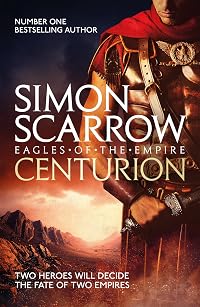
In Centurion, Scarrow continues the adventures of centurions Macro and Cato, as they wage war to defend the imperium. Scarrow combines stunning historical detail with riveting battles and rich characters to bring the Roman Empire to life. Already an international bestseller, Centurion follows Macro and Cato to the Eastern edges of the Empire. In the first century AD, Rome faces a potent new threat from its long-standing enemy Parthia. The two rivals are vying for control of Palmyra, an show more officially neutral kingdom along the Euphrates River. Palmyra's royal household is on the brink of open revolt, so Rome dispatches a task force under the command of veteran warriors Macro and Cato to defend its king and guard its borders. If Palmyra is not to fall into the clutches of Parthia, they will have to defeat superior numbers in a desperate siege. The quest for a lasting peace has never been more challenging, nor more critical for the future of the Empire. show lessTags
Recommendations










Member Reviews
‘Centurion’ is a Roman adventure set in Syria, full of action and drama, along with a little humour. The plot is strong and is engaging.
The main characters from the previous books, Cato and Macro, endure more hardships and dangers.
I didn’t get into this novel as much as I did with the previous in the series, namely ‘The Eagle in the Sand’, which gripped me from start to finish, but ‘Centurion’ features many captivating scenes and the author does a good job of placing me in first-century Syria.
One thing this book has that most of the previous ones don't is titillation. Cato meets a Roman woman who cares for the sick and injured and romance blossoms. The author is good at creating female characters, so glad he's introduced show more one here to spice the story up.
The language is contemporary, which makes the narrative flow better than if the author had used archaic turns of phrase. He also uses modern English slang, which some readers won’t like, but at least it’s consistent. I’ve read historical novels where in one scene a character says something like, ‘Keep it in your trousers,’ while in another scene someone else says, ‘Whence came he thus?’
While I admit I would’ve preferred the language to not incorporate modern slang, the characters and third-person narration are engaging enough for this not to make me feel like I’m reading a story set during any period other than the first century AD.
Perhaps my being an Englishman makes the slang words and phrases more palatable. I admit, it did annoy me when, in another historical novel, the author of that book used the odd Americanism – ‘ass’ and ‘butt’, for example – so I can understand why any non-English reader – and certainly non-British – would be distracted by the slang terms.
So, while the slang words and phrases didn’t bother me, three other elements did distract me at times. One being a trait that keeps cropping up in books I’ve read this year by different authors, namely this sort of thing: ‘more loudly’, ‘more closely’, instead of the concise ‘louder’ and ‘closer’. Don’t use two words if one will do.
Adverbs: they ‘tell’, not ‘show’, and should be cut or replaced with a strong verb wherever possible.
The two points above are minor criticisms. The one big gripe I have is the overuse of ‘then’ to state what happens next. This novel is riddled with ‘thens’, at times making the third-person narrative sound like a child’s voice. ‘Then’ is easy to cut when editing, and it’s not hard to drop it altogether. It ends up being a filler word, notably when using it to start a sentence. The reader knows whatever’s happening is taking place after what’s just happened, so no need to put, ‘Then he …’ and such like.
In most cases, I deduct a star if a book is riddled with ‘thens’ or swamped with adverbs. As someone who appreciates good writing style, these things drive me to distraction. Yet, as mentioned, ‘The Eagle in the Desert’ is such a cracking story it overrode these niggling points.
It’s easier to go on and on criticising a book than it is to praise it over and over, and I’ve doubtless not expressed how impressed I am with ‘Centurion’ to the extent it deserves, so, in a nutshell, I’ll state this: it’s a damn good read. show less
The main characters from the previous books, Cato and Macro, endure more hardships and dangers.
I didn’t get into this novel as much as I did with the previous in the series, namely ‘The Eagle in the Sand’, which gripped me from start to finish, but ‘Centurion’ features many captivating scenes and the author does a good job of placing me in first-century Syria.
One thing this book has that most of the previous ones don't is titillation. Cato meets a Roman woman who cares for the sick and injured and romance blossoms. The author is good at creating female characters, so glad he's introduced show more one here to spice the story up.
The language is contemporary, which makes the narrative flow better than if the author had used archaic turns of phrase. He also uses modern English slang, which some readers won’t like, but at least it’s consistent. I’ve read historical novels where in one scene a character says something like, ‘Keep it in your trousers,’ while in another scene someone else says, ‘Whence came he thus?’
While I admit I would’ve preferred the language to not incorporate modern slang, the characters and third-person narration are engaging enough for this not to make me feel like I’m reading a story set during any period other than the first century AD.
Perhaps my being an Englishman makes the slang words and phrases more palatable. I admit, it did annoy me when, in another historical novel, the author of that book used the odd Americanism – ‘ass’ and ‘butt’, for example – so I can understand why any non-English reader – and certainly non-British – would be distracted by the slang terms.
So, while the slang words and phrases didn’t bother me, three other elements did distract me at times. One being a trait that keeps cropping up in books I’ve read this year by different authors, namely this sort of thing: ‘more loudly’, ‘more closely’, instead of the concise ‘louder’ and ‘closer’. Don’t use two words if one will do.
Adverbs: they ‘tell’, not ‘show’, and should be cut or replaced with a strong verb wherever possible.
The two points above are minor criticisms. The one big gripe I have is the overuse of ‘then’ to state what happens next. This novel is riddled with ‘thens’, at times making the third-person narrative sound like a child’s voice. ‘Then’ is easy to cut when editing, and it’s not hard to drop it altogether. It ends up being a filler word, notably when using it to start a sentence. The reader knows whatever’s happening is taking place after what’s just happened, so no need to put, ‘Then he …’ and such like.
In most cases, I deduct a star if a book is riddled with ‘thens’ or swamped with adverbs. As someone who appreciates good writing style, these things drive me to distraction. Yet, as mentioned, ‘The Eagle in the Desert’ is such a cracking story it overrode these niggling points.
It’s easier to go on and on criticising a book than it is to praise it over and over, and I’ve doubtless not expressed how impressed I am with ‘Centurion’ to the extent it deserves, so, in a nutshell, I’ll state this: it’s a damn good read. show less
Our boys defeat the mighty Parthian Empire (with a little help), and bring the important city of Palmyra into the Roman fold, but most important of all, Cata takes a wife—even though I thought that serving Roman soldiers were forbidden to marry. A good read. I will admit though, having powered through all of the previous novels to date I am growing a little weary of the constant battles, the blood and death, but then again, we are talking about two Roman centurions and the Roman Empire! What else can you expect?
I have read a few negative reviews of Scarrow and this series. Let me rebut. These are not deep literature, I view them as a fun read, entertaining, enjoyable, twists and turns of the plot. All great fun. The language is show more modern, true, but then again, many things do not change, and I believe that in many ways we in the modern world are closer culturally to the ancient Romans than to the Medieval types who came after. For anyone who believes these stories are too light, I say lighten up. Life is not always about Conrad and "Lord Jim" (which I just finished re-reading). show less
I have read a few negative reviews of Scarrow and this series. Let me rebut. These are not deep literature, I view them as a fun read, entertaining, enjoyable, twists and turns of the plot. All great fun. The language is show more modern, true, but then again, many things do not change, and I believe that in many ways we in the modern world are closer culturally to the ancient Romans than to the Medieval types who came after. For anyone who believes these stories are too light, I say lighten up. Life is not always about Conrad and "Lord Jim" (which I just finished re-reading). show less
I am a fan of this series so I hope my bias is not coming into my reviews, but perhaps it is. Scarrow I find transports me to the primitive time of the Roman Empire.
His use of language, though not riddled with terms of the legions, is also not filled with modern constructs that other writers use and throw me out of the setting.
In this instance Macro and Cato are still in the Holy Lands for during this period of time, after JC (And I took umbrage with the last book and bringing our heroes into the realm of the early politics of Christianity) a great deal is happening for Rome in the Eastern borders.
Parthia, Palmyra and the ambitions of the Governor of Syria are converging. This story was good and we see that Cato is really coming into show more his own. I do not know if Scarrow has the entire series plotted, but I hope we see Cato further his career with the Legions and the machinations of Roman Politics, especially when we know Vespasian and Titus have made appearances in the series and should have play since we know Nero is coming, and the wars after him.
What is great about this series, and well worth the time to read it, is not only the historical feel, but the military feel as well. We have several books of detectives set in the Roman milieu, but few series of legionaries.
Well worth your time and when the series is complete, definitely a reread. show less
His use of language, though not riddled with terms of the legions, is also not filled with modern constructs that other writers use and throw me out of the setting.
In this instance Macro and Cato are still in the Holy Lands for during this period of time, after JC (And I took umbrage with the last book and bringing our heroes into the realm of the early politics of Christianity) a great deal is happening for Rome in the Eastern borders.
Parthia, Palmyra and the ambitions of the Governor of Syria are converging. This story was good and we see that Cato is really coming into show more his own. I do not know if Scarrow has the entire series plotted, but I hope we see Cato further his career with the Legions and the machinations of Roman Politics, especially when we know Vespasian and Titus have made appearances in the series and should have play since we know Nero is coming, and the wars after him.
What is great about this series, and well worth the time to read it, is not only the historical feel, but the military feel as well. We have several books of detectives set in the Roman milieu, but few series of legionaries.
Well worth your time and when the series is complete, definitely a reread. show less
This his best book in the series even better than the last (Eagle in the Sand) . The battle scenes were very well done. The relationship between Macro and Cato is very well defined and fun to read.
Macro and Cato have been sent to Syria by Narcissus to determine if Cassius Longinius is a traitor or not. They don't have the evidence but suspicions are strong. Cassius Longinius is on to their intentions and commands then to set off on a rescue mission of the city of Palmrya which is under siege by the King's eldest son. The enemy state of Rome, Parthia, stands to gain greatly if Palmrya. Macro and Cato have the Second Illyrian Axillary troops and a cohort of the 10th legion to do the job and there is bad blood between the two groups. The show more book gives you an interesting view of life in this Arab city, as well as the politics of a king and his sons. There is even a love interest for Cato to entertain.
I did not really like the ending to the book and that is why I did not give it a full 5 stars. There are a lot of loose ends. The fate of Cassius Longinius is unknown, the execution of one of the King's sons at the end seems unfair, pointless as he is a good guy...at least he seems so. The story is wrapped up too quickly for my liking. There is also an odd "prequel" describing Macro's young life and seems to have been thrown in as an after thought.
However the story for 90% of the book was well told and not predictable at all. show less
Macro and Cato have been sent to Syria by Narcissus to determine if Cassius Longinius is a traitor or not. They don't have the evidence but suspicions are strong. Cassius Longinius is on to their intentions and commands then to set off on a rescue mission of the city of Palmrya which is under siege by the King's eldest son. The enemy state of Rome, Parthia, stands to gain greatly if Palmrya. Macro and Cato have the Second Illyrian Axillary troops and a cohort of the 10th legion to do the job and there is bad blood between the two groups. The show more book gives you an interesting view of life in this Arab city, as well as the politics of a king and his sons. There is even a love interest for Cato to entertain.
I did not really like the ending to the book and that is why I did not give it a full 5 stars. There are a lot of loose ends. The fate of Cassius Longinius is unknown, the execution of one of the King's sons at the end seems unfair, pointless as he is a good guy...at least he seems so. The story is wrapped up too quickly for my liking. There is also an odd "prequel" describing Macro's young life and seems to have been thrown in as an after thought.
However the story for 90% of the book was well told and not predictable at all. show less
Nueva entrega de las aventuras de Cato y Macro. Como en la anterior entrega, Scarrow se centra cada vez más en las batallas (En este libro mete cuatro) y deja más a un lado la intriga (que tampoco es que sea su punto fuerte) Diría que este libro es para los habituales de la serie (como yo) pero le veo un par de problemillas (para mi gusto) Uno, que vuelve a poner a Cato en el centro de la acción (lo que más me gustaba de las anteriores es que Macro tenía más protagonismo) y que no me gusta demasiado el nuevo diseño de la serie (Que, por lo que veo están imitando en las reediciones) pero supongo que así venderá más, con lo que tampoco es para quejarse mucho.
I have read now, in about 10 days, just about all of Simon Scarrow's novels about Macro and Cato, Roman centurions. They are still in Syria, Macro the commander of an auxilliary cohort, Cato his adjudant, both still watching Longinus for ambitions of supplanting the emperor. They march to relieve a garrison, Cato falls in love, and they finally trap the Parthians and rebels of Palmyra. Another Kindle e-book
Book 8, Signed
Members
- Recently Added By
Lists

Kindle Books - To Read
63 works; 1 member
Author Information

Some Editions
Series

Work Relationships
Common Knowledge
- Canonical title
- Centurion
- Original title
- Centurion
- Original publication date
- 2007
- People/Characters
- Lucius Cornelius Macro; Quintus Licinius Cato
- Important places
- Antioch
- Publisher's editor*
- Békési, József
- Original language*
- angol
*Some information comes from Common Knowledge in other languages. Click "Edit" for more information.
Classifications
Statistics
- Members
- 542
- Popularity
- 54,920
- Reviews
- 8
- Rating
- (3.78)
- Languages
- 10 — Danish, English, German, Hungarian, Italian, Polish, Portuguese, Serbian, Spanish, Swedish
- Media
- Paper, Audiobook, Ebook
- ISBNs
- 37
- ASINs
- 12