The Sexuality of Christ in Renaissance Art and in Modern Oblivion
by Leo Steinberg
On This Page
Description
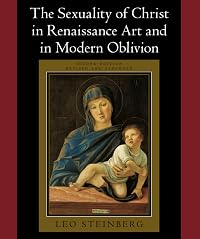
"The second edition of The Sexuality of Christ in Renaissance Art and in Modern Oblivion - doubled in size by the addition of a "Retrospect"--Expands the now classic original text in three directions. It brings in a host of confirming images; deepens the theological argument; and answers skeptical or scandalized critics who decried the book at its first publication. In its polemical parts, the book wrestles large issues, such as the validity of interpretations that come without supporting show more texts, or the modern pleas that the maleness of Christ be tempered into androgyny. Along the way, the topics engaged range from Christ's human nature to Dr. Strangelove, from St. Augustine's dismal assessment of babyhood to the aesthetics of the U.S. Post Office."--Jacket. show lessTags
Recommendations


























Member Reviews
This significant monograph by art historian Leo Steinberg might be more accurately titled The Phallus of Christ in Renaissance Art and Its Modern Concealment. The text, with its abundant demonstration through black-and-white reproductions of paintings and sculpture, explores the former artistic conspicuousness of Jesus' tallywacker in a serious and perceptive way. The visual motif is found in a myriad of representations of the infant Christ and the condemned Jesus suffering and slain.
Steinberg is persuasive at reconstructing an intellectual and cultural context for these images in terms of late medieval and Renaissance theologies of incarnation. "Christ's necessary exemption from genital shame follows from the theological definition of show more shame as the penalty of Original Sin" (17, n 17). The sermons and exegeses that serve as documentation here are sometimes hilariously self-regarding, as each act of Christ has for its divine intention the disproof of a then-future heresy (57, 63-4).
The main text was developed out of a seminar given by Steinberg in 1981, where the "discussants" included fellow art historian Julius S. Held and Jesuit scholar John W. O'Malley. Perhaps surprisingly to some readers, the churchman proved much more receptive to Steinberg's thesis than the secular academic did. The bulk of O'Malley's sympathetic reply is reproduced at the end of the book, and it also influenced revisions of the main text to draw on Renaissance sermons regarding the circumcision of Christ for theological orientation.
Held's positions are cited chiefly in the form of counter-argument in the "Excursuses" which form the second half of the book: forty digressive short essays, talmudically tied to the primary monograph by capital Roman numerals in the page margins. Besides responses to Held, these supplementary texts range widely over such topics as the erotic chin-chucking motif, historical depictions of nudity in baptism, the role of church sermons in Renaissance culture, phallic icons on ancient Egyptian monuments, and modern modes and motives of iconoclasm.
Despite the "Sexuality" in the title, the book never questions the traditional imputation of chaste virginity to the character of Jesus Christ. It is concerned to provide reflections on the significance of the ostentio genitalium (i.e. pointing out the penis) in the context of spiritualized sexual continence. Previous art historians had satisfied themselves that such anatomical explicitness was mere artistic exuberance in the rediscovery of classical models, giving quotidian detail to the bodily form in order to assert its reality. By contrast, Steinberg observes that "What the Christian art of the Renaissance took from pagan antiquity was the license to plumb its own mythic depths" (49).
The Sexuality of Christ is a mere two hundred pages, and perhaps half of it is illustrations. I was expecting it to be a pretty quick read, but it demanded and earned my sustained attention over several weeks. I recommend it to anyone interested in the subject matter. show less
Steinberg is persuasive at reconstructing an intellectual and cultural context for these images in terms of late medieval and Renaissance theologies of incarnation. "Christ's necessary exemption from genital shame follows from the theological definition of show more shame as the penalty of Original Sin" (17, n 17). The sermons and exegeses that serve as documentation here are sometimes hilariously self-regarding, as each act of Christ has for its divine intention the disproof of a then-future heresy (57, 63-4).
The main text was developed out of a seminar given by Steinberg in 1981, where the "discussants" included fellow art historian Julius S. Held and Jesuit scholar John W. O'Malley. Perhaps surprisingly to some readers, the churchman proved much more receptive to Steinberg's thesis than the secular academic did. The bulk of O'Malley's sympathetic reply is reproduced at the end of the book, and it also influenced revisions of the main text to draw on Renaissance sermons regarding the circumcision of Christ for theological orientation.
Held's positions are cited chiefly in the form of counter-argument in the "Excursuses" which form the second half of the book: forty digressive short essays, talmudically tied to the primary monograph by capital Roman numerals in the page margins. Besides responses to Held, these supplementary texts range widely over such topics as the erotic chin-chucking motif, historical depictions of nudity in baptism, the role of church sermons in Renaissance culture, phallic icons on ancient Egyptian monuments, and modern modes and motives of iconoclasm.
Despite the "Sexuality" in the title, the book never questions the traditional imputation of chaste virginity to the character of Jesus Christ. It is concerned to provide reflections on the significance of the ostentio genitalium (i.e. pointing out the penis) in the context of spiritualized sexual continence. Previous art historians had satisfied themselves that such anatomical explicitness was mere artistic exuberance in the rediscovery of classical models, giving quotidian detail to the bodily form in order to assert its reality. By contrast, Steinberg observes that "What the Christian art of the Renaissance took from pagan antiquity was the license to plumb its own mythic depths" (49).
The Sexuality of Christ is a mere two hundred pages, and perhaps half of it is illustrations. I was expecting it to be a pretty quick read, but it demanded and earned my sustained attention over several weeks. I recommend it to anyone interested in the subject matter. show less
Incarnational theology taken seriously.
Ratings
Members
- Recently Added By
Lists

Top Five Books of 2025
954 works; 303 members
Author Information

16+ Works 511 Members
Awards and Honors
Awards
Common Knowledge
- Original publication date
- 1983
- People/Characters
- Jesus Christ; Andrea del Sarto; Filippo Lippi; Michelangelo Buonarroti
- Dedication
- To Phoebe Lloyd
- First words
- The first necessity is to admit a long-suppressed matter of fact: that Renaissance art, both north and south of the Alps, produced a large body of devotional imagery in which the genitalia of the Christ Child, or of the dead ... (show all)Christ, receive such demonstrative emphasis that one must recognize an ostentatio genitalium comparable to the canonic ostentatio vulnerum, the showing forth of the wounds.
- Quotations
- Perhaps we must rank the strip-tease with the drama, the dance, and the oratorio as another cultural form whose deep roots are religious.
What the Christian art of the Renaissance took from pagan antiquity was the license to plumb its own mythic depths. - Blurbers
- Danto, Arthur C.; Trilling, Diana; Cohen, Arthur A.; Brilliant, Richard; Douglas, Mary; Howard, Richard
Classifications
Statistics
- Members
- 226
- Popularity
- 144,070
- Reviews
- 2
- Rating
- (4.64)
- Languages
- English, Polish, Spanish
- Media
- Paper, Ebook
- ISBNs
- 9
- ASINs
- 1