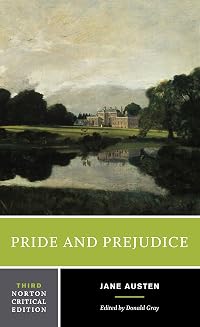
Pride and Prejudice [Norton Critical Edition, 3rd ed.]
by Donald Gray (Editor), Jane Austen (Author)
On This Page
Description
"A perennial favorite in the Norton Critical Editions series, Pride and Prejudice is based on the 1813 first edition text, which has been thoroughly annotated for undergraduate readers." ""Backgrounds and Sources" includes biographical portraits of Austen by members of her family and by biographers Park Honan, Claire Tomalin, and David Nokes. Seventeen of Austen's letters - eight of them new to the Third Edition - allow readers to glimpse the close-knit society that was Austen's world, both show more in life and in literature. Samples of Austen's early writing - from the epistolary Love and Friendship and A Collection of Letters - allow readers to trace Austen's growth as a writer." ""Criticism" includes eighteen assessments of the novel by nineteenth- and twentieth-century commentators, six of them new to the Third Edition, among them remarks on the recent BBC television adaptation of the novel and on the tensions and accommodations of class in Austen's work." "Also included are A Note on Money, a Chronology of Austen's life and work, and an updated Selected bibliography."--Jacket. show lessRecommendations


Member Reviews
This is among my favorite novels. After having stumbled through it as a teenager I have read it several times as an adult and find it a delightful and very humorous read. My most recent reading was with a group where we were able to explore our varied viewpoints on the travails of the life and love of Elizabeth Bennett and Mr. D'Arcy.
I was impressed with the clarity and classical balance of Jane Austen's Pride and Prejudice. From the balanced structure with three sections of almost equal length to the deliberate, yet pleasing, way that the story advances the novel seems designed to display both an intimate and timeless story with a reasonableness that does not deny the underlying emotions on display. Mr. Bennet's apparent sedate show more approach to life provides counterpoint to the dizzying distress displayed by Mrs. Bennet. Life's little problems (yes they are little, in retrospect), while they seem large and insoluble at the time, will work themselves out, despite the immediate concerns over whether daughters will marry. Will the young Bennet women be able to demonstrate their marriageability, much less choose among the landowners, the clergyman, the overly-proud (?) and the gamester to find fitting matches? Interweaving the misunderstanding of misplaced perspective and the imprecision of unwarranted judgements Austen has created a classic comedy of manners and marriage with a sensible narrative. Within a limited time and space she illumines both the rational and irrational in the humanity on display in this seemingly sheltered world (the turmoil of the outside world is indirectly displayed in the presence of the militia). Austen would go on to more mature demonstrations in Emma and Persuasion, but this book continues to delight the discerning reader. show less
I was impressed with the clarity and classical balance of Jane Austen's Pride and Prejudice. From the balanced structure with three sections of almost equal length to the deliberate, yet pleasing, way that the story advances the novel seems designed to display both an intimate and timeless story with a reasonableness that does not deny the underlying emotions on display. Mr. Bennet's apparent sedate show more approach to life provides counterpoint to the dizzying distress displayed by Mrs. Bennet. Life's little problems (yes they are little, in retrospect), while they seem large and insoluble at the time, will work themselves out, despite the immediate concerns over whether daughters will marry. Will the young Bennet women be able to demonstrate their marriageability, much less choose among the landowners, the clergyman, the overly-proud (?) and the gamester to find fitting matches? Interweaving the misunderstanding of misplaced perspective and the imprecision of unwarranted judgements Austen has created a classic comedy of manners and marriage with a sensible narrative. Within a limited time and space she illumines both the rational and irrational in the humanity on display in this seemingly sheltered world (the turmoil of the outside world is indirectly displayed in the presence of the militia). Austen would go on to more mature demonstrations in Emma and Persuasion, but this book continues to delight the discerning reader. show less
Re-read for a graduate seminar on Romantic Era women writers at CU Boulder.
Though this is my 5th time through this novel, I find myself delighting more and more in the intricate details. I have to chuckle at myself for falling in love with this relic over and over again, but it is so cleverly written and full of joyful humor that I can't help myself!
Hopefully, I don't have to recommend this read, but if I do - get on it already!
Though this is my 5th time through this novel, I find myself delighting more and more in the intricate details. I have to chuckle at myself for falling in love with this relic over and over again, but it is so cleverly written and full of joyful humor that I can't help myself!
Hopefully, I don't have to recommend this read, but if I do - get on it already!
The Bennet household is in a bit of a financial bind. They have five unmarried daughters with almost no dowry, and the estate is to be inherited by a mysterious cousin that no one's met yet. But things get exciting when a rich bachelor moves to town and brings is even richer bachelor friend. Every young lady in the area is ready to throw themselves at these men. Except, of course, for Elizabeth Bennet. She instantly decides that the rich bachelor is perfect for her sister, Jane, and his richer friend is the most detestable man on the planet. Thus starts one of the best-loved romances in Western literature. And, like most everyone else, I loved this story. Even on the nth reading of it.
Since there's not much else I can say in a show more mini-review of the story that hasn't been said over and over, I'll discuss the supplementary material in the Norton Critical Edition. There wasn't a LOT of supplementary information in the book, but it was generally of good quality. It started with a biography of Austen, punctuated with letters written by the author. This part would be helpful to someone who isn't familiar with Austen's life, but wouldn't be particularly new to anyone who's read a biography of her. Additionally, there were several critical analyses of Pride and Prejudice, both contemporary and modern. I enjoyed most of these--though I admit I got bored with the Freudian one and moved on to the next. The piece I found most surprising was the interview with Colin Firth. I really didn't think that this interview belonged in a critical edition of P&P and wasn't expecting much from it. But I was very wrong. Colin Firth had a strong understanding of Darcy's character (of course! how could I doubt? It IS his job!). It was fascinating to read his thoughts about how he incorporated his understanding of Darcy's motivations in the most powerful scenes (such as the first ball, the drawing room discussion when Lizzy was at Netherfield, the dance at Netherfield, and the proposal). It gave me a completely new impression of Darcy's character and made me want to watch the whole miniseries again.
I found the excerpt by Marilyn Butler Jane Austen and the War of Ideas: Pride and Prejudice, quite helpful...I feel encouraged to read Butler's entire book (after I finish re-reading the rest of Austen's novels). In this excerpt, Butler shows how Darcy and Elizabeth have elements of both pride and prejudice in their personalities. I had always thought about Darcy being proud and Elizabeth being prejudiced...but now I see that it is not that simple. Darcy was proud of his lineage and wealth, and he was prejudiced against people who had less wealth and less sophistication than himself. Elizabeth was prejudiced against Darcy because of his initial bad impression, but she was too proud to allow for the possibility that she might be mistaken in her first impressions.
For my full review see my blog: http://rachelreadingnthinking.blogspot.com/2012/10/pride-and-prejudice-by-jane-a... show less
Since there's not much else I can say in a show more mini-review of the story that hasn't been said over and over, I'll discuss the supplementary material in the Norton Critical Edition. There wasn't a LOT of supplementary information in the book, but it was generally of good quality. It started with a biography of Austen, punctuated with letters written by the author. This part would be helpful to someone who isn't familiar with Austen's life, but wouldn't be particularly new to anyone who's read a biography of her. Additionally, there were several critical analyses of Pride and Prejudice, both contemporary and modern. I enjoyed most of these--though I admit I got bored with the Freudian one and moved on to the next. The piece I found most surprising was the interview with Colin Firth. I really didn't think that this interview belonged in a critical edition of P&P and wasn't expecting much from it. But I was very wrong. Colin Firth had a strong understanding of Darcy's character (of course! how could I doubt? It IS his job!). It was fascinating to read his thoughts about how he incorporated his understanding of Darcy's motivations in the most powerful scenes (such as the first ball, the drawing room discussion when Lizzy was at Netherfield, the dance at Netherfield, and the proposal). It gave me a completely new impression of Darcy's character and made me want to watch the whole miniseries again.
I found the excerpt by Marilyn Butler Jane Austen and the War of Ideas: Pride and Prejudice, quite helpful...I feel encouraged to read Butler's entire book (after I finish re-reading the rest of Austen's novels). In this excerpt, Butler shows how Darcy and Elizabeth have elements of both pride and prejudice in their personalities. I had always thought about Darcy being proud and Elizabeth being prejudiced...but now I see that it is not that simple. Darcy was proud of his lineage and wealth, and he was prejudiced against people who had less wealth and less sophistication than himself. Elizabeth was prejudiced against Darcy because of his initial bad impression, but she was too proud to allow for the possibility that she might be mistaken in her first impressions.
For my full review see my blog: http://rachelreadingnthinking.blogspot.com/2012/10/pride-and-prejudice-by-jane-a... show less
The very, very rare book that I can and do read over and over again. What makes this utterly mysterious is the issue of suspense: why do I find it so utterly gripping (and anxious), even when I know the intimate details of how the plot will unravel (or rather, ravel)?
I reread this book for my Berkeley TA-ship, and I'm glad it's a creative writing course where I don't have to grade analytical essays on Austen. I do admire her prose--her dialogue is excellent--but I'm not a fan of P&P (and I hated Northanger Abbey). The marriage plot is barely tolerable, but I enjoyed the friendship of the elder Bennet sisters and Austen's delightful sentences more than I did when I read P&P in high school. Also, the extra material in this edition, like the interview with Colin Firth about playing Darcy in the BBC series, is interesting.
I first read this as a senior in high school (very quickly as I was suddenly changing schools, and this was part of our summer reading list, which I was getting with little notice), and have loved it ever since. Brilliantly written and detailed. Fabulous heroine (do we not all want to be Lizzie Bennett?). Marvelous comic relief, from Mrs. Bennett, surely the silliest mother in fiction, to the ridiculous Mr. Collins.
The Norton Critical Edition of Pride and Prejudice is divided into three parts:
1. The novel itself
2. Background and Sources (includes excerpts from various biographies, 17 letters that Austen wrote, and two excerpts from Austen's earlier writing)
3. Criticism (14 excerpts from important scholarly essays on P&P, two essays on "Darcy on film" and three essays on "Class and Money"
As I've read Pride and Prejudice several times already, this time I read only the third section, which was 118 pages long. For the most part the essays were interesting and enlightening, although most of them were very academic.
Recommended for: Austen scholars and readers who want to gain more understanding of P&P.
For fans of the 1995 BBC production, I highly show more recommend "A Conversation with Colin Firth" by Sue Birtwhistle and Susie Conklin (Sue Birtwhistle was the producer, Susie Conklin has written other historical productions and co-wrote The Making of Pride and Prejudice, where this piece was previously published.)
I recently read The Cambridge Companion to 'Pride and Prejudice', which is similar to the Criticism section in the Norton. I preferred the essays in the Cambridge. However, if you're looking for some criticism and a copy of the actual novel, you can't go wrong with this Norton edition. show less
1. The novel itself
2. Background and Sources (includes excerpts from various biographies, 17 letters that Austen wrote, and two excerpts from Austen's earlier writing)
3. Criticism (14 excerpts from important scholarly essays on P&P, two essays on "Darcy on film" and three essays on "Class and Money"
As I've read Pride and Prejudice several times already, this time I read only the third section, which was 118 pages long. For the most part the essays were interesting and enlightening, although most of them were very academic.
Recommended for: Austen scholars and readers who want to gain more understanding of P&P.
For fans of the 1995 BBC production, I highly show more recommend "A Conversation with Colin Firth" by Sue Birtwhistle and Susie Conklin (Sue Birtwhistle was the producer, Susie Conklin has written other historical productions and co-wrote The Making of Pride and Prejudice, where this piece was previously published.)
I recently read The Cambridge Companion to 'Pride and Prejudice', which is similar to the Criticism section in the Norton. I preferred the essays in the Cambridge. However, if you're looking for some criticism and a copy of the actual novel, you can't go wrong with this Norton edition. show less
Members
- Recently Added By
Lists

Literature About Social Class
134 works; 19 members

Female Protagonist
1,056 works; 57 members
Female Author
1,234 works; 65 members

University literature
145 works; 5 members

Literary Works Read in College
316 works; 15 members
Author Information


Jane Austen's life is striking for the contrast between the great works she wrote in secret and the outward appearance of being quite dull and ordinary. Austen was born in the small English town of Steventon in Hampshire, and educated at home by her clergyman father. She was deeply devoted to her family. For a short time, the Austens lived in the show more resort city of Bath, but when her father died, they returned to Steventon, where Austen lived until her death at the age of 41. Austen was drawn to literature early, she began writing novels that satirized both the writers and the manners of the 1790's. Her sharp sense of humor and keen eye for the ridiculous in human behavior gave her works lasting appeal. She is at her best in such books as Pride and Prejudice (1813), Mansfield Park (1814), and Emma (1816), in which she examines and often ridicules the behavior of small groups of middle-class characters. Austen relies heavily on conversations among her characters to reveal their personalities, and at times her novels read almost like plays. Several of them have, in fact, been made into films. She is considered to be one of the most beloved British authors. (Bowker Author Biography) show less
All Editions
Series
Belongs to Publisher Series
Work Relationships
Is a (non-series) sequel to
Has the (non-series) sequel
Has the (non-series) prequel
Common Knowledge
- Canonical title
- Pride and Prejudice [Norton Critical Edition, 3rd ed.]
- Original publication date
- 2001
- Disambiguation notice
- (2001) Do Not Combine with other editions: a "Norton Critical Edition" is a unique work with significant added material, including essays and background materials. The 2nd and 4th editions particularly have major chang... (show all)es from previous. The main text is that of the 1813 first edition, accompanied by revised and expanded explanatory annotations.
Please maintain the phrase "Norton Critical Edition" in the Canonical Title and Publisher Series fields.
----------
"Backgrounds and Sources" includes biographical portraits of Austen by members of her family, with the Third Edition adding those by acclaimed biographers Claire Tomalin and David Nokes. Seventeen of Austen's letters --eight of them new to this edition-- illustrate the close-knit society that was Austen's world, in life and in her writing. Samples of Austen's early work allow readers to trace her growth as a writer and to read her fiction comparatively. "Criticism" features nineteen assessments of the novel, seven of them new to the Third Edition. Among them is an interview with Colin Firth on the recent BBC television adaptation of the novel, excerpted from "The Making of Pride and Prejudice." Also included are pieces which address societal aspects of Austen's time, a Chronology --new to the Third Edition-- and a Selected Bibliography.
Classifications
Statistics
- Members
- 1,035
- Popularity
- 25,082
- Reviews
- 13
- Rating
- (4.62)
- Languages
- English
- Media
- Paper, Ebook
- ISBNs
- 1
- ASINs
- 5