Due Considerations: Essays and Criticism
by John Updike
On This Page
Description
John Updike's sixth collection of essays and literary criticism opens with a skeptical overview of literary biographies, proceeds to five essays on topics ranging from China and small change to faith and late works, and takes up, under the heading "General Considerations," books, poker, cars, and the American libido. The last, informal section of Due Considerations assembles more or less autobiographical pieces--reminiscences, friendly forewords, comments on the author's own recent works, show more responses to probing questions. In between, many books are considered, some in introductions--to such classics as Walden, The Portrait of a Lady, and The Mabinogion--and many more in reviews, usually for The New Yorker. Ralph Waldo Emerson and the five Biblical books of Moses come in for appraisal, along with Uncle Tom's Cabin and The Wizard of Oz. Contemporary American and English writers--Colson Whitehead, E. L. Doctorow, Don DeLillo, Norman Rush, William Trevor, A. S. Byatt, Muriel Spark, Ian McEwan--receive attentive and appreciative reviews, as do Rohinton Mistry, Salman Rushdie, Peter Carey, Margaret Atwood, Gabriel García Márquez, Haruki Murakami, Günter Grass, and Orhan Pamuk. In factual waters, Mr. Updike ponders the sinking of the Lusitania and the "unsinkable career" of Coco Chanel, the adventures of Lord Byron and Iris Murdoch, the sexual revolution and the advent of female Biblical scholars, and biographies of Robert Frost, Sinclair Lewis, Marcel Proust, and Søren Kierkegaard.--From publisher's description. show lessTags
Recommendations










Member Reviews
Give Updike his Due Consideration
If your a regular reader of "The New Yorker" magazine, than you'll not only enjoy this collection of John Updike essays, but you'll cherish its place on your bookshelf.
As a Canadian, I especially enjoyed Updike's reviews of Margaret Atwood and Alice Munro. But I was enjoyed reading about Harriet Beecher Stowe's "Uncle Tom's Cabin" and E.L. Doctorow's "Ragtime" among others. Updike writes with such clarity and common sense, he is a man of clear conscience with a strong moral conviction. Updike is a true gem in the literary world.
I cannot find a single reason to not recommend "Due Considerations".
If your a regular reader of "The New Yorker" magazine, than you'll not only enjoy this collection of John Updike essays, but you'll cherish its place on your bookshelf.
As a Canadian, I especially enjoyed Updike's reviews of Margaret Atwood and Alice Munro. But I was enjoyed reading about Harriet Beecher Stowe's "Uncle Tom's Cabin" and E.L. Doctorow's "Ragtime" among others. Updike writes with such clarity and common sense, he is a man of clear conscience with a strong moral conviction. Updike is a true gem in the literary world.
I cannot find a single reason to not recommend "Due Considerations".
Updike's reading has a staggering range. He is comfortable just about anywhere. Literary Biography. American Fiction. English Fiction. Non-Fiction. Art. Personal Considerations. Here is the epigraph to the Preface:
What terrifies me now . . . is the whole question of catching & meeting & proceeding with the least tension (or emotion!) along docks, railway platforms, ups or downs of any kind where being DUE at some moment plays a part.
Updike starts the Preface:
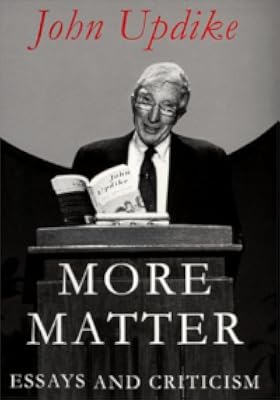
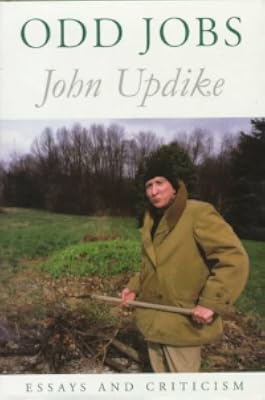
Bills come due; dues must be paid. After 8 years, I was due for another collection of non-fictional prose. I had hoped that, thanks to the dwindling powers of old age, the bulk would be considerably smaller than that of the two previous assemblages ODD JOBS (1991) and MORE MATTER show more (1999). My hope, as I sorted and rooted through my deposits of old tearsheets and typescripts ("hard copies," we call them now), was slowly dashed. There was less, but not significantly less. There was no escaping the accumulated weight of my daily exertions.
Updike's daily exertions can hardly be fathomed by we LTers. show less
What terrifies me now . . . is the whole question of catching & meeting & proceeding with the least tension (or emotion!) along docks, railway platforms, ups or downs of any kind where being DUE at some moment plays a part.
Updike starts the Preface:
Bills come due; dues must be paid. After 8 years, I was due for another collection of non-fictional prose. I had hoped that, thanks to the dwindling powers of old age, the bulk would be considerably smaller than that of the two previous assemblages ODD JOBS (1991) and MORE MATTER show more (1999). My hope, as I sorted and rooted through my deposits of old tearsheets and typescripts ("hard copies," we call them now), was slowly dashed. There was less, but not significantly less. There was no escaping the accumulated weight of my daily exertions.
Updike's daily exertions can hardly be fathomed by we LTers. show less
Ratings
Members
- Recently Added By
Author Information

343+ Works 53,899 Members
American novelist, poet, and critic John Updike was born in Reading, Pennsylvania on March 18, 1932. He received an A.B. degree from Harvard University, which he attended on a scholarship, in 1954. After graduation, he accepted a one-year fellowship to study painting at the Ruskin School of Drawing and Fine Art in Oxford, England. After returning show more from England in 1955, he worked for two years on the staff of The New Yorker. This marked the beginning of a long relationship with the magazine, during which he has contributed numerous short stories, poems, and book reviews. Although Updike's first published book was a collection of verse, The Carpentered Hen and Other Tame Creatures (1958), his renown as a writer is based on his fiction, beginning with The Poorhouse Fair (1959). During his lifetime, he wrote more than 50 books and primarily focused on middle-class America and their major concerns---marriage, divorce, religion, materialism, and sex. Among his best-known works are the Rabbit tetrology---Rabbit, Run (1960), Rabbit Redux (1971), Rabbit Is Rich (1981), and Rabbit at Rest (1988). Rabbit, Run introduces Harry "Rabbit" Angstrom as a 26-year-old salesman of dime-store gadgets trapped in an unhappy marriage in a dismal Pennsylvania town, looking back wistfully on his days as a high school basketball star. Rabbit Redux takes up the story 10 years later, and Rabbit's relationship with representative figures of the 1960s enables Updike to provide social commentary in a story marked by mellow wisdom and compassion in spite of some shocking jolts. In Rabbit Is Rich, Harry is comfortably middle-aged and complacent, and much of the book seems to satirize the country-club set and the swinging sexual/social life of Rabbit and his friends. Finally, in Rabbit at Rest, Harry arrives at the age where he must confront his mortality. Updike won the Pulitzer Prize for both Rabbit Is Rich and Rabbit at Rest. Updike's other novels range widely in subject and locale, from The Poorhouse Fair, about a home for the aged that seems to be a microcosm for society as a whole, through The Court (1978), about a revolution in Africa, to The Witches of Eastwick (1984), in which Updike tries to write from inside the sensibilities of three witches in contemporary New England. The Centaur (1963) is a subtle, complicated allegorical novel that won Updike the National Book Award in 1964. In addition to his novels, Updike also has written short stories, poems, critical essays, and reviews. Self-Consciousness (1989) is a memoir of his early life, his thoughts on issues such as the Vietnam War, and his attitude toward religion. He was elected to the American Academy of Arts and Letters in 1977. He died of lung cancer on January 27, 2009 at the age of 76. (Bowker Author Biography) John Updike was born in 1932, in Shillington, Pennsylvania. Since 1957 he has lived in Massachusetts. His novels have won the Pulitzer Prize, the National Book Award, the National Book Critics Circle Award, & the Howells Medal. (Publisher Provided) John Updike was born in 1932 and attended Harvard College and the Ruskin School of Drawing and Fine Art in Oxford, England. Form 1955 to 1957 he was a staff member of The New Yorker, which he contributed numerous writings. Updike's art criticism has appeared in publications including Arts and Antiques, The New Republic, The New York Times Book Review, and Realites, among many others. He is the author of such best-selling novels as Rabbit Run and Rabbit is Rich. His many works of fiction, poetry and criticism have been awarded the Pulitzer Prize, the National Book Award, the American Book Award, and the National Book Critics Circle Award. For the past 40 years he has lived in Massachusetts. (Publisher Provided) John Updike is the author of some 50 books, including collections of short stories, poems, & criticism. His novels have won the Pulitzer Prize, the National Book Award, the National Book Critics Circle Award, & the Howells Medal. Born in Shillington, Pennsylvania, in 1932, he has lived in Massachusetts since 1957. (Publisher Provided) show less
Awards and Honors
Distinctions
Common Knowledge
- Original publication date
- 2007
- Publisher's editor
- Jones, Judith
Classifications
Statistics
- Members
- 287
- Popularity
- 112,706
- Reviews
- 2
- Rating
- (4.19)
- Languages
- English, German
- Media
- Paper, Ebook
- ISBNs
- 6
- ASINs
- 4