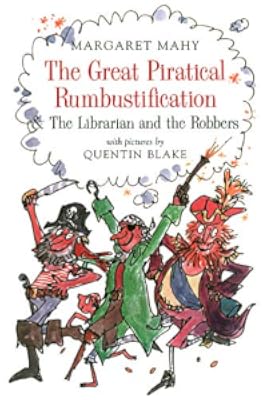
The Great Piratical Rumbustification & The Librarian and the Robbers
by Margaret Mahy
On This Page
Description
In these two stories the protagonists have mischievous fun with a former pirate and a band of robbers.Tags
Recommendations























Member Recommendations
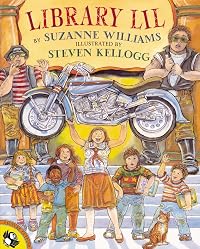
lquilter Readers who enjoyed Mahy's "The Librarian and the Robbers" will also enjoy "Library Lil" by Suzanne Williams. A super-powered librarian converts some lawless types into bookworms.
Member Reviews
Two books worth of story crammed into 63 magical pages, full of robbers tricked by librarians and retired pirates who know how to party and revive the joys of boyhood (while paying the bills). No impossibly articulate child protagonists with clearly defined goals or desires, no rhyme or reason, just a pair of stories cut from the same cloth as books by Willaim Stieg and Roald Dahl.
In the first story, it is spring and the retired, land-locked pirates are restless. They long for a Pirate Party but the sign in the sky informing them of a pending party is not there. The problem is that a pirate party must be stolen.
Next we see the Terrapin family, having moved up from their cramped flat to a spacious house. The three Terrapin boys have been show more promised that with a bigger house came opportunities for adventurous behavior, but father's overwhelming dread at purchasing a house beyond their means has soured things.
It is only natural that these two parties be united, and when the adult Terrapins call the Mother Goose Baby-sitting service it should be no surprise that they are assigned an ex-pirate as a sitter. Fears of qualifications quelled, the boys find their sitter deserving, and with this the boys are off. Sitter Orpheus Clinker sends up the announcement that he has found a suitable location, and a Pirate Party proceeds to take place at the Terrapin's.
Father Terrapin is at a big, important dinner but he senses something wrong, something taking place elsewhere that is more fun. There appears to be some great rumpus taking place in the part of town near his house, and how he wishes he was there. Leaving the important dinner as soon as he can possibly escape he returns home to find a Pirate Party well under way. Once over his initial indignation, Father Terrapin falls in and enjoys the Pirate Party, after which he is richly rewarded by the pirates and never has to worry about his financial situation ever again.
& & & & &
Our second story in this double-feature finds a band of woods-living robbers who have come upon the idea of stealing the town librarian for ransom. Her warning that she has recently spent time with children infected with measles goes unheeded and soon all the robbers but one, the Chief Robber, are sick. Allowed to return to the library for a reference book to heal the sick robbers the librarian returns with books to read. Having never been read to, or taught how to read, she begins with Peter Rabbit and proceeds to give them a classic education in children's literature.
Eventually everyone forget about the ransom and the librarian returns to work. One day the Chief Robber dashes into the library to escape being apprehended by police. With quick thinking the librarian shelves the Chief Robber and refuses to turn him over to the police without a library card. Of course, once the officer has left the librarian slyly checks the robber out for herself and prevents the officer from coming back and apprehending him for the indefinite future. Saved, the Chief Robber continues with his initial task: checking books out for the other robbers because now they have insatiable reading habit.
One day an earthquake brings down all the books in the library, burying the librarian. Chief Robber and his fellow robbers join the police and other citizens in saving the librarian. Chief Robber admits to liking the librarian and they marry on the condition that they all give up robbing. The Chief Robber even becomes the head children's librarian in perhaps the most rambunctious branch any library has ever seen.
* * * * *
I can understand some of why this book was withdrawn from my town library and put on the 25 cent shelf in the sales alcove. It is hard to imagine any book today would be published where a babysitter requires rum as part of his services, and that he carries a bottle large enough in his coat pocket to cause him to list to one side when he walks. And I'm not sure what to make of an adult male, upon meeting three young boys, exclaiming how he likes the cut of their jibs. Indeed, this very slang expression is the sort of thing that caused me to snort out loud.
But we are talking about pirates here, and removing rum and salty pirate talk (within reason) is like drawing cows without udders or exchanging water for soda in stories because we don't want to scar or unduly influence young minds. This political correctness has its place at times, but not here.
And these are stories about adults primarily, adults behaving like children at times but adults nonetheless. It's as if we don't expect children to identify with anyone except protagonists their own age, but so often these child protagonists are forced to carry the weight of stories and messages beyond their years. The idea of fun seems no longer the province of adults or kids in children's books anymore. Do we think that kids won't understand or identify with a parent character longing for the carefree days before bills and important dinner? Do we feel that they'll reject a book because it includes a romance between an unlikely duo, one half of which is a librarian?
Also, I admire the amount of ground covered despite the brevity of the text. The Great Piratical Rumbustification is told in thirteen chapters, many of them fewer than three full pages. I know this is a hallmark of books aimed at readers who are still gaining fluency, but I'll take a dozen well-crafted books like this any day to a sprawling attempt to build the chapter book into something more substantial from fewer parts. show less
In the first story, it is spring and the retired, land-locked pirates are restless. They long for a Pirate Party but the sign in the sky informing them of a pending party is not there. The problem is that a pirate party must be stolen.
Next we see the Terrapin family, having moved up from their cramped flat to a spacious house. The three Terrapin boys have been show more promised that with a bigger house came opportunities for adventurous behavior, but father's overwhelming dread at purchasing a house beyond their means has soured things.
It is only natural that these two parties be united, and when the adult Terrapins call the Mother Goose Baby-sitting service it should be no surprise that they are assigned an ex-pirate as a sitter. Fears of qualifications quelled, the boys find their sitter deserving, and with this the boys are off. Sitter Orpheus Clinker sends up the announcement that he has found a suitable location, and a Pirate Party proceeds to take place at the Terrapin's.
Father Terrapin is at a big, important dinner but he senses something wrong, something taking place elsewhere that is more fun. There appears to be some great rumpus taking place in the part of town near his house, and how he wishes he was there. Leaving the important dinner as soon as he can possibly escape he returns home to find a Pirate Party well under way. Once over his initial indignation, Father Terrapin falls in and enjoys the Pirate Party, after which he is richly rewarded by the pirates and never has to worry about his financial situation ever again.
& & & & &
Our second story in this double-feature finds a band of woods-living robbers who have come upon the idea of stealing the town librarian for ransom. Her warning that she has recently spent time with children infected with measles goes unheeded and soon all the robbers but one, the Chief Robber, are sick. Allowed to return to the library for a reference book to heal the sick robbers the librarian returns with books to read. Having never been read to, or taught how to read, she begins with Peter Rabbit and proceeds to give them a classic education in children's literature.
Eventually everyone forget about the ransom and the librarian returns to work. One day the Chief Robber dashes into the library to escape being apprehended by police. With quick thinking the librarian shelves the Chief Robber and refuses to turn him over to the police without a library card. Of course, once the officer has left the librarian slyly checks the robber out for herself and prevents the officer from coming back and apprehending him for the indefinite future. Saved, the Chief Robber continues with his initial task: checking books out for the other robbers because now they have insatiable reading habit.
One day an earthquake brings down all the books in the library, burying the librarian. Chief Robber and his fellow robbers join the police and other citizens in saving the librarian. Chief Robber admits to liking the librarian and they marry on the condition that they all give up robbing. The Chief Robber even becomes the head children's librarian in perhaps the most rambunctious branch any library has ever seen.
* * * * *
I can understand some of why this book was withdrawn from my town library and put on the 25 cent shelf in the sales alcove. It is hard to imagine any book today would be published where a babysitter requires rum as part of his services, and that he carries a bottle large enough in his coat pocket to cause him to list to one side when he walks. And I'm not sure what to make of an adult male, upon meeting three young boys, exclaiming how he likes the cut of their jibs. Indeed, this very slang expression is the sort of thing that caused me to snort out loud.
But we are talking about pirates here, and removing rum and salty pirate talk (within reason) is like drawing cows without udders or exchanging water for soda in stories because we don't want to scar or unduly influence young minds. This political correctness has its place at times, but not here.
And these are stories about adults primarily, adults behaving like children at times but adults nonetheless. It's as if we don't expect children to identify with anyone except protagonists their own age, but so often these child protagonists are forced to carry the weight of stories and messages beyond their years. The idea of fun seems no longer the province of adults or kids in children's books anymore. Do we think that kids won't understand or identify with a parent character longing for the carefree days before bills and important dinner? Do we feel that they'll reject a book because it includes a romance between an unlikely duo, one half of which is a librarian?
Also, I admire the amount of ground covered despite the brevity of the text. The Great Piratical Rumbustification is told in thirteen chapters, many of them fewer than three full pages. I know this is a hallmark of books aimed at readers who are still gaining fluency, but I'll take a dozen well-crafted books like this any day to a sprawling attempt to build the chapter book into something more substantial from fewer parts. show less
Only Margaret Mahy would have a kidnapped librarian save the robber chief who kidnapped her by shelving him, and requiring the policeman to go get his library card to 'take him out." Whimsical, literate and charming
Ratings
Members
- Recently Added By
Lists

Amusing Book Titles
146 works; 39 members

Top 100 NZ Children's Books
100 works; 1 member
Author Information

287+ Works 13,530 Members
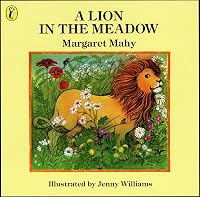
Margaret Mahy was born on March 21, 1936 in Whakatane, Bay of Plenty, New Zealand. She received a B.A. degree from the University of New Zealand. She worked as a nurse, an assistant librarian, and a children's librarian in England and New Zealand. Her first book, A Lion in the Meadow, was published in 1969. She became a full-time author in 1980. show more During her lifetime, she wrote more than 120 children's books including The Haunting, The Changeover, Memory, The Seven Chinese Brothers, The Man Whose Mother Was a Pirate and A Summery Saturday Morning. She won the Esther Glen Award five times, the Carnegie Medal of the British Library Association three times, the Boston Globe-Horn Book Award, Hans Christian Andersen Award, and in 1999, she won the New Zealand Post Children's Book Award in two categories, Picture Book and Supreme Award. She died after a brief illness on July 23, 2012 at the age of 76. (Bowker Author Biography) show less
All Editions
Work Relationships
Common Knowledge
- Canonical title
- The Great Piratical Rumbustification & The Librarian and the Robbers
- Original publication date
- 1978
- People/Characters
- Mr Henry Terrapin; Mrs Millie Terrapin; Alpha Terrapin; Oliver Terrapin; Omega Terrapin; Orpheus Clinker (show all 13); Terrible Crabmeat/Sir John; Mother Goose; Serena Laburnum; Robber Chief/Salvation Loveday; Robbers; Policeman; Mayor
- Important places
- City; Terrapin house; Library
- Important events
- Great Piratical Rumbustification; Kidnapping; Earthquake
- First words
- Great Piratical Rumbustification
All over the town the pirates were getting restless.
The Librarian and the Robbers
One day Serena Laburnum, the beautiful librarian, was carried off by wicked robbers. - Quotations
- Great Piratical Rumbustification
“The meaning of it?” he croaked. “It doesn’t have to mean anything.”
“If you think that,” said Sir-John-Terrible-Crabmeat, “then you are a noodle.”
The Librarian and the Robbers
As for Miss Laburnum, there is no doubt that she was aiding and abetting robbers; not very good behaviour in a librarian, but she had her reasons.
“Quickly!” they shouted. “To the rescue! Rescue! Rescue Miss Laburnum. Save the books.” - Last words
- (Click to show. Warning: May contain spoilers.)Great Piratical Rumbustification
The pirates are beginning to be restless again.
(Click to show. Warning: May contain spoilers.)The Librarian and the Robbers
Perhaps she herself was more of a robber at heart than anyone ever suspected ... except, of course, Robber Chief-and-First-Library-Assistant Salvation Loveday, and he did not tell anyone.
Classifications
- Genres
- Children's Books, Fiction and Literature
- DDC/MDS
- 823.914 — Literature & rhetoric English & Old English literatures English fiction 1900- 1901-1999 1945-1999
- LCC
- PZ7 .M2773 .G — Language and Literature Fiction and juvenile belles lettres Fiction and juvenile belles lettres Juvenile belles lettres
- BISAC
Statistics
- Members
- 201
- Popularity
- 163,164
- Reviews
- 2
- Rating
- (4.06)
- Languages
- Danish, Dutch, English, Swedish
- Media
- Paper
- ISBNs
- 17