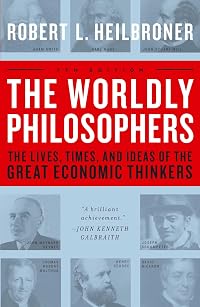
The Worldly Philosophers: The Lives, Times, and Ideas of the Great Economic Thinkers
by Robert L. Heilbroner
On This Page
Description
"The Worldly Philosophers is one of the bestselling economics books of all time. For more than half a century, it has not only enabled us to see more deeply into our history but helped us better understand our own times. In this seventh edition, Robert L. Heilbroner unearths a theme that connects thinkers as diverse as Adam Smith and Karl Marx. The theme is the common focus of their highly varied ideas-- namely, the search to understand how a capitalist society works."--Back cover.Tags
Recommendations
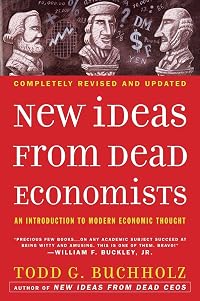
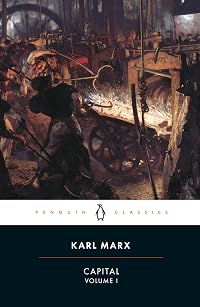
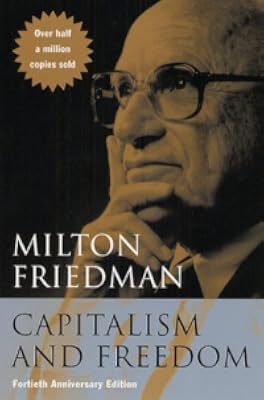

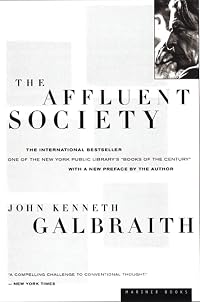













Member Reviews
I've had this book on the shelf for over twenty years. I purchased it for an Intro to Macroeconomics class but I must not have read it at the time – or maybe we only had to read a small part because I found my annotations in only one chapter – but I decided to pick it up again and I'm very glad I did. Heilbroner looks at the great (and not-so-great) economists from Adam Smith down to John Maynard Keynes. And he truly tells you about their "lives, times and ideas" and makes the history come alive. Not only does he tell about Smith's "Invisible Hand" and supply and demand but also how he'd sometimes go into these trances where he'd end up marching for hours before coming out of it! And you learn about Keynes' insights into economic show more depressions (which may explain our current economic malaise) as well as his dalliances with men. There's also many in between, including some of the 'nuts' like Robert Owen, Henry George, and Thorstein Veblen. And, of course, there's Karl Marx.
The section on Marx is probably my favorite because Heilbroner makes you see the world Marx and his theories came from – as well as how often he was right! He points out that Marx "was not the architect of actual socialism" – that was Lenin – and it's so insightful that it almost makes me want to read Capital! In fact, the whole book was utterly fascinating. Heilbroner doesn't just explain economic ideas or even merely put them into context, he does it in a way that entertains, and he even made me laugh! My copy is from 1986 and it would be interesting to see what he'd thought of the collapse of communism just a few years later (maybe it was updated in a later edition?). (Modified from my 2/10/15 blog posting:http://bookworm-dad.blogspot.com/2015/02/marx-maynard-and-dr-dick.html) show less
The section on Marx is probably my favorite because Heilbroner makes you see the world Marx and his theories came from – as well as how often he was right! He points out that Marx "was not the architect of actual socialism" – that was Lenin – and it's so insightful that it almost makes me want to read Capital! In fact, the whole book was utterly fascinating. Heilbroner doesn't just explain economic ideas or even merely put them into context, he does it in a way that entertains, and he even made me laugh! My copy is from 1986 and it would be interesting to see what he'd thought of the collapse of communism just a few years later (maybe it was updated in a later edition?). (Modified from my 2/10/15 blog posting:http://bookworm-dad.blogspot.com/2015/02/marx-maynard-and-dr-dick.html) show less
Одна из лучших книг, которых я читал за всю жизнь. Автор мастерски описал социо-экономические революции произошедшие за всю историю человечества, но самое главное автор указал, кто смог проанализировать и описать данные революции, а иногда даже предсказать их. Каждая глава имеет историю о великом экономисте, его жизненном пути, а также как он пришел к своей великой идее. Каждая глава начинается с вопроса show more и отвечает на него, но в процессе ответа, задает след. вопрос. Книга имеет 10 глав, и подводит читателя к пику книги - что будет дальше с Миром? Что будет дальше с экономикой? Я считаю, книга обязательна к прочтению любому человеку. Она поможет понять, почему мир такой как он есть. show less
What I particularly like about this book is how Heilbroner begins with the term “political economy”, then relegates it to “economics” (as happened in history), only to revive the term at the end where he tells us that Schumpeter is the last worldly philosopher as we have – more or less – learnt all we can through a scientific approach based significantly on grand assumptions about the behaviour of homo economicus, and it is time to reintroduce politics. That Heilbroner ends with Schumpeter is interesting. I am not sure if his eschewing of Hayek (who gets a few mentions in the book) is ideological. Nonetheless, it is an interesting approach to understanding the economy although a newer edition (the seventh was released in show more 1999) might be useful to mention the impact of the return to free trade and back again with the recent Global Financial Crisis. Regardless, this should be the first port of call for novice economists or political scientists alike. As a second reading, I found the suggested reading list at the end of the book to be most helpful to guide a revisit to the many classics which are now readily available for free on the Net. Indeed, it was well-worth revisiting Heilbroner and I may do so yet again. show less
This is history of when what we call economics was still part of philosophy, with some more recent economists too. Each one is worth knowing about.
Later, in 2023, I learn that the seventh and last edition of Worldly Philosophers included a new chapter, chapter 11, titled "The End of Worldly Philosophy?". It discusses "end" in both of its possible meanings, as termination, and as purpose or goal.
Heilbroner mentions how economics has become very mathematical, with lots of numbers and theories. That's fine, he thinks. What disturbs him, though, is economists who believe their field is a science like physics. Humans, with our free will and emotions, and ethics, and values can't be described in the same way that, say, electrons can.
He hopes show more for an economics that more and more realizes that it is linked to politics more than to physics, and one that realizes it is not value-free, an economics with a sense of social responsibility. show less
Later, in 2023, I learn that the seventh and last edition of Worldly Philosophers included a new chapter, chapter 11, titled "The End of Worldly Philosophy?". It discusses "end" in both of its possible meanings, as termination, and as purpose or goal.
Heilbroner mentions how economics has become very mathematical, with lots of numbers and theories. That's fine, he thinks. What disturbs him, though, is economists who believe their field is a science like physics. Humans, with our free will and emotions, and ethics, and values can't be described in the same way that, say, electrons can.
He hopes show more for an economics that more and more realizes that it is linked to politics more than to physics, and one that realizes it is not value-free, an economics with a sense of social responsibility. show less
Curious about the theoretical insights of history's great economic minds? How about their financial troubles, sexual orientations, and eccentric views regarding extraterrestrial life? Perhaps one of the most engagingly written works of academic non-fiction, this highly readable classic covers the economic theories of Adam Smith, Karl Marx, John Maynard Keynes, Joseph Schumpeter, and others -- without skimping on the quirky biographical details and larger historical context. No stock tips, though, I'm afraid.
The prose is excellent. Well written and lively, and easy to digest. I also like the introduction of some more fringe "economists" that would have escaped my attention otherwise.
My criticism is that the book seems outdated, and more interesting to read as a window into an age rather than for information. I would take most of the Heilbroner explains as "fact" with a large grain of salt. The book overall seems to be a product of an earlier pre-Chicago school age, of a leftist- to socialist grain. It's interesting as a historical artifact but has little informative value in my opinion. Heilbroner is far more sympathetic to Utopians, Marx and Keynes than to cornerstones of the economic establishment. He dismisses Marshall and Edgeworth show more with a wave of the hand. For some basic economic ideas, Heilbroner seems confused, or even misconstrues them.
I liked the exploration of the individual lives of the economists. I thought probably the best point that Heilbroner makes is that economics needs to see society as evolving and changing (each era of history is likely to have it's own set of economics, all possibly valid since the nature of organization has changed) and that abstract math cannot and should not replace the political, social and psychological aspects of economics.
I feel mixed about the book overall. I did not agree with the ideas and saw some simplifications as simply wrong but ultimately I am glad that I read the book. show less
My criticism is that the book seems outdated, and more interesting to read as a window into an age rather than for information. I would take most of the Heilbroner explains as "fact" with a large grain of salt. The book overall seems to be a product of an earlier pre-Chicago school age, of a leftist- to socialist grain. It's interesting as a historical artifact but has little informative value in my opinion. Heilbroner is far more sympathetic to Utopians, Marx and Keynes than to cornerstones of the economic establishment. He dismisses Marshall and Edgeworth show more with a wave of the hand. For some basic economic ideas, Heilbroner seems confused, or even misconstrues them.
I liked the exploration of the individual lives of the economists. I thought probably the best point that Heilbroner makes is that economics needs to see society as evolving and changing (each era of history is likely to have it's own set of economics, all possibly valid since the nature of organization has changed) and that abstract math cannot and should not replace the political, social and psychological aspects of economics.
I feel mixed about the book overall. I did not agree with the ideas and saw some simplifications as simply wrong but ultimately I am glad that I read the book. show less
With a very personal Introduction by the author for this VIth edition.
Heilbroner introduces the "economic revolution". Humans have found only three ways to keep "the possibility of social breakdown" at bay: (1) organizing society around tradition, (2) submitting to authorities, or (3) allowing development of a "free market system". This last calls forth the economists. [21]
My disagreements with Heilbroner stem from the ivory tower quality of his global pronouncements, but he is brilliant in biography and the historical positioning of his selected "economists": Adam Smith, Parson Malthus, David Ricardo, Frederick Bastiat, the Utopians Socialists, Karl Marx, the Victorians, Thorstein Veblen, Henry George, John Maynard Keynes, and Joseph show more Schumpeter.
By way of contextualizing the relevance of this work for today, post Heritage Foundation assault on the free market by monopolists, there is not the slightest suggestion drawn from the faintest shadow of a fact, which can support the late GOP suggestion that "the wealthy create jobs". This serious work was published in 1986, the last year of middle class growth and at the onset of the war declared by the Koch Brothers and executed by Roger Ailes on behalf of the GOP against the middle class. Clearly, its abundant message was swept aside, and political America stopped listening to economists. show less
Heilbroner introduces the "economic revolution". Humans have found only three ways to keep "the possibility of social breakdown" at bay: (1) organizing society around tradition, (2) submitting to authorities, or (3) allowing development of a "free market system". This last calls forth the economists. [21]
My disagreements with Heilbroner stem from the ivory tower quality of his global pronouncements, but he is brilliant in biography and the historical positioning of his selected "economists": Adam Smith, Parson Malthus, David Ricardo, Frederick Bastiat, the Utopians Socialists, Karl Marx, the Victorians, Thorstein Veblen, Henry George, John Maynard Keynes, and Joseph show more Schumpeter.
By way of contextualizing the relevance of this work for today, post Heritage Foundation assault on the free market by monopolists, there is not the slightest suggestion drawn from the faintest shadow of a fact, which can support the late GOP suggestion that "the wealthy create jobs". This serious work was published in 1986, the last year of middle class growth and at the onset of the war declared by the Koch Brothers and executed by Roger Ailes on behalf of the GOP against the middle class. Clearly, its abundant message was swept aside, and political America stopped listening to economists. show less
Members
- Recently Added By
Lists

Books Read in 2016
4,666 works; 197 members

1964 College Preparatory Reading List
202 works; 8 members

Top 50 Favourite Books
50 works; 2 members

My List
302 works; 1 member

My wishlist
85 works; 1 member

2024-2025 Ezra Klein Guest Recommendations
213 works; 6 members

In Our Time books
4,934 works; 2 members
Author Information

Robert Heilbroner is Norman Thomas Professor (Emeritus) at the New School for Social Research.
Some Editions
Awards and Honors
Distinctions
Work Relationships
Contains
Has as a student's study guide
Has as a teacher's guide
Common Knowledge
- Canonical title
- The Worldly Philosophers: The Lives, Times, and Ideas of the Great Economic Thinkers
- Original title
- The Worldly Philosophers: The Lives, Times and Ideas of the Great Economic Thinkers
- Original publication date
- 1953
- People/Characters
- John Maynard Keynes; Adam Smith; John Stuart Mill; Henry George; Karl Marx; Thorstein Veblen (show all 7); David Ricardo
- Important places
- England, UK; France; Germany; New England, USA
- Important events
- Industrial Revolution; French Revolution; Great Depression
- Dedication
- To Adolph Lowe with deepest respect and to Joan with deepest love
To my teachers - First words
- Since he came down from the trees, man has faced the problem of survival, not as an individual, but as a member of a social group.
- Last words
- (Click to show. Warning: May contain spoilers.)It is from the scope and wisdom of the economists of the past that we must reap the knowledge with which to face the future.
- Blurbers
- Galbraith, John Kenneth; Prescott, Orville; Samuelson, Paul; Thurow, Lester; Silk, Leonard
- Original language
- English
Classifications
Statistics
- Members
- 3,315
- Popularity
- 5,122
- Reviews
- 29
- Rating
- (3.95)
- Languages
- 10 — Chinese, Dutch, English, French, German, Greek, Portuguese, Russian, Spanish, Swedish
- Media
- Paper, Audiobook, Ebook
- ISBNs
- 42
- ASINs
- 54