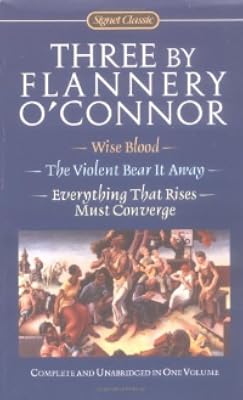
The Violent Bear It Away / Everything That Rises Must Converge / Wise Blood
by Flannery O'Connor 
On This Page
Description
Flannery O'Connor's provocative and critically-acclaimed works have established her reputation as one of America's most original authors, and three of them are available in this collection: "Wise Blood, The Violent Bear It Away" and "Everything That Rises Must Converge". Afterword by author Dorothy Allison.Tags
Recommendations




Member Reviews
Wise Blood is weird, The Violent Bear It Away lives up to its name in violence, and the short stories are mostly good. The best of the latter by far is “Revelation.” This stars Mrs. Turpin, one of the earliest Karens in American fiction. I have read this many times, and I will likely read it many times again.
This is quite the body of work. I’m not quite sure where to begin, so, this book. I have the 6th printing of the 1983 Signet Classics edition. It’s one of the worst examples of the printer’s craft I have ever seen. The cover is made of horrible brittle card. The paper’s vile. The text column on the obverse shuttles back and forth across the page. That on the reverse is printed right in to the inner margin. This thing was a reading copy when printed. It’s an insult to the contents. They only reason you might want it is for the excellent introduction by Sally Fitzgerald.
I sometimes fall into the trap of thinking that Americans are closer to us culturally than they really are because we share a language. I know the Southern show more states can bear some strange fruit, but these stories really bring it home to you just how alien a culture we’re dealing with here. Not only that, but Old Flanners was herself deeply strange. What the introduction does is lay out those oddities. Without it I would have missed so much, or even entirely misinterpreted the fiction.
Take The Violent Bear it Away. The protagonist is young Tarwater. He lives with his great uncle. If you look at the beats and features of his early life you’ll see they match the story of Moses. That would make the uncle God. Like Moses, Tarwater rejects the call to prophecy and the conflicts of the novel flow from there.
But the uncle shouts in the wilderness, is obsessed with baptism and dies early on (on page one, folks. I’m got giving anything away) so he is also John the Baptist. Which makes Tarwater Christ. Fine. Got it. I know where I am with this set-up, or I thought I did.
As it happens I know a man very like the uncle. By coincidence his name’s John. He doesn’t live in the wilderness or anything; he lives in a council flat, but he’s crazy in the way the uncle is crazy. I don’t mean mentally ill, but crazed, if you know what I mean. He has a number of beliefs about the physical nature of reality of which he would have difficulty finding proofs anywhere outside his own head. He also cannot stop talking about them. Take baptism. I think of this as a naming ceremony. But, (and this is where the introduction was so important) O’Connor believed it to be a working magical rite, as critically important as pulling the rip-cord after you jump. In other words, she believed that the uncle is right and within the world of the novel he IS right.
I’ve seen her characters described as grotesques. I’m also seen a couple of comments by people from the South who consider them realistic. I used to work for a charity for the homeless. If you or I went to view a property we could probably conform to social norms for the short time necessary to trick the landlord into believing we were suitable tenants. Many times I worked with people who were so far over the line that the line was a dot to them. They couldn’t trick the landlord because they couldn’t conceive of the social norms they needed to ape. Some people I’ve met don’t need to fake it. These people are boring. But I wouldn’t consider the non-conformists to be grotesque, just very real. You have to learn the way they’re built before you can successfully interact with them. With a writer as strange and complex as this you can’t learn her ways on a first reading.
This might make it sound as if she’s preachy, but this really is not the case. It’s just that (shock horror) she actually has something to say. And it’s not heavy going. The pages flow over. Probably some sort of genius. show less
I sometimes fall into the trap of thinking that Americans are closer to us culturally than they really are because we share a language. I know the Southern show more states can bear some strange fruit, but these stories really bring it home to you just how alien a culture we’re dealing with here. Not only that, but Old Flanners was herself deeply strange. What the introduction does is lay out those oddities. Without it I would have missed so much, or even entirely misinterpreted the fiction.
Take The Violent Bear it Away. The protagonist is young Tarwater. He lives with his great uncle. If you look at the beats and features of his early life you’ll see they match the story of Moses. That would make the uncle God. Like Moses, Tarwater rejects the call to prophecy and the conflicts of the novel flow from there.
But the uncle shouts in the wilderness, is obsessed with baptism and dies early on (on page one, folks. I’m got giving anything away) so he is also John the Baptist. Which makes Tarwater Christ. Fine. Got it. I know where I am with this set-up, or I thought I did.
As it happens I know a man very like the uncle. By coincidence his name’s John. He doesn’t live in the wilderness or anything; he lives in a council flat, but he’s crazy in the way the uncle is crazy. I don’t mean mentally ill, but crazed, if you know what I mean. He has a number of beliefs about the physical nature of reality of which he would have difficulty finding proofs anywhere outside his own head. He also cannot stop talking about them. Take baptism. I think of this as a naming ceremony. But, (and this is where the introduction was so important) O’Connor believed it to be a working magical rite, as critically important as pulling the rip-cord after you jump. In other words, she believed that the uncle is right and within the world of the novel he IS right.
I’ve seen her characters described as grotesques. I’m also seen a couple of comments by people from the South who consider them realistic. I used to work for a charity for the homeless. If you or I went to view a property we could probably conform to social norms for the short time necessary to trick the landlord into believing we were suitable tenants. Many times I worked with people who were so far over the line that the line was a dot to them. They couldn’t trick the landlord because they couldn’t conceive of the social norms they needed to ape. Some people I’ve met don’t need to fake it. These people are boring. But I wouldn’t consider the non-conformists to be grotesque, just very real. You have to learn the way they’re built before you can successfully interact with them. With a writer as strange and complex as this you can’t learn her ways on a first reading.
This might make it sound as if she’s preachy, but this really is not the case. It’s just that (shock horror) she actually has something to say. And it’s not heavy going. The pages flow over. Probably some sort of genius. show less
perhaps our most underrated author: Wise Blood (1952)(Flannery O'Connor 1925-68) All human nature vigorously resists grace because grace changes us and the change is painful. -Flannery O'Connor
Wise Blood is Flannery O'Connor's grotesque picaresque tale of Hazel Motes of Eastrod, Tennessee; a young man who has come to the city of Taulkinham bringing with him an enormous resentment of Christianity and the clergy. He is in an open state of rebellion against the rigidity of his itinerant preacher grandfather and his strict mother. So when one of the first people he encounters is the blind street preacher Asa Hawks and Motes finds himself both attracted and repelled by Hawks' bewitching fifteen year old daughter Lily Sabbath, he reacts by show more establishing his own street ministry. He founds the "Church without Christ":
Listen you people, I'm going to take the truth with me wherever I go. I'm going to preach it to whoever'll listen at whatever place. I'm going to preach there was no Fall because there was nothing to fall from and no Redemption because there was no Fall and no Judgment because there wasn't the first two. Nothing matters but that Jesus was a liar.
As you can guess the church is singularly unsuccessful, although he does attract a couple of other crackpots: Enoch Emery a young man who works at the zoo and longs for a kind word from anybody; and Onnie Jay Holy, yet another rival preacher who believes Motes when he says he's found a "new jesus."
While at first this cast of bizarre characters, ranging from merely repugnant to truly evil, and the scenes of physical, moral and spiritual degradation through which they pass all seem to be just a little too much, the reader is carried along by O'Connor's sure hand for dark comedy. The book is very funny. But as the story draws to a close, O'Connor's true mission is revealed; Motes loses his fight against faith and he achieves a kind of grace, becoming something like a Christian martyr to atone for his sins. O'Connor has something serious and important to say about the modern human condition and the emptiness of a life without faith. That she is able to disguise this message in such a ribald comic package is quite an achievement.
Reading the book inevitably called to mind Carson McCullers' dreadful book The Heart Is a Lonely Hunter (1940), which made the Modern Library Top 100 Novels of the Twentieth Century list. It too is a Southern gothic, populated by dismal misanthropes. But it is devoid of humor and has nothing to say about the characters and the world they've created. Wise Blood is a superior novel in every sense and really deserves that spot on the list.
GRADE: A
The Violent Bear It Away (1960)(Flannery O'Connor 1925-68)
From the days of John the Baptist until now, the Kingdom of Heaven suffereth violence, and the violent bear it away. -Matthew 11:12
Flannery O'Connor wrote with one of the most distinctive voices in American Literature; a kind of grotesque amalgam of Jonathan Edwards, Charles Brockden Brown, Edgar Allen Poe, and William Faulkner. She perceived the world in starkly Manichean terms, as a struggle between the forces of Light and Dark, Good and Evil. The Violent Bear it Away is a psychomachia--literally a battle for the soul--the story of a backwoods Southern boy named Francis Marion Tarwater (see The Violent Bear it Away and The Bible by Angela Lucey for more on this). The boy's great uncle, an Old Testament style patriarch, kidnapped him away from an uncle, George Rayber, and has raised him to be a prophet of God. Upon his great uncle's death, Tarwater rejects the prophetic mission and heads to the city to live with his uncle, who tries to wean the boy away from the teachings of the great uncle. Through a series of increasingly violent actions Tarwater is eventual driven back to the woods and a final acceptance of God and his own role in God's plans.
This is powerful stuff, O'Connor felt that exaggeration and caricature were more likely to reach a modern audience than more subtle styles ever could. Combine that with her vision of violence as a sort of crucible which forces the individual to make a final choice between Good and Evil, and you've got the makings of a truly disturbing fiction. The book will surely not appeal to all tastes, but it is undeniably affecting and thought provoking.
GRADE: B- show less
Wise Blood is the first novel in this book. It is a grotesque and is described by the author as a comedy about serious issues. I didn't find it comedic. Hypocrisy is a major topic and is explored while considering religious belief. Catholicism was important to the author and from this perspective several gruesome events are used to show that though Catholicism is not as easy as the other religious options, it is the correct choice as other denominations are corrupt and full of hypocrisies. In some ways a more secondary character, Enoch Emery, is more interesting than the main character (Hazel Motes). Enoch was powerfully lonely and this causes him to make decisions that do not have a positive result. This novel was both repulsive and show more thought provoking, though I found some of the presentation of religion to be oversimplified.
(SPOILERS for the next part- sorry, couldn't avoid it)
The Violent Bear It Away is the second novel in this book. This was truly violent and objectionable. The main characters at different times plan to kill and finally actually kill a child with an intellectual disability. The characters all assume that something is wrong with the child (Bishop) existing as he is and he becomes their focus in dealing with the issues that have been inculcated by the senior Tarwater. The younger Tarwater was not a likeable character- he both drowns and baptizes Bishop and doesn't seem to understand the reality of the situation, which is that he killed a child! All of the characters have horrible things happen to them, and though one wants to empathize with their situation, in the end they are all so violent themselves that only a general sense of pity can be roused. This was a better written novel than Wise Blood but I found it appalling.
The final part of the book is a collection of short stories, Everything that Rises Must Converge. A lot of issues rise. The collection demonstrates that complex issues such as racism and sexism are not cleanly resolved by laws, social pressures, and more fully educating a younger generation. As blatantly offensive as some of the views of the older generation are, the younger generation behave in ways that are also quite offensive, for other reasons. Many of the characters live off of older mothers, calling them "Sweetheart," which is not an endearment in this situation, and disrespecting them while at the same time relying on them for financial support.
This was not an enjoyable book but it was a worthy book to read and the idea that hypocrisy is offensive remains relevant. I do question the value of the grotesque genre when taken to this extreme. It seems to interfere with clarity and makes it impossible to like any of the characters. show less
(SPOILERS for the next part- sorry, couldn't avoid it)
The Violent Bear It Away is the second novel in this book. This was truly violent and objectionable. The main characters at different times plan to kill and finally actually kill a child with an intellectual disability. The characters all assume that something is wrong with the child (Bishop) existing as he is and he becomes their focus in dealing with the issues that have been inculcated by the senior Tarwater. The younger Tarwater was not a likeable character- he both drowns and baptizes Bishop and doesn't seem to understand the reality of the situation, which is that he killed a child! All of the characters have horrible things happen to them, and though one wants to empathize with their situation, in the end they are all so violent themselves that only a general sense of pity can be roused. This was a better written novel than Wise Blood but I found it appalling.
The final part of the book is a collection of short stories, Everything that Rises Must Converge. A lot of issues rise. The collection demonstrates that complex issues such as racism and sexism are not cleanly resolved by laws, social pressures, and more fully educating a younger generation. As blatantly offensive as some of the views of the older generation are, the younger generation behave in ways that are also quite offensive, for other reasons. Many of the characters live off of older mothers, calling them "Sweetheart," which is not an endearment in this situation, and disrespecting them while at the same time relying on them for financial support.
This was not an enjoyable book but it was a worthy book to read and the idea that hypocrisy is offensive remains relevant. I do question the value of the grotesque genre when taken to this extreme. It seems to interfere with clarity and makes it impossible to like any of the characters. show less
I never know how to rate her stuff; she's brilliant, because her characters are relentlessly real-- and at the same time, I can't stand to be exposed to them.
I read two of the novels in this compilation; The Violent Bear it Away and Wise Blood. Confusing, sinister and riveting, O'Connor's writing is surreal, with complex story lines where you have to re-read certain passages to determine whether the action is a dream or is actual. Characters are genuine and strange; her writing is superb.
Feeling that I had not been open to her writing before, I recently decided to read "A Good Man is Hard to Find" but only got through this one before tossing this book aside. If you love metaphors and descriptive works that bring you to the feel of a place, this book might be for you.
It was not for me however, in that it seems only to display the lowest aspects of all human life in the story, with no positive argument whatsoever for the survival of the human race. In reading her biography, she appears to dismiss all critics who did not like her work as unsophisticated readers or (worse!) "northern readers". Having lived in the south for fifteen years and having a passing acquaintance with her hometown of Milledgeville, I am familiar show more with the hostility of some of her neighbors who share her views. She did win literary awards as well as fans, and there is no question that she had great talent for graphic "gothic" writing. I feel that I can always read the newspapers if I want to revel in misery and brutality though, and when I want to read something , I usually look forward to a positive experience, a scary experience, or at least an enlightening one in literature. show less
It was not for me however, in that it seems only to display the lowest aspects of all human life in the story, with no positive argument whatsoever for the survival of the human race. In reading her biography, she appears to dismiss all critics who did not like her work as unsophisticated readers or (worse!) "northern readers". Having lived in the south for fifteen years and having a passing acquaintance with her hometown of Milledgeville, I am familiar show more with the hostility of some of her neighbors who share her views. She did win literary awards as well as fans, and there is no question that she had great talent for graphic "gothic" writing. I feel that I can always read the newspapers if I want to revel in misery and brutality though, and when I want to read something , I usually look forward to a positive experience, a scary experience, or at least an enlightening one in literature. show less
Members
- Recently Added By
Lists

Stephen King's 'Danse Macabre' reading list
111 works; 25 members

Undiscovered Classics to Read
70 works; 15 members
Author Information

181+ Works 29,973 Members
Flannery O'Connor was born in Savannah, Georgia. She had a quiet, bookish life as a child before attending Georgia State College for Women and going on tot he Writers Workshop at the State University of Iowa, where she earned a Master of Fine Arts degree. Her 1949 dissertation consisted of six short stories, one of which she developed into her show more first novel, Wise Blood (1952). Wise Blood is the story of a fanatical, wandering preacher who sets out to found a "church of truth without Jesus Christ crucified." The book introduces some of the religious themes that run throughout O'Connor's later work. Her second novel, The Violent Bear It Away (1960), is the story of murder involving a Tennessee backwoods preacher and a small boy. Once again, O'Connor explores unusual manifestation of religion and human eccentricities. Although O'Connor produced only a small body of work during her relatively brief lifetime, she has received much critical attention. O'Connor suffered from lupus, an inherited disease, which crippled her and cut short her life, and so her creative work was largely compressed within a decade of the 1950's. Her father also dies of Lupus when she was 15 years old. O'Connor is frequently praised as being the most creative and distinctive writer of this period. The two most notable aspects of her fiction are its religious themes and its commentary on the oppressive traditions of the mid-twentieth-century Deep South. (Bowker Author Biography) show less
Flannery O'Connor has a Legacy Library. Legacy libraries are the personal libraries of famous readers, entered by LibraryThing members from the Legacy Libraries group.
Work Relationships
Is contained in
Common Knowledge
- Canonical title
- The Violent Bear It Away / Everything That Rises Must Converge / Wise Blood
- Disambiguation notice
- There are two versions of Three (or 3); this page is for the one which contains the works Wise Blood, Everything That Rises Must Converge, and The Violent Bear it Away. If your book appears on this page but contains A Good M... (show all)an Is Hard to Find instead of Everything That Rises Must Converge, please separate it from this work and combine it with the other version of Three.
Classifications
Statistics
- Members
- 1,551
- Popularity
- 14,803
- Reviews
- 13
- Rating
- (4.21)
- Languages
- English
- Media
- Paper
- ISBNs
- 9
- ASINs
- 7