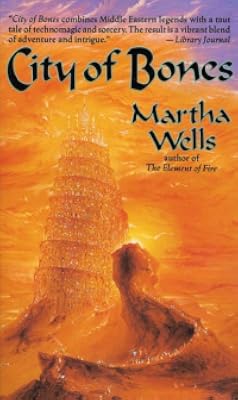
City of Bones
by Martha Wells 
On This Page
Description
Khat, a member of a humanoid race created by the Ancients to survive in the Waste, and Sagai, his human partner, are relic dealers working on the edge of society, trying to stay one step ahead of the Trade Inspectors and to support Sagai's family. When Khat is hired to find relics believed to be part of one of the Ancients' arcane engines, they are both reluctant to become involved. But the request comes from the Warders, powerful mages who serve Charisat's Elector. Khat soon discovers that show more the deadly politics of Charisat's upper tiers aren't the only danger. The relics the Warders want are the key to an Ancient magic of unknown power, and, as all the inhabitants of Charisat know, no one understands the Ancients' magic. show lessTags
Recommendations










Member Reviews
*Free e-book ARC made available by the publisher through Edelweiss Plus - thank you!*
Khat is a krisman living in the city of Charisat, an outsider and second-class citizen, but he has built a life and a partnership with Sagai. They deal in relics of an ancient people who left behind only hints of the technologies people were once proficient in, the Waste where most krismen live, and the kris themselves. Then, a powerful Warder demands Khat's help, first as a guide into the Waste, and then in finding two specific relics that may help unlock the past.
I really enjoyed the time I spent with Khat, Sagai and Elen, the understudy of the powerful Warder who works most closely with the pair in their adventures. The world-building and show more descriptions of the city were complicated, and while I like a good complex world, it did slow things down for me in the beginning as I struggled to wrap my head around what everything must look like. But the characters are great, their struggles and initial distrust of each other believable and empathetic, and I became invested in their story. I will look forward to reading more of Wells's backlist. show less
Khat is a krisman living in the city of Charisat, an outsider and second-class citizen, but he has built a life and a partnership with Sagai. They deal in relics of an ancient people who left behind only hints of the technologies people were once proficient in, the Waste where most krismen live, and the kris themselves. Then, a powerful Warder demands Khat's help, first as a guide into the Waste, and then in finding two specific relics that may help unlock the past.
I really enjoyed the time I spent with Khat, Sagai and Elen, the understudy of the powerful Warder who works most closely with the pair in their adventures. The world-building and show more descriptions of the city were complicated, and while I like a good complex world, it did slow things down for me in the beginning as I struggled to wrap my head around what everything must look like. But the characters are great, their struggles and initial distrust of each other believable and empathetic, and I became invested in their story. I will look forward to reading more of Wells's backlist. show less
I came to 'City Of Bones' via the 'Murderbot Diaries' I'd read each instalment as came out and enjoyed them all. The next one won't be released for another eight month's so I decided to try out Martha Wells' back catalogue.
I found 'City Of Bones', released in 2007, a decade before Murderbot, and what a find it turned out to be. How did I miss it back in 2007? Well, perhaps I read the publisher's summary which makes it sound like Indiana Jones meets Alladin, and passed. The actual story is much more original.
It tells of powerful people competing to find and control artefacts of an ancient technology that they think will give them powers that are almost magical. The story is set in a world that long ago was turned almost entirely into a show more deadly desert, leaving the remnants of humanity living in small stone cities built into coastal cliffs. The only people who can move freely through the desert are the Kris, a humanoid race bioengineered by the last of the ancient technologists to survive the worst the desert can do and with whom humanity has an uneasy relationship.
From the start, I found 'City Of Bones' to be breathtakingly good. The world the action took place in was original, credible, richly detailed and very strange. From the outside, these look like people who are struggling to survive, trapped between desert and sea in a city carved into the cliff. A city they'd no longer be able to build and in which society is literally stratified, with the poorest people living at the bottom and the elite having a great view from the top.
From the inside, it doesn't feel like that. This society is hundreds of years old. It has survived the really bad times. It's thriving. The city is expanding. It's elite have ambitions to control neighbouring cities and history is interesting only to academics unless it yields usable technology. I think this inside view is often missing from post-apocalyptic novels. People don't spend generations regretting what was lost. They focus on what they have, what they need and how they can close the gap.
One of the things I liked most about the story was that Martha Wells presents it from the point of view of outsiders. Khat, the main character, is a Krisman, His partner is an immigrant from a neighbouring city who, although he used to be an academic, is not allowed to be a member of the University. Both of them are excluded from official commerce, which is reserved for citizens. This excluded pair make their living on the shady edges of the trade in ancient artefacts and try not to come to the notice of the authorities. Martha Wells understands that the excluded need to see the society they live in very clearly in order to survive.
Khat is charismatic, intelligent, loyal, lethal and a little broken. An early trauma resulted in him exiling himself from his people to live among humans. It also left him with a deep fear of confinement and almost no ability to trust anyone. Khat's emotional detachment seems like a survival trait when we first meet him but, as we get to know him better, it becomes clear that it is a manifestation of a crippling emotional scar.
I liked that Martha Wells didn't trivialise this. She recognises that there are scars that don't heal and experiences that you don't recover from. Khat has built himself a life where he is surrounded by people who accept him for what he's become not out of charity but because they carry scars of their own. Perhaps Khat's biggest achievement is that he has made one friend that he will trust with his life.
All of which will be familiar to those of us who love reading Murderbot.
The plot reads like a thriller wrapped around a treasure hunt, except that Khat isn't thrilled. Hee doesn't want to be there but he can't find a way leave and the treasure being hunted may very well be a curse.
These days, a good Fantasy Thriller needs a heroine to save the day and Martha Wells gives us one. In a normal fantasy novel, our heroine would be presented as bright, brave, more talented than she knows and determined to make things better. Martha Wells gives our heroine all those attributes but also gives us Khat's view of her as naive and unconscious of her privilege.
The relationship between her (the princess-in-waiting / Jedi not yet come into her full powers) and Khat, (the excluded, scarred, survivor) is fascinating. Instead of the normal denied-attraction-blooming-into-romance trope, we have something more complex and truer to the nature of both people.
I had a lot of fun with this book and I'll be dipping into more of Martha Well's back catalogue soon. show less
I found 'City Of Bones', released in 2007, a decade before Murderbot, and what a find it turned out to be. How did I miss it back in 2007? Well, perhaps I read the publisher's summary which makes it sound like Indiana Jones meets Alladin, and passed. The actual story is much more original.
It tells of powerful people competing to find and control artefacts of an ancient technology that they think will give them powers that are almost magical. The story is set in a world that long ago was turned almost entirely into a show more deadly desert, leaving the remnants of humanity living in small stone cities built into coastal cliffs. The only people who can move freely through the desert are the Kris, a humanoid race bioengineered by the last of the ancient technologists to survive the worst the desert can do and with whom humanity has an uneasy relationship.
From the start, I found 'City Of Bones' to be breathtakingly good. The world the action took place in was original, credible, richly detailed and very strange. From the outside, these look like people who are struggling to survive, trapped between desert and sea in a city carved into the cliff. A city they'd no longer be able to build and in which society is literally stratified, with the poorest people living at the bottom and the elite having a great view from the top.
From the inside, it doesn't feel like that. This society is hundreds of years old. It has survived the really bad times. It's thriving. The city is expanding. It's elite have ambitions to control neighbouring cities and history is interesting only to academics unless it yields usable technology. I think this inside view is often missing from post-apocalyptic novels. People don't spend generations regretting what was lost. They focus on what they have, what they need and how they can close the gap.
One of the things I liked most about the story was that Martha Wells presents it from the point of view of outsiders. Khat, the main character, is a Krisman, His partner is an immigrant from a neighbouring city who, although he used to be an academic, is not allowed to be a member of the University. Both of them are excluded from official commerce, which is reserved for citizens. This excluded pair make their living on the shady edges of the trade in ancient artefacts and try not to come to the notice of the authorities. Martha Wells understands that the excluded need to see the society they live in very clearly in order to survive.
Khat is charismatic, intelligent, loyal, lethal and a little broken. An early trauma resulted in him exiling himself from his people to live among humans. It also left him with a deep fear of confinement and almost no ability to trust anyone. Khat's emotional detachment seems like a survival trait when we first meet him but, as we get to know him better, it becomes clear that it is a manifestation of a crippling emotional scar.
I liked that Martha Wells didn't trivialise this. She recognises that there are scars that don't heal and experiences that you don't recover from. Khat has built himself a life where he is surrounded by people who accept him for what he's become not out of charity but because they carry scars of their own. Perhaps Khat's biggest achievement is that he has made one friend that he will trust with his life.
All of which will be familiar to those of us who love reading Murderbot.
The plot reads like a thriller wrapped around a treasure hunt, except that Khat isn't thrilled. Hee doesn't want to be there but he can't find a way leave and the treasure being hunted may very well be a curse.
These days, a good Fantasy Thriller needs a heroine to save the day and Martha Wells gives us one. In a normal fantasy novel, our heroine would be presented as bright, brave, more talented than she knows and determined to make things better. Martha Wells gives our heroine all those attributes but also gives us Khat's view of her as naive and unconscious of her privilege.
The relationship between her (the princess-in-waiting / Jedi not yet come into her full powers) and Khat, (the excluded, scarred, survivor) is fascinating. Instead of the normal denied-attraction-blooming-into-romance trope, we have something more complex and truer to the nature of both people.
I had a lot of fun with this book and I'll be dipping into more of Martha Well's back catalogue soon. show less
Not murderbot! but better than Rakusa. I've tagged it as fantasy, but there's a bit of SF corssover in there too. It's based on a dystopian collapsed world where something the Ancients did managed to cause the rise of the Wastes. The Survivors managed to limit the disaster a little bit, and now generations on, people are as they've ever been, greedy and selfish but with compassion where it can be afforded.
In a tiered City the ruling class live lives of luxury while the poorer struggle with contaminated water and crowded spaces. Life goes on, but every now and then fragments of Ancient artifcats come to light and provide a little excess. Kris isn't struggling too badly, but very suspicious when one of the city's elite asks him to lead an show more expedition into the Waste. His race can do so, and he badly needs the funds, and so accepts, against the wiser heads of his partner and family. It goes as well as you might expect.
Inventive and clever, as always with Wells. The characters don't quite engage and it's perhaps missing a little bit of humour and banter between them. The romance is gently handled and delicate. I was less convinced by the motivations of the 'Bad Guys' but greed is universal. More to be explored in this universe. show less
In a tiered City the ruling class live lives of luxury while the poorer struggle with contaminated water and crowded spaces. Life goes on, but every now and then fragments of Ancient artifcats come to light and provide a little excess. Kris isn't struggling too badly, but very suspicious when one of the city's elite asks him to lead an show more expedition into the Waste. His race can do so, and he badly needs the funds, and so accepts, against the wiser heads of his partner and family. It goes as well as you might expect.
Inventive and clever, as always with Wells. The characters don't quite engage and it's perhaps missing a little bit of humour and banter between them. The romance is gently handled and delicate. I was less convinced by the motivations of the 'Bad Guys' but greed is universal. More to be explored in this universe. show less
Martha Wells never disappoints. I am so, so glad that her backlist is getting rereleased (and revised! So it's up to her current awesome writing abilities!) because I've been wanting to read them and they're hard to find. On to the review:
City of Bones is about Khat, who is a very Martha Wells main character, and by that I mean that he is a bit of an outsider, both from his own people and from the city he lives in, and has some past trauma which makes him angry, snarky and mistrustful of others. Literally my favorite character type, a thing I did not know before reading her books. This city is a city-state in a dry and barren world, centuries after a cataclysmic event burned up the seas and destroyed the ancient civilization. Khat is a show more krismen, a people descended from magically bio-engineered humans to be able to survive in the toxic desert wasteland that is most of the world now. They are mistrusted by ordinary humans for this ability, and the regular humans all live in tightly packed cities with strict water regulations for the poor. Khat and his partner, a scholar from another city-state and therefore almost as much of an outsider as Khat, trade in relics of the ancient peoples. It's a living, and it allows them the opportunity to get to see and study the fascinating ancient civilization without being in the scholars guild. Then Khat is hired to take a nobleman out to a ruin left from the ancients, and inadvertantly gets involved in a struggle for power and magic which goes up to the highest levels of the city. Literally, because the city is tiered, with the ruler living in lush tropical luxury at the top.
I just love Khat as a character. And I love the consistency with which he is characterized. There is something that happens towards the end of the book which in nearly every other story would have gone a certain way, but Martha Wells doesn't force her characters to change to fit society, and readers, expectations and it works so well.
The world building is also fascinating. The current state of the world is grim, but people persevere as they do, and adapt, sometimes well and sometimes ruthlessly. The glimpses of understanding we get of the ancient world adds depth to the current state of things. but there is a huge amount people do not know about them, which from an archealogical standpoint rings very true. Most of what Khat and his partner trade in are pottery shards, tile pieces and bits of metal. What they, and we as readers, know about the ancients is so small compared to what there is to know, but watching things unfold and slowly getting to glimpse more is riveting.
The only downside is that this is a standalone. I know! Usually I would not complain about that, there are so few. But I love the world and the characters and while I am glad this particular story of theirs is complete, I would love to read about their next adventures. Thank you thank you to tordotcom and NetGalley for access to the eARC in exchange for an honest review. show less
City of Bones is about Khat, who is a very Martha Wells main character, and by that I mean that he is a bit of an outsider, both from his own people and from the city he lives in, and has some past trauma which makes him angry, snarky and mistrustful of others. Literally my favorite character type, a thing I did not know before reading her books. This city is a city-state in a dry and barren world, centuries after a cataclysmic event burned up the seas and destroyed the ancient civilization. Khat is a show more krismen, a people descended from magically bio-engineered humans to be able to survive in the toxic desert wasteland that is most of the world now. They are mistrusted by ordinary humans for this ability, and the regular humans all live in tightly packed cities with strict water regulations for the poor. Khat and his partner, a scholar from another city-state and therefore almost as much of an outsider as Khat, trade in relics of the ancient peoples. It's a living, and it allows them the opportunity to get to see and study the fascinating ancient civilization without being in the scholars guild. Then Khat is hired to take a nobleman out to a ruin left from the ancients, and inadvertantly gets involved in a struggle for power and magic which goes up to the highest levels of the city. Literally, because the city is tiered, with the ruler living in lush tropical luxury at the top.
I just love Khat as a character. And I love the consistency with which he is characterized. There is something that happens towards the end of the book which in nearly every other story would have gone a certain way, but Martha Wells doesn't force her characters to change to fit society, and readers, expectations and it works so well.
The world building is also fascinating. The current state of the world is grim, but people persevere as they do, and adapt, sometimes well and sometimes ruthlessly. The glimpses of understanding we get of the ancient world adds depth to the current state of things. but there is a huge amount people do not know about them, which from an archealogical standpoint rings very true. Most of what Khat and his partner trade in are pottery shards, tile pieces and bits of metal. What they, and we as readers, know about the ancients is so small compared to what there is to know, but watching things unfold and slowly getting to glimpse more is riveting.
The only downside is that this is a standalone. I know! Usually I would not complain about that, there are so few. But I love the world and the characters and while I am glad this particular story of theirs is complete, I would love to read about their next adventures. Thank you thank you to tordotcom and NetGalley for access to the eARC in exchange for an honest review. show less
I enjoyed this author’s “Murderbot” series so much that I decided to tackle her backlist, and with this book was not disappointed at all.
City of Bones is a standalone fantasy that takes place more than a thousand years after the time of the “Ancients.” Khat and Sagai are partners working in the city of Charisat who deal in relics from the Ancient Civilization. Both of them would rather have been scholars of ancient artifacts instead of just market traders, but neither would be admitted to the halls of Charisat’s academia: Sagai is a foreigner from another city, and Khat is a “krisman” - a different breed altogether.
The Kris are mostly human, having been genetically engineered by the Ancients to survive in the Waste, the show more large arid and desolate area that replaced the sea and destroyed the Ancients's way of life. The impetus for this cataclysmic event is a mystery to current inhabitants of the world, who are trying to piece together the fragments of text and objects they find to determine what happened and perhaps even to replicate aspects of the Ancients’s clearly more advanced civilization.
[The Waste seems a bit like a volcanic area, and the relics traded are quite evocative of those of Pompeii. But Wells’s world-building goes way beyond known references. Nevertheless, readers can clearly envision the landscapes she creates despite their alien nature.]
As the story begins, Khat is hired by a Warder, a mage from the ruling class, to help locate particular relics the mages believe will further their quest to find the key to Ancient magic. Khat is reluctant, but one doesn’t easily refuse the powerful. He guides a group to the Waste to the site of one of the Remnants - mysterious structures that may yield clues.
In the course of the journey, the group is attacked by Waste pirates, and Khat helps the Warder escape. The two become close, and work together to defeat all the forces arrayed to stymie their efforts and destroy them as well.
Evaluation: Wells’s world-building is outstanding, but it is the protagonists who make this author’s works so appealing. As in her later books, Wells has created endearing characters who manage to have integrity and nobility even in the midst of violence and cruelty. I found this book, like the others by her I read, to be both intellectually and emotionally rewarding. show less
City of Bones is a standalone fantasy that takes place more than a thousand years after the time of the “Ancients.” Khat and Sagai are partners working in the city of Charisat who deal in relics from the Ancient Civilization. Both of them would rather have been scholars of ancient artifacts instead of just market traders, but neither would be admitted to the halls of Charisat’s academia: Sagai is a foreigner from another city, and Khat is a “krisman” - a different breed altogether.
The Kris are mostly human, having been genetically engineered by the Ancients to survive in the Waste, the show more large arid and desolate area that replaced the sea and destroyed the Ancients's way of life. The impetus for this cataclysmic event is a mystery to current inhabitants of the world, who are trying to piece together the fragments of text and objects they find to determine what happened and perhaps even to replicate aspects of the Ancients’s clearly more advanced civilization.
[The Waste seems a bit like a volcanic area, and the relics traded are quite evocative of those of Pompeii. But Wells’s world-building goes way beyond known references. Nevertheless, readers can clearly envision the landscapes she creates despite their alien nature.]
As the story begins, Khat is hired by a Warder, a mage from the ruling class, to help locate particular relics the mages believe will further their quest to find the key to Ancient magic. Khat is reluctant, but one doesn’t easily refuse the powerful. He guides a group to the Waste to the site of one of the Remnants - mysterious structures that may yield clues.
In the course of the journey, the group is attacked by Waste pirates, and Khat helps the Warder escape. The two become close, and work together to defeat all the forces arrayed to stymie their efforts and destroy them as well.
Evaluation: Wells’s world-building is outstanding, but it is the protagonists who make this author’s works so appealing. As in her later books, Wells has created endearing characters who manage to have integrity and nobility even in the midst of violence and cruelty. I found this book, like the others by her I read, to be both intellectually and emotionally rewarding. show less
Watch out for Martha Wells–I get the feeling she is playing with a different Dungeons and Dragons set than the rest of the world. Rarely has someone in fantasy so consistently impressed me with inventiveness. In City of Bones, she does it again.**
City of Bones is set in the city of Charisat, one of the few major cities remaining after an apocalypse has nearly destroyed humanity. Cities are surrounded by a hostile, desert Waste, and survivors rely on the roads of the Ancients to travel from one city to another. In Charisat, Khat, a krisman, and Sagai, a foreign scholar, are bargaining with a relic trader when they are approached by the entourage of a heavily robed but obviously wealthy individual. The group wants guidance to a nearby show more Ancient Remnant. Of course, Khat has skills as a local expert in Ancient artifacts–but he is all too aware that a kris, he is also expendable. However, there is a debt he’d like to clear and both the guide money and the wealthy patronage could buy him a way out. When the caravan is attacked by pirates in the Waste outside the city, it sets off a chain of complex events that result in Khat working with the mystery person to ‘collect’ two more relics from inside the city of Charisat. The anonymous aristocrat is revealed early on, so I hesitate to say more at the risk of spoilers, but bone prophecies, thievery, the underground market, the academy, ghost spirits–so many elements make this intriguing.
****************************
2018 update: Yep, still good. I tend to wonder when I read a book and love it, what all is playing into it on the first read? Time? Distraction? You get the picture. This remains extremely good, satisfying, as I recently noted on another review. This is despite a lackluster interest in fantasy in general lately. I think because Wells is so damn smart. Highly competent writing, enough description to answer some questions (which only leads to more) and then follows with a solid plot. This is one of her earliest books, published in 1995. Despite that, it is by no means a sophomore slump, and remains one of my favorites.
Notes from this read: the protagonist, Khat, is quite a bit like the sardonic noble-thief in [b:The Death of the Necromancer|321357|The Death of the Necromancer (Ile-Rien, #2)|Martha Wells|https://i.gr-assets.com/images/S/compressed.photo.goodreads.com/books/1287846738l/321357._SY75_.jpg|2510225]. I don't mind. He's a great hero. Two, fight scenes seemed a little weak. Three, it deserves concentration. While the pace initially seems slow, it's because she won't hold your hand later when the plotting escalates. Second read still gave me book-hangover. Fourth, if she ever comes back to this world, I'm there in a flash.
**Wells' release of a 2023 updated version means I have to rework my 2018 review, as GR has inconveniently lumped the two editions together (sigh).
I was extremely interested to discover what choices might be made, decades after it was first published. I'm happy to report that I believe the changes worked very well. In a personal nod to my long-term memory, I think I noticed quite a few of those changes, but that's because this has long been one of my go-to stand-alone fantasy novels. I'll note that it is very tailored to the type of fantasy and sci-fi I grew up with; very much what I think of as 'head voice,' and one-person perspective (okay, she sneaks in another, but not often). If you like the fast pace of Murderbot, or a dialogue-based book or multiple narratives, this might not work. Then again, give it a try. She just might help you develop that long, deep attention span because it's hard to pull away.
Many, many thanks to NetGalley and Tor for an advance reader copy of the 2023 edition. show less
City of Bones is set in the city of Charisat, one of the few major cities remaining after an apocalypse has nearly destroyed humanity. Cities are surrounded by a hostile, desert Waste, and survivors rely on the roads of the Ancients to travel from one city to another. In Charisat, Khat, a krisman, and Sagai, a foreign scholar, are bargaining with a relic trader when they are approached by the entourage of a heavily robed but obviously wealthy individual. The group wants guidance to a nearby show more Ancient Remnant. Of course, Khat has skills as a local expert in Ancient artifacts–but he is all too aware that a kris, he is also expendable. However, there is a debt he’d like to clear and both the guide money and the wealthy patronage could buy him a way out. When the caravan is attacked by pirates in the Waste outside the city, it sets off a chain of complex events that result in Khat working with the mystery person to ‘collect’ two more relics from inside the city of Charisat. The anonymous aristocrat is revealed early on, so I hesitate to say more at the risk of spoilers, but bone prophecies, thievery, the underground market, the academy, ghost spirits–so many elements make this intriguing.
****************************
2018 update: Yep, still good. I tend to wonder when I read a book and love it, what all is playing into it on the first read? Time? Distraction? You get the picture. This remains extremely good, satisfying, as I recently noted on another review. This is despite a lackluster interest in fantasy in general lately. I think because Wells is so damn smart. Highly competent writing, enough description to answer some questions (which only leads to more) and then follows with a solid plot. This is one of her earliest books, published in 1995. Despite that, it is by no means a sophomore slump, and remains one of my favorites.
Notes from this read: the protagonist, Khat, is quite a bit like the sardonic noble-thief in [b:The Death of the Necromancer|321357|The Death of the Necromancer (Ile-Rien, #2)|Martha Wells|https://i.gr-assets.com/images/S/compressed.photo.goodreads.com/books/1287846738l/321357._SY75_.jpg|2510225]. I don't mind. He's a great hero. Two, fight scenes seemed a little weak. Three, it deserves concentration. While the pace initially seems slow, it's because she won't hold your hand later when the plotting escalates. Second read still gave me book-hangover. Fourth, if she ever comes back to this world, I'm there in a flash.
**Wells' release of a 2023 updated version means I have to rework my 2018 review, as GR has inconveniently lumped the two editions together (sigh).
I was extremely interested to discover what choices might be made, decades after it was first published. I'm happy to report that I believe the changes worked very well. In a personal nod to my long-term memory, I think I noticed quite a few of those changes, but that's because this has long been one of my go-to stand-alone fantasy novels. I'll note that it is very tailored to the type of fantasy and sci-fi I grew up with; very much what I think of as 'head voice,' and one-person perspective (okay, she sneaks in another, but not often). If you like the fast pace of Murderbot, or a dialogue-based book or multiple narratives, this might not work. Then again, give it a try. She just might help you develop that long, deep attention span because it's hard to pull away.
Many, many thanks to NetGalley and Tor for an advance reader copy of the 2023 edition. show less
This is not going to be my favourite Martha Wells book. It was first published in 1995 - this means that I was looking at the evolution of Murderbot's creator (All hail, Murderbot!).
It was a NICE, solid fantasy novel. I liked the post-apocalyptic setting and the relic-hunting business. The characters were likable, but not very interesting. After a slow start, the plot became more exciting - yet I found it kind of messy (of a "oh, and then this just happened" variety).
I will definitely be reading more by Martha Wells, but it might be a good idea to go for her more recent books.
It was a NICE, solid fantasy novel. I liked the post-apocalyptic setting and the relic-hunting business. The characters were likable, but not very interesting. After a slow start, the plot became more exciting - yet I found it kind of messy (of a "oh, and then this just happened" variety).
I will definitely be reading more by Martha Wells, but it might be a good idea to go for her more recent books.
Members
- Recently Added By
Lists

Best Fantasy Novels
821 works; 361 members

Jean's Sci Fi/Fantasy Reading list
189 works; 12 members

SF&F Book Chat options
15 works; 1 member

Books Read in 2017
4,249 works; 130 members

Books Read in 2018
4,360 works; 110 members

mom
729 works; 1 member

Books Read in 2024
4,727 works; 128 members

BookTube Fantasy Recommendations
37 works; 1 member
Author Information

89+ Works 48,977 Members
Martha Wells is an American author, born in 1964, based in Texas. She writes fantasy and science fiction novels, novellas, and short stories. Her first novel was, The Element of Fire, published in 1993. Her other work includes City of Bones, The Death of the Necromancer, The Fall of IIe-Rien trilogy, Books of Raksura series, The Murderbot Diaries show more series, and Stargate universe novels. She was awarded the 2017 Nebula Award for Best Novella for All Systems Red (The Murderbot Diaries). (Bowker Author Biography) show less
Martha Wells is a LibraryThing Author, an author who lists their personal library on LibraryThing.
Work Relationships
Is contained in
Common Knowledge
- Canonical title
- City of Bones
- Original publication date
- 1995
- People/Characters
- Khat; Sagai; Elen son Dia'riadin; Sonet Riathen; Aristai Constans
- Dedication
- To Scott McCullar and Nancy Buchanan, for everything
- First words
- Somewhere else, in a room shadowed by age and death, a man readies himself to look into the future for what may be the last time.
- Last words
- (Click to show. Warning: May contain spoilers.)It was too late in the day to get passage on a caravan, so they spent the night at Arad's house, but by morning they were at the docks, and ready to leave the dust of the city behind them.
- Original language
- English
Classifications
Statistics
- Members
- 1,103
- Popularity
- 23,093
- Reviews
- 30
- Rating
- (3.90)
- Languages
- English
- Media
- Paper, Audiobook, Ebook
- ISBNs
- 9
- ASINs
- 3