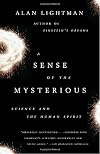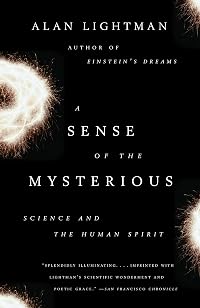
A Sense of the Mysterious: Science and the Human Spirit
by Alan Lightman
On This Page
Description
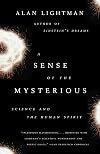
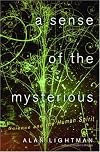
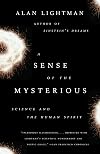
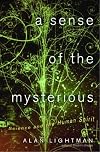
From the bestselling author of Einstein's Dreams comes this lyrical and insightful collection of science writing that delves into the mysteries of the scientific process-physics, astronomy, mathamatics-and exposes its beauty and intrigue.In these brilliant essays, Lightman explores the emotional life of science, the power of imagination, the creative moment, and the alternate ways in which scientists and humanists think about the world. Along the way, he provides in-depth portraits of some show more of the great geniuses of our time, including Albert Einstein, Richard Feynman, Edward Teller, and astronomer Vera Rubin. Thoughtful, beautifully written, and wonderfully original, A Sense of the Mysterious confirms Alan Lightman's unique position at the crossroads of science and art. show lessTags
Recommendations


Member Recommendations
Member Reviews
I've been wondering if the (un)discipline of physics has suffered the fate that so commonly befalls victims: that is, to become the bully. In the jostle for space and acceptance today by religion and science, may one speculate that this is what has happened? I keep meeting physicists who don’t even seem to realise that they are acting in ways which are not dissimilar to the methods of the administration of Christianity and some other religions against which they fought for so long. If only all scientists were forced to do some study of ethics, philosophy, sociology, etc. They don’t seem to understand that just as suspicious, ignorant Christians might once have seen this thing called science as bewitched hokery-pokery, they now show more appear in that position themselves, unwilling – unable? – to understand anything past their tiny area and therefore rejecting its possible legitimacy.
There are those like Rees who, in contrast to the Dawkins ‘type’ (not a physicist, but a spokesman for the more belligerent of them), modestly see areas such as religion and philosophy as outside their purview. Then again, there must be some who are capable in a modern Renaissance way to reflect upon both in an illuminating way and Lightman is one of these. This collection begins with thoughts on the relationship of science to philosophy. Lightman, being both a novelist of note as well as physicist, is entirely comfortable with discussing the nature of words, the differentiated notion of concept for the novelist and the scientist. I don’t know that I altogether agree with his ideas here, but they are thought-provoking. His loving, caring sketches of various eminent men in the field of physics are followed by his laments about his life, his chosen fields, the changed nature of life. I was utterly happy to be up at 5am today engrossed in his lovely prose, his easy way of making me feel like I had half a clue about physics and maths – nothing I’ve been reading lately has come close to giving me an idea about these things. If only I could get across what an accomplishment that is!
Five star. Reading another by him now. show less
There are those like Rees who, in contrast to the Dawkins ‘type’ (not a physicist, but a spokesman for the more belligerent of them), modestly see areas such as religion and philosophy as outside their purview. Then again, there must be some who are capable in a modern Renaissance way to reflect upon both in an illuminating way and Lightman is one of these. This collection begins with thoughts on the relationship of science to philosophy. Lightman, being both a novelist of note as well as physicist, is entirely comfortable with discussing the nature of words, the differentiated notion of concept for the novelist and the scientist. I don’t know that I altogether agree with his ideas here, but they are thought-provoking. His loving, caring sketches of various eminent men in the field of physics are followed by his laments about his life, his chosen fields, the changed nature of life. I was utterly happy to be up at 5am today engrossed in his lovely prose, his easy way of making me feel like I had half a clue about physics and maths – nothing I’ve been reading lately has come close to giving me an idea about these things. If only I could get across what an accomplishment that is!
Five star. Reading another by him now. show less
This book was published in 2006, so some of the information is a little out of date. For example, gravitational waves had been theorized, but not yet measured. This did little to dampen my enthusiasm for the book, though, and I especially liked the profiles of such luminaries as Albert Einstein (the family housekeeper thought him "stupid"), Richard Feynman (the Michael Jordan of physics) and Edward Teller (his life slogan, "Trust nobody."), and discovered things that I did not know about each. Lightman writes with such a sense of awe, it is easy to be captivated and carried away with him as he describes black holes, dark matter and other mysteries of the universe. We even learn a bit about Lightman himself.
Occasionally I decide to read something a bit more educational. This collection of essays, by Alan Lightman, explores how we use science to understand our world. Included are essays on not only how we use our minds, but also about several famous scientists and the complexity of handling the "wired world". The author uses his expertise, not only as a scientist, but as a writer to deliver interesting viewpoints that can be understood by most people without much difficulty. It was enjoyable, for me, to learn a bit more about the process of science and also get a bit of insight into some of the science superstars.
Lightman is an American writer, physicist, and social entrepreneur who served on the faculties of Harvard and the Massachusetts Institute of Technology (MIT) and was the first person at MIT to receive dual faculty appointments in science and in the humanities. From these two vantage points he views the world with wonder. While considering the joys of problem-solving and reasoning he marks the difference of this rewarding life of the mind with the distracting modern world. Along the way he discusses the private and professional lives of Richard P. Feynman (who did not share Lightman's appreciation of the humanities), Einstein (similarly introverted), impressive individualistic mentor Kip Thorne, irascible and controversial Edward Teller, show more and more. show less
Occasionally I decide to read something a bit more educational. This collection of essays, by Alan Lightman, explores how we use science to understand our world. Included are essays on not only how we use our minds, but also about several famous scientists and the complexity of handling the "wired world". The author uses his expertise, not only as a scientist, but as a writer to deliver interesting viewpoints that can be understood by most people without much difficulty. It was enjoyable, for me, to learn a bit more about the process of science and also get a bit of insight into some of the science superstars.
Ratings
Members
- Recently Added By
Published Reviews
ThingScore 75
Like Oliver Sacks, Stephen Jay Gould, Richard Dawkins and countless others, Lightman is that phenomenon mistakenly believed to be rare: a scientist in love with words, one who can write clearly and appealingly about his subject for a lay readership
added by jlelliott
Author Information

42+ Works 11,160 Members
Alan Lightman was born in Memphis, Tennessee on November 28, 1948. After completing an A.B. at Princeton University in 1970, a Ph.D. at the California Institute of Technology in 1974, and postdoctoral studies at Cornell University in 1976, he moved directly into academia, teaching astronomy and physics at Harvard University, the Smithsonian show more Astrophysical Observatory, and the Massachusetts Institute of Technology. In the 1980s, he found a way to combine his literary and scientific interests when he began to write essays about science. He explored astronomy, cosmology, particle physics, space exploration, and the life of a scientist, writing about these topics in a way that makes them understandable to the average reader. Many of his essays can be found in the collections Time Travel and Papa Joe's Pipe and A Modern-Day Yankee in a Connecticut Court and Other Essays on Science. He is the author of Ancient Light: Our Changing View of the Universe, which won the Boston Globe's 1991 Critics' Choice award for non-fiction; and is co-author of Origins: The Lives and Worlds of Modern Cosmologists, which received an award from the Association of American Publishers in 1990. In the 1990's, he branched out into fiction, although still with a focus on science. His novels include Einstein's Dreams, Good Benito, and The Diagnosis. (Bowker Author Biography) show less
Awards and Honors
Awards
Common Knowledge
- Original title
- A Sense of the Mysterious: Science and the Human Spirit
- Original publication date
- 2005
- Original language
- English
Classifications
Statistics
- Members
- 246
- Popularity
- 132,102
- Reviews
- 5
- Rating
- (3.87)
- Languages
- English
- Media
- Paper, Audiobook, Ebook
- ISBNs
- 8
- ASINs
- 2