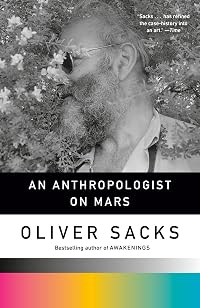
An Anthropologist On Mars: Seven Paradoxical Tales
by Oliver Sacks
On This Page
Description
The author profiles seven neurological patients, including a surgeon with Tourette's syndrome and an artist whose color sense is destroyed in an accident but finds new creative power in black and white.Tags
Recommendations



Member Recommendations

Member Reviews
This book was my car book for a WHILE, meaning it lived in my car and I mostly read it during the 5-10 minutes I waited for my kid in the school pick-up line. It was an ideal book for that purpose: engaging enough to be happy to pick it up each time, but not so gripping that I had a hard time putting it down when it was time to go.
This is the first book I've read by Oliver Sacks, just because I picked up a nice used copy somewhere. The first thing you need to know about this book is that it was originally published in 1995. That was not so relevant in the first two essays, which were both about vision and which I found SO FASCINATING and spent a lot of time repeating to everyone around me. It was, however, VERY relevant in the last two show more essays, which were both about autism.
While parts of those essays were still relevant and interesting, enough to talk me out of my repeated impulses to give up on this book, I had to keep reminding myself over and over that the way we understand and talk about autism has changed SO MUCH in the past three decades, partly due to the work of brain scientists like Sacks. But the way he talks about these case studies... is so othering. Especially given WHO the last case study was. I was repeatedly like, exCUSE ME, are we really CONDESCENDING TO TEMPLE MOTHERFUCKING GRANDIN?
So. The book ended on a frustrating note, but I think it would be INCREDIBLY interesting to see an updated anniversary edition of this book that rewrites or appends the last two essays with updates on Temple Grandin & Stephen and a discussion on how our understanding of autism has rapidly evolved in the recent past. show less
This is the first book I've read by Oliver Sacks, just because I picked up a nice used copy somewhere. The first thing you need to know about this book is that it was originally published in 1995. That was not so relevant in the first two essays, which were both about vision and which I found SO FASCINATING and spent a lot of time repeating to everyone around me. It was, however, VERY relevant in the last two show more essays, which were both about autism.
While parts of those essays were still relevant and interesting, enough to talk me out of my repeated impulses to give up on this book, I had to keep reminding myself over and over that the way we understand and talk about autism has changed SO MUCH in the past three decades, partly due to the work of brain scientists like Sacks. But the way he talks about these case studies... is so othering. Especially given WHO the last case study was. I was repeatedly like, exCUSE ME, are we really CONDESCENDING TO TEMPLE MOTHERFUCKING GRANDIN?
So. The book ended on a frustrating note, but I think it would be INCREDIBLY interesting to see an updated anniversary edition of this book that rewrites or appends the last two essays with updates on Temple Grandin & Stephen and a discussion on how our understanding of autism has rapidly evolved in the recent past. show less
The video-gone-viral featuring "this autistic boy" drawing New York City in amazing detail after a helicopter trip gets a back story and the artist, Stephen Wiltshire, is introduced in the chapter entitled Prodigies. The inclusion of some of Wiltshire's drawings adds immensely to the book, as do the coloured plates in the chapter about the expatriate from an Italian hill town who obsessively painted his home village in great detail, despite not having returned for decades. (He later returned, in the company of Dr. Sacks, to be honoured with a local exhibition in a neighbouring town - his birthplace is now virtually deserted, ironically similar to his unpeopled paintings.)
I can't seem to focus on reading these days, though I'm supposed to be reading brothers karamazov for a book club. I plowed through, this, however, which is a testament to how fascinating these case studies are. It was my first experience with Oliver Sacks, and a wonderful one. I get the feeling I'll be reading his other books in the years to come.
In a way, reading Sacks is like taking a hallucinogen: you realize how many complex mental faculties are required for us to constitute our world. What we perceive as reality is an illusion generated by the coordination of sensory input with higher brain functions like memory. Somewhere along the line you develop something of a sense of self, which, reading these case studies of people whose show more brains work differently from most, is more tenuous than we like to imagine. I didn't actually hallucinate while sitting down with this book, though, unless you consider reading one.
I loved the fable-like quality of some of the scenarios: a painter who becomes colorblind, a surgeon with Tourettic physical tics, another painter who can only make images of his childhood village, so possessed is he by memories of it.
Sacks is a generous observer. He brings to bear great scientific understanding, but also great human empathy for his subjects. The mixture never seems out of balance. His methods are kind of a throwback to a time when science was less cordoned off from humanistic inquiry like philosophy and the arts. Literary and philosophical allusions, as well as constant reference to centuries-old accounts of neurological conditions are only the most obvious evidence of this sensibility. It is a welcome point of view, as his subjects' stories get to some pretty fundamental questions about human existence, which questions, if not explored fully here, are at least evoked with requisite wonder and care. A more strictly scientific or medical approach would not be able to take this more holistic view.
(I want to note that the proliferation of footnotes in this book is outrageous, something I would never normally tolerate. And yet... they were by and large fascinating, each like the best Wikipedia page you've ever stumbled upon.) show less
In a way, reading Sacks is like taking a hallucinogen: you realize how many complex mental faculties are required for us to constitute our world. What we perceive as reality is an illusion generated by the coordination of sensory input with higher brain functions like memory. Somewhere along the line you develop something of a sense of self, which, reading these case studies of people whose show more brains work differently from most, is more tenuous than we like to imagine. I didn't actually hallucinate while sitting down with this book, though, unless you consider reading one.
I loved the fable-like quality of some of the scenarios: a painter who becomes colorblind, a surgeon with Tourettic physical tics, another painter who can only make images of his childhood village, so possessed is he by memories of it.
Sacks is a generous observer. He brings to bear great scientific understanding, but also great human empathy for his subjects. The mixture never seems out of balance. His methods are kind of a throwback to a time when science was less cordoned off from humanistic inquiry like philosophy and the arts. Literary and philosophical allusions, as well as constant reference to centuries-old accounts of neurological conditions are only the most obvious evidence of this sensibility. It is a welcome point of view, as his subjects' stories get to some pretty fundamental questions about human existence, which questions, if not explored fully here, are at least evoked with requisite wonder and care. A more strictly scientific or medical approach would not be able to take this more holistic view.
(I want to note that the proliferation of footnotes in this book is outrageous, something I would never normally tolerate. And yet... they were by and large fascinating, each like the best Wikipedia page you've ever stumbled upon.) show less
Oliver Sacks wrote profound stuff. the stories of cases he’s managed or been aware of or studies all put perspective on the human condition. like all his books, this one is a collection of recollections about people he’s studied and/or helped over the years.
centering around skewed perceptions of color, sight, sound, detail acuity, and generally the way some people process stimuli from the world, express themselves, and interact with it, this set of notes really brings into sharp relief the artistic, social misfit, and mystical underpinnings of humanity. reading about the 3D VR world created by temporal lobe epilepsy and the people who experience it one cannot escape thinking about the awe surrounding certain historical figures. how show more people with extraordinary skills and insights given them by these “disorders” might have been elevated to guru, visionary, leader, shaman, prophet. Sacks all but says this outright in his story about Greg, “The Last Hippie” where a man with an undiagnosed benign meningioma was almost deified by the Krishnas as “transcendental” and saintlike. Sacks himself described him as “Buddha-like” and beatific. the book ends with Temple Grandin, not only a well-known and high-functioning austic person but a paragon of rationality and ethics, dissembling about possible divine retribution, immortality, and life after death. Sacks also mentions people fictional and otherwise who might now be recognized as having autism: Sherlock Holmes, the blessed fools of Russia, one of the follower’s of Saint Francis, etc. how many people throughout history have suffered thus and been proclaimed either insane or exalted? how many people in everyday life undergo similar processes but to a much lesser extent? maybe their tumor isn’t as big or invasive, maybe their epilepsy isn’t as pronounced, maybe autism is more of a spectrum than we think, maybe they have the precursors of whatever causes Tourette’s but it does not manifest as tics in them, instead sublimating into other feelings, behaviors, and perceptions?
Sacks always causes me to rethink my interactions with others and how i interpret their behavior. i know from my own experience, reason, and many studies on human communication, that we cannot merely look upon someone and know what they are thinking or feeling. there is no one-to-one relationship between outward expression and inward experience nor any consistency of that between humans. there are tendencies, yes, and, in general, we can learn the body language and idiomatic meanings of social interactions within our given cultures but the universality of emotional expression is very limited. fewer facial expressions are ubiquitous across cultures than most people would guess. the tales Sacks tells highlight this. the very title of the book, taken from a self-descriptive quote by Temple Grandin, activates cognitive nodes in my mind leading to thoughts of the study of alien cultures, odd and non-usual modes of the body’s senses, and offers a rational framework from which to understand and integrate these facts about what it means to be human. show less
centering around skewed perceptions of color, sight, sound, detail acuity, and generally the way some people process stimuli from the world, express themselves, and interact with it, this set of notes really brings into sharp relief the artistic, social misfit, and mystical underpinnings of humanity. reading about the 3D VR world created by temporal lobe epilepsy and the people who experience it one cannot escape thinking about the awe surrounding certain historical figures. how show more people with extraordinary skills and insights given them by these “disorders” might have been elevated to guru, visionary, leader, shaman, prophet. Sacks all but says this outright in his story about Greg, “The Last Hippie” where a man with an undiagnosed benign meningioma was almost deified by the Krishnas as “transcendental” and saintlike. Sacks himself described him as “Buddha-like” and beatific. the book ends with Temple Grandin, not only a well-known and high-functioning austic person but a paragon of rationality and ethics, dissembling about possible divine retribution, immortality, and life after death. Sacks also mentions people fictional and otherwise who might now be recognized as having autism: Sherlock Holmes, the blessed fools of Russia, one of the follower’s of Saint Francis, etc. how many people throughout history have suffered thus and been proclaimed either insane or exalted? how many people in everyday life undergo similar processes but to a much lesser extent? maybe their tumor isn’t as big or invasive, maybe their epilepsy isn’t as pronounced, maybe autism is more of a spectrum than we think, maybe they have the precursors of whatever causes Tourette’s but it does not manifest as tics in them, instead sublimating into other feelings, behaviors, and perceptions?
Sacks always causes me to rethink my interactions with others and how i interpret their behavior. i know from my own experience, reason, and many studies on human communication, that we cannot merely look upon someone and know what they are thinking or feeling. there is no one-to-one relationship between outward expression and inward experience nor any consistency of that between humans. there are tendencies, yes, and, in general, we can learn the body language and idiomatic meanings of social interactions within our given cultures but the universality of emotional expression is very limited. fewer facial expressions are ubiquitous across cultures than most people would guess. the tales Sacks tells highlight this. the very title of the book, taken from a self-descriptive quote by Temple Grandin, activates cognitive nodes in my mind leading to thoughts of the study of alien cultures, odd and non-usual modes of the body’s senses, and offers a rational framework from which to understand and integrate these facts about what it means to be human. show less
Here's a thin balance between the unsentimental reporting of bizarre conditions and impairments, and, the deeply human depictions of the individuals having to experience them. Oliver Sacks is a scientist, but he knows to put his patients before their afflictions. It makes for both a vivid and instructive read. It makes, above all, for a bizarre journey through the baffling inner corners of our brains!
There are seven individuals whose conditions are portrayed in here; allowing Sacks to delve from our how we perceive the world around us to memory, from our sense of self to how, bottom line, we define so-called 'disabilities'. Some stories are echoing each others (eg. the colour-blind painter and the blind man who 'regained' sight). Some show more feel like celebrity portraits, as when he interacts with a couple of amazing characters famous for their savant skills (eg. Stephen Wiltshire, Temple Grandin). All, though, are a startling testimony to brain plasticity, and all the bizarre and intricate modelling and re-modelling our minds can come up with to adjust to pretty much any situations - even if with weird yet fascinating consequences.
I only have one reservation: the author is at times so captivated and admirative of his subjects that, he tells us more about them as individuals than about their conditions. I have learnt a lot on achromatopsia, agnosia, and amnesia; not so much on savant syndrome... Yet, I felt there were more pages dedicated to such autistic individuals than others! (Or was it just my impression?)
This aside, here's an engrossing journey into the land of the bizarre: the human mind.
'Defects, disorders, diseases (…) can play a paradoxical role, by bringing out latent powers, developments, evolutions, forms of life, that might never be seen, or even be imaginable, in their absence.'
Indeed! A captivating read. show less
There are seven individuals whose conditions are portrayed in here; allowing Sacks to delve from our how we perceive the world around us to memory, from our sense of self to how, bottom line, we define so-called 'disabilities'. Some stories are echoing each others (eg. the colour-blind painter and the blind man who 'regained' sight). Some show more feel like celebrity portraits, as when he interacts with a couple of amazing characters famous for their savant skills (eg. Stephen Wiltshire, Temple Grandin). All, though, are a startling testimony to brain plasticity, and all the bizarre and intricate modelling and re-modelling our minds can come up with to adjust to pretty much any situations - even if with weird yet fascinating consequences.
I only have one reservation: the author is at times so captivated and admirative of his subjects that, he tells us more about them as individuals than about their conditions. I have learnt a lot on achromatopsia, agnosia, and amnesia; not so much on savant syndrome... Yet, I felt there were more pages dedicated to such autistic individuals than others! (Or was it just my impression?)
This aside, here's an engrossing journey into the land of the bizarre: the human mind.
'Defects, disorders, diseases (…) can play a paradoxical role, by bringing out latent powers, developments, evolutions, forms of life, that might never be seen, or even be imaginable, in their absence.'
Indeed! A captivating read. show less
An Anthropologist on Mars showcases Oliver Sacks’s rare ability to write about serious neurological cases while never losing sight of the humanity of his subjects. Where many academic case studies feel distant and clinical, Sacks is sympathetic and deeply attentive to the people behind the diagnoses, which makes the book warmer and more engaging. While he occasionally lingers too long on certain details, it’s easy to skim those sections and return to the core of each narrative.
Oliver Sacks does cognitive science in the best sense. Away from neurons, and systems, and syndromes, and into reality of perception, and different kinds of perception. From a artist who loses his color, to a man who regains his sight, he delves into altered perceptions to find out how the mind works to understand reality. The final half of the book is concerned with autism, and the profoundly strange and isolating world of the autistic. Some people, Temple Grandin particular, have learned to function without any natural theory of mind, treating their time on Earth as a task of brute-force social pattern recognition, being an 'anthropologist on Mars'
Members
- Recently Added By
Lists

Jordan B. Peterson's Recommended Books
104 works; 5 members

My List
302 works; 1 member

neurology
2 works; 1 member

GraceCollection TBR/To Buy List
106 works; 1 member

naturallogg's 2025 in Books
50 works; 1 member
Talk Discussions
Past Discussions
DECEMBER READS - SPOILERS - An Anthropologist on Mars in The Green Dragon (January 2015)
Author Information

66+ Works 43,670 Members
Oliver Sacks was born in London, England on July 9, 1933. He received a medical degree from Queen's College, Oxford University and performed his internship at Middlesex Hospital in London and Mount Zion Hospital in San Francisco. He completed his residency at UCLA. In 1965, he became a clinical neurologist to the Little Sisters of the Poor and show more Beth Abraham Hospital. His work in a Bronx charity hospital led him to write the book Awakenings in 1973. The book inspired a play by Harold Pinter and became a film starring Robert De Niro and Robin Williams. His other works included An Anthropologist on Mars, The Mind's Eye, The Man Who Mistook His Wife for a Hat, Uncle Tungsten, Musicophilia, A Leg to Stand On, On the Move: A Life, and Gratitude. In 2007, he ended his 42-year relationship with the Albert Einstein College of Medicine to accept an interdisciplinary teaching position at Columbia. In 2012, he returned to the New York University School of Medicine as a professor of neurology. He died of cancer on August 30, 2015 at the age of 82. (Bowker Author Biography) show less
Some Editions
Awards and Honors
Work Relationships
Is contained in
Contains
Has as a student's study guide
Common Knowledge
- Canonical title*
- Un antropologo su Marte: sette racconti paradossali
- Original title
- An Anthropologist on Mars
- Original publication date
- 1995
- People/Characters
- Jonathan I.; Greg F.; Carl Bennett; Virgil; Franco Magnani; Stephen Wiltshire (show all 7); Temple Grandin
- Related movies
- At First Sight (1999 | IMDb)
- Epigraph
- The universe is not only queerer than we imagine, but queerer than we can imagine.
J. B. S. Haldane
Ask not what disease the person has, but rather what person the disease has.
(attributed to) William Osler - Dedication
- To the seven whose stories are related here
- First words
- Preface
I am writing this with my left hand, although I am strongly right-handed.
Early in March 1986 I received the following letter:
I am a rather successful artist just past 65 years of age. - Last words
- (Click to show. Warning: May contain spoilers.)I hugged her—and (I think) she hugged me back.
- Original language
- English
*Some information comes from Common Knowledge in other languages. Click "Edit" for more information.
Classifications
- Genres
- General Nonfiction, Science & Nature, Nonfiction
- DDC/MDS
- 616.8 — Applied science & technology Medicine & health Diseases, Allergies, Skin Conditions Nervous Disorders: Autism, Anorexia, OCD
- LCC
- RC351 — Medicine Internal medicine Internal medicine Neurosciences. Biological psychiatry. Neuropsychiatry Neurology. Diseases of the nervous system
- BISAC
Statistics
- Members
- 4,646
- Popularity
- 3,113
- Reviews
- 66
- Rating
- (4.10)
- Languages
- 18 — Catalan, Czech, Danish, Dutch, English, Finnish, French, German, Greek, Hungarian, Italian, Japanese, Polish, Portuguese, Russian, Spanish, Swedish, Turkish
- Media
- Paper, Audiobook, Ebook
- ISBNs
- 70
- UPCs
- 1
- ASINs
- 32