
Rikki-Tikki-Tavi
by Rudyard Kipling 
On This Page
Description
A courageous mongoose thwarts the evil plans of Nag and Nagaina, two big black cobras who live in the garden.Tags
Recommendations




Member Recommendations

Member Reviews
The great war between eternal foes, Mongoose and Serpent. Much like his other Jungle Book tales, Kipling adroitly straddles the fine line between beast and man to deliver a marvelous rendition of nature underscoring its beauty as well as parallel brutality.
I like the odd methodical "aside" nature of Kipling's prose. This story is: Humans and animals illustrating their nature in order for us to contrast with our own nature, to whimsical effect. Short, no decisions. Observant.
I must have read, or listened to, Rikki Tikki Tavi at some point in my life; I wonder if I had an abridged record (yes, I mean vinyl) when I was small. I wonder if I still have it. I knew the basics, but there was a lot more to it than I recalled (if I had a record when I was small, it was probably bowldlerized). I have to give Kipling credit – Rikki Tikki was cocky and self-important – but I liked him.
And the narration by Emma Lysy was a delight. I received this via Audiobookblast.com in exchange for a review. With thanks!
And the narration by Emma Lysy was a delight. I received this via Audiobookblast.com in exchange for a review. With thanks!
The Classic tale of a mongoose pitted against the cobras and welcomed among his human family for it. Set culturally and language wise in the late 1800s, and the ruling classes during the occupation of the British Empire, it may be a little 'dated' but it's a perfect short story of the animal underdog winning the day.
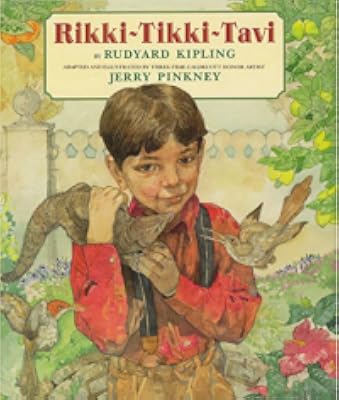
"Rikk-tikk-tikki-tikki-tchk!" A classic story from Rudyard Kipling's The Jungle Book, adapted and illustrated by award-winning artist Jerry Pinkney, this is the tale of Rikki-Tikki-Tavi, a fearless young mongoose. Soon after a flood washes Rikki into the garden of an English family, he comes face-to-face with Nag and Nagaina, two giant cobras. The snakes are willing to attack Rikki, and even the human family who lives there, to claim the garden and house for themselves. But they do not count on the heart and pride of the brave little mongoose.
Rikki-Tikki-Tavi, a mongoose, lives with a small family in India. He finds out that two cobras, Nag and his wife Nagaina, are planning to kill the two adults and their young son Teddy. The clever mongoose decides to protect them and to take on the dangerous snakes. I first got to know this story through the 1970s animated movie and I fell in love with the brave animal. The book is even better.
I've love the story of Rikki-Tikki-Tavi since I was a little boy and this Rudyard Kipling story is complimented by beautiful artwork by Jerry Pinkney who does an excellent job of bringing to life the characters. the story follows Rikki a mongoose as he is taken in by a family and how he protects the little boy from snakes that are trying to kill him.
Members
- Recently Added By
Lists

Favorite Childhood Books
1,646 works; 518 members

Favorite Animal Fiction
359 works; 156 members

A Child's Book Tour of India
71 works; 3 members

Geek Dad Read to Your Kids Additions List
66 works; 4 members

Favorite Short Fiction
228 works; 99 members

Book Titles Mentioned In Newberry Medal And Honor Books
884 works; 3 members

Precious People
119 works; 1 member

Our Favorite Comfort Reads
334 works; 200 members
Talk Discussions
Past Discussions
Rudyard Kiplings's Rikki-Tikki-Tavi by The Prototype Press in Fine Press Forum (August 2023)
Author Information

Kipling, who as a novelist dramatized the ambivalence of the British colonial experience, was born of English parents in Bombay and as a child knew Hindustani better than English. He spent an unhappy period of exile from his parents (and the Indian heat) with a harsh aunt in England, followed by the public schooling that inspired his "Stalky" show more stories. He returned to India at 18 to work on the staff of the Lahore Civil and Military Gazette and rapidly became a prolific writer. His mildly satirical work won him a reputation in England, and he returned there in 1889. Shortly after, his first novel, The Light That Failed (1890) was published, but it was not altogether successful. In the early 1890s, Kipling met and married Caroline Balestier and moved with her to her family's estate in Brattleboro, Vermont. While there he wrote Many Inventions (1893), The Jungle Book (1894-95), and Captains Courageous (1897). He became dissatisfied with life in America, however, and moved back to England, returning to America only when his daughter died of pneumonia. Kipling never again returned to the United States, despite his great popularity there. Short stories form the greater portion of Kipling's work and are of several distinct types. Some of his best are stories of the supernatural, the eerie and unearthly, such as "The Phantom Rickshaw," "The Brushwood Boy," and "They." His tales of gruesome horror include "The Mark of the Beast" and "The Return of Imray." "William the Conqueror" and "The Head of the District" are among his political tales of English rule in India. The "Soldiers Three" group deals with Kipling's three musketeers: an Irishman, a Cockney, and a Yorkshireman. The Anglo-Indian Tales, of social life in Simla, make up the larger part of his first four books. Kipling wrote equally well for children and adults. His best-known children's books are Just So Stories (1902), The Jungle Books (1894-95), and Kim (1901). His short stories, although their understanding of the Indian is often moving, became minor hymns to the glory of Queen Victoria's empire and the civil servants and soldiers who staffed her outposts. Kim, an Irish boy in India who becomes the companion of a Tibetan lama, at length joins the British Secret Service, without, says Wilson, any sense of the betrayal of his friend this actually meant. Nevertheless, Kipling has left a vivid panorama of the India of his day. In 1907, Kipling became England's first Nobel Prize winner in literature and the only nineteenth-century English poet to win the Prize. He won not only on the basis of his short stories, which more closely mirror the ambiguities of the declining Edwardian world than has commonly been recognized, but also on the basis of his tremendous ability as a popular poet. His reputation was first made with Barrack Room Ballads (1892), and in "Recessional" he captured a side of Queen Victoria's final jubilee that no one else dared to address. (Bowker Author Biography) show less
Rudyard Kipling has a Legacy Library. Legacy libraries are the personal libraries of famous readers, entered by LibraryThing members from the Legacy Libraries group.
Some Editions
Series
Belongs to Publisher Series
Work Relationships
Is contained in
Penguin Modern Classics: 10 books set Breakfast at Tiffany's, The Day of the Triffids, The Jungle Books, One Flew Over the Cuckoo's Nest, A Room with a View, Goldfinger, A Clockwork Orange, A Kestrel for a Knave, Lolita and Orlando by Penguin (indirect)
Jungle Book / 2nd Jungle Book / Just So Stories / Puck of Pook's Hill / Stalky and Co. / Kim by Rudyard Kipling (indirect)
The Little Prince and Other Stories (Wordsworth Library Collection) by Wordsworth Editions (indirect)
The Adventure Collection: Treasure Island, The Jungle Book, Gulliver's Travels, White Fang, The Merry Adventures of Robin by Jonathan Swift (indirect)
Has the adaptation
Has as a student's study guide
Common Knowledge
- Original title
- Rikki-Tikki-Tavi
- Original publication date
- 1894
- People/Characters
- Teddy; Father; Mother; Darzee; Rikki-Tikki-Tavi
- Important places
- India
- Important events
- British Raj (1857 | 1947)
- Original language
- English
- Disambiguation notice
- Please do not combine with "... and related stories".
Also dont combine with adapted versions.
Classifications
Statistics
- Members
- 1,085
- Popularity
- 23,517
- Reviews
- 28
- Rating
- (4.09)
- Languages
- 14 — Chinese, Danish, English, Finnish, French, German, Hungarian, Italian, Korean, Russian, Spanish, Swedish, Ukrainian, Portuguese (Portugal)
- Media
- Paper, Audiobook, Ebook
- ISBNs
- 92
- UPCs
- 2
- ASINs
- 23