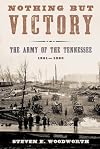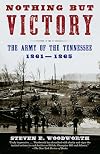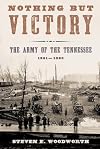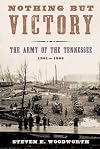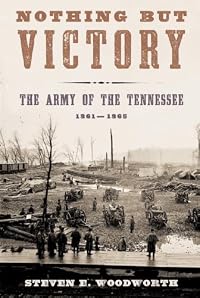
Nothing but Victory: The Army of the Tennessee, 1861-1865
by Steven E. Woodworth
On This Page
Description
Composed almost entirely of Midwesterners and molded into a lean, skilled fighting machine by Ulysses S. Grant and William Tecumseh Sherman, the Army of the Tennessee marched directly into the heart of the Confederacy and won major victories at Shiloh and at the rebel strongholds of Vicksburg and Atlanta.Acclaimed historian Steven Woodworth has produced the first full consideration of this remarkable unit that has received less prestige than the famed Army of the Potomac but was responsible show more for the decisive victories that turned the tide of war toward the Union. The Army of the Tennessee also shaped the fortunes and futures of both Grant and Sherman, liberating them from civilian life and catapulting them onto the national stage as their triumphs grew. A thrilling account of how a cohesive fighting force is forged by the heat of battle and how a confidence born of repeated success could lead soldiers to expect “nothing but victory.” show lessTags
Recommendations















Member Reviews
Steven Woodworth delivers a masterful Stephen Ambrose-like paean to the men and leaders of the Union Army of the Tennessee (named after the river not the state). While the Army of the Potomac was kept in check by Robert E. Lee, the men of the Army of the Tennessee criss-crossed the Confederate States from Fort Donelson to Pittsburgh Landing to Corinth to Vicksburg to Meridian to Chattanooga to Atlanta to Savannah to Columbia and finally to Washington DC. They defeated their opponents, because the Confederacy never reached a coherent decision about its defensive priorities. In defending everything, it defended nothing. The politcial priorities of the two contestants meant that the Union A team fought against the Confederate C team. The show more importance of the Army of the Tennessee shrank after its high tide at Vicksburg. Never a large force to begin with, its two to three corps were absorbed into Grant's and then Sherman's group of armies.
Woodworth's claim of "nothing but victory" is exaggerated as the Army of Tennessee witnessed a number of near disasters (Belmont, Ft Donelson, Shiloh) and setbacks (Chickasaw Bayou, Resaca, Kennesaw) distinguished from defeat only by the ineptitude of the Confederate leadership and Grant's unwillingness to quit.
Woodworth is soft on Grant and his boys and harsh about others (McClernand, Rosecrans, Thomas). Compare Woodworth's treatment of McPherson's hesitation in the Atlanta campaign and Rosecrans' caution at Corinth. Grant is a master strategist but a lousy tactician. If Grant had positioned himself at his weakest general's command post, he might have averted many mishaps and limited his casualties. Instead, he stayed with his favorites which further reduced the communication flow with the outsiders (McClernand, Rosecrans, Thomas) who then did not meet Grant's expectations, triggering the next round of alienation.
Overall, a magnificent book which gives voice both to the commanders and the common man. The book could be even better if it included more than a single map. A scarcity of maps seems to be a Woodworth trademark. show less
Woodworth's claim of "nothing but victory" is exaggerated as the Army of Tennessee witnessed a number of near disasters (Belmont, Ft Donelson, Shiloh) and setbacks (Chickasaw Bayou, Resaca, Kennesaw) distinguished from defeat only by the ineptitude of the Confederate leadership and Grant's unwillingness to quit.
Woodworth is soft on Grant and his boys and harsh about others (McClernand, Rosecrans, Thomas). Compare Woodworth's treatment of McPherson's hesitation in the Atlanta campaign and Rosecrans' caution at Corinth. Grant is a master strategist but a lousy tactician. If Grant had positioned himself at his weakest general's command post, he might have averted many mishaps and limited his casualties. Instead, he stayed with his favorites which further reduced the communication flow with the outsiders (McClernand, Rosecrans, Thomas) who then did not meet Grant's expectations, triggering the next round of alienation.
Overall, a magnificent book which gives voice both to the commanders and the common man. The book could be even better if it included more than a single map. A scarcity of maps seems to be a Woodworth trademark. show less
If you're interested in the Civil War, I just finished reading Steven Woodworth's "Nothing But Victory: The Army of the Tennessee, 1861 - 1865," the first of his works I've read, and it's a great book. Woodworth focuses a lot on the private soldiers, and his research shows he's done a lot of reading of journals, diaries and letters written by the foot soldiers who served in the Army of the Tennessee (primarily from midwestern regiments - Iowa, Illinois, Missouri, Indiana, Ohio, etc.) These are the men who fought, whose names remain pretty much unknown, many of them who gave their lives for the survival of the United States as a whole, healthy and powerful country. Unlike some Civil War writers, Woodworth sees some of the humor in the show more war, and more than once I found myself laughing out loud at something he had written. Sometimes a little humor helps to lighten the serious and often nerve-wracking tales of violence and death. Of the Civil War writers that I admire, Steven Woodworth is right up there with Bruce Catton, James McPherson, Jeffry Wert and Shelby Foote. I'll be buying and reading more books by Woodworth. show less
Great book! A masterful blend of detailed, primary-sourced research and compelling narrative.
While I don't have a lot to say about this book that hasn't been said by others, I do wish that it had existed about ten or fifteen years ago, as it does provide a good synopsis of the field force in question. If you've already done a fair amount of reading about the late unpleasantness between the states you might have that been there/done that feeling.
There is also no doubt that the author loves him some U.S. Grant, and could probably have stood to have been more critical. On the other hand it is refreshing to see Henry Halleck get the drubbing he so richly deserves. Woodworth's unvarnished attitude in regards to federal command politics is probably the main attraction for the experienced reader.
Finally, as has also been commented show more upon, one map for a whole war does not cut it. show less
There is also no doubt that the author loves him some U.S. Grant, and could probably have stood to have been more critical. On the other hand it is refreshing to see Henry Halleck get the drubbing he so richly deserves. Woodworth's unvarnished attitude in regards to federal command politics is probably the main attraction for the experienced reader.
Finally, as has also been commented show more upon, one map for a whole war does not cut it. show less
Ratings
Members
- Recently Added By
Author Information

42+ Works 1,939 Members
Steven E. Woodworth was born on January 28, 1961. He received a B.A. in history from Southern Illinois University in 1982 and a Ph.D. from Rice University in 1987. He is a professor of history at Texas Christian University and an expert on the Civil War. He has written a number of books on the topic including Jefferson Davis and His Generals: The show more Failure of Confederate Command in the West, While God Is Marching On: The Religious World of Civil War Soldiers, Nothing but Victory: The Army of the Tennessee 1861-1865, Manifest Destinies: Westward Expansion and the Civil War, and This Great Struggle: America's Civil War. (Bowker Author Biography) show less
Awards and Honors
Awards
Common Knowledge
- People/Characters
- Ulysses S. Grant; William Tecumseh Sherman; George H. Thomas; Frank Blair; Don Carlos Buell; Grenville M. Dodge (show all 18); Henry W. Halleck; Oliver O. Howard; Stephen A. Hurlbut; John Bell Hood; Joseph E. Johnston; John A. Logan; John A. McClernand; James B. McPherson; John C. Pemberton; William S. Rosecrans; Giles Smith; George Wills
- Important places
- USA; Tennessee, USA
- Important events
- American Civil War (1861 | 1865)
- Original language
- English
Classifications
- Genres
- History, Nonfiction, General Nonfiction
- DDC/MDS
- 973.7468 — History & geography History of North America United States Civil War Era (1857-1865) Great Battles and Generals South Central or Gulf States Tennessee
- LCC
- E470.5 .W66 — History of the United States United States Civil War period, 1861-1865 The Civil War, 1861-1865
- BISAC
Statistics
- Members
- 297
- Popularity
- 107,674
- Reviews
- 4
- Rating
- (4.17)
- Languages
- English
- Media
- Paper, Ebook
- ISBNs
- 3
- ASINs
- 4