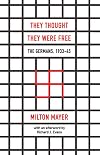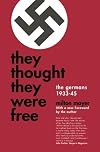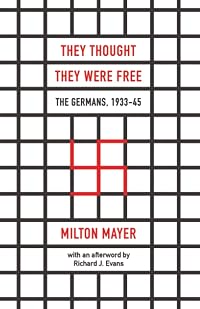
They Thought They Were Free: The Germans, 1933-45
by Milton Mayer
On This Page
Description
First published in 1955, They Thought They Were Free is an eloquent and provocative examination of the development of fascism in Germany. Milton Mayer's book is a study of ten Germans and their lives from 1933-45, based on interviews he conducted after the war when he lived in Germany. Mayer had a position as a research professor at the University of Frankfurt and lived in a nearby small Hessian town, which he disguised with the name "Kronenberg." "These ten men were not men of distinction," show more Mayer noted, but they had been members of the Nazi Party; Mayer wanted to discover what had made them Nazis. show lessTags
Recommendations


























Member Recommendations

2wonderY Moore films German classroom discussions of WW2 history.
Member Reviews
From the original forward: “As an American, I was repelled by the rise of National Socialism in Germany. As an American of Jewish descent, I was ashamed. As a Jew, I was stricken. As a newspaperman, I was fascinated.” It was the fascination that led him to spend time in Germany after the war, getting to know the ordinary German men who had been Nazis.
When our book group read Mein Kampf, I had hoped to gain a better understanding of how Hitler rose to power and caused so much devastation. Our general conclusion was that few Germans had actually read the book. Meyer’s book went much farther in helping me understand how a nation could follow the path that Nazi Germany followed.
Part I, the first two thirds of the book, introduces us show more to his Ten Men, and I found this part to be most informative. Parts II (The Germans) and III (Their Cause and Cure) spent more time on speculation and generalization. Some of this was also helpful, although—for the sake of context—this book was published six years before the Berlin Wall was built. The generalizations I found least helpful, because I think that many readers will be lulled into a sense of “ah, but we are different and that will never happen here.” Certainly cultures and traditions differ, but human nature is human nature and so (at the risk of being a bit silly) I end with a quote from Mad-Eye Moody: “Constant vigilance!” show less
When our book group read Mein Kampf, I had hoped to gain a better understanding of how Hitler rose to power and caused so much devastation. Our general conclusion was that few Germans had actually read the book. Meyer’s book went much farther in helping me understand how a nation could follow the path that Nazi Germany followed.
Part I, the first two thirds of the book, introduces us show more to his Ten Men, and I found this part to be most informative. Parts II (The Germans) and III (Their Cause and Cure) spent more time on speculation and generalization. Some of this was also helpful, although—for the sake of context—this book was published six years before the Berlin Wall was built. The generalizations I found least helpful, because I think that many readers will be lulled into a sense of “ah, but we are different and that will never happen here.” Certainly cultures and traditions differ, but human nature is human nature and so (at the risk of being a bit silly) I end with a quote from Mad-Eye Moody: “Constant vigilance!” show less
Causes one to ask some hard questions about my willingness "to not interfere" if it would jeopardize my rather comfortable position in this society. Especially relevant as we inch (if not leap) our way toward a totalitarian state. If nothing else, just read Part 1 and hear these ten men tell (and sometimes lie about) their own stories. Hopefully, it's not too late.
A profound experience. Opens up the experience of being a citizen and should be read by everyone. Who is responsible? How? If they aren't just exactly like us then what are they like? As much a book about America as it is about Germany. I would say it is critically important to read especially at this time so near to trump's presidency and the obvious split between what seems rational and what half the country professes to believe. If you haven't seen the red in the eyes of the people gathering in hate then perhaps this will help you to understand how little it seems to take to captivate a population.
I picked up this book because I figured the description of how seemingly “ordinary” people ending up supporting a Fascist party would be very topical and it was!
The first part was very much worth reading. This section was about the 10 former Nazis he interviewed and how they justified or explained their past involvement in the party.
The second and third parts were a lot more abstract and not that interesting and kind of lessened the impact of the book. He rambles on about the Cold War and German rearmament, and the national character of the Germans and blah blah blah.
The afterword brings up a lot of the issues I had with the book and gives a lot of context to the study and author that end up making it a lot better. I was feeling a 3 show more before it, but I’m feeling a 4 now. show less
The first part was very much worth reading. This section was about the 10 former Nazis he interviewed and how they justified or explained their past involvement in the party.
The second and third parts were a lot more abstract and not that interesting and kind of lessened the impact of the book. He rambles on about the Cold War and German rearmament, and the national character of the Germans and blah blah blah.
The afterword brings up a lot of the issues I had with the book and gives a lot of context to the study and author that end up making it a lot better. I was feeling a 3 show more before it, but I’m feeling a 4 now. show less
Really insightful and definitely unnerving in its relevance to what's happening with regards to immigrants and asylum seekers at the southern border of the U. S. right now. My only real issue with this book is that the author's religious and anti-socialist bias tends to pour over into his commentary at times.
Engaging and important, and ultimately revealing portrait of the average man in any modern 'Western' society. That is to say: very, very upsetting.
Everyone should read this book!! Wars aren't cut and dry, and there are many signs that are missed. We look back at WWII and wonder how any one could have followed Hitler but, as this book will show, it was pretty darn easy. It's also super scary how this book reflects current life in US America.
Members
- Recently Added By
Lists

Totalitarianism and Democratic Erosion: Essential Readings
45 works; 1 member
Author Information

9+ Works 893 Members
Awards and Honors
Common Knowledge
- Quotations
- For the first time [I] realized that Nazism was a mass movement and not the tyranny of a diabolical few over helpless millions.
Now I see a little better how Nazism overcame Germany—not by attack from without or by subversion from within, but with a whoop and a holler. It was what most Germans wanted—or, under pressure of combined reality and illu... (show all)sion, came to want. They wanted it; they got it; and they liked it.
I came back home a little afraid for my country, afraid of what it might want, and get, and like, under pressure of combined reality and illusion.
My friends wanted Germany purified. They wanted it purified of the politicians, of all the politicians. They wanted a representative leader in place of unrepresentative representatives. And Hitler, the pure man, the antipolit... (show all)ician, was the man, untainted by “politics,” which was only a cloak for corruption.
Thus Nazism, as it proceeded from practice to theory, had to deny expertness in thinking and then (this second process was never completed), in order to fill the vacuum, had to establish expert thinking of its own—that is, ... (show all)to find men of inferior or irresponsible caliber whose views conformed dishonestly or, worse yet, honestly to the Party line.
Did they know what Communism, “Bolshevism,” was? They did not; not my friends. Except for Herr Kessler, Teacher Hildebrandt, and young Horstmar Rupprecht (after he entered the university, in 1941), they knew Bolshevism as... (show all) a specter which, as it took on body in their imaginings, embraced not only the Communists but the Social Democrats, the trade-unions, and, of course, the Jews, the gypsies, the neighbor next door whose dog had bit them, and his dog; the bundled root cause of all their past, present, and possible tribulations. - Canonical DDC/MDS
- 943.086
- Canonical LCC
- DD256.5
Classifications
- Genres
- History, Nonfiction, General Nonfiction
- DDC/MDS
- 943.086 — History & geography History of Europe Central Europe: Germany, Austria, Switzerland, Czech, Poland, Hungary Historical periods of Germany Germany 1866- Third Reich 1933-1945
- LCC
- DD256.5 — History of Europe, Asia, Africa and Oceania Germany History of Germany History By period Modern, 1519- 19th-20th centuries Revolution and Republic, 1918- Hitler, 1933-1945. National socialism Period of World War II, 1939-1945
- BISAC
Statistics
- Members
- 759
- Popularity
- 36,861
- Reviews
- 16
- Rating
- (4.04)
- Languages
- English, Portuguese, Spanish
- Media
- Paper, Audiobook, Ebook
- ISBNs
- 12
- ASINs
- 11