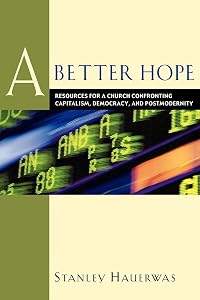
A Better Hope: Resources for a Church Confronting Capitalism, Democracy, and Postmodernity
by Stanley Hauerwas
On This Page
Description
A leading theologian reflects on the challenges of the American church and explores how it can faithfully survive in a peculiarly American Christian ethical system.Tags
Recommendations








Member Reviews
A Better Hope was my first introduction to Stanley Hauerwas, and I'm sure it will prove to be the start of a long fruitful journey. In this audaciously subtitled book, Hauerwas has collected 14 of his essays in one place.
If you haven't read Hauerwas before, he's an American theologian with a reputation for never backing down from a fight—which is mildly ironic given his devotion to pacifism. In these essays, though, he has set out to provide hope instead of just tearing down. Like the prophets Isaiah and Ezekiel, you can only write so much judgment before you must present a new vision.
This was a great introduction to Hauerwas because many of the essays are surveys of or reactions to other scholars he's interacted with. It's like a show more buy-one-get-one-free deal. You learn Hauerwas' views while in the process discovering people like Rauschenbusch, Niebuhr (both of them), Yoder, and Jenson.
My only criticism of this collection is its randomness. In the Introduction and Table of Contents he tries to provide a framework to relate the diverse essays, but the topics are too diverse to wrap up so neatly. It would be better to understand this as a simple Hauerwas miscellany.
While I enjoyed and learned a lot from every essay, one in particular stood out: "Worship, Evangelism, Ethics: On Eliminating the 'And'". In it, Hauerwas laments the dumbing-down of modern corporate worship. One moment I was chuckling to myself:
"'I come to the garden alone' are not appropriate words to be sung in corporate worship, no matter how meaningful some people may find the hymn."
Then immediately following that I was humbled and convicted:
"Part of the difficulty is that Protestant Christians, evangelical and mainstream alike, have lost their ability to make such judgments. They have done so, moreover, because they debased their worship in the name of evangelism and moral uplift."
That's the sort of depth you get when you read Hauerwas. I can hardly wait to dive deeper into his works. show less
If you haven't read Hauerwas before, he's an American theologian with a reputation for never backing down from a fight—which is mildly ironic given his devotion to pacifism. In these essays, though, he has set out to provide hope instead of just tearing down. Like the prophets Isaiah and Ezekiel, you can only write so much judgment before you must present a new vision.
This was a great introduction to Hauerwas because many of the essays are surveys of or reactions to other scholars he's interacted with. It's like a show more buy-one-get-one-free deal. You learn Hauerwas' views while in the process discovering people like Rauschenbusch, Niebuhr (both of them), Yoder, and Jenson.
My only criticism of this collection is its randomness. In the Introduction and Table of Contents he tries to provide a framework to relate the diverse essays, but the topics are too diverse to wrap up so neatly. It would be better to understand this as a simple Hauerwas miscellany.
While I enjoyed and learned a lot from every essay, one in particular stood out: "Worship, Evangelism, Ethics: On Eliminating the 'And'". In it, Hauerwas laments the dumbing-down of modern corporate worship. One moment I was chuckling to myself:
"'I come to the garden alone' are not appropriate words to be sung in corporate worship, no matter how meaningful some people may find the hymn."
Then immediately following that I was humbled and convicted:
"Part of the difficulty is that Protestant Christians, evangelical and mainstream alike, have lost their ability to make such judgments. They have done so, moreover, because they debased their worship in the name of evangelism and moral uplift."
That's the sort of depth you get when you read Hauerwas. I can hardly wait to dive deeper into his works. show less
Ratings
Members
- Recently Added By
Lists

Best Essay Collections
61 works; 24 members
Author Information

74+ Works 9,532 Members
Stanley Hauerwas, one of America's best-known and most highly regarded contemporary theologians, is the author of many notable works, including The Work of Theology, Approaching the End, Hannah's Child, and Growing Old in Christ.
Common Knowledge
- Original publication date
- 2001
- People/Characters
- Walter Raushenbusch; Reinhold Niebuhr; Robert Jenson; John Howard Yoder
- First words
- I hope A Better Hope will be read as a hopeful book.
- Quotations
- Christians cannot afford to let ourselves be defined by what we are against.
- Last words
- (Click to show. Warning: May contain spoilers.)It is a dangerous way to live, but then the alternative, as we learn from murder mysteries, is that lives lived safely are not worth living.
- Blurbers
- Placher, William
Classifications
- Genres
- Religion & Spirituality, Nonfiction
- DDC/MDS
- 261.0973 — Religion Christian organization, social work & worship Social theology and interreligious relations and attitudes Biography And History North America United States
- LCC
- BJ1275 .H36 — Philosophy, Psychology and Religion Ethics Ethics Religious ethics
- BISAC
Statistics
- Members
- 230
- Popularity
- 141,638
- Reviews
- 1
- Rating
- (4.31)
- Languages
- English
- Media
- Paper, Ebook
- ISBNs
- 2
- ASINs
- 1