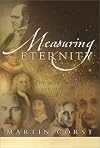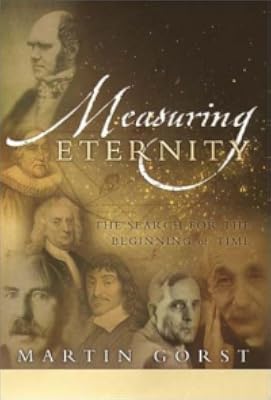
Measuring Eternity: The Search for the Beginning of Time
by Martin Gorst
On This Page
Description
The untold story of the religious figures, philosophers, astronomers, geologists, physicists, and mathematicians who, for more than four hundred years, have pursued the answer to a fundamental question at the intersection of science and religion: When did the universe begin? The moment of the universe's conception is one of science's Holy Grails, investigated by some of the most brilliant and inquisitive minds across the ages. Few were more committed than Bishop James Ussher, who lost his show more sight during the fifty years it took him to compose his Annals of all known history, now famous only for one date: 4004 b.c. Ussher's date for the creation of the world was spectacularly inaccurate, but that didn't stop it from being so widely accepted that it was printed in early twentieth-century Bibles. As writer and documentary filmmaker Martin Gorst vividly illustrates in this captivating, character-driven narrative, theology let Ussher down just as it had thwarted Theophilus of Antioch and many before him. Geology was next to fail the test of time. In the eighteenth century, naturalist Comte de Buffon, working out the rate at which the earth was supposed to have cooled, came up with an age of 74,832 years, even though he suspected this was far too low. Biology then had a go in the hands of fossil hunter Johann Scheuchzer, who alleged to have found a specimen of a man drowned at the time of Noah's flood. Regrettably it was only the imprint of a large salamander. And so science inched forward via Darwinism, thermodynamics, radioactivity, and, most recently, the astronomers at the controls of the Hubble space telescope, who put the beginning of time at 13.4 billion years ago (give or take a billion). Taking the reader into the laboratories and salons of scholars and scientists, visionaries and eccentrics, Measuring Eternity is an engagingly written account of an epic, often quixotic quest, of how individuals who dedicated their lives to solving an enduring mystery advanced our knowledge of the universe. show lessTags
Recommendations








Member Reviews
There is a charming second hand bookshop, not too far away, that boasts,'No book costs more than £3'. A visit to this Aladdin's Cave regularly unearths a missed gem.
I had never, to the best of my knowledge, heard of Martin Gorst or his book but, it looked interesting and, at £1, I would not be too disappointed were the initial impression to be proved erroneous: it wasn't. I was hooked, from the first few pages where I learned of Bishop Ussher's calculation of the date - and time!- for the start of the World. Should you be interested, it's 6pm on Saturday 22nd October 4004bc. If you want to know how the reverent gentleman came to this conclusion, then you'll have to read the book.
The book then leads one from this early attempt to the show more latest view upon the age of the Universe. One of the things that impresses me most about this tome, is that Mr Gorst does not ridicule the early attempts at dating this mortal coil, or become too enamoured of the latest efforts. He treats both with the respect, and scepticism, that they deserve, whilst making a novice in the field, such as myself, feel that they have some grasp of the concepts being discussed. I never felt patronized, or bamboozled by the science and, when dealing with a reader as pernickety as myself, that takes some doing.
This is one of those books which leads one to read the science section of the newspaper with renewed interest. show less
I had never, to the best of my knowledge, heard of Martin Gorst or his book but, it looked interesting and, at £1, I would not be too disappointed were the initial impression to be proved erroneous: it wasn't. I was hooked, from the first few pages where I learned of Bishop Ussher's calculation of the date - and time!- for the start of the World. Should you be interested, it's 6pm on Saturday 22nd October 4004bc. If you want to know how the reverent gentleman came to this conclusion, then you'll have to read the book.
The book then leads one from this early attempt to the show more latest view upon the age of the Universe. One of the things that impresses me most about this tome, is that Mr Gorst does not ridicule the early attempts at dating this mortal coil, or become too enamoured of the latest efforts. He treats both with the respect, and scepticism, that they deserve, whilst making a novice in the field, such as myself, feel that they have some grasp of the concepts being discussed. I never felt patronized, or bamboozled by the science and, when dealing with a reader as pernickety as myself, that takes some doing.
This is one of those books which leads one to read the science section of the newspaper with renewed interest. show less
What an excellent read! Measuring Infinity traces the search for the time the Earth was created, a search that began as early as 400+ years AD, and ultimately the birth of the universe as well.
It covers the scientists we are all familiar with and those we have probably never heard of. It covers the exciting 'real' discoveries and the amusing 'mistakes'. It shows the great scientists, such as Newton and Einstein, making 'right' discoveries and their heartbreak when they were sometimes glaringly wrong.
The book shows the wide range of disciplines that were involved. The early naturalists - working to find answers through biology, fossils, geology and later the chemists and physicists.
The book is well written, telling you a tale of search, show more rather than being pages of data and formulas. It is a tale of people.
It's even fun. At the end of the 1600s, people were trying to explain how fossils were buried in so many layers of the earth, - if they had been deposited by the Flood. One explanation was that 'the water for the Flood came from an interior ocean hidden beneath the Earth's crust. In the normal state this was held in place by gravity, but at the time of the Flood, God had momentarily suspended the full force of gravity and the water had spilled out.' Later when God restored the gravity the fossils were sank by their density - therefore the heavier ones being lowest. show less
It covers the scientists we are all familiar with and those we have probably never heard of. It covers the exciting 'real' discoveries and the amusing 'mistakes'. It shows the great scientists, such as Newton and Einstein, making 'right' discoveries and their heartbreak when they were sometimes glaringly wrong.
The book shows the wide range of disciplines that were involved. The early naturalists - working to find answers through biology, fossils, geology and later the chemists and physicists.
The book is well written, telling you a tale of search, show more rather than being pages of data and formulas. It is a tale of people.
It's even fun. At the end of the 1600s, people were trying to explain how fossils were buried in so many layers of the earth, - if they had been deposited by the Flood. One explanation was that 'the water for the Flood came from an interior ocean hidden beneath the Earth's crust. In the normal state this was held in place by gravity, but at the time of the Flood, God had momentarily suspended the full force of gravity and the water had spilled out.' Later when God restored the gravity the fossils were sank by their density - therefore the heavier ones being lowest. show less
The book's title is a mess! The style these days is to have a title and a subtitle, the title is supposed to be short and catchy, and the subtitle is supposed to explain the title better. This book's title, "Measuring Eternity", seems like nonsense to me, and I can not explain why the author chose it. Every hypothesis I develop about the relation between the title and the book seems to fall quite short of being an adequate explanation. The subtitle, "The Search for the Beginning of Time", is also quite misleading, since the book's subject is not actually time, at all. A more appropriate title would have been "How Did We Find Out the Age of the Universe?".
Another flaw in the book, sadly common these days, is the illustrations. They are show more not particularly well chosen, there is no list of figures, just picture credits, and the diagrams are poorly drawn and labeled.
The subject, the narrative, and the selected quotations are rather good, though, and the science is pretty clearly explained. On the whole, I quite enjoyed this book, and I'm not sure that it is really fair to blame the author for the inadequacies of his publisher. It's actually quite a good book if you like science and its history, which I do. show less
Another flaw in the book, sadly common these days, is the illustrations. They are show more not particularly well chosen, there is no list of figures, just picture credits, and the diagrams are poorly drawn and labeled.
The subject, the narrative, and the selected quotations are rather good, though, and the science is pretty clearly explained. On the whole, I quite enjoyed this book, and I'm not sure that it is really fair to blame the author for the inadequacies of his publisher. It's actually quite a good book if you like science and its history, which I do. show less
History of finding the age of the world and universe. The second half is good, but too much space is wasted on prescientific imaginings -- if Gorst thinks I'm going to read scores of pages on Bishop Ussher and his ilk, ...
Ratings
Members
- Recently Added By
Published Reviews
Well-written and highly entertaining history of progressively more successful efforts to date the earth and later efforts to do the same for the universe.
added by mysterymax
Few questions have baffled and excited mathematicians, astronomers, physicists, geologists, theologians and average Joes as much as those that seek to explore the mysteries of time. Gorst, a writer and director of science documentaries, discusses how human understanding of time shifted throughout the centuries, as models of the universe became more accurate and instruments for gathering data show more grew more sophisticated. show less
added by mysterymax
Lists

Author Information
5 Works 193 Members
Awards and Honors
Awards
Common Knowledge
- Alternate titles
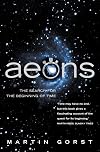
- Aeons: The Search for the Beginning of Time
Classifications
Statistics
- Members
- 185
- Popularity
- 177,718
- Reviews
- 4
- Rating
- (4.00)
- Languages
- Dutch, English, Italian
- Media
- Paper, Ebook
- ISBNs
- 7
- ASINs
- 2