
On This Page
Description
India Bridge's house is a prison, her life a collection of redundancies. Overnight her children have turned into willful, frightening creatures, and her husband into an unsolvable enigma. When India tries to reach beyond the limitations around her, she begins to realize the scattered truths that hide themselves in fear and solitude.Tags
Recommendations













Member Reviews
This is a modern classic and Evan S. Connell's debut novel, a sometimes sympathetic, sometimes uncharitable look at a woman's life. Mrs. Bridge of Kansas City is a woman who has lived within the confines of what is expected of her and she places those same restrictions and expectations on her family. Yet while she is the one who keeps the rules and knows what to do, this doesn't mean she doesn't also chafe sometimes or realize that there is something missing from her life, an entirely pleasant, financially comfortable existence that doesn't entirely cover for her lack of connection to her children or her husband's emotional and often physical absence.
Connell does not go lightly on Mrs. Bridge, spotlighting moments where her need to show more preserve appearances was silly or harmed her relationship with her children. But he's also often kind to her, revealing how little respect or support she receives from her husband. This book is also full of quietly powerful moments or humorous ones and Connell's descriptions of daily life allows plenty of room for the small disappointments and harms to be given their due. This quiet novel is a wonderful glimpse of a world that no longer exists, and of a woman who honestly did her best. show less
Connell does not go lightly on Mrs. Bridge, spotlighting moments where her need to show more preserve appearances was silly or harmed her relationship with her children. But he's also often kind to her, revealing how little respect or support she receives from her husband. This book is also full of quietly powerful moments or humorous ones and Connell's descriptions of daily life allows plenty of room for the small disappointments and harms to be given their due. This quiet novel is a wonderful glimpse of a world that no longer exists, and of a woman who honestly did her best. show less
We met to discuss [Mrs. Bridge] yesterday, and it was a very satisfying conversation. Most of us (numbering about 15) liked the book very much, and we immediately began talking about our mothers or grandmothers, and how the need to conform so pervaded some of these women's lives. This is a portrait of a culture that is not really gone, even now, although the generalization may be fragmented. We all have our cohorts, whether religious, social, geographic, racial, or class, and each cohort has a certain amount of unspoken norms dangerous to transgress. Mrs. Bridge, of course, cannot step out of her cohort. Each time she initiates an individual action, however mild, she pulls back. Poor lady. She has exactly what she wanted, and that's the show more problem.
The language and style is wonderfully spare, and the reader (or listener, in my case) can look into the episodes of her life through a one-way mirror of crystalline description. Nothing happens except a life, and it's mesmerizing. show less
The language and style is wonderfully spare, and the reader (or listener, in my case) can look into the episodes of her life through a one-way mirror of crystalline description. Nothing happens except a life, and it's mesmerizing. show less
This little book is so, so clever I can't stop thinking about it.
On the surface it seems straightforwardly simple - a series of short vignettes about the daily minutiae of Mrs Bridge's life, peppered with subtle specks of black humour.
Mrs Bridge is the quintessential wealthy suburban housewife during the pre-war period. In vignettes of not more than 2 or 3 pages long, we are a fly on the wall of her daily struggle against the minor insignificances which dominate her everyday being, such as her son using the guest towels, her struggle to parallel park the impressive Lincoln her husband bought her, the new washer woman who doesn't take the hint about sitting in the back of the car. At first all seem trivial, amusing, delicately clever show more observances on human behaviour.
For example, this quote reminded me very much of my co-founder at work who puts in 100 hour weeks:
(Talking about Mrs Bridge's husband) The family saw very little of him. It was not unusual for an entire week to pass without any of the children seeing him. On Sunday morning they would come downstairs and he might be at the breakfast table; he greeted them pleasantly and they responded differentially, and a little wistfully because they missed him. Sensing this, he would redouble his efforts at the office in order to give them everything they wanted.
Many times I got to the end of a vignette thinking "ohhh, that was clever" as Connell deftly dealt another ironic blow or observation.
On their own, the vignettes were cleverly enjoyable parodies. For the first while I enjoyed them well enough, but thought to myself that I wouldn't be desperately rushing to read anything further by Evan S. Connell. However, less than halfway through the mist cleared and I realised that he was a master in disguise. A pattern started to form from the seemingly unimportant snapshots of Mrs Bridge's life, and a novel began to emerge as all the pieces fell into place.
Mrs Bridge is a sadly familiar tale of a privileged wife whose only job is to raise her children and attend luncheons, and who finds herself totally at sea as she loses them to adulthood. She is a desperate people pleaser, yet the harder she tries to please people the less they respect her.
Evan S. Connell so eloquently succeeds in 'show' rather than 'tell'. It's a short novel, yet by the end you have a lump in your throat at the unjust realism of a life that has passed her by, of a wife, a mother and a friend who is loved yet overlooked at the same time.
4.5 stars - achingly subtle in its execution yet hugely impacting. I'll be thinking about this book for some time to come. show less
On the surface it seems straightforwardly simple - a series of short vignettes about the daily minutiae of Mrs Bridge's life, peppered with subtle specks of black humour.
Mrs Bridge is the quintessential wealthy suburban housewife during the pre-war period. In vignettes of not more than 2 or 3 pages long, we are a fly on the wall of her daily struggle against the minor insignificances which dominate her everyday being, such as her son using the guest towels, her struggle to parallel park the impressive Lincoln her husband bought her, the new washer woman who doesn't take the hint about sitting in the back of the car. At first all seem trivial, amusing, delicately clever show more observances on human behaviour.
For example, this quote reminded me very much of my co-founder at work who puts in 100 hour weeks:
(Talking about Mrs Bridge's husband) The family saw very little of him. It was not unusual for an entire week to pass without any of the children seeing him. On Sunday morning they would come downstairs and he might be at the breakfast table; he greeted them pleasantly and they responded differentially, and a little wistfully because they missed him. Sensing this, he would redouble his efforts at the office in order to give them everything they wanted.
Many times I got to the end of a vignette thinking "ohhh, that was clever" as Connell deftly dealt another ironic blow or observation.
On their own, the vignettes were cleverly enjoyable parodies. For the first while I enjoyed them well enough, but thought to myself that I wouldn't be desperately rushing to read anything further by Evan S. Connell. However, less than halfway through the mist cleared and I realised that he was a master in disguise. A pattern started to form from the seemingly unimportant snapshots of Mrs Bridge's life, and a novel began to emerge as all the pieces fell into place.
Mrs Bridge is a sadly familiar tale of a privileged wife whose only job is to raise her children and attend luncheons, and who finds herself totally at sea as she loses them to adulthood. She is a desperate people pleaser, yet the harder she tries to please people the less they respect her.
Evan S. Connell so eloquently succeeds in 'show' rather than 'tell'. It's a short novel, yet by the end you have a lump in your throat at the unjust realism of a life that has passed her by, of a wife, a mother and a friend who is loved yet overlooked at the same time.
4.5 stars - achingly subtle in its execution yet hugely impacting. I'll be thinking about this book for some time to come. show less
I wasn't sure what to make of this book at first - it seemed nothing more than somewhat isolated scenes in the life of 1930s American family and in particular, its privileged and increasingly bored wife/mother. Mrs Bridge was not especially sympathetic and I started to think her story, including her hard-working but absent husband and her children, who grew into whatever they were regardless of her more appropriate hopes for them, would be only marginally interesting all the way through.
I was wrong! Just past the midpoint of the book I had a shock, and it was not the last one. I do not use the word 'heartbreaking' often but I can't think of a better one to describe Mrs Bridge.
A quote that I keep going back to - Mrs Bridge thinking about show more her marriage, later in life - “They had started off together to explore something that promised to be wonderful, and, of course, there had been wonderful times. And yet, thought Mrs. Bridge, why is it that we haven't—that nothing has—that whatever we—?” show less
I was wrong! Just past the midpoint of the book I had a shock, and it was not the last one. I do not use the word 'heartbreaking' often but I can't think of a better one to describe Mrs Bridge.
A quote that I keep going back to - Mrs Bridge thinking about show more her marriage, later in life - “They had started off together to explore something that promised to be wonderful, and, of course, there had been wonderful times. And yet, thought Mrs. Bridge, why is it that we haven't—that nothing has—that whatever we—?” show less
Mrs Bridge the character comes across early as a satirical caricature of normality - the upper middle class country club lady sort. A little innocent, trying always to fit into the moneyed waspish Kansas City lifestyle; her husband so clearly wants her to succeed in this world by working long loving hours in the law firm to pay for it.
Mrs Bridge’s life is filled with homilies. We could be reading the opening line of a 1920s women’s magazine full of homemaker home truths:
Boys, as everyone knew, were more trouble than girls, but to Mrs Bridge it began to seem that Douglas was more trouble than both the girls together
Written in the late 1950s, the story spans the end of WW1 to the middle of WW2. It has that in between world feel about show more it too. It’s a long enough time span to see the changing social forces of the 1920s and 1930s. “Negroes” are always in service and many people seem to work as maids, housekeepers, drivers and washers in this world. The rich are very rich and they are all white. But women are slowly becoming independent, playing competitive golf, heading off to New York to work in magazines, discovering sex their own way.
There’s a Doris Day Don’t Eat the Daisies feel about the story-telling as though the narrator is a kind of 1950s voice over in a semi-magical world of normality. When you start reading it, you think you’ve already seen the film. Each vignette is small time, small town issues of raising children, driving a large clunky car, anxiety over whether one of the country club friends will steal the housekeeper by offering a higher salary. Day to day business drives the action.
This breezy vignette style of very short episodes provides punctures the seamless veneer of its surface.
Grace Barron was a puzzle and she was disturbing. She belonged in the country club district, for Virgil was a banker, and yet she seemed dissatisfied there.
We see neighbours toying with psychoanalysis, parents raising children in radical new ways with radial consequences, racial harmony when one daughter befriends a black girl only for Mrs Bridge to take exception. We see the anxiety of raising children and wondering when to intervene and not to intervene alongside boring country club friends who insist on visiting. The life of Mrs Bridge has elements not unlike our own, except that there’s always revelation when Connell takes us from exterior world of action and consequences to the interior world in which we share with Mrs Bridge the emotional problem of never quite knowing how to act, what to do and what the moral consequences of our actions might be.
Mrs Bridge is a product of her times, we can see the national disgrace of racism, but we’re not convinced Mrs Bridge is a raving racist. Her times give her wealth and standing. It cannot be otherwise. There is much material for social critique and satire in here. But character complexity is more interesting than political outrage. We’re not asked to dislike her, nor think her above criticism. Complexity is built into good storytelling.
What makes this book very good is the way the interior world of Mrs Bridge is full of the many thoughts and emotions contained broadly as a very human world. She’s not great or heroic, often weak, insecure and protective. We see her suffering for her children – how to keep her eldest daughter from precocious sexual activity, her youngest son from hanging out with riff-raff, how to manage her middle daughter after she marries when her husband beats her. While the story-telling and setting is so insufferably middle class, it's hard to stop reading it.
Thing is, Mrs Bridge appears a closed off wasp lady, but is she? Not exactly. She can accept some the world as it is, but that means tasting it now and then. She toys with voting independently from her husband, she accepts her youngest son’s oddities, her eldest’s eventual independence from her. In France there's a moment of bohemian thrill when they eat in a restaurant where spiders crawl out of salads.
As we get deeper into the story, the impacts of the age they live in catches up. War looms, the son goes off to the army. A country club lady suicides, no one knows why. It’s hidden from the kids, but not from oneself. It raises questions when Mrs Bridge’s world becomes more isolated as the kids grow older. The sameness of that protected country club lifestyle disappears. No one is like any other, Mrs Bridge is not a caricature. Yet we are all the same when we are alone, facing ageing, death and sadness.
and as she turned through these recipes she thought how strangely intimate the faded penciled notes remained
But it is also a milieu that has been and gone by the time Connell wrote it. It’s like he’s captured it through one person like a snow dome souvenir. Fittingly, the story ends with snow falling. show less
Mrs Bridge’s life is filled with homilies. We could be reading the opening line of a 1920s women’s magazine full of homemaker home truths:
Boys, as everyone knew, were more trouble than girls, but to Mrs Bridge it began to seem that Douglas was more trouble than both the girls together
Written in the late 1950s, the story spans the end of WW1 to the middle of WW2. It has that in between world feel about show more it too. It’s a long enough time span to see the changing social forces of the 1920s and 1930s. “Negroes” are always in service and many people seem to work as maids, housekeepers, drivers and washers in this world. The rich are very rich and they are all white. But women are slowly becoming independent, playing competitive golf, heading off to New York to work in magazines, discovering sex their own way.
There’s a Doris Day Don’t Eat the Daisies feel about the story-telling as though the narrator is a kind of 1950s voice over in a semi-magical world of normality. When you start reading it, you think you’ve already seen the film. Each vignette is small time, small town issues of raising children, driving a large clunky car, anxiety over whether one of the country club friends will steal the housekeeper by offering a higher salary. Day to day business drives the action.
This breezy vignette style of very short episodes provides punctures the seamless veneer of its surface.
Grace Barron was a puzzle and she was disturbing. She belonged in the country club district, for Virgil was a banker, and yet she seemed dissatisfied there.
We see neighbours toying with psychoanalysis, parents raising children in radical new ways with radial consequences, racial harmony when one daughter befriends a black girl only for Mrs Bridge to take exception. We see the anxiety of raising children and wondering when to intervene and not to intervene alongside boring country club friends who insist on visiting. The life of Mrs Bridge has elements not unlike our own, except that there’s always revelation when Connell takes us from exterior world of action and consequences to the interior world in which we share with Mrs Bridge the emotional problem of never quite knowing how to act, what to do and what the moral consequences of our actions might be.
Mrs Bridge is a product of her times, we can see the national disgrace of racism, but we’re not convinced Mrs Bridge is a raving racist. Her times give her wealth and standing. It cannot be otherwise. There is much material for social critique and satire in here. But character complexity is more interesting than political outrage. We’re not asked to dislike her, nor think her above criticism. Complexity is built into good storytelling.
What makes this book very good is the way the interior world of Mrs Bridge is full of the many thoughts and emotions contained broadly as a very human world. She’s not great or heroic, often weak, insecure and protective. We see her suffering for her children – how to keep her eldest daughter from precocious sexual activity, her youngest son from hanging out with riff-raff, how to manage her middle daughter after she marries when her husband beats her. While the story-telling and setting is so insufferably middle class, it's hard to stop reading it.
Thing is, Mrs Bridge appears a closed off wasp lady, but is she? Not exactly. She can accept some the world as it is, but that means tasting it now and then. She toys with voting independently from her husband, she accepts her youngest son’s oddities, her eldest’s eventual independence from her. In France there's a moment of bohemian thrill when they eat in a restaurant where spiders crawl out of salads.
As we get deeper into the story, the impacts of the age they live in catches up. War looms, the son goes off to the army. A country club lady suicides, no one knows why. It’s hidden from the kids, but not from oneself. It raises questions when Mrs Bridge’s world becomes more isolated as the kids grow older. The sameness of that protected country club lifestyle disappears. No one is like any other, Mrs Bridge is not a caricature. Yet we are all the same when we are alone, facing ageing, death and sadness.
and as she turned through these recipes she thought how strangely intimate the faded penciled notes remained
But it is also a milieu that has been and gone by the time Connell wrote it. It’s like he’s captured it through one person like a snow dome souvenir. Fittingly, the story ends with snow falling. show less
In some respects this is just domestic comedy - a woman in the mid-west marries, has kids, interacts with her friends, feel discontented, grows old.
But it's so much more than that, with the lovely grace notes of Cornell's writing at its best.
Mrs. Bridge - and her first name is "India" which hints at the exotic and strange - lives her life and accepts it. She's sort of a female Bartleby the Scrivener. She goes to her husband for sex (and love?) and doesn't get it - and accepts that love sometimes means being disappointed.
She sees her son building a tower in the vacant lot next door and watches - and watches -- and then quietly arranges to have it knocked down. But never talks to him about it. Communication is not her best thing.
Her show more little daughter can play with the smarty pants little black girl but only when both children are . . . little.
What does Frost say? "(S)He will not go behind (her) father's sayings" Mrs. Bridge is a little bit like that. But her awareness of her limitations -- which comes and goes - makes her an almost tragic figure.
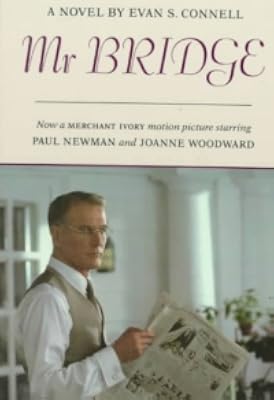
There is a companion piece Mr. Bridge but it seems to be just an addendum. Mrs. B is the real deal.
Lovely and unforgettable show less
But it's so much more than that, with the lovely grace notes of Cornell's writing at its best.
Mrs. Bridge - and her first name is "India" which hints at the exotic and strange - lives her life and accepts it. She's sort of a female Bartleby the Scrivener. She goes to her husband for sex (and love?) and doesn't get it - and accepts that love sometimes means being disappointed.
She sees her son building a tower in the vacant lot next door and watches - and watches -- and then quietly arranges to have it knocked down. But never talks to him about it. Communication is not her best thing.
Her show more little daughter can play with the smarty pants little black girl but only when both children are . . . little.
What does Frost say? "(S)He will not go behind (her) father's sayings" Mrs. Bridge is a little bit like that. But her awareness of her limitations -- which comes and goes - makes her an almost tragic figure.
There is a companion piece Mr. Bridge but it seems to be just an addendum. Mrs. B is the real deal.
Lovely and unforgettable show less
"I wish I knew what to do but I just don't understand", April 18, 2015
This review is from: Mrs. Bridge (Paperback)
A wonderful exploration of people: the unbridgeable distances between us, even members of the same family. Set in the 30s/40s, this is a family story seen almost entirely from the perspective of India Bridge. Living a comfortable middle-class life in Kansas City, Mrs Bridge's days revolve around her lawyer husband, her three increasingly alien children, and her friends at the country club.
Mrs Bridge has received a 'proper' upbringing and her inability to raise children with the same values, and her constant need to make bright, courteous, meaningless remarks are perhaps her defining characteristics. And yet at moments she show more becomes aware that there is something missing from her life - an emptiness that she tries in vain to fill...
The author describes her life in a series of 'sketches' rather than in lengthy chapters. At times hilarious (who could forget dinner with the unutterably dull and patronising Van Metres), elsewhere sad and hopeless, many of the events are minor in themselves yet illustrate life as it is.
I couldn't put this down and would totally recommend it. show less
This review is from: Mrs. Bridge (Paperback)
A wonderful exploration of people: the unbridgeable distances between us, even members of the same family. Set in the 30s/40s, this is a family story seen almost entirely from the perspective of India Bridge. Living a comfortable middle-class life in Kansas City, Mrs Bridge's days revolve around her lawyer husband, her three increasingly alien children, and her friends at the country club.
Mrs Bridge has received a 'proper' upbringing and her inability to raise children with the same values, and her constant need to make bright, courteous, meaningless remarks are perhaps her defining characteristics. And yet at moments she show more becomes aware that there is something missing from her life - an emptiness that she tries in vain to fill...
The author describes her life in a series of 'sketches' rather than in lengthy chapters. At times hilarious (who could forget dinner with the unutterably dull and patronising Van Metres), elsewhere sad and hopeless, many of the events are minor in themselves yet illustrate life as it is.
I couldn't put this down and would totally recommend it. show less
Members
- Recently Added By
Lists

Great American Novels
158 works; 42 members

The Top Ten: Writers Pick Their Favorite Books
240 works; 33 members

Best Love Stories
107 works; 14 members

Willoyd's Tour of the USA
25 works; 1 member
Read This Next
120 works; 3 members

Books Set in Missouri
29 works; 4 members

A Novel Cure
742 works; 23 members
Blue Pyramid 1,276 Best Books of All Time
1,248 works; 32 members

National Book Award Finalists - Fiction
377 works; 12 members

Books Read in 2021
5,361 works; 114 members

Michael Dirda's Desert Island Books
62 works; 5 members
Author Information

30+ Works 5,309 Members
Evan S. Connell was born August 17, 1924 in Kansas City, Missouri. He graduated from the University of Kansas in 1947. His first work, The Anatomy Lesson and Other Stories, was published in 1957. His first novel, Mrs. Bridge, was published in 1959. The sequel, Mr. Bridge, was published ten years later. In 1990, both novels were adapted into the show more film Mr. and Mrs. Bridge starring Paul Newman and Joanne Woodward. He wrote more than 15 books during his lifetime including Son of the Morning Star: Custer and the Little Bighorn, The Patriot, The Diary of a Rapist, The Connoisseur, Deus Lo Volt!, and Lost in Uttar Pradesh. He died on January 10, 2013 at the age of 88. (Bowker Author Biography) show less
Some Editions
Awards and Honors
Series

Belongs to Publisher Series
Arion Press (85)
Work Relationships
Is contained in
Common Knowledge
- Canonical title
- Mrs. Bridge
- Original publication date
- 1959
- Important places
- Kansas City, Missouri, USA
- Related movies
- Mr. & Mrs. Bridge (1990 | IMDb)
- Dedication
- To Barbara and Matthew Zimmerman
- First words
- Her first name was India - she was never able to get used to it.
- Quotations
- Her first name was India - she was never able to get used to it. It seemed to her that her parents must have been thinking of someone else when they named her. Or were they hoping for another sort of daughter? As a child she ... (show all)was often on the point of inquiring, but time passed, and she never did.
- Last words
- (Click to show. Warning: May contain spoilers.)But no one answered, unless it was the falling snow.
Classifications
Statistics
- Members
- 1,212
- Popularity
- 20,545
- Reviews
- 43
- Rating
- (4.08)
- Languages
- 6 — Danish, Dutch, English, French, Italian, Swedish
- Media
- Paper, Audiobook, Ebook
- ISBNs
- 28
- ASINs
- 8