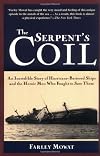
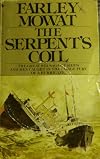
The Serpent's Coil
by Farley Mowat
On This Page
Description
The Serpent's Coil recounts the amazing story of the Liberty ship Leicester, which sailed for New York from England in the summer of 1948, ran into a hurricane (with the loss of six lives), and was abandoned in mid-Atlantic. It also tells of the deep-sea tug Foundation Josephine, which tracked the derelict Leicester over a vast distance, found her listing severely, and towed her another thousand miles to Bermuda, where both ships ran into yet another hurricane. Farley Mowat, whom The New show more York Times has called "a master storyteller," expertly weaves together the different threads of his tale as he traces the hurricane from its origins to its fateful meeting with the Leicester, describes what it's like to endure a hurricane, and shows the difficult nature of the Josephine's salvage mission. A predecessor of The Perfect Storm, The Serpent's Coil is a classic of the sea. (6 X 9, 192 pages, map, illustrations) show lessTags
Recommendations



















Member Reviews
An exciting story of salvage on the high seas. I liked this one a little less than Grey Seas Under; the Newfoundlanders seemed a bit stereotyped and I didn't appreciate how the only time women appeared were as sex objects for the men on shore leave.
Mowat's tale of an Atlantic hurricane and the damage it wreaks on men and ships and ambitions. These events pre-date our ability to use satellites and computers to see into the dark corners of climate and the mid Atlantic beyond the range of light ships and weather stations. As such it is a story of another time, but the classic enduring relationship of men and women and the sea is all there, and told very well indeed. Not Mowat's best - to my mind he really excels at the small story on the small stage - but good enough as an entertainment, and an-almost-classic tale of the sea.
There were about 200 SAM-key ships built during WW II. Called SAM- ships because of their origin: Uncle Sam Lend-lease. So each vessel became know as SAM-this or SAM that. They were Liberty ships that were basically identical in design. Barely half survived the war and many disappeared without a trace. There was some speculation it had to do with how the ballast was shipped (between decks rather than lower in the hull) when the ship was empty.
The Leicester was a renamed Samkey ship but the company that bought it after the war became concerned about ballasting and added shifting boards, a carry-over from clipper ship days when loads might shift as the ship heeled under sail. The Leiscester was about to sail into a vicious hurricane. How show more she survived is told in inimitable style by Farley Mowat.
Mowat is a big fan of the Merchant Marine and especially ocean-going salvage vessels, those specially built vessels designed to save big ships in trouble. (see [book:Grey Seas Under ]) The salvation of the Leicester was the Foundation Josephine who took the Leicester in tow after she developed a pronounced list and towed it out of one hurricane and through another to save the ship.
The Leicester confounded the experts and sailors who could not believe a ship could survive with such a horrifying list - more than 50 degrees and swells would make it even worse. Just connecting the towing line proved to be quite a feat, let alone towing the ship.
Great story well told. show less
The Leicester was a renamed Samkey ship but the company that bought it after the war became concerned about ballasting and added shifting boards, a carry-over from clipper ship days when loads might shift as the ship heeled under sail. The Leiscester was about to sail into a vicious hurricane. How show more she survived is told in inimitable style by Farley Mowat.
Mowat is a big fan of the Merchant Marine and especially ocean-going salvage vessels, those specially built vessels designed to save big ships in trouble. (see [book:Grey Seas Under ]) The salvation of the Leicester was the Foundation Josephine who took the Leicester in tow after she developed a pronounced list and towed it out of one hurricane and through another to save the ship.
The Leicester confounded the experts and sailors who could not believe a ship could survive with such a horrifying list - more than 50 degrees and swells would make it even worse. Just connecting the towing line proved to be quite a feat, let alone towing the ship.
Great story well told. show less
The story of storms at sea and the men who rescue ships caught in those storms. very good, straight-forward reading: though the book is 40-some years old, it's still fresh, and it reminds me of William Langeweische, actually.
Ratings
Members
- Recently Added By
Author Information

60+ Works 15,325 Members
Farley Mowat's nearly forty books have sold millions of copies & have been published in more than twenty languages. His books include "Never Cry Wolf", "Sea of Slaughter", "The Farfarers", "People of the Deer", "The Dog Who Wouldn't Be", "The Desperate People", & "Ordeal by Ice". (Publisher Provided) He is one of Canada's most popular & show more distinguished writers. Through the past five decades he has recorded his experiences in several highly successful books for both adults & children. He has received scores of literary awards & his works have been translated into more than 30 languages. (Publisher Provided) Farley Mowat was born in Belleville, Ontario, Canada on May 12, 1921. During World War II, he fought in the Allied invasion of Sicily. He was discharged in 1945 with the rank of Captain. He studied at the University of Toronto. Farley was an author, activist, and environmentalist. He wrote more than 40 books during his lifetime including both novels and non-fiction works. His books include Never Cry Wolf, My Father's Son, Otherwise, and Eastern Passage. He received several awards including the Queen Elizabeth II Jubilee Medal in 1956, the Governor General's Award for Lost in the Barrens in 1956, the Leacock Medal for Humour for The Boat Who Wouldn't Float in 1970, and the Order of Canada in 1981. He died on May 6, 2014 at the age of 92. (Bowker Author Biography) show less
Series
Belongs to Publisher Series
Work Relationships
Is contained in
Common Knowledge
- Canonical title*
- Ouragan aux Bermudes
- Original title
- The Serpent's Coil
- Original publication date
- 1961
- Dedication
- To the seafaring men of Newfoundland peers of the greatest mariners who ever sailed the unquiet plains of the Western Ocean.
- First words
- Foreward:
During the final days of 1951, hurricane winds in the North Atlantic savaged an ex-wartime Liberty freighter named Flying Enterprise, some three hundred miles southwest of Ireland. Abandoned by all except her... (show all) Captain, and heeled over until she was virtually on her beam ends, Flying Enterprise held the world's attention during two bitter weeks while men fought desperately to save her. But on January 10th, 1952, the old sea took its victory and Flying Enterprise went down only forty miles from a safe port.
*Some information comes from Common Knowledge in other languages. Click "Edit" for more information.
Classifications
- Genres
- Nonfiction, History
- DDC/MDS
- 910.91631 — History & geography Geography & travel modified standard subdivisions of Geography and travel Explorers & Travelers Geography of and travel in areas, regions, places in general Air And Water Atlantic Ocean
- LCC
- G530 .M86 — Geography, Anthropology and Recreation Geography (General) Adventures, shipwrecks, buried treasure, etc.
- BISAC
Statistics
- Members
- 214
- Popularity
- 153,207
- Reviews
- 4
- Rating
- (3.85)
- Languages
- Czech, English, French
- Media
- Paper
- ISBNs
- 12
- ASINs
- 9