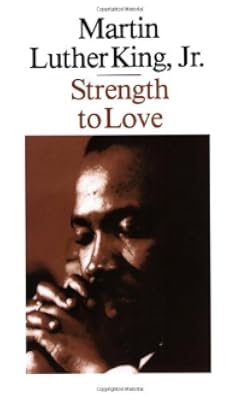
Strength to Love
by Martin Luther King, Jr.
On This Page
Description
A collection of sermons by this martyred Black American leader which explains his convictions in terms of the conditions and problems of contemporary society.Tags
Recommendations




Member Reviews
Coretta Scott King says of this collection of sermons that it is the most requested and read of the books produced from King’s life. Interesting, that King himself was reluctant to put the collection together, worrying that the reading of the sermons would lose something. But they are powerful essays on social justice and how religious faith should inspire the best in us, not the worst. And they read as important to the chaotic and mean-spirited world of today as they were when he preached them as sermons during the Civil Rights Movement. In reading them, it feels that we haven’t come very far, but King would quibble with that conclusion, and actually does in one of the sermons, even then. As he often said, the arc of the moral show more universe may be long – sometimes painfully long – but it tends toward justice.
5 bones!!!!!
Highly recommended, especially for today. show less
5 bones!!!!!
Highly recommended, especially for today. show less
Many people think of Dr. King primarily as a civil rights leader; but first of all, he was a Baptist minister, thoroughly trained in systematic theology and philosophy. This collection of sermons (capped with an article about the development of his "pilgrimage to nonviolence") makes it abundantly clear that Dr. King's work for civil rights and his principles of nonviolent resistance were rooted in his deep Christian faith and careful theological reflection.
While the book clearly reflects the circumstances of its time and place of origin -- the U.S. Civil Rights movement, the Vietnam war, and nuclear proliferation -- the book transcends time and place, dealing with timeless and universal issues and principles.
Chapters 1 through 13 are show more sermons, each based on a Bible text. Chapter 14 is a sermon in the form of an imaginary epistle, "Paul's letter to American Christians," in which Dr. King offered his take on what the apostle might write to American Christians at that time.
In his preface, Dr. King noted that sermons are oral events which lose something when imparted on paper; he adapted the sermons to the written medium with some reluctance. But as I read, I could imagine his clear, resonant voice delivering each paragraph in my imagination.
In Chapter 15, the closing article, Dr. King made explicit what I sensed throughout the book -- the influence of existentialism upon his beliefs and practices. This book tackles the most basic issues of human existance and shines the light of the Christian gospel upon them. This is Christianity at its best -- a faith of love and reconciliation, addressing the deepest conflicts and needs of humanity. But Dr. King did not hesitate to address the Church in its failures -- its divisions and biases, its acceptance (and, too often, even defense) of the "status quo" in an unjust society, and more.
The sermons in this volume exhibit a great depth of faith and logic. Biblical and literary allusions are extensive. The rhetoric (and I use that word in its classical sense) was constructed with the skill of a master.
I may not agree with each and every word -- there are subtle theological points I might debate based on my own religious tradition, and the past 40+ years have shown that limited war (however you view it) can exist and not lead to nuclear holocaust; nonetheless, the vast majority of King's preaching in this volume made me want to say AMEN!
Notes to younger readers: twenty-first century eyes, unfamiliar with the 1960's, may be startled by vocabulary rooted in the time of the volume's publication -- use of the term "negro" and male-dominated language. This was simply the way of speech in 1963, when the book was first published.
Most highly recommended. show less
While the book clearly reflects the circumstances of its time and place of origin -- the U.S. Civil Rights movement, the Vietnam war, and nuclear proliferation -- the book transcends time and place, dealing with timeless and universal issues and principles.
Chapters 1 through 13 are show more sermons, each based on a Bible text. Chapter 14 is a sermon in the form of an imaginary epistle, "Paul's letter to American Christians," in which Dr. King offered his take on what the apostle might write to American Christians at that time.
In his preface, Dr. King noted that sermons are oral events which lose something when imparted on paper; he adapted the sermons to the written medium with some reluctance. But as I read, I could imagine his clear, resonant voice delivering each paragraph in my imagination.
In Chapter 15, the closing article, Dr. King made explicit what I sensed throughout the book -- the influence of existentialism upon his beliefs and practices. This book tackles the most basic issues of human existance and shines the light of the Christian gospel upon them. This is Christianity at its best -- a faith of love and reconciliation, addressing the deepest conflicts and needs of humanity. But Dr. King did not hesitate to address the Church in its failures -- its divisions and biases, its acceptance (and, too often, even defense) of the "status quo" in an unjust society, and more.
The sermons in this volume exhibit a great depth of faith and logic. Biblical and literary allusions are extensive. The rhetoric (and I use that word in its classical sense) was constructed with the skill of a master.
I may not agree with each and every word -- there are subtle theological points I might debate based on my own religious tradition, and the past 40+ years have shown that limited war (however you view it) can exist and not lead to nuclear holocaust; nonetheless, the vast majority of King's preaching in this volume made me want to say AMEN!
Notes to younger readers: twenty-first century eyes, unfamiliar with the 1960's, may be startled by vocabulary rooted in the time of the volume's publication -- use of the term "negro" and male-dominated language. This was simply the way of speech in 1963, when the book was first published.
Most highly recommended. show less
Martin Luther King Jr was not only a civil right activist; he was also, first and foremost, a pastor. This part of his personality is often overlooked (if not forgotten) yet it's crucial to fully understand him. Indeed, his faith fuelled his political engagement and militant activities.
Here's a short collection, then, gathering some of his most representative sermons. We discover a man deeply shaped by his Christianity, to the point of using the Gospels as a weapon to deeply transform an unfair society. Luther King Jr being quite smart, open minded, and everything but a bigot, it's a book which is very interesting to get to grip with his motivating convictions; from his views on Communism and the Cold War to the relevance of Jesus in show more addressing societal issues plaguing then the USA (the book dates back to 1964), as seen through the prism of his Christian faith.
Now, of course, as an atheist, I couldn't but smile at his reading and interpreting of the Bible (e.g. his cherry picking to suit his prejudices) and at his own contradictions when it comes to science and religion. Personally, I also found him annoying at times (e.g. his disregarding of Humanism). Having said that, these are personal criticisms stemming from personal opinions that were not his (I am everything but a spiritual person). My disagreements, then, were predictable; although they don't take anything away from the relevance of his core message.
All in all, then, here's a good read to help understand him better. show less
Here's a short collection, then, gathering some of his most representative sermons. We discover a man deeply shaped by his Christianity, to the point of using the Gospels as a weapon to deeply transform an unfair society. Luther King Jr being quite smart, open minded, and everything but a bigot, it's a book which is very interesting to get to grip with his motivating convictions; from his views on Communism and the Cold War to the relevance of Jesus in show more addressing societal issues plaguing then the USA (the book dates back to 1964), as seen through the prism of his Christian faith.
Now, of course, as an atheist, I couldn't but smile at his reading and interpreting of the Bible (e.g. his cherry picking to suit his prejudices) and at his own contradictions when it comes to science and religion. Personally, I also found him annoying at times (e.g. his disregarding of Humanism). Having said that, these are personal criticisms stemming from personal opinions that were not his (I am everything but a spiritual person). My disagreements, then, were predictable; although they don't take anything away from the relevance of his core message.
All in all, then, here's a good read to help understand him better. show less
This collection of Martin Luther King Jr.'s sermons, published in 1963, contains sixteen messages on various topics and an essay entitled "Pilgrimage to Nonviolence," in which Dr. King describes the study and philosophy that informs his convictions. Dr. King preached these sermons "during or after the bus protest in Montgomery, Alabama" (ix), and does indeed often refer to the struggle against segregation going on in that time. Instead of dating the collection, this fact puts them firmly in a specific historic moment while strikingly illustrating many universal, still-relevant truths he espouses.
That this took me a month to read should not be taken as a negative. From the first sermon, I realized that to be fully engaged with Dr. King's show more wisdom, intellect, and passion, I wanted to take it slowly. Even so, I rather wish it were a book I owned, because I rushed at the end when the library due date sneaked up on me. I didn't always agree with Dr. King's theology, but my admiration and respect for him have only grown as a result of reading some of his sermons. I was often challenged personally and a few times the sermon I was reading was directly applicable to something else I was mulling over or struggling with at the time. I would recommend those unfamiliar with Dr. King's theology and philosophy read the final essay first, as it clarified some points that I had been wondering about while reading. show less
That this took me a month to read should not be taken as a negative. From the first sermon, I realized that to be fully engaged with Dr. King's show more wisdom, intellect, and passion, I wanted to take it slowly. Even so, I rather wish it were a book I owned, because I rushed at the end when the library due date sneaked up on me. I didn't always agree with Dr. King's theology, but my admiration and respect for him have only grown as a result of reading some of his sermons. I was often challenged personally and a few times the sermon I was reading was directly applicable to something else I was mulling over or struggling with at the time. I would recommend those unfamiliar with Dr. King's theology and philosophy read the final essay first, as it clarified some points that I had been wondering about while reading. show less
I'd heard this King guy was good, but I had no idea. Seriously, I had read "I have a Dream" and "Letter from Birmingham Jail," but I wasn't still blown away by this. It's a collection of 14 sermons (which he revised for a written format) and an essay. I'm not sure what surprised me most. The range of his allusions and quotations is larger than I would have guessed for sermons. He quotes poets from Shakespeare to Tennyson to Dunbar and philosophers from Plato to Schopenhauer(!). I probably shouldn't have been surprised by his anti-war and anti-nuclear stances, but I just don't think of him in terms of debates over disarmament, for example. I think that was my major blind spot: I thought of him only in terms of the Civil Rights Movement. show more Certainly these sermons often touch on civil rights, but only in the larger context that he is established in his reading of the biblical verse. I checked out another book of his writings, and I can hardly wait to start. show less
This short book was very good. King's voice is heard loud and well; I truly felt like I could hear his unique cadence spotting these great truths from the pulpit.
A collection of 15 sermons that King had given during his time pastoring a growing Baptist congregation. A much deeper faith that many Christian leaders of today, and certain much more than what we were tough of MLK in public school.
I can't recommend this enough and I'm looking to get a copy for our Pastor. While there are certainly some clearly protestant positions touched on, like salvation by faith alone, when he does he clearly states that they are Protestant positions.
A collection of 15 sermons that King had given during his time pastoring a growing Baptist congregation. A much deeper faith that many Christian leaders of today, and certain much more than what we were tough of MLK in public school.
I can't recommend this enough and I'm looking to get a copy for our Pastor. While there are certainly some clearly protestant positions touched on, like salvation by faith alone, when he does he clearly states that they are Protestant positions.
There was more to Martin Luther King, Jr. than as the leading representative of the early 1960s Civil Rights Movement. He was a Baptist preacher first and foremost. And here we have a collection of his sermons, some written while he was jailed.
This is the third of the five books King collected/wrote before his tragic assassination in 1968. They were composed during the years 1955-1963. It’s also one of his most requested works.
Theses short and meditative sermons, crafted during the heyday of the Civil Rights Movement, are predominately about racial segregation in America. They have a heavy emphasis “on permanent religious values. I was amazed that the words spoken by King sixtyish years ago are purposeful today as they were back show more then. Well, the first ten spoke to today’s racial unrest; the other five didn’t for me, carry the weight of modern times.
His widow, Coretta Scott King, wrote in a Forward that was penned in 1981: "I believe it is because this book best explains the central element of Martin Luther King, Jr.’s philosophy of nonviolence: His belief in a divine, loving presence that binds all life. That insight, luminously conveyed in this classic text, here presented in a new and attractive edition, hints at the personal transformation at the root of social justice: “By reaching into and beyond ourselves and tapping the transcendent moral ethic of love, we shall overcome these evils."
One of the things I thought about as I read, is that we, event in the 21st Century, and especially here is St. Louis, are still practicing segregation. Oh the Colored Only signs may be gone, but look at our neighborhoods. And not only in St. Louis, but around the country, blacks and whites are segregated via their neighborhoods. Interesting concept, in my opinion, and something on which to ponder. show less
This is the third of the five books King collected/wrote before his tragic assassination in 1968. They were composed during the years 1955-1963. It’s also one of his most requested works.
Theses short and meditative sermons, crafted during the heyday of the Civil Rights Movement, are predominately about racial segregation in America. They have a heavy emphasis “on permanent religious values. I was amazed that the words spoken by King sixtyish years ago are purposeful today as they were back show more then. Well, the first ten spoke to today’s racial unrest; the other five didn’t for me, carry the weight of modern times.
His widow, Coretta Scott King, wrote in a Forward that was penned in 1981: "I believe it is because this book best explains the central element of Martin Luther King, Jr.’s philosophy of nonviolence: His belief in a divine, loving presence that binds all life. That insight, luminously conveyed in this classic text, here presented in a new and attractive edition, hints at the personal transformation at the root of social justice: “By reaching into and beyond ourselves and tapping the transcendent moral ethic of love, we shall overcome these evils."
One of the things I thought about as I read, is that we, event in the 21st Century, and especially here is St. Louis, are still practicing segregation. Oh the Colored Only signs may be gone, but look at our neighborhoods. And not only in St. Louis, but around the country, blacks and whites are segregated via their neighborhoods. Interesting concept, in my opinion, and something on which to ponder. show less
Members
- Recently Added By
Lists

CCE 100 Great Books List
145 works; 8 members

Books mentioned in bell hooks' All About Love
70 works; 1 member
Author Information

158+ Works 13,392 Members
Martin Luther King, Jr. was born on January 15, 1929 into a middle-class black family in Atlanta, Georgia. He received a degree from Morehouse College. While there his early concerns for social justice for African Americans were deepened by reading Henry David Thoreau's essay "Civil Disobedience." He enrolled in Crozer Theological Seminary and show more there became acquainted with the Social Gospel movement and the works of its chief spokesman, Walter Rauschenbusch. Mohandas Gandhi's practice of nonviolent resistance (ahimsaahimsa) later became a tactic for transforming love into social change. After seminary, he postponed his ministry vocation by first earning a doctorate at Boston University School of Theology. There he discovered the works of Reinhold Niebuhr and was especially struck by Niebuhr's insistence that the powerless must somehow gain power if they are to achieve what is theirs by right. In the Montgomery bus boycott, it was by economic clout that African Americans broke down the walls separating the races, for without African American riders, the city's transportation system nearly collapsed. The bus boycott took place in 1954, the year King and his bride, Coretta Scott, went to Montgomery, where he had been called to serve as pastor of the Dexter Avenue Baptist Church. Following the boycott, he founded the Southern Christian Leadership Conference (SCLC) to coordinate civil rights organizations. Working through African American churches, activists led demonstrations all over the South and drew attention, through television and newspaper reports, to the fact that nonviolent demonstrations by blacks were being suppressed violently by white police and state troopers. The federal government was finally forced to intervene and pass legislation protecting the right of African Americans to vote and desegregating public accommodations. For his nonviolent activism, King received the Nobel Peace Prize in 1964. While organizing a "poor people's campaign" to persuade Congress to take action against poverty, King accepted an invitation to visit Memphis, Tennessee, where sanitation workers were on strike. There, on April 4, 1968, he was gunned down while standing on the balcony of his hotel. (Bowker Author Biography) show less
Some Editions
Awards and Honors
Distinctions
Common Knowledge
- Original publication date
- 1963
- Dedication
- To my mother and father, whose deep commitment to the Christian faith and unswerving devotion to its timeless principles have given me an inspiring example of the Strength to Love.
- First words
- A French philosopher said, "No man is strong unless he bears within his character antitheses strongly marked.
- Last words
- (Click to show. Warning: May contain spoilers.)In a dark, confused world, the Kingdom of God may yet reign in the hearts of men.
Classifications
- Genres
- Nonfiction, Religion & Spirituality, Politics and Government, General Nonfiction, History, Biography & Memoir
- DDC/MDS
- 252.0613 — Religion Christian pastoral practice & religious orders Texts of sermons Baptist
- LCC
- BX6452 .K5 — Philosophy, Psychology and Religion Christian Denominations Christian Denominations Protestantism Other Protestant denominations Baptists Individual branches
- BISAC
Statistics
- Members
- 1,462
- Popularity
- 16,020
- Reviews
- 17
- Rating
- (4.36)
- Languages
- 9 — Catalan, Danish, English, Finnish, French, German, Italian, Spanish, Swedish
- Media
- Paper, Ebook
- ISBNs
- 24
- ASINs
- 32