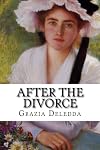
After the Divorce
by Grazia Deledda
On This Page
Description
The novel begins with Costantino Ledda's conviction and sentencing for the murder of his cruel uncle. Though innocent of the crime, he accepts the guilty verdict as punishment for marrying Giovanna Era through a civil ceremony rather than an expensive church wedding. When her husband is taken away, Giovanna has no way to provide for herself, her mother, and her son, who soon dies of malnutrition. Out of desperation she divorces Costantino, according to a new law for wives of convicts, and show more marries a wealthy but brutish landowner. When the true murderer confesses and Costantino returns, he and Giovanna begin a forbidden and ultimately destructive affair. Deleda's tragic story of poverty, passion, and guilt portrays the primitive and remote world of the church, pre-Christian superstitions, and laws dictated from the mainland, in her native Sardinia, where society hangs in a delicate balance. Once this order is disrupted, none of these characters can escape the spiral of destruction dictated by fate, God, and society. show lessTags
Recommendations




















Member Reviews
I will just say that I read Cold Comfort Farm some years ago, and I could not read this book without thinking of Sardinian Starkadders. The lyrical descriptions of scenery and the tragic story of Constantino and Giovanna left me entirely unaffected, in fact more inclined to childish sniggering. I didn't appreciate this work, and it's all my own fault.
A word of caution. Try and get Susan Ashe's English translation. There is a much older English translation available but it changes the ending completely. We discovered this during our book club discussion when someone started talking about the terrible ending. It wasn't the ending in the Ashe version or in the original Italian. As it turns out, Deledda did not write a terrible ending. Her show more story of Constantino and Giovanna ends in a way that is entirely in keeping with the rest of her creation, while the altered ending is disgracefully sentimental and so different in tone from the rest of the story as to be utterly jarring.
To get the best experience possible, stick with the most recent translation and try not to think about Seth and Reuben. show less
A word of caution. Try and get Susan Ashe's English translation. There is a much older English translation available but it changes the ending completely. We discovered this during our book club discussion when someone started talking about the terrible ending. It wasn't the ending in the Ashe version or in the original Italian. As it turns out, Deledda did not write a terrible ending. Her show more story of Constantino and Giovanna ends in a way that is entirely in keeping with the rest of her creation, while the altered ending is disgracefully sentimental and so different in tone from the rest of the story as to be utterly jarring.
To get the best experience possible, stick with the most recent translation and try not to think about Seth and Reuben. show less
Deledda (winner of the 1926 Nobel Prize) was the daughter of a wealthy landowner from rural Sardinia, a largely impoverished island ruled by the Italians since the 18th century. Indeed, Deledda often used island’s hostile landscape as a ruling metaphor. She was particularly adept at using her style—verismo (realism), the same as that employed by Giovanni Verga—to telling effect. After the Divorce is a particularly representative work inasmuch as Deledda was fascinated by how temptation and sin played out, particularly among the poorer classes. The plot is simple: Costantino is convicted of murdering his vicious uncle, despite being innocent; he accepts the verdict as the price for his failure (because of his poverty) to be married show more in the church. His wife, Giovanna, quickly becomes unable to support herself and their child and her mother pushes her to divorce Costantino and remarry, a well-to-do landowner. When Costantino is released, he and Giovanna begin meeting secretly and, unsurprisingly, things end badly. The cast of characters is not large but most are indelibly drawn. After the Divorce evokes Sardinian culture by highlighting the local: language, tradition, families, landscape, and, above all, the poverty and pessimism locked into place by centuries of oppression. Two of Deledda’s choices are worth noting: she took poverty as a given and focused on its effects, not it causes, and she emphasized women’s suffering instead of their autonomy. Neither choice is particularly surprising, but both substantially define her writing and her approach. For her, the world was a place of sin, suffering, and remorse. Like Thomas Hardy, her near contemporary, Deledda was preoccupied with the notion of transgression. Her fiction is peopled by fatally flawed characters torn between hope and despair, right and wrong, sin and redemption. Here, as in other works, a moral dilemma leads to tragedy, all set against the background of a mythical, primordial world. show less
After the Divorce by Grazia Deledda
Grazia Deledda was awarded the Nobel Prize in 1926, the second woman to be so honored. Many of her novels depict the day-to-day lives of Sardinian peasants, and such peasants are the subject of After the Divorce. Giovanna and Costantino are a young happily married couple with an infant son, when Costantino is wrongly accused and convicted of murder. He is sent to prison on the mainland. Giovanna and their son and her mother, face a life of penury and starvation.
When Giovanna's mother learns that the law has been changed to allow a woman whose husband is in prison for a long time to divorce her husband, she begins to pressure Giovanni to divorce Costantino. Brontu Dejas, a wealthy (by peasant show more standards) young man who Giovanna had spurned in favor of Costantino, alleges he still loves her and wants to marry her. Giovanna fights the pressure as long as she can, but eventually succumbs to the pressure. After she marries Brontu, she learns that he is a drunken brute, and he and her mother-in-law treat her no better than a slave. Tragically soon after she divorces and remarries, the true murderer is discovered and Costantino is released and returns to the village.
Deledda writes poetically and lyrically--for example, this description of Giovanna's mother: "...a tall tragic-looking figure all in black. The gaunt, yellow face, shaped like that of some bird of prey...two brilliant green spots indicated eyes, deep-set, overhung by fierce, heavy brows and surrounded by livid circles." She is also clearly knowledgeable about peasant life and practices. For example, she describes a rite of exorcism for the cure of a tarantula bite which is nothing less than surreal---the victim must first wallow in a dung heap, and then roast in an oven, all the while accompanied by twenty women "chanting in melancholy monotone" a song of exorcism. Not surprisingly, victims rarely survived. (Although I have heard that tarantula bites are not necessarily fatal.)
Highly recommended. show less
Grazia Deledda was awarded the Nobel Prize in 1926, the second woman to be so honored. Many of her novels depict the day-to-day lives of Sardinian peasants, and such peasants are the subject of After the Divorce. Giovanna and Costantino are a young happily married couple with an infant son, when Costantino is wrongly accused and convicted of murder. He is sent to prison on the mainland. Giovanna and their son and her mother, face a life of penury and starvation.
When Giovanna's mother learns that the law has been changed to allow a woman whose husband is in prison for a long time to divorce her husband, she begins to pressure Giovanni to divorce Costantino. Brontu Dejas, a wealthy (by peasant show more standards) young man who Giovanna had spurned in favor of Costantino, alleges he still loves her and wants to marry her. Giovanna fights the pressure as long as she can, but eventually succumbs to the pressure. After she marries Brontu, she learns that he is a drunken brute, and he and her mother-in-law treat her no better than a slave. Tragically soon after she divorces and remarries, the true murderer is discovered and Costantino is released and returns to the village.
Deledda writes poetically and lyrically--for example, this description of Giovanna's mother: "...a tall tragic-looking figure all in black. The gaunt, yellow face, shaped like that of some bird of prey...two brilliant green spots indicated eyes, deep-set, overhung by fierce, heavy brows and surrounded by livid circles." She is also clearly knowledgeable about peasant life and practices. For example, she describes a rite of exorcism for the cure of a tarantula bite which is nothing less than surreal---the victim must first wallow in a dung heap, and then roast in an oven, all the while accompanied by twenty women "chanting in melancholy monotone" a song of exorcism. Not surprisingly, victims rarely survived. (Although I have heard that tarantula bites are not necessarily fatal.)
Highly recommended. show less
3.5 A tale in a tiny village in the wilds of Sardinia, it captures the extreme poverty and harshness of life there quite well. The translation seems very uneven which might be why it did not read particularly well, and parts just don't seem realistic. Despite the odd language you get a feel for the characters and the times. I'm not sure if I'll read more by Deledda, but I expect some of her other work must be better than this for her to be awarded the Nobel.
A well told tale of tragic love written in a simple but effective style, this captures the poverty, prejudices and superstitions of a remote peasant village in nineteenth century Sardinia. It is an interesting contrast to The Leopard. February 2019
Ratings
Members
- Recently Added By
Lists

Books Read in 2015
3,299 works; 129 members

Women and the Family, European Fiction, 1900-1934
68 works; 1 member
Author Information

155+ Works 1,715 Members
Among the most honored women writers of modern Italy, Deledda wrote naturalistic or realistic novels, drawing upon her Sardinian background for material. Some critics hold, however, that in Deledda's formula often only the names of places and people serve to evoke a Sardinian atmosphere of strangeness. Her best works especially Elias Portolu show more (1903), Cenere (1904), and The Mother (1920) contain excellent portrayals of women. While her characters are complex, often dominated by an overwhelming sense of destiny and by nature's mythic powers, her narrative structures remain simple and classic. She was awarded the Nobel Prize for Literature in 1926. (Bowker Author Biography) show less
Some Editions
Awards and Honors
Notable Lists
Series
Belongs to Publisher Series
Common Knowledge
- Canonical title
- After the Divorce
- Original publication date
- 1902
- Important places
- Sardinia, Italy
- Original language
- Italian
Classifications
- Genres
- Fiction and Literature, General Fiction
- DDC/MDS
- 853.8 — Literature & rhetoric Italian, Romanian & related literatures Italian fiction Later 19th century 1859–1900
- LCC
- PQ4811 .E6 .N313 — Language and Literature French, Italian, Spanish and Portuguese literatures Italian literature Individual authors, 1900-1960
- BISAC
Statistics
- Members
- 97
- Popularity
- 332,330
- Reviews
- 5
- Rating
- (3.47)
- Languages
- English, Italian, Portuguese, Spanish
- Media
- Paper, Audiobook, Ebook
- ISBNs
- 19
- ASINs
- 3