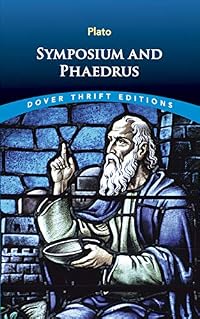
Le Banquet ; Phèdre
by Plato
On This Page
Description
The Symposium and the Phaedrus are combined here because of their shared theme: a reflection on the nature of erotic love, the love that begins with sexual desire but can transcend that origin and reach even the heights of religious ecstasy. This reflection is carried out explicitly in the speeches and conversations in the dialogues, and implicitly in the dramatic depiction of actions and characters. Thus, the two dialogues deal with a theme of enduring interest and are interesting for both show more their literary and their philosophical character. In addition to the introduction, the book contains substantial commentaries and thorough endnotes. Key Greek terms are discussed for readers who are unfamiliar with the language. A special feature is a discussion on the importance of the dramatic and literary aspects of the dialogues for interpreting their philosophical content. -- Back cover. show lessTags
Recommendations

















Member Reviews
Reading ancient classics in their entirety is an interesting exercise. Not reading them from start to finish, and instead gaining one's classical education purely from secondary sources, is a sure way to reinforce modern prejudices. The standard "folk-style" (re)interpretations render one's thoughts on the classics, the Renaissance, ethics, and sexuality recast in modern fashions of morality. This is no laughing matter, and as recent as 2005, pointing out the obvious was less an exercise in self-flagellation (pardon the pun), and more an exercise in publicly shooting oneself in the foot. For example, the book [b:Same-Sex Desire and Love in Greco-Roman Antiquity and in the Classical Tradition of the West|5071444|Same-Sex Desire and Love show more in Greco-Roman Antiquity and in the Classical Tradition of the West|Beert C Verstraete|https://images.gr-assets.com/books/1348444935s/5071444.jpg|5138110] was not going to be published (according to the Chronicle of Higher Education, 12 October 2005) following objections by "conservative activists". This is what leaves me shaking my head - if being a conservative is all about respect for the traditions of the past, where "Western" thought and the Hellenic tradition are one and the same (especially in opposition to "others"), then the veritable chink in the conservative armour is undoubtedly amour homosexuel. That is not to say that one shouldn't take the best bits of the past and reject those practices that were not simply actions between consenting adults (specifically pederasty, but bestiality and cannibalism probably count, for that matter), but to whitewash history so thoroughly dishonours George Santayana's legacy no end. In Symposium, it was a real treat to hear from Alcibiades (even if he did mention how he tried to seduce Socrates). Undoubtedly,
[a:Steven Pressfield|867|Steven Pressfield|https://images.gr-assets.com/authors/1298914893p2/867.jpg]'s depiction of Alcibiades' character in [b:Tides of War|1317|Tides of War|Steven Pressfield|https://images.gr-assets.com/books/1388329271s/1317.jpg|544748] was magnificently rendered. It is a challenge to deliberately reconfigure my "knowledge", which was invariably based on abridged and whitewashed versions of history, and taught by well-meaning but oppressive moral crusaders. As I write this I am experiencing waves of liberal education that are making me feel truly free. I will have to find all of the sources that have stated time and again that if you do not read, you are not free. This is true. I am fortunate to have read [b:History of the Peloponnesian War|261243|History of the Peloponnesian War|Thucydides|https://images.gr-assets.com/books/1422072332s/261243.jpg|804111] and [b:Zen and the Art of Motorcycle Maintenance: An Inquiry Into Values|629|Zen and the Art of Motorcycle Maintenance An Inquiry Into Values|Robert M. Pirsig|https://images.gr-assets.com/books/1410136019s/629.jpg|175720] (Vale Robert Pirsig) beforehand, but whether a proper reading of Homer is better before or after I shall not know until I get through that tome. While Baz Luhrmann innocuously advises one to wear sunscreen, I would advise one to read. But don't blame me if taking the red pill destroys the prefabricated foundations to your intellectual existence. show less
[a:Steven Pressfield|867|Steven Pressfield|https://images.gr-assets.com/authors/1298914893p2/867.jpg]'s depiction of Alcibiades' character in [b:Tides of War|1317|Tides of War|Steven Pressfield|https://images.gr-assets.com/books/1388329271s/1317.jpg|544748] was magnificently rendered. It is a challenge to deliberately reconfigure my "knowledge", which was invariably based on abridged and whitewashed versions of history, and taught by well-meaning but oppressive moral crusaders. As I write this I am experiencing waves of liberal education that are making me feel truly free. I will have to find all of the sources that have stated time and again that if you do not read, you are not free. This is true. I am fortunate to have read [b:History of the Peloponnesian War|261243|History of the Peloponnesian War|Thucydides|https://images.gr-assets.com/books/1422072332s/261243.jpg|804111] and [b:Zen and the Art of Motorcycle Maintenance: An Inquiry Into Values|629|Zen and the Art of Motorcycle Maintenance An Inquiry Into Values|Robert M. Pirsig|https://images.gr-assets.com/books/1410136019s/629.jpg|175720] (Vale Robert Pirsig) beforehand, but whether a proper reading of Homer is better before or after I shall not know until I get through that tome. While Baz Luhrmann innocuously advises one to wear sunscreen, I would advise one to read. But don't blame me if taking the red pill destroys the prefabricated foundations to your intellectual existence. show less
Quite enjoyable read, although Eros might not be as relevant in our society as it was in Plato's. Love holds the central idea in both books, which are held as the most accessible of Plato's works. Personally I would recommend that anyone interested in reading these works that (s)he pay attention to the setting, especially the countryside in Phaedrus.
It seems weird rating Plato with stars?
Sinds de Deventer boekenmarkt van 1998 ben ik in het bezit van het volledig werk van Plato (in de vertaling van de school voor filosofie) waar ik nu in ben begonnen te lezen.
Plato is de belangrijkste Griekse filosoof uit de oudheid en het schijnt dat zijn dialogen ook voor de leek goed te lezen moeten zijn. In dit eerste deeltje van de complete serie vind je de dialogen Phaidros en Symposion die vooral over de liefde gaan. Verschillende personen voeren het woord maar Socrates heeft toch steeds het laatste woord, waarbij hij door middel van vraag en antwoord steeds dichter naar de waarheid probeert toe te werken. Het meest opvallend in dit deeltje is de toespraak van Aristophanes wanneer hij het over de evolutie van de mensen heeft. show more Volgens hem waren de mannelijke en de vrouwelijke helft in het verleden een geheel en hadden de mensen 4 benen, 4 armen en 2 gezichten. Voortbewegen deed hij door zich rond te wentelen als een soort wiel. Een interessante gedachte echter niet meer gesteund door de moderne wetenschap.
Plato heeft de naam een groot stilist te zijn. In een vertaling valt dat moeilijk te beoordelen. Deze is zeker niet briljant maar valt toch prettig te lezen. Op naar het volgende deel!
Uitgelezen: zondag 17 december 2000 show less
Plato is de belangrijkste Griekse filosoof uit de oudheid en het schijnt dat zijn dialogen ook voor de leek goed te lezen moeten zijn. In dit eerste deeltje van de complete serie vind je de dialogen Phaidros en Symposion die vooral over de liefde gaan. Verschillende personen voeren het woord maar Socrates heeft toch steeds het laatste woord, waarbij hij door middel van vraag en antwoord steeds dichter naar de waarheid probeert toe te werken. Het meest opvallend in dit deeltje is de toespraak van Aristophanes wanneer hij het over de evolutie van de mensen heeft. show more Volgens hem waren de mannelijke en de vrouwelijke helft in het verleden een geheel en hadden de mensen 4 benen, 4 armen en 2 gezichten. Voortbewegen deed hij door zich rond te wentelen als een soort wiel. Een interessante gedachte echter niet meer gesteund door de moderne wetenschap.
Plato heeft de naam een groot stilist te zijn. In een vertaling valt dat moeilijk te beoordelen. Deze is zeker niet briljant maar valt toch prettig te lezen. Op naar het volgende deel!
Uitgelezen: zondag 17 december 2000 show less
Sep 15, 2009Dutch
Ratings
Members
- Recently Added By
Author Information

2,711+ Works 100,287 Members
Plato was born c. 427 B.C. in Athens, Greece, to an aristocratic family very much involved in political government. Pericles, famous ruler of Athens during its golden age, was Plato's stepfather. Plato was well educated and studied under Socrates, with whom he developed a close friendship. When Socrates was publically executed in 399 B.C., Plato show more finally distanced himself from a career in Athenian politics, instead becoming one of the greatest philosophers of Western civilization. Plato extended Socrates's inquiries to his students, one of the most famous being Aristotle. Plato's The Republic is an enduring work, discussing justice, the importance of education, and the qualities needed for rulers to succeed. Plato felt governors must be philosophers so they may govern wisely and effectively. Plato founded the Academy, an educational institution dedicated to pursuing philosophic truth. The Academy lasted well into the 6th century A.D., and is the model for all western universities. Its formation is along the lines Plato laid out in The Republic. Many of Plato's essays and writings survive to this day. Plato died in 347 B.C. at the age of 80. (Bowker Author Biography) show less
Some Editions
Series
Belongs to Publisher Series
Common Knowledge
- Canonical title
- Phaedrus; Symposium; Le Banquet ; Phèdre
- Alternate titles
- Symposium and Phaedrus
Classifications
Statistics
- Members
- 729
- Popularity
- 38,511
- Reviews
- 5
- Rating
- (3.68)
- Languages
- 6 — Catalan, English, Finnish, French, German, Spanish
- Media
- Paper, Ebook
- ISBNs
- 20
- UPCs
- 2
- ASINs
- 11