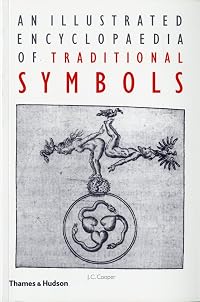
An Illustrated Encyclopaedia of Traditional Symbols
by J. C. Cooper
On This Page
Description
People all over the world have always used symbols to express and communicate the things that mean most to them. From a country's flag, which can signify more than patriotism, to a charm bracelet, with its "portable memories," symbolism takes various forms. Familiarity with symbolism opens up levels of understanding most of us have probably never been aware of. Why, for instance, do we share a secret with the words "a little bird told me?" What is it about a horseshoe that, in the right show more circumstances, brings luck? Why a horse's shoe? How old is the swastika, and where has it been used as a symbol (and what was Jung getting at when he said the Nazis used it "backwards")? show lessTags
Recommendations
























Member Reviews
This is the sort of book which the internet has largely made redundant. In itself, it was quite an achievement as a single volume reference text covering a wide range of civilisations on many continents, albeit without much contextualisation.
It is a 'ready reckoner'. It stays on the library shelf to allow a quick check of possible meanings of symbols in probable contexts before going on to explore matters through far more useful online resources. If you have it, keep it but you probably don't need it if you do not.
It is a 'ready reckoner'. It stays on the library shelf to allow a quick check of possible meanings of symbols in probable contexts before going on to explore matters through far more useful online resources. If you have it, keep it but you probably don't need it if you do not.
This is the only "dream" reference book I have ever found useful because you can discover the diiferences between say Celtic, Christian, Judaic. Buddhist meanings and allow your unconscious to pick up on these. Also some facinating, if small, illustraions. A reference must.
In nearly 1500 entries, many of them strikingly and often surprisingly illustrated, J. C. Cooper has documented the history and evolution of symbols from prehistory to our own day.
With over 200 illustrations and lively, informative and often ironic texts, she discusses and explains an enormous variety of symbols extending from the Arctic to Dahomey, from the Iroquois to Oceana, and coming from systems as diverse as Tao, Christianity, Judaism, Buddhism, Islam, Tantra, the cult of Cybele and the Great Goddess, the Pre-Columbian religions of the Western Hemisphere and the Voodoo cults of Brazil and West Africa.
Source: Publisher: 1987 eBook edition
With over 200 illustrations and lively, informative and often ironic texts, she discusses and explains an enormous variety of symbols extending from the Arctic to Dahomey, from the Iroquois to Oceana, and coming from systems as diverse as Tao, Christianity, Judaism, Buddhism, Islam, Tantra, the cult of Cybele and the Great Goddess, the Pre-Columbian religions of the Western Hemisphere and the Voodoo cults of Brazil and West Africa.
Source: Publisher: 1987 eBook edition
With a glossary, extensive bibliography and 210 illustrations, some small, it covers many cultures, religions and esoteric doctrines with a fine impartiality.
badly fire damages
Ratings
Members
- Recently Added By
Author Information

14 Works 1,087 Members
J.C. Cooper writes extensively on philosophy, comparative religion and symbolism
Series
Belongs to Publisher Series
Common Knowledge
- Original publication date
- 1978
- Dedication
- In memoriam Vincent Morse Cooper
- First words
- Introduction: The study of symbolism is not mere erudition; it concerns man's knowledge of himself.
- Last words
- (Click to show. Warning: May contain spoilers.)The Islamic Zodiac has six 'northern' (wet) and six 'southern' (dry) signs: Aries, Leo, Sagitarrius - fire, hot, dry, East; Taurus, Virgo, Capricornus - earth, cold, dry, South; Gemini, Libra, Aquarius - air, hot, wet, West: Cancer, Scorpio, Pisces - water, cold, wet, North.
Classifications
- Genres
- Reference, Nonfiction, Anthropology, Art & Design, General Nonfiction
- DDC/MDS
- 301.21 — Society, government, & culture Social sciences, sociology & anthropology Sociology and anthropology Formerly: Culture and cultural processes
- LCC
- BL603 .C66 — Philosophy, Psychology and Religion Religions. Mythology. Rationalism Religions. Mythology. Rationalism Worship. Cultus
- BISAC
Statistics
- Members
- 607
- Popularity
- 48,153
- Reviews
- 5
- Rating
- (3.99)
- Languages
- 12 — Czech, Danish, Dutch, English, German, Greek, Italian, Norwegian (Bokmål), Serbian, Croatian, Spanish, Swedish
- Media
- Paper, Ebook
- ISBNs
- 22
- ASINs
- 9