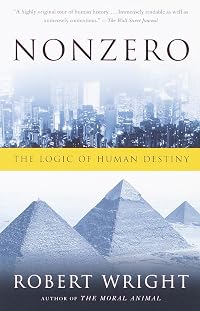
Nonzero: The Logic of Human Destiny
by Robert Wright
On This Page
Description
In his bestselling The Moral Animal, Robert Wright applied the principles of evolutionary biology to the study of the human mind. Now Wright attempts something even more ambitious: explaining the direction of evolution and human history–and discerning where history will lead us next. In Nonzero: The Logic of Human Destiny, Wright asserts that, ever since the primordial ooze, life has followed a basic pattern. Organisms and human societies alike have grown more complex by mastering the show more challenges of internal cooperation. Wright's narrative ranges from fossilized bacteria to vampire bats, from stone-age villages to the World Trade Organization, uncovering such surprises as the benefits of barbarian hordes and the useful stability of feudalism. Here is history endowed with moral significance–a way of looking at our biological and cultural evolution that suggests, refreshingly, that human morality has improved over time, and that our instinct to discover meaning may itself serve a higher purpose. Insightful, witty, profound, Nonzero offers breathtaking implications for what we believe and how we adapt to technology's ongoing transformation of the world. show lessTags
Recommendations
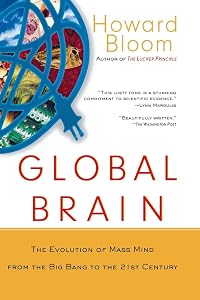
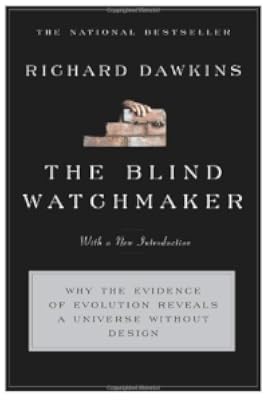
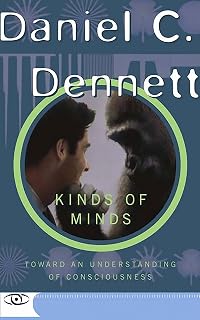

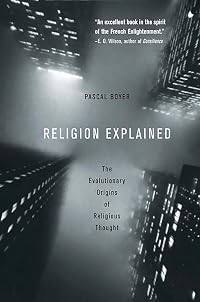
Member Recommendations
Member Reviews
I really wanted to like this book. I am sympathetic to its general premise: that human history is generally "Whiggish" and has moved in the direction of greater peace and prosperity over time. (I loved Steven Pinker's The Better Angels of Our Nature: Why Violence Has Declined, which made a similar point but in what I found a much more solid manner.) And I found its opening chapters, looking at pre-state societies through anthropological and archaeological, to be fascinating.
But as Wright moved forward in development, from pre-historical states to the realm of history, I grew less enchanted. This wasn't a coincidence: I know a lot more about classical, medieval and early modern history than I do about prehistory and anthropology, and I show more immediately identified where Wright's breezy, 10,000-foot view was omitting important counterexamples. (One immediate one: his dismissal of the collapse of the Western Roman Empire as a relative nonevent ran directly against The Evolution of God: it was similarly breezy, as well as sharing a similar obsession with the philosopher Philo of Alexandria.)
I like big-picture books. I just think Wright's historical case could have done with another 100 pages worth of examples. Perhaps those could have been inserted in place of the book's misplaced second section, which detoured from cultural evolution back to biological evolution to reapply the same thesis.
Of course, I don't need to wish for that. Pinker's more solidly written Better Angels essentially took Wright's general thesis, stripped it of his metaphysical musings, and backed it up with a bevy of prehistorical, historical and psychological research to produce a much more compelling read. show less
But as Wright moved forward in development, from pre-historical states to the realm of history, I grew less enchanted. This wasn't a coincidence: I know a lot more about classical, medieval and early modern history than I do about prehistory and anthropology, and I show more immediately identified where Wright's breezy, 10,000-foot view was omitting important counterexamples. (One immediate one: his dismissal of the collapse of the Western Roman Empire as a relative nonevent ran directly against The Evolution of God: it was similarly breezy, as well as sharing a similar obsession with the philosopher Philo of Alexandria.)
I like big-picture books. I just think Wright's historical case could have done with another 100 pages worth of examples. Perhaps those could have been inserted in place of the book's misplaced second section, which detoured from cultural evolution back to biological evolution to reapply the same thesis.
Of course, I don't need to wish for that. Pinker's more solidly written Better Angels essentially took Wright's general thesis, stripped it of his metaphysical musings, and backed it up with a bevy of prehistorical, historical and psychological research to produce a much more compelling read. show less
I enjoyed the book, although I found it a bit too dense. Thoroughly researched, but took too long to get the messsges across which therefore became a little lost. The main idea is that humans are shaped by both biological and cultural evolution. That biological is no longer determining natural selection, that there is an inevitable direction towards increasing complexity, that if humans hadn’t evolved intelligence, another animal would have. And not one necessarily closely related to us. Eg dolphins show many traits of cultural evolution. I got a bit lost about the idea of purpose in the design of life. Recommended for the hardy few.
Wright's thesis is that human history has a destiny -- or at least a direction. This is not a mystic or supernatural direction. Rather, the history of matter, life in general, and humanity in particular tends toward complexity over time. This, in turn, is because there exist opportunities for nonzero sum interactions.
The rest of the book builds this argument starting with human culture and then discussing the origination and evolution of life. It's history through a particular lens in the style of Jared Diamond (or, to use a more contemporary example, Yuval Noah Harari). Like all good lenses, it doesn't explain everything but it does help bring clarity in certain areas. As is common for this genre, the tour through history is somewhat show more selective so as to emphasize the point. However, Wright gets credit for selecting the examples that both best support and most challenge his lens. A number of the chapters belabor the point more than they need to, and Wright spends a decent amount of time immersing himself in the debates that were de rigueur in 2000 -- hence 4 stars.
Instead of going into detail about the full argument, I'll focus on the core: nonzero sumness and how it leads to complexity. Given that core, the rest of the argument is interesting and important to work out in detail (beautiful theories often fail when faced with the detail of reality), but I'll leave that as an exercise to the reader. :-D
A nonzero sum interaction is one where coordinated action yields more net value than uncoordinated action. I intentionally use the term coordinated rather than cooperative to highlight the key point that a nonzero sum interaction need not involve conscious agents. That said, I'm going to use agent based language from here on out because to do otherwise tortures English. But remember that conscious agents are not necessary for nonzero sum interactions.
A coordinated action yields more value than the agents would have realized independently, but for the coordination to really be successful, each agent needs to individually realize more value than they would have realized without the coordination. Otherwise, there is no incentive to coordinate. As Wright puts it, every nonzero sum interaction has a zero sum core: the coordination produces more value than not coordinating, but that value needs to be divided and that division is zero sum. (Unless the agents have gotten to the point where their destinies are so shared that they can hardly be called independent anymore and they both realize all the costs and value of coordination.)
Time again to step back from agents. I said that Wright used this model to discuss the broad stroke mechanisms by which life might have originated. Molecules have no incentive to coordinate. So we have to instead think about success through the lens of natural selection. Natural selection works by a sheer numbers game: whatever genes are more successfully propagated to the next generation "win" the evolution game. The same is true for more mechanical molecular structures. Coordination at this level -- and really, up to the level of somewhat sophisticated life -- is a matter of there just being more of a particular structure around. And eventually, levels of coordination become intricate enough that the two coordinating agents are not really independent any more (e.g. nuclei and mitochondria in cells or humans who want to live in societies that have massive infrastructure like electricity).
(In normal evolutionary manner, this doesn't mean that the less coordinated agents don't continue along their own evolutionary track. Increasing complexity doesn't require less coordinated agents to disappear, although it may introduce pressures that they need to adapt to.)
Getting back to nonzero sum interactions, if coordination yields more value than a lack of coordination, then coordination strategies will be more successful over time. This is true even if every instance of coordination requires completely random coincidence to get started. Think of nonzero sum interactions as a ratchet: once a particular source of nonzero sum value started to be exploited, it's hard to move back to less cooperative strategies.
This ratcheting effect is the heart of Wright's argument that history has a direction. Because each step of complexity tends to be hard to undo and because more complex structures and organisms yield the potential for even more nonzero sum interactions, complexity tends to increase over time. A subset of molecules coordinate to become simple organisms to become more complex organisms to start evolving ever and ever more complex culture.
As Wright makes sure we are all clear on, this does not violate entropy. This order does not come without a cost. Acts of coordination -- including the coordination to merely sustain something like an organism -- take in energy; some goes to waste.
In this framing, nonzero sumness sounds totally awesome! And it is pretty awesome. In general, coordinating will yield more total value than the sum of the value created by not coordinating. However, coordination that lasts over many iterations increases interdependence. Nonzero sum interaction mean we succeed together and we fail together. To use an example from human culture, if two societies start trading they can specialize but that means that if their trading relationship is interrupted, they will no longer be able to provide as effectively for themselves as they would have if they had stayed independent. This yoking explains why nonzero sum relationships have often failed just as spectacularly as they have succeeded. Wright does not argue that coordination always brings success, just that coordination is the more successful strategy in the long run. Even in the case of our hypothetical trading partners, if they realized enough value before their relationship were interrupted, then coordination is likely a net win.
Overall, this was a good book that has aged well. show less
The rest of the book builds this argument starting with human culture and then discussing the origination and evolution of life. It's history through a particular lens in the style of Jared Diamond (or, to use a more contemporary example, Yuval Noah Harari). Like all good lenses, it doesn't explain everything but it does help bring clarity in certain areas. As is common for this genre, the tour through history is somewhat show more selective so as to emphasize the point. However, Wright gets credit for selecting the examples that both best support and most challenge his lens. A number of the chapters belabor the point more than they need to, and Wright spends a decent amount of time immersing himself in the debates that were de rigueur in 2000 -- hence 4 stars.
Instead of going into detail about the full argument, I'll focus on the core: nonzero sumness and how it leads to complexity. Given that core, the rest of the argument is interesting and important to work out in detail (beautiful theories often fail when faced with the detail of reality), but I'll leave that as an exercise to the reader. :-D
A nonzero sum interaction is one where coordinated action yields more net value than uncoordinated action. I intentionally use the term coordinated rather than cooperative to highlight the key point that a nonzero sum interaction need not involve conscious agents. That said, I'm going to use agent based language from here on out because to do otherwise tortures English. But remember that conscious agents are not necessary for nonzero sum interactions.
A coordinated action yields more value than the agents would have realized independently, but for the coordination to really be successful, each agent needs to individually realize more value than they would have realized without the coordination. Otherwise, there is no incentive to coordinate. As Wright puts it, every nonzero sum interaction has a zero sum core: the coordination produces more value than not coordinating, but that value needs to be divided and that division is zero sum. (Unless the agents have gotten to the point where their destinies are so shared that they can hardly be called independent anymore and they both realize all the costs and value of coordination.)
Time again to step back from agents. I said that Wright used this model to discuss the broad stroke mechanisms by which life might have originated. Molecules have no incentive to coordinate. So we have to instead think about success through the lens of natural selection. Natural selection works by a sheer numbers game: whatever genes are more successfully propagated to the next generation "win" the evolution game. The same is true for more mechanical molecular structures. Coordination at this level -- and really, up to the level of somewhat sophisticated life -- is a matter of there just being more of a particular structure around. And eventually, levels of coordination become intricate enough that the two coordinating agents are not really independent any more (e.g. nuclei and mitochondria in cells or humans who want to live in societies that have massive infrastructure like electricity).
(In normal evolutionary manner, this doesn't mean that the less coordinated agents don't continue along their own evolutionary track. Increasing complexity doesn't require less coordinated agents to disappear, although it may introduce pressures that they need to adapt to.)
Getting back to nonzero sum interactions, if coordination yields more value than a lack of coordination, then coordination strategies will be more successful over time. This is true even if every instance of coordination requires completely random coincidence to get started. Think of nonzero sum interactions as a ratchet: once a particular source of nonzero sum value started to be exploited, it's hard to move back to less cooperative strategies.
This ratcheting effect is the heart of Wright's argument that history has a direction. Because each step of complexity tends to be hard to undo and because more complex structures and organisms yield the potential for even more nonzero sum interactions, complexity tends to increase over time. A subset of molecules coordinate to become simple organisms to become more complex organisms to start evolving ever and ever more complex culture.
As Wright makes sure we are all clear on, this does not violate entropy. This order does not come without a cost. Acts of coordination -- including the coordination to merely sustain something like an organism -- take in energy; some goes to waste.
In this framing, nonzero sumness sounds totally awesome! And it is pretty awesome. In general, coordinating will yield more total value than the sum of the value created by not coordinating. However, coordination that lasts over many iterations increases interdependence. Nonzero sum interaction mean we succeed together and we fail together. To use an example from human culture, if two societies start trading they can specialize but that means that if their trading relationship is interrupted, they will no longer be able to provide as effectively for themselves as they would have if they had stayed independent. This yoking explains why nonzero sum relationships have often failed just as spectacularly as they have succeeded. Wright does not argue that coordination always brings success, just that coordination is the more successful strategy in the long run. Even in the case of our hypothetical trading partners, if they realized enough value before their relationship were interrupted, then coordination is likely a net win.
Overall, this was a good book that has aged well. show less
Having just finished Nonzero for the second time, I've got to admit it is seriously one of the best and most important books I've ever read. Why did I have to read it a second time? The first was a quick read over a long weekend two years ago -- but something stuck in my mind that I hadn't really "grokked" it. And that was true, because, I read it as an archaeologist, rather than as an anthropologist, and I guess I was just looking at it as another theoretical bent. But there was that gnawing feeling I'd missed something. On a second 'conscious' reading of the book, slowly digesting as I read, and following all the notes, I came away with the gist of it, and you know, Wright's right: civilizations may come and go, but cultural evolution show more is here to stay. Is there a method to the madness? Yes, absolutely. Is it 'conscious' in its own right? Well, there's the rub. But as far as showing that cultural evolution proceeds pretty much along the same route as biological evolution (only at hyper-speed), well, Mr. Wright, I'm convinced.
If there is any criticism, I'd have to say it centers on the fact that he lays it all at the feet of (the pursuit of?) non-zero-sumness (a sub-set of outcomes related to game theory, and which he freely admits was awkward at times), and that took some getting used to, as well as understanding, and then believing.
The exploration of history against a background of Darwinian biological evolution, even to the molecular level, is mind-numbing, but well worth the ride. And his explanation of the (probability and) nature of life is awe-inspiring. I would suggest it become a standard text in Anthropology graduate courses as soon as possible.
But again, I think it is a very important book, and I would highly recommend it to anyone with an open mind, intelligence, and hope for the future (and a good background in the sciences wouldn't hurt either). Read it slowly and contemplate the consequences. Thanks Mr. Wright. show less
If there is any criticism, I'd have to say it centers on the fact that he lays it all at the feet of (the pursuit of?) non-zero-sumness (a sub-set of outcomes related to game theory, and which he freely admits was awkward at times), and that took some getting used to, as well as understanding, and then believing.
The exploration of history against a background of Darwinian biological evolution, even to the molecular level, is mind-numbing, but well worth the ride. And his explanation of the (probability and) nature of life is awe-inspiring. I would suggest it become a standard text in Anthropology graduate courses as soon as possible.
But again, I think it is a very important book, and I would highly recommend it to anyone with an open mind, intelligence, and hope for the future (and a good background in the sciences wouldn't hurt either). Read it slowly and contemplate the consequences. Thanks Mr. Wright. show less
I've just finished re-reading Nonzero. Robert Heinlein once defined a good book as one which you can read again and get more out of it, and a great book as one which you can read again and again and keep getting more out of it. Nonzero is definitely in the great category. A conversation I was having recently with John Smart of the Acceleration Studies Foundation reminded me of Nonzero and made it clear to me that a re-read was in order. In Nonzero, Robert Wright brilliantly applies game theory to the evolution of life and human culture and makes an excellent case for the continuous expansion of non-zero-sum games in both arenas, giving a strong direction of progressive change in both. The book is much deeper and broader than that simple show more sentence implies, and I consider the book a must read for anyone who is interested in the nature of being human. show less
It's brilliant. Like Guns, Germs, and Steel, examines all of human history through a single lens, in this case win-win games.
The thesis is that human life and all progress comes about as a series of non-zero sum interactions, games where both parties win.
It gets a bit repetitive some times - when a story begins you can start predicting how it will end because there is only one theme in the book, but it effectively demonstrates the idea and shows you the impact throughout history and applications for the future.
The thesis is that human life and all progress comes about as a series of non-zero sum interactions, games where both parties win.
It gets a bit repetitive some times - when a story begins you can start predicting how it will end because there is only one theme in the book, but it effectively demonstrates the idea and shows you the impact throughout history and applications for the future.
In his bestselling The Moral Animal, Robert Wright applied the principles of evolutionary biology to the study of the human mind. Now Wright attempts something even more ambitious: explaining the direction of evolution and human history
Members
- Recently Added By
Lists

Atheism, humanism, freethought, &c. — Best nonfiction books in favour of
167 works; 14 members
Author Information

6+ Works 6,488 Members
Robert Wright is the bestselling author of The Evolution of God, The Moral Animal, and Nonzero. He has taught in the psychology department at the University of Pennsylvania and the religion department at Princeton University. He is currently Visiting Professor of Science and Religion at Union Theological Seminary in New York.
Some Editions
Awards and Honors
Notable Lists
Work Relationships
Common Knowledge
- Original title
- Nonzero: The Logic of Human Destiny
- Original publication date
- 2000
- Original language
- English
Classifications
- Genres
- Anthropology, Nonfiction, Science & Nature, History, General Nonfiction, Philosophy
- DDC/MDS
- 303.4 — Society, government, & culture Social sciences, sociology & anthropology Social processes Social change
- LCC
- GN360 .W75 — Geography, Anthropology and Recreation Anthropology Anthropology Ethnology. Social and cultural anthropology Culture and cultural processes
- BISAC
Statistics
- Members
- 1,395
- Popularity
- 16,991
- Reviews
- 19
- Rating
- (3.92)
- Languages
- 7 — Chinese, Czech, Dutch, English, Polish, Spanish, Portuguese (Portugal)
- Media
- Paper, Audiobook, Ebook
- ISBNs
- 12
- ASINs
- 5