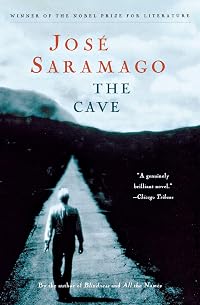
The Cave
by José Saramago
On This Page
Description
Cipriano Algor, an elderly potter, lives with his daughter Marta and her husband Marçal in a small village on the outskirts of The Center, an imposing complex of shops, apartments, and offices to which Cipriano delivers his pots and jugs every month. On one such trip, he is told not to make any more deliveries. Unwilling to give up his craft, Cipriano tries his hand at making ceramic dolls. Astonishingly, The Center places an order for hundreds, and Cipriano and Marta set to work-until the show more order is cancelled and the three have to move from the village into The Center. When mysterious sounds of digging emerge from beneath their apartment, Cipriano and Marçal investigate, and what they find transforms the family's life. Filled with the depth, humor, and the extraordinary philosophical richness that marks each of Saramago's novels, The Cave is one of the essential books of our time. show lessTags
Recommendations










Member Recommendations
Member Reviews
“Cipriano Algor put the spade down and plunged his two hands into the ashes. He touched the thin and unmistakable roughness of the fired clay. Then, as if he were helping at a birth, he grasped between thumb, forefinger, and middle finger the still buried head of a figurine and pulled it out. It happened to be the nurse. He brushed the ashes from her body and blew on her face, as if he were endowing her with some kind of life, giving to her the breath of his own lungs, the beating of his own heart.” - José Saramago, The Cave
Protagonist Cipriano Algor, an artisan living in the country with his daughter and son-in-law, sells his handmade tableware to the Center. The Center’s agent tells Cipriano his services are no longer required, show more so he attempts to find another way to make money from his skill as a potter. It is a story of everyday life involving a family, a stray dog, a budding relationship, and how these people deal with change.
This book requires patience, as the meaning of The Cave is not apparent until the end. It is not for anyone looking for plot-driven action. As is typical of Saramago, it is written in stream-of-consciousness without quotation marks or separation of dialogue, so the reader has to keep track mentally. He strings together a series of words to convey many shades of meaning.
It is a story of human (and animal) connections in uncertain times, how people can deceive themselves, and how we maintain our illusions rather than confronting the truth. It is a social commentary on the increasing artificiality of our world. I think it is particularly pertinent to our present time.
I embark annually on a project to read five works from a notable author. This year I picked Portuguese author José Saramago, recipient of the 1998 Nobel Prize in Literature. This is the fifth of five for the year. I just loved it and am adding it to my list of favorites.
-------------------------------------------------
In case anyone is interested, these are the others I have read. His work is consistently high quality.
[a:José Saramago|1285555|José Saramago|https://images.gr-assets.com/authors/1497455560p2/1285555.jpg]: 2020
- [b:Blindness|2526|Blindness|José Saramago|https://i.gr-assets.com/images/S/compressed.photo.goodreads.com/books/1327866409l/2526._SY75_.jpg|3213039] - 4 stars - My Review
- [b:The Stone Raft|39968691|The Stone Raft|José Saramago|https://i.gr-assets.com/images/S/compressed.photo.goodreads.com/books/1524777696l/39968691._SY75_.jpg|864507] by [a:José Saramago|1285555|José Saramago|https://images.gr-assets.com/authors/1497455560p2/1285555.jpg] - 4 stars - My Review
- [b:The Year of the Death of Ricardo Reis|38824970|The Year of the Death of Ricardo Reis|José Saramago|https://i.gr-assets.com/images/S/compressed.photo.goodreads.com/books/1519766070l/38824970._SX50_.jpg|340108] - 4 stars - My Review
- [b:The History of the Siege of Lisbon|13065136|The History of the Siege of Lisbon|José Saramago|https://i.gr-assets.com/images/S/compressed.photo.goodreads.com/books/1328325338l/13065136._SX50_.jpg|1109068] - 3 stars - My Review show less
Protagonist Cipriano Algor, an artisan living in the country with his daughter and son-in-law, sells his handmade tableware to the Center. The Center’s agent tells Cipriano his services are no longer required, show more so he attempts to find another way to make money from his skill as a potter. It is a story of everyday life involving a family, a stray dog, a budding relationship, and how these people deal with change.
This book requires patience, as the meaning of The Cave is not apparent until the end. It is not for anyone looking for plot-driven action. As is typical of Saramago, it is written in stream-of-consciousness without quotation marks or separation of dialogue, so the reader has to keep track mentally. He strings together a series of words to convey many shades of meaning.
It is a story of human (and animal) connections in uncertain times, how people can deceive themselves, and how we maintain our illusions rather than confronting the truth. It is a social commentary on the increasing artificiality of our world. I think it is particularly pertinent to our present time.
I embark annually on a project to read five works from a notable author. This year I picked Portuguese author José Saramago, recipient of the 1998 Nobel Prize in Literature. This is the fifth of five for the year. I just loved it and am adding it to my list of favorites.
-------------------------------------------------
In case anyone is interested, these are the others I have read. His work is consistently high quality.
[a:José Saramago|1285555|José Saramago|https://images.gr-assets.com/authors/1497455560p2/1285555.jpg]: 2020
- [b:Blindness|2526|Blindness|José Saramago|https://i.gr-assets.com/images/S/compressed.photo.goodreads.com/books/1327866409l/2526._SY75_.jpg|3213039] - 4 stars - My Review
- [b:The Stone Raft|39968691|The Stone Raft|José Saramago|https://i.gr-assets.com/images/S/compressed.photo.goodreads.com/books/1524777696l/39968691._SY75_.jpg|864507] by [a:José Saramago|1285555|José Saramago|https://images.gr-assets.com/authors/1497455560p2/1285555.jpg] - 4 stars - My Review
- [b:The Year of the Death of Ricardo Reis|38824970|The Year of the Death of Ricardo Reis|José Saramago|https://i.gr-assets.com/images/S/compressed.photo.goodreads.com/books/1519766070l/38824970._SX50_.jpg|340108] - 4 stars - My Review
- [b:The History of the Siege of Lisbon|13065136|The History of the Siege of Lisbon|José Saramago|https://i.gr-assets.com/images/S/compressed.photo.goodreads.com/books/1328325338l/13065136._SX50_.jpg|1109068] - 3 stars - My Review show less
This is a sardonic condemnation of the commercialization, relentless and dehumanizing technological development, and desensitizing inflexible bureaucracy of capitalism. A potter, his daughter, and his son-in-law live in a small, antiquated village outside the city, where the ever-expanding Center, representing all that is modern, looms. The family depends for its livelihood on the Center, where the potter sells his wares and the son-in-law works as a security guard, awaiting a promotion that will allow the family to move in permanently.
Saramago, as always, treats his characters with irony and tenderness. He also made me laugh out loud with his self-referential observations about writing and narrative, like this one, which is even show more funnier if you're familiar with his idiosyncratic punctuation and his habit of seemingly irrelevant but often most illuminating digressions:
"The trouble with digressions is the ease with which the digressor can become distracted by diversions, making him lose the thread of words and events, as has just happened to Found [the dog], who caught only the second half of the following words spoken by Cipriano Algor, which is why, as you will notice, they do not start with a capital letter, that's it, I won't go running after her any more, said the potter, obviously he wasn't referring to the above-mentioned capital letter, since he doesn't use them when he speaks, but to the woman called Isaura Estudiosa." show less
Saramago, as always, treats his characters with irony and tenderness. He also made me laugh out loud with his self-referential observations about writing and narrative, like this one, which is even show more funnier if you're familiar with his idiosyncratic punctuation and his habit of seemingly irrelevant but often most illuminating digressions:
"The trouble with digressions is the ease with which the digressor can become distracted by diversions, making him lose the thread of words and events, as has just happened to Found [the dog], who caught only the second half of the following words spoken by Cipriano Algor, which is why, as you will notice, they do not start with a capital letter, that's it, I won't go running after her any more, said the potter, obviously he wasn't referring to the above-mentioned capital letter, since he doesn't use them when he speaks, but to the woman called Isaura Estudiosa." show less
One would think that reading a book without quotation marks or paragraphs separating speakers would be very difficult and confusing, but this one wasn't. In fact it carried me along quite nicely. Perhaps because the old man and his daughter had lived together long enough that they knew what each other would say and there was no need to separate who said what. Perhaps because their voices were different enough that it was generally obvious who said what. This is not a relationship I have ever experienced, but it is one I almost envy, if 'envy' weren't a pejorative word.
It is a story of common people, villagers, with a simple daily life revolving around their work in their family pottery. Yet Cipriano's regular journeys to the big town show more show us that this village is on the edge of a zone of environmental destruction caused by the mega-corp that is taking over the city. We don't know where this is located and therefore can easily imagine it is here in our country. We know such a mega-corp. We fear for the continuation of our own village life.
In the first 50 pages I had jotted down dozens of homely aphorisms, charmed by new ways of looking at daily existence. Lo and behold, the author now speaks to the reader (p.56), acknowledging his use of aphorisms and how useless they are in difficult circumstances. I am charmed by the author acknowledging my existence, and, in later passages, taking the time to interrupt his story to explain what he will or will not tell us, meanwhile giving the story time to unfold as it will.
I enjoyed getting to know Cipriano, Marta, and Marcal; their love and support for each other, their good humor in trying times, their acceptance of what the other needs. And even tho I didn't learn enough to become a potter myself, we do learn quite a bit about the steps in creating items from clay the old-fashioned way.
I was, however, very surprised at the ending. Since Cipriano called the repository where he put his reject work a 'cave,' I had imagined people discovering these rejects and cherishing them as unique/quaint/charming. Well, what else could happen to provide a livelihood for this village family? show less
It is a story of common people, villagers, with a simple daily life revolving around their work in their family pottery. Yet Cipriano's regular journeys to the big town show more show us that this village is on the edge of a zone of environmental destruction caused by the mega-corp that is taking over the city. We don't know where this is located and therefore can easily imagine it is here in our country. We know such a mega-corp. We fear for the continuation of our own village life.
In the first 50 pages I had jotted down dozens of homely aphorisms, charmed by new ways of looking at daily existence. Lo and behold, the author now speaks to the reader (p.56), acknowledging his use of aphorisms and how useless they are in difficult circumstances. I am charmed by the author acknowledging my existence, and, in later passages, taking the time to interrupt his story to explain what he will or will not tell us, meanwhile giving the story time to unfold as it will.
I enjoyed getting to know Cipriano, Marta, and Marcal; their love and support for each other, their good humor in trying times, their acceptance of what the other needs. And even tho I didn't learn enough to become a potter myself, we do learn quite a bit about the steps in creating items from clay the old-fashioned way.
I was, however, very surprised at the ending. Since Cipriano called the repository where he put his reject work a 'cave,' I had imagined people discovering these rejects and cherishing them as unique/quaint/charming. Well, what else could happen to provide a livelihood for this village family? show less
In this novel, with cautious probing and subtle sarcasm, so characteristic of his writing, Jose Saramago explores the perils of modernization and so-called "progress". Apart from his down-to-earth wisdom, it's his style of writing that stands out - if there ever was a unique style it's his; reading his book is like an exercise in concentration at times: almost page-long sentences, with narrative and dialogue all one homogeneous whole; yet it never becomes boring. I must also complement the translator - it's not an easy task to translate this kind of writing, and yet the result is excellent. In this book, I have but one regret: while the relationship between the old potter and his daughter and son-in-law is quite vivid, his attachment show more (from incipient to full-blown) to the widow is less convincing... Very worthy book nevertheless. One of my favorite quotes: "We have to live with what is, not with what could be or might have been." show less
“Cipriano Algor put the spade down and plunged his two hands into the ashes. He touched the thin and unmistakable roughness of the fired clay. Then, as if he were helping at a birth, he grasped between thumb, forefinger, and middle finger the still buried head of a figurine and pulled it out. It happened to be the nurse. He brushed the ashes from her body and blew on her face, as if he were endowing her with some kind of life, giving to her the breath of his own lungs, the beating of his own heart.” - José Saramago, The Cave
Protagonist Cipriano Algor, an artisan living in the country with his daughter and son-in-law, sells his handmade tableware to the Center. The Center’s agent tells Cipriano his services are no longer required, show more so he attempts to find another way to make money from his skill as a potter. It is a story of everyday life involving a family, a stray dog, a budding relationship, and how these people deal with change.
This book requires patience, as the meaning of The Cave is not apparent until the end. It is not for anyone looking for plot-driven action. As is typical of Saramago, it is written in stream-of-consciousness without quotation marks or separation of dialogue, so the reader has to keep track mentally. He strings together a series of words to convey many shades of meaning.
It is a story of human (and animal) connections in uncertain times, how people can deceive themselves, and how we maintain our illusions rather than confronting the truth. It is a social commentary on the increasing artificiality of our world. I think it is particularly pertinent to our present time.
I embark annually on a project to read five works from a notable author. This year I picked Portuguese author José Saramago, recipient of the 1998 Nobel Prize in Literature. This is the fifth of five for the year. I just loved it and am adding it to my list of favorites.
-------------------------------------------------
In case anyone is interested, these are the others I have read. His work is consistently high quality.
[a:José Saramago|1285555|José Saramago|https://images.gr-assets.com/authors/1497455560p2/1285555.jpg]: 2020
- [b:Blindness|2526|Blindness|José Saramago|https://i.gr-assets.com/images/S/compressed.photo.goodreads.com/books/1327866409l/2526._SY75_.jpg|3213039] - 4 stars - My Review
- [b:The Stone Raft|39968691|The Stone Raft|José Saramago|https://i.gr-assets.com/images/S/compressed.photo.goodreads.com/books/1524777696l/39968691._SY75_.jpg|864507] by [a:José Saramago|1285555|José Saramago|https://images.gr-assets.com/authors/1497455560p2/1285555.jpg] - 4 stars - My Review
- [b:The Year of the Death of Ricardo Reis|38824970|The Year of the Death of Ricardo Reis|José Saramago|https://i.gr-assets.com/images/S/compressed.photo.goodreads.com/books/1519766070l/38824970._SX50_.jpg|340108] - 4 stars - My Review
- [b:The History of the Siege of Lisbon|13065136|The History of the Siege of Lisbon|José Saramago|https://i.gr-assets.com/images/S/compressed.photo.goodreads.com/books/1328325338l/13065136._SX50_.jpg|1109068] - 3 stars - My Review show less
Protagonist Cipriano Algor, an artisan living in the country with his daughter and son-in-law, sells his handmade tableware to the Center. The Center’s agent tells Cipriano his services are no longer required, show more so he attempts to find another way to make money from his skill as a potter. It is a story of everyday life involving a family, a stray dog, a budding relationship, and how these people deal with change.
This book requires patience, as the meaning of The Cave is not apparent until the end. It is not for anyone looking for plot-driven action. As is typical of Saramago, it is written in stream-of-consciousness without quotation marks or separation of dialogue, so the reader has to keep track mentally. He strings together a series of words to convey many shades of meaning.
It is a story of human (and animal) connections in uncertain times, how people can deceive themselves, and how we maintain our illusions rather than confronting the truth. It is a social commentary on the increasing artificiality of our world. I think it is particularly pertinent to our present time.
I embark annually on a project to read five works from a notable author. This year I picked Portuguese author José Saramago, recipient of the 1998 Nobel Prize in Literature. This is the fifth of five for the year. I just loved it and am adding it to my list of favorites.
-------------------------------------------------
In case anyone is interested, these are the others I have read. His work is consistently high quality.
[a:José Saramago|1285555|José Saramago|https://images.gr-assets.com/authors/1497455560p2/1285555.jpg]: 2020
- [b:Blindness|2526|Blindness|José Saramago|https://i.gr-assets.com/images/S/compressed.photo.goodreads.com/books/1327866409l/2526._SY75_.jpg|3213039] - 4 stars - My Review
- [b:The Stone Raft|39968691|The Stone Raft|José Saramago|https://i.gr-assets.com/images/S/compressed.photo.goodreads.com/books/1524777696l/39968691._SY75_.jpg|864507] by [a:José Saramago|1285555|José Saramago|https://images.gr-assets.com/authors/1497455560p2/1285555.jpg] - 4 stars - My Review
- [b:The Year of the Death of Ricardo Reis|38824970|The Year of the Death of Ricardo Reis|José Saramago|https://i.gr-assets.com/images/S/compressed.photo.goodreads.com/books/1519766070l/38824970._SX50_.jpg|340108] - 4 stars - My Review
- [b:The History of the Siege of Lisbon|13065136|The History of the Siege of Lisbon|José Saramago|https://i.gr-assets.com/images/S/compressed.photo.goodreads.com/books/1328325338l/13065136._SX50_.jpg|1109068] - 3 stars - My Review show less
One reviewer mentioned how "slow" the book reads in comparison to Saramago's other works. Stylistically, the "slowness" of the novel helps relate the overwhelming message of the dangers of living in a culture distracted by the illusions of instant gratification-- a green belt that ironically isn't green, strawberries that are lovely but taste like cardboard, plastic cups over clay cups made by a craftsman. I relished the slowness of this novel, and it's reminder that faster isn't better, that what we trade for what's quick, what's cheap, what's easy is merely an illusion-- the shadow on the wall. What is real demands your attention, possess authenticity, takes work, and produces an undeniable satisfaction, much like the reading of this show more book. The choice the principle character, Cipriano, must make in this novel is heroic: whether to live in the cave created by an out-of-control culture of consumption and profit and accept the shadows on the wall and the shackles on his feet or to walk away and live authentically, to slow down, to live simply. This book has staying power unlike his others because it shouts of the dangers we are all living in the Walmartitization of the world. His others are at times shocking, compelling, and also speaks of man's inhumanity to man and worthwhile reading, but this one is his best. The most artful; the most meaningful. It is not the sort of read you can just "let slip by you." Saramago's style in itself is a challenge and the work is nuanced throughout. It is a book that demands your ultimate presence when reading. show less
The Perfect Circle
In Plato’s Republic, Socrates expands his theory of forms through the famous allegory of the cave. For Plato and by extension, Socrates, objects existed in two realms: the spiritual and the physical. By definition, the physical realm comprised of imperfect objects; the spiritual realm, on the other hand, contained perfect representations of objects.
As an example, consider a drawn circle. No matter how hard one tries to compose this circle, it will never be perfect. Our hands refuse to remain steady; our pencils or pens meet the paper poorly. Nevertheless, we, by definition, know what a circle is. Each point in the circle is precisely the same distance away from the middle point even if we could never compose such an show more image in real life.
The Allegory of the Cave
Plato, however, penned the allegory of the cave in order to share the same principles. In this cave, shackled people stare at fire-lit images of real-life objects dancing on the cave wall while the real objects exist outside the cave. Put simply, Plato argues that our world is like this cave and our actions are no different than staring at an ancient moving picture.
Leaning heavily on this metaphor, José Saramago wrote The Cave with an attention to translating the theory of forms to modern life through the lens of work.
Set in an unnamed city, Cipriano Algor is a potter who lives with his daughter, Marta, and his son-in-law, Marçal Gacho in the city’s surrounding countryside. Cipriano molds earthenware in his rustic pottery and exclusively delivers his goods to the Center, a gigantic commercial/residential complex for which Marçal works as a security guard.
An Inquiry into the Value of Work
One day, upon delivering his goods, Cipriano learns that the Center no longer desires his products. Faced with unemployment, Cipriano and Marta devise a new product for the Center to buy: clay figurines. Having received a preliminary order, Cipriano encounters numerous difficulties with his work and his family as they cautiously consider a move to the Center apartments.
With Saramago’s typical meta-narrative style and dense sentence structures comprising multiple-page-long paragraphs, the author ponders the superficiality of overtly consumerist capitalism. With the Center functioning as the typical transnational corporation, and Cipriano as the mom-and-pop shop, The Cave acts as an exploration in the value of work and the dehumanizing elements of major corporations substituting human relationship with bottom-line metrics.
Saramago illustrates the dichotomy between small and big business well when he writes,
“The head of the buying department did not respond immediately, he must have been considering whether it was worth amusing himself further with this kind of cat-and-mouse game, but his position on the Center’s organization chart reminded him that the whole definition and maintenance of hierarchical configurations is based on their being scrupulously respected and never contravened or transgressed, and, of course, the inevitable result of being too free and easy with one’s inferiors or subalterns is to undermine respect and to encourage license, or, to put it more explicitly and unambiguously, it all ends in insubordination, indiscipline and anarchy” (111).
In contrast to this structured hierarchy exhibited by the head of the buying department at the Center lies Cipriano’s pottery. A two person operation at most, the potter labors directly with materials, creating something out of nothing. Despite the beauty in manual labor and the creation of artisan consumer goods, the world is passing Cipriano by.
Saramago writes,
“Cipriano Algor complains and complains, but he does not seem to understand that kneaded clay is no longer stored like this, that it will not be long before the basic ceramics industries of today turn into laboratories with employees in white coats taking notes and with immaculate robots doing all the work” (124).
Rightly, Saramago observes the death of manual labor in the developed world. No matter the care one takes in hand making a product, the modern world dictates that the same product can be made cheaper somewhere else.
While some people possess gifts of the mind, others, sadly, carry gifts of the hand. Given contemporary culture, this second set of people is finding their work slowly drying up. For Cipriano, his only choice is to become dependent upon the salary of his son-in-law or to move in with Isaura Madruga, a widow Cipriano fancies.
The Beauty of Meta-Narrative
As with every Saramago novel I have read, I am floored by the author’s mastery of language and the use of meta-narrative within the storyline. For example, Saramago loves pausing to discuss strange occurrences in language.
Consider this example:
“Authoritarian, paralyzing, circular, occasionally elliptical stock phrases, also jocularly referred to as nuggets of wisdom, are a malignant plague, one of the very worst ever to ravage the earth. We say to the confused, Know thyself, as if knowing yourself was not the fifth and most difficult of human arithmetical operations, we say to the apathetic, Where there’s a will, there’s a way, as if the brute realities of the world did not amuse themselves each day by turning that phrase on its head, we say to the indecisive, Begin at the beginning, as if beginning were the clearly visible point of a loosely wound thread and all we had to do was keep pulling until we reached the other end, and as if, between the former and latter, we had held in our hands a smooth, continuous thread with no knots to untie, no snarls to untangle, a complete impossibility in the life of a skein, or indeed, if we may be permitted one more stock phrase, in the skein of life” (56).
With a sense of poetry and impeccable descriptive language, Saramago ponders the absurdity of clichés. In the span of a sentence – yes, a very long sentence – Saramago formulates the absurdity of a stock phrase before he uses it in his narrative.
While only one example, The Cave is littered with these meta-narrative illustrations.
Saramago and Plato on Work
Aesthetic comments aside, The Cave ponders work and what it means to be alive in the modern world. What is work? Is it sculpting with your hands or is it sitting at a desk? Saramago likens this comparison to Plato’s allegory of the cave. Without the capability of truly forming an object with the opportunity to sell it in the open market, are we really any different than the shackled prisoners whose only reality dances in shadows upon the cave walls? If this question interests you, if you find the idea about a literary novel waxing philosophically on work, or if you like Saramago’s particular aesthetic prose, I recommend that you read The Cave.
Originally published at http://wherepenmeetspaper.blogspot.com show less
In Plato’s Republic, Socrates expands his theory of forms through the famous allegory of the cave. For Plato and by extension, Socrates, objects existed in two realms: the spiritual and the physical. By definition, the physical realm comprised of imperfect objects; the spiritual realm, on the other hand, contained perfect representations of objects.
As an example, consider a drawn circle. No matter how hard one tries to compose this circle, it will never be perfect. Our hands refuse to remain steady; our pencils or pens meet the paper poorly. Nevertheless, we, by definition, know what a circle is. Each point in the circle is precisely the same distance away from the middle point even if we could never compose such an show more image in real life.
The Allegory of the Cave
Plato, however, penned the allegory of the cave in order to share the same principles. In this cave, shackled people stare at fire-lit images of real-life objects dancing on the cave wall while the real objects exist outside the cave. Put simply, Plato argues that our world is like this cave and our actions are no different than staring at an ancient moving picture.
Leaning heavily on this metaphor, José Saramago wrote The Cave with an attention to translating the theory of forms to modern life through the lens of work.
Set in an unnamed city, Cipriano Algor is a potter who lives with his daughter, Marta, and his son-in-law, Marçal Gacho in the city’s surrounding countryside. Cipriano molds earthenware in his rustic pottery and exclusively delivers his goods to the Center, a gigantic commercial/residential complex for which Marçal works as a security guard.
An Inquiry into the Value of Work
One day, upon delivering his goods, Cipriano learns that the Center no longer desires his products. Faced with unemployment, Cipriano and Marta devise a new product for the Center to buy: clay figurines. Having received a preliminary order, Cipriano encounters numerous difficulties with his work and his family as they cautiously consider a move to the Center apartments.
With Saramago’s typical meta-narrative style and dense sentence structures comprising multiple-page-long paragraphs, the author ponders the superficiality of overtly consumerist capitalism. With the Center functioning as the typical transnational corporation, and Cipriano as the mom-and-pop shop, The Cave acts as an exploration in the value of work and the dehumanizing elements of major corporations substituting human relationship with bottom-line metrics.
Saramago illustrates the dichotomy between small and big business well when he writes,
“The head of the buying department did not respond immediately, he must have been considering whether it was worth amusing himself further with this kind of cat-and-mouse game, but his position on the Center’s organization chart reminded him that the whole definition and maintenance of hierarchical configurations is based on their being scrupulously respected and never contravened or transgressed, and, of course, the inevitable result of being too free and easy with one’s inferiors or subalterns is to undermine respect and to encourage license, or, to put it more explicitly and unambiguously, it all ends in insubordination, indiscipline and anarchy” (111).
In contrast to this structured hierarchy exhibited by the head of the buying department at the Center lies Cipriano’s pottery. A two person operation at most, the potter labors directly with materials, creating something out of nothing. Despite the beauty in manual labor and the creation of artisan consumer goods, the world is passing Cipriano by.
Saramago writes,
“Cipriano Algor complains and complains, but he does not seem to understand that kneaded clay is no longer stored like this, that it will not be long before the basic ceramics industries of today turn into laboratories with employees in white coats taking notes and with immaculate robots doing all the work” (124).
Rightly, Saramago observes the death of manual labor in the developed world. No matter the care one takes in hand making a product, the modern world dictates that the same product can be made cheaper somewhere else.
While some people possess gifts of the mind, others, sadly, carry gifts of the hand. Given contemporary culture, this second set of people is finding their work slowly drying up. For Cipriano, his only choice is to become dependent upon the salary of his son-in-law or to move in with Isaura Madruga, a widow Cipriano fancies.
The Beauty of Meta-Narrative
As with every Saramago novel I have read, I am floored by the author’s mastery of language and the use of meta-narrative within the storyline. For example, Saramago loves pausing to discuss strange occurrences in language.
Consider this example:
“Authoritarian, paralyzing, circular, occasionally elliptical stock phrases, also jocularly referred to as nuggets of wisdom, are a malignant plague, one of the very worst ever to ravage the earth. We say to the confused, Know thyself, as if knowing yourself was not the fifth and most difficult of human arithmetical operations, we say to the apathetic, Where there’s a will, there’s a way, as if the brute realities of the world did not amuse themselves each day by turning that phrase on its head, we say to the indecisive, Begin at the beginning, as if beginning were the clearly visible point of a loosely wound thread and all we had to do was keep pulling until we reached the other end, and as if, between the former and latter, we had held in our hands a smooth, continuous thread with no knots to untie, no snarls to untangle, a complete impossibility in the life of a skein, or indeed, if we may be permitted one more stock phrase, in the skein of life” (56).
With a sense of poetry and impeccable descriptive language, Saramago ponders the absurdity of clichés. In the span of a sentence – yes, a very long sentence – Saramago formulates the absurdity of a stock phrase before he uses it in his narrative.
While only one example, The Cave is littered with these meta-narrative illustrations.
Saramago and Plato on Work
Aesthetic comments aside, The Cave ponders work and what it means to be alive in the modern world. What is work? Is it sculpting with your hands or is it sitting at a desk? Saramago likens this comparison to Plato’s allegory of the cave. Without the capability of truly forming an object with the opportunity to sell it in the open market, are we really any different than the shackled prisoners whose only reality dances in shadows upon the cave walls? If this question interests you, if you find the idea about a literary novel waxing philosophically on work, or if you like Saramago’s particular aesthetic prose, I recommend that you read The Cave.
Originally published at http://wherepenmeetspaper.blogspot.com show less
Members
- Recently Added By
Lists

Best 21st Century Books (So Far)
670 works; 85 members

Favourite Books
1,819 works; 308 members

Magic Realism
371 works; 52 members

2000s (the decade, not the century)
184 works; 11 members

Slipstream or Interstitial Fiction
160 works; 19 members
LibraryThingers' 1001 Books You Must Read Before You Die
442 works; 30 members

Authors from Portugal
3 works; 1 member

Five star books
1,755 works; 108 members

Favorite Books in Translation
320 works; 133 members
Author Information

240+ Works 53,155 Members
José Saramago was born on November 16, 1922. He spent most of his childhood on his parent's farm, except while attending school in Lisbon. Before devoting himself exclusively to writing novels in 1976, he worked as a draftsman, a publisher's reader, an editor, translator, and political commentator for Diario de Lisboa. He is indisputably show more Portugal's best-known literary figure and his books have been translated into more than 25 languages. Although he wrote his first novel in 1947, he waited some 35 years before winning critical acclaim for work such as the Memorial do Convento. His works include The Year of the Death of Ricardo Reis, The Stone Raft, Baltasar and Blimunda, The History of the Siege of Lisbon, The Gospel According to Jesus Christ, and Blindness. At age 75, he was awarded the Nobel Prize for Literature in 1998 for his work in which "parables sustained by imagination, compassion and irony, continually enables us to apprehend an elusory reality." He died from a prolonged illness that caused multiple organ failure on June 18, 2010 at the age of 87. (Bowker Author Biography) show less
Some Editions
Awards and Honors
Awards
Distinctions
Series
Belongs to Publisher Series
Work Relationships
Is contained in
Common Knowledge
- Canonical title
- The Cave
- Original title
- A caverna
- Alternate titles*
- Het schijnbestaan : roman
- Original publication date
- 2003 (English translation) (English translation); 2000 (Portuguese edition) (Portuguese edition)
- People/Characters
- Cipriano Algor
- Important places
- The Center
- Epigraph
- What a strange scene you describe and what strange prisoners, they are just like us.
Plato, The Republic, Book VII - Dedication
- For Pilar
- First words
- The man driving the truck is called Cipriano Algor, he is a potter by profession and is sixty-four years old, although he certainly does not look his age.
- Quotations
- Cipriano Algor would like to go on luxuriating in the tranquility of his bed, to take advantage of that delicious morning sleep, which, perhaps because we are vaguely aware of it, is alway the most restoring.
Moments never arrive either late or early, they merely arrive at the right time for them, not for us, there is no need to feel grateful when what they propose happens to coincide with what we need.
...some people spend their entire lives reading but never get beyond reading the words on the page, they don't understand that the words are merely stepping stones placed across a fast-flowing river, and the reason they're th... (show all)ere is so that we can reach the farther shore, it's the other side that matters...unless each reader is his or her own shore, and that shore is the only shore worth reaching. (p.62)
...very few people are aware that in each of our fingers...there is a tiny brain...the organ which we call the brain...has only ever had very general, vague, diffuse and, above all, unimaginative ideas about what the hands an... (show all)d fingers should do....the fingers are not born with brains, these develop gradually with the passage of time and with the help of what the eyes see....(p.66-67)
only with the invisible knowledge of the fingers will one ever be able to paint the infinite fabric of dreams. (p.68)
Fortunately there are books. We can leave them on a shelf or in a trunk, abandon them to the dust and the moths...they wait quietly, closed in upon themselves so that noe of their contents are lost, for the moment that alway... (show all)s arrives, te day when we ask ourselves, I wonder where that book about firing clay has got to...(p.159)
I'll get used to it, we say...what no one asks is at what cost do we get used to things. (p.213)
The only time we can talk about death is while we're alive, not afterward. (p.23)
...there will again be the first flame from the wood, the first hot breath of air that encircles the dry clay like a caress, and then, very gradually, the slight tremor in the air, the rapidly increasing glow, the dawning spl... (show all)endor, the dazzling irruption into flames. (p.24)
I don't doubt that a man can live perfectly well on hhis own, but I'm convinced that he begins to die as soon as he closes the door of his house behind him. (p.29)
the important thing was not to stand there [at the grave]...the important thing is the road you walked, the journey you made...(p.32) - Last words
- (Click to show. Warning: May contain spoilers.)..., Wir haben keine Ahnung, antworteten beide, und da sagte Marçal, als rezitiere er, BALDIGE ERÖFFNUNG DER PLATONSCHEN HÖHLE, EXKLUSIV-ERLEBNIS, EINZIGARTIG AUF DER GANZEN WELT, KAUFEN SIE JETZT IHRE EINTRITTSKARTE.
(Click to show. Warning: May contain spoilers.)We've no idea, they replied, and, as if he were reciting something, Marcal said COMING SOON, PUBLIC OPENING OF PLATO'S CAVE, AN EXCLUSIVE ATTRACTION, UNIQUE IN THE WORLD, BUY YOUR TICKET NOW. - Original language
- Portuguese
- Canonical DDC/MDS
- 869.342
- Canonical LCC
- PQ9281.A66
*Some information comes from Common Knowledge in other languages. Click "Edit" for more information.
Classifications
- Genres
- Fiction and Literature, General Fiction
- DDC/MDS
- 869.342 — Literature & rhetoric Spanish Literature Literatures of Portuguese and Galician languages Portuguese fiction 20th Century 1945-1999
- LCC
- PQ9281 .A66 — Language and Literature French, Italian, Spanish and Portuguese literatures Portuguese literature Individual authors, 1961-2000
- BISAC
Statistics
- Members
- 2,796
- Popularity
- 6,514
- Reviews
- 51
- Rating
- (3.87)
- Languages
- 16 — Catalan, Danish, Dutch, English, Finnish, French, German, Hebrew, Hungarian, Italian, Norwegian (Bokmål), Romanian, Spanish, Swedish, Turkish, Portuguese (Portugal)
- Media
- Paper, Audiobook, Ebook
- ISBNs
- 72
- ASINs
- 17