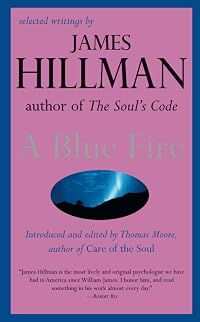
A Blue Fire
by James Hillman
On This Page
Description
Gathers the influential psychologist's writings on imaginal psychology, betrayal, suicide, parenthood, perception and consciousness.Tags
Recommendations





















Member Reviews
Hillman was an animist, and student of Jung, and an influence to David Abram.
Although Hillman does have a book by this title, this recording is a series of talks and discussion recorded at Rowe Retreat Center in Western Massachusetts back in 1990 (focused on the themes of the book).
Having been a student of Bill Plotkin and David Abram, I'm quite struck by the ways I can hear Hillman speaking through them. I'll begin by looking at the concept of imaging.
Carol Sanford spoke a lot about the importance of imaging; “always work in specific situations and experiences from your life, never in the generic!” Only after her death in listening to Hillman am I realizing that the term has a Greek lineage. Imaging is the practice of sitting with show more a somatic understanding of something rather than allowing ourselves to collapse into what something “means,” or other rational mental models (a right-hemisphere understand as opposed to left hemisphere). For example, in speaking about dreams, Hillman speaks about the importance of letting the image work on you rather than trying to move right into interpretation; experience as doorway. Images are infinitely-dimensional; the longer you sit with them, the more you get out of them.
As a series of talks, Hillman does bounce around a lot. He speaks about the three faces of Eros (I would describe them as carnal, unitive, and insatiable). He speaks about Eros' arrow prying open our wounded places.
There are some novel moments, such as when he speaks about ceilings, and the way in which they initially were designed both for the protection from certain energies while concentrating others (as in the canopy above a king or queen).
Hillman feels that the fundamental fallacy of the Western World is the belief in the individual. This is something to sit with.
If you're a fan of Jung and an animist, you'll love this recording!
A word of warning to those considering getting into other Hillman material: I've been advised to stay away from Hillman's best-known work—"The Soul's Code." show less
Although Hillman does have a book by this title, this recording is a series of talks and discussion recorded at Rowe Retreat Center in Western Massachusetts back in 1990 (focused on the themes of the book).
Having been a student of Bill Plotkin and David Abram, I'm quite struck by the ways I can hear Hillman speaking through them. I'll begin by looking at the concept of imaging.
Carol Sanford spoke a lot about the importance of imaging; “always work in specific situations and experiences from your life, never in the generic!” Only after her death in listening to Hillman am I realizing that the term has a Greek lineage. Imaging is the practice of sitting with show more a somatic understanding of something rather than allowing ourselves to collapse into what something “means,” or other rational mental models (a right-hemisphere understand as opposed to left hemisphere). For example, in speaking about dreams, Hillman speaks about the importance of letting the image work on you rather than trying to move right into interpretation; experience as doorway. Images are infinitely-dimensional; the longer you sit with them, the more you get out of them.
As a series of talks, Hillman does bounce around a lot. He speaks about the three faces of Eros (I would describe them as carnal, unitive, and insatiable). He speaks about Eros' arrow prying open our wounded places.
There are some novel moments, such as when he speaks about ceilings, and the way in which they initially were designed both for the protection from certain energies while concentrating others (as in the canopy above a king or queen).
Hillman feels that the fundamental fallacy of the Western World is the belief in the individual. This is something to sit with.
If you're a fan of Jung and an animist, you'll love this recording!
A word of warning to those considering getting into other Hillman material: I've been advised to stay away from Hillman's best-known work—"The Soul's Code." show less
I arrived at this book long after reading, "The Soul's Code", which is a book I much admire.
Unfortunately, this book didn't hold up. It's a collection of Hillman's essays, and perhaps the format of short essay doesn't permit for the development ideas as did "The Soul's Code." I found the reading somewhat pompous, difficult to track and in sections downright self-indulgent and obtuse.
I'm sure there are words of wisdom buried in there, but they sure are buried. Consider, for example, this opening sentence: "The blue transit between black and white is like that sadness which emerges from despair as it proceeds toward reflection." What? Never mind that it's grammatically incorrect. And then, further on the blue theme: "It is the blue which show more deepens the idea of reflection beyond the single notion of mirroring, to the further notions of pondering, considering, meditating." I swear I feel like I should be high to figure that out, and I can't help wondering if he was high when he wrote it.
There's an awful lot of that. Far too much for me. I tell my students that no amount of 'mouth feel' in prose will rescue it from a lack of clarity. I rest my case.
I will return to Viktor Frankl, to Martin Buber. show less
Unfortunately, this book didn't hold up. It's a collection of Hillman's essays, and perhaps the format of short essay doesn't permit for the development ideas as did "The Soul's Code." I found the reading somewhat pompous, difficult to track and in sections downright self-indulgent and obtuse.
I'm sure there are words of wisdom buried in there, but they sure are buried. Consider, for example, this opening sentence: "The blue transit between black and white is like that sadness which emerges from despair as it proceeds toward reflection." What? Never mind that it's grammatically incorrect. And then, further on the blue theme: "It is the blue which show more deepens the idea of reflection beyond the single notion of mirroring, to the further notions of pondering, considering, meditating." I swear I feel like I should be high to figure that out, and I can't help wondering if he was high when he wrote it.
There's an awful lot of that. Far too much for me. I tell my students that no amount of 'mouth feel' in prose will rescue it from a lack of clarity. I rest my case.
I will return to Viktor Frankl, to Martin Buber. show less
Disappointed. I encountered a reference to this book which implied that it contained a reprint of Hillman's essay "Pan and the Nightmare", which I wanted to read. However it contains only a few brief snippets from it, totalling no more than 2 pages. The 'excerpts' format of this book makes it more a 'Portait of Hillman by Thomas Moore' than an effective anthology of Hillman's writings.
A good introduction to his writing, with selections from various of his works.
Ratings
Members
- Recently Added By
Author Information

140+ Works 6,358 Members
James Hillman was born in Atlantic City, New Jersey on April 12, 1926. He attended the School of Foreign Service at Georgetown University for two years before joining the Navy's Hospital Corps in 1944. He studied English literature in Paris at the Sorbonne and graduated with a degree in mental and moral science from Trinity College in Dublin. In show more 1953, he moved to Zurich and enrolled at the C. G. Jung Institute. In 1959, he became the director of studies at the institute and stayed in that position for the next 10 years. He wrote over 20 books including Suicide and the Soul, Re-Visioning Psychology, and The Soul's Code. He died due to complications of bone cancer on October 27, 2011 at the age of 85. (Bowker Author Biography) show less
Classifications
- Genres
- Nonfiction, Religion & Spirituality
- DDC/MDS
- 150.1954 — Philosophy & psychology Psychology Emotions, Relationships, & Family Theory And Instruction Systems, schools, viewpoints Psychoanalytic systems Jungian system
- LCC
- BF175.5 .A72 .H54 — Philosophy, Psychology and Religion Psychology Psychology Psychoanalysis
- BISAC
Statistics
- Members
- 344
- Popularity
- 92,179
- Reviews
- 4
- Rating
- (4.08)
- Languages
- English, Italian
- Media
- Paper, Audiobook
- ISBNs
- 6
- ASINs
- 4