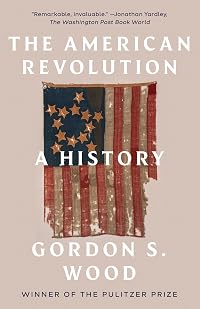
The American Revolution: A History
by Gordon S. Wood
On This Page
Description
The American Revolution signaled a great change in the course of world history and progress. From this colonial revolt sprouted ideals of liberty and democracy, and all the aspirations and ambitions of a new people. In this work, Pulitzer Prize-winning historian Gordon S. Wood discusses the character and consequences of the revolution, grounding the events and ideas that shaped the American consciousness.Tags
Recommendations























Member Recommendations
Member Reviews
When I decided to revise the history of the American Revolutionary War, it was because of the controversy of Ken Burns' new documentary. After reading about battles and biographies, I decided to pick up this small introduction to the subject,which proved to be small in pages but big in content. As one of my good teachers used to say, there is always something new to write and understand about history. In this book, Gordon Wood makes a great case about how the revolutionary feeling erupted from the American Colonies. In the first 30 pages, you get a good political, social, and economic background on the situation of the British Colonies in America, with great importance given to Indian Affairs, slavery, settlers, and the capitalist show more commercial enterprise in the new world.
Even though the book takes a more direct approach into the political movements and Enlightenment ideas of the Revolution, the war, diplomacy, and post-conflict young republic situation is reviewed in depth. The main theme is the ideas, thoughts, and political movements. This is a good introduction to the subject and clears the path to understand the much-complicated situation of the birth of America and its influence on future republican ideas in the world. Highly recommended. show less
Even though the book takes a more direct approach into the political movements and Enlightenment ideas of the Revolution, the war, diplomacy, and post-conflict young republic situation is reviewed in depth. The main theme is the ideas, thoughts, and political movements. This is a good introduction to the subject and clears the path to understand the much-complicated situation of the birth of America and its influence on future republican ideas in the world. Highly recommended. show less
A brilliantly compact general survey of the American Revolution, starting with the factors that led up to it and ending with the ratification of the constitution. Speaking as someone whose elementary, middle, and high schools covered it mostly on a military and mythic level - with the historiography stalled out somewhere in the 19th century - the book did an amazing job of illustrating the true variety of causes and contexts that this seminal event held. I know most readers come at this subject through the biographies of various Founding Fathers, but if you're going to read one book about the American Revolution, this should be it.
Plus the bibliography is probably the most badass bibliography I have ever read, essentially a roadmap to show more what you should read if you're interested in any specific facet of the subject. show less
Plus the bibliography is probably the most badass bibliography I have ever read, essentially a roadmap to show more what you should read if you're interested in any specific facet of the subject. show less
Nice, short history of the revolution, the preceding events and the succeeding events as a new nation stumbled like a toddler. I think we’ve forgotten that the Constitution and the America we know today was very much in jeopardy if it weren’t for calm heads and shrewd negotiations by folks like Hamilton and Washington. Had Patrick Henry gotten his way the US would look very different today.
The title of this book suggests that it is a general history of the Revolution, but this is a bit misleading. In fact, it focuses fairly narrowly on the Revolution in social relations and political theory. It's treatment of the actual military conflict is quite cursory. It also gives short shrift to one of the main currents of recent scholarship on the Revolution -- the significant but largely overlooked role of marginalized groups like the white urban underclass, free blacks and slaves, Indians and women.
But with that caveat in mind, this is nonetheless and excellen introduction to the social, intellectual, and political origins and consequences of the American Revolution. In concise and highly readable prose, Gordon Wood deftly show more synthesizes the main points of several decades of historical scholarship that have shown that the intellectual influences on the American colonists were much broader than John Locke, and that their struggle needs to be understood in the context of a long tradition of distrust of the British crown and court by country gentry in both Britain and the colonies, and that the Revolution and American constitution need to be understood in terms of the Republican ideology they espoused rather than the Lockean liberalism more characteristic of American politics since the late-nineteenth century. In the final three chapters, Wood does a masterful job of distilling the essence of his two groundbreaking but difficult tomes -- The Creation of the American Republic (1969) and The Radicalism of the American Revolution (1991) -- showing how dramatically the Revolution re-shaped the eighteenth century social and political world in ways that the founders did not anticipate and could not control. show less
But with that caveat in mind, this is nonetheless and excellen introduction to the social, intellectual, and political origins and consequences of the American Revolution. In concise and highly readable prose, Gordon Wood deftly show more synthesizes the main points of several decades of historical scholarship that have shown that the intellectual influences on the American colonists were much broader than John Locke, and that their struggle needs to be understood in the context of a long tradition of distrust of the British crown and court by country gentry in both Britain and the colonies, and that the Revolution and American constitution need to be understood in terms of the Republican ideology they espoused rather than the Lockean liberalism more characteristic of American politics since the late-nineteenth century. In the final three chapters, Wood does a masterful job of distilling the essence of his two groundbreaking but difficult tomes -- The Creation of the American Republic (1969) and The Radicalism of the American Revolution (1991) -- showing how dramatically the Revolution re-shaped the eighteenth century social and political world in ways that the founders did not anticipate and could not control. show less
A very concise and readable history of the Revolution, its origins and its aftermath. Marred by a lack of citations, but the wound is not mortal. Worth a read.
When I saw the size of this book, I realized that it wasn't going to be a comprehensive history, but that was fine by me. I was just looking for an overview of the Revolution, highlighting key events leading up to and throughout the war, as well as notable personalities on all sides. Even with that relatively low bar in mind, I was disappointed by what I got. It's hard to imagine that a book called The American Revolution would gloss over the actual Revolution, but that's exactly what it did.
That said, the book succeeds pretty well in what it sets out to do, which is, mainly, to outline the outcome and aftermath of the Revolution. It was interesting and easy to read, even for someone like myself who doesn't particularly care for show more non-fiction or Colonial history. I'll just have to look elsewhere for an overview that's at least slightly more in-depth (not to mention focused on the Revolution itself). show less
That said, the book succeeds pretty well in what it sets out to do, which is, mainly, to outline the outcome and aftermath of the Revolution. It was interesting and easy to read, even for someone like myself who doesn't particularly care for show more non-fiction or Colonial history. I'll just have to look elsewhere for an overview that's at least slightly more in-depth (not to mention focused on the Revolution itself). show less
This is a brief history of the American Revolution. This should not be confused with the Revolutionary War. While he does talk about the Revolutionary War, Wood makes the case for the American Revolution to be much bigger than just that. It was a political revolution, it was an ideological revolution. Wood states that this revolution took place because of wrongs that might occur. The Americans were concerned about the direction things were going, and believed that their freedom could be infringed upon. . . even though this had not yet happened. I found this to be an interesting read, not what I had been anticipating, but still very informative.
Members
- Recently Added By
Lists

Best U.S. History Books (1754-1828)
363 works; 18 members
Author Information

37+ Works 10,155 Members
History professor and award-winning author Gordon S. Wood was born in Concord, Massachusetts on November 27, 1933. After graduating in 1955 from Tufts University he served in the US Air Force in Japan and earned his master's degree from Harvard University. In 1964, Wood earned his Ph. D. in history from Harvard, and he taught there, as well as at show more the College of William and Mary and the University of Michigan, before joining the Brown University faculty in 1969. Wood has published a number of articles and books, including The Creation of the American Republic, 1776-1787, which won the Bancroft Prize and the John H. Dunning Prize in 1970, and The Radicalism of the American Revolution, winner of the Pulitzer Prize for History and the Ralph Waldo Emerson Prize in 1993. He has won many other awards in the past five decades from organizations such as the American Historical Association, the New York Historical Society, and the Fraunces Tavern Museum. Wood is a fellow of both the American Academy of Arts and Sciences and the American Philosophical Society. In 2014, his book, The American Revolution: A History, was on the New York Times bestseller list. (Bowker Author Biography) show less
Some Editions
Series
Belongs to Publisher Series
Common Knowledge
- Canonical title
- The American Revolution: A History
- Original publication date
- 2002 (Modern Library edition) (Modern Library edition)
- People/Characters
- John Adams; Samuel Adams; Abraham Lincoln; George Bancroft; Benjamin Franklin; Daniel Boone (show all 25); Ezra Stiles; Patrick Henry; William Pitt; Edmund Burke; Jeffery Amherst, 1st Baron Amherst; George III, King of the United Kingdom; George Grenville; John Wilkes; George Washington; William Smith, Jr.; Andrew Oliver; Thomas Hutchinson; Thomas Jefferson; Thomas Paine; Paul Revere; William Howe; Alexander Pope; Jonathan Swift; Richard Henry Lee
- Important places
- New York, New York, USA; Pennsylvania, USA; Philadelphia, Pennsylvania, USA; Philadelphia County, Pennsylvania, USA; Massachusetts, USA
- Important events
- American Revolution (1775 | 1783)
- First words
- When in the midst of the Civil War Abraham Lincoln sought to define the significance of the United States, he naturally looked back to the American Revolution. (Preface)
The origins of the Revolution necessarily lie deep in America's past. - Last words
- (Click to show. Warning: May contain spoilers.)The emergence of this rambunctious middling democracy was the most significant consequence of the American Revolution.
Classifications
Statistics
- Members
- 1,085
- Popularity
- 23,668
- Reviews
- 13
- Rating
- (3.76)
- Languages
- English, Portuguese, Spanish
- Media
- Paper, Audiobook, Ebook
- ISBNs
- 15
- ASINs
- 6