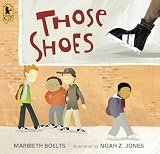
Those Shoes
by Maribeth Boelts, Noah Z. Jones (Illustrator)
On This Page
Description
Jeremy, who longs to have the black high tops that everyone at school seems to have but his grandmother cannot afford, is excited when he sees them for sale in a thrift shop and decides to buy them even though they are the wrong size.Tags
Recommendations



Member Reviews
This book is fantastic! I initially came across it on a list of picture books that introduce kids to the concepts of poverty and homelessness. I think this is a very important topic for kids to learn that they often don’t until they are older, which causes many misconceptions in their early interactions with others.
Those Shoes tells the story of a boy who needs new shoes and really wants the ones that everyone else is wearing, you know: the high tops with the stripes on the sides. The shoes that make you look cool, and supposedly even run faster! But when his grandma can’t afford the shoes he wants, they decide to try and find them at local thrift stores. They go from store to store and finally find a pair that are perfect aside show more from the fact that they are too small. Still, Jeremy shoves his feet in and tries to wear the shoes. This of course end up working against the point of shoes and is hurting his feet. When Jeremy sees another boy in his class that also doesn’t seem to have enough money to afford new shoes, and whose feet are a little smaller than his, he eventually decides to give him the shoes. They are a perfect fit for his classmate and Jeremy is happy to see it even after he struggled with whether to give them up or not. Jeremy learns to be grateful for the snug, functional boots his grandma got him when it snows at the end of the book.
This book covers so many topics that are important for kids to see in books. First of all is the obvious topic of poverty and how there will be things your family won’t always be able to afford but you can still find ways to get what you need. Another topic is that of wanting the popular fads. We have all wanted something so bad before just because it’s what everyone else had, but it didn’t make that thing any better once we actually got it. The shoes were just shoes, and they weren’t even particularly suited for the season. Yet another great thing shown here is that Jeremy seems to live with just his grandma, so she is providing for them on her own and it shows a different family type other than the “nuclear” one that is more typically shown. I also really appreciate that instead of just giving his shoes over, it showed Jeremy really struggle with it at first. It’s not always easy to give up that idea of something you really wanted even though it would be better for someone else.
I also enjoyed the illustrations and would overall highly recommend this book as being both a great story and having super important topics for kids to learn about! show less
Those Shoes tells the story of a boy who needs new shoes and really wants the ones that everyone else is wearing, you know: the high tops with the stripes on the sides. The shoes that make you look cool, and supposedly even run faster! But when his grandma can’t afford the shoes he wants, they decide to try and find them at local thrift stores. They go from store to store and finally find a pair that are perfect aside show more from the fact that they are too small. Still, Jeremy shoves his feet in and tries to wear the shoes. This of course end up working against the point of shoes and is hurting his feet. When Jeremy sees another boy in his class that also doesn’t seem to have enough money to afford new shoes, and whose feet are a little smaller than his, he eventually decides to give him the shoes. They are a perfect fit for his classmate and Jeremy is happy to see it even after he struggled with whether to give them up or not. Jeremy learns to be grateful for the snug, functional boots his grandma got him when it snows at the end of the book.
This book covers so many topics that are important for kids to see in books. First of all is the obvious topic of poverty and how there will be things your family won’t always be able to afford but you can still find ways to get what you need. Another topic is that of wanting the popular fads. We have all wanted something so bad before just because it’s what everyone else had, but it didn’t make that thing any better once we actually got it. The shoes were just shoes, and they weren’t even particularly suited for the season. Yet another great thing shown here is that Jeremy seems to live with just his grandma, so she is providing for them on her own and it shows a different family type other than the “nuclear” one that is more typically shown. I also really appreciate that instead of just giving his shoes over, it showed Jeremy really struggle with it at first. It’s not always easy to give up that idea of something you really wanted even though it would be better for someone else.
I also enjoyed the illustrations and would overall highly recommend this book as being both a great story and having super important topics for kids to learn about! show less
Those Shoes is a wonderful book. The most notable thing about the book for me was how it would be relatable for a child who doesn't normally find relatable books. The protagonist is Black, he lives with his grandma in an urban setting, they only have money for "needs" not "wants," and he desperately wants new, expensive shoes so he can fit in with the other boys. The story is heartwarming as he finally gives his too-small shoes to a boy who needs them, a boy who never laughed at his ugly shoes. There are so many benefits to reading this book to a group of young students.
This book made me all misty eyed when it was read aloud to us in class. I really felt for the boy when his caregiver couldn’t buy him the latest shoes. And then when all they could find for him in the school box was those baby shoes omg, I bet he would have rather been shoeless. That’s almost worse and don’t adults know that? Like get the kid some plain shoes before you downgrade him to toddler looking lion shoes. No wonder he was going to buy the fad shoes no matter how small they were. I really liked how it ended of course I thought that was so sweet he gave his shoes to someone even poorer than him. Again, a great tool as an empathy lesson.
Maribeth Boelts, the author of "Those Shoes," uses a relatable and understandable way of explaining poverty to children. Jeremy is dying to get "those shoes" that all his classmates are wearing. When the shoes he already owns break, he is hopeful that his Grandmother will get him the "those shoes." He is disappointed when he has to settle with the kid-like shoes his guidance counselor provides. He is overcome with joy when he finds "those shoes" in a thrift store, but is heartbroken when they are too small. He buys them anyway and pretends they fit. After a while, he is unable to stand the pain of his smushed toes. He notices his friend, Brandon, does not have "those shoes" and the shoes he has are falling apart. He debates on wether or show more not to give him the shoes, but ultimately makes the right decision and gives his friend his shoes.
I can relate to this story because when I was younger, I remember not having things that the "popular" girls would wear. This was not because we could not afford it, but my mom told me that she was not spending extra money on "fancy things" when the important aspect was, "was it functional?" At the time, I was always mortified by my walmart shoes or hand-me-down clothes from my cousin, but looking back I appreciate her for helping me not be so materialistic. Although Jeremy's situation was different, I think a lot of children can relate to not having something that their friends have. The author's purpose is to explain to children that it is okay to not have the latest trend, it matters who you are on the inside. show less
I can relate to this story because when I was younger, I remember not having things that the "popular" girls would wear. This was not because we could not afford it, but my mom told me that she was not spending extra money on "fancy things" when the important aspect was, "was it functional?" At the time, I was always mortified by my walmart shoes or hand-me-down clothes from my cousin, but looking back I appreciate her for helping me not be so materialistic. Although Jeremy's situation was different, I think a lot of children can relate to not having something that their friends have. The author's purpose is to explain to children that it is okay to not have the latest trend, it matters who you are on the inside. show less
I would rate this book 4 out of 5 stars because it is a very relatable book. There are many children who will be able to relate to going to school and the feeling of wanting to fit in with their peers. The feeling of acceptance is very important to children of all ages. Personally, I remember wanting to buying certain things just to fit in with my classmates during grade school. I also remember feeling extremely upset when my mother would not agree on buying me something that I knew everyone had. I had these pressures to fit in in order to make many friends, and it took a higher level of maturity to realize that materialistic items are not important, especially in comparison to having a true friend. During the book, Jeremy was faced show more with this conflict of balancing fitting in and having a nice pair of shoes just like his classmates, or valuing his friendship with Antonio. At first, as Jeremy believed having the shoes was so important, he was determined to make a pair that was too small fit him, causing blisters. Eventually when he realizes that he can't wear the shoes without hurting himself and finds he truly has what he needs. It was't until Jeremy became embarrassed when he learned that friendship should depend on how a person treats you instead of what you can afford. I would recommend this book to 5th-6th graders as they will be able to relate to this story the best. This book can start a great conversation with children of all ages about the difference between what is the right thing to do, even if it might not feel iike the best thing to do. show less
The hottest fad can also be the most expensive and out of reach for children in limited financial circumstances. Jeremy, living with his Grandma, dreams of wearing the latest cool black high-tops with two white stripes. But as Grandma points out, “There’s no room for ‘want’ around here—just ‘need’ ” and what Jeremy needs and gets is a new pair of winter boots. Jeremy’s quest for new sneakers takes on more urgency when his old pair fall apart, and the only choice is the Velcro baby-blue set meant for little kids found in the school’s donation box by the guidance counselor. Even Grandma understands and together they search several thrift shops and actually find the coveted black high-tops, but they’re too small. show more Buying them anyway, Jeremy makes a heartfelt decision to put them to a more practical and generous use. Boelts blends themes of teasing, embarrassment and disappointment with kindness and generosity in a realistic interracial school scenario bringing affecting closure to a little boy’s effort to cope in a world filled with materialistic attractions and distractions. Muted browns/greens/blues done in watercolors, pencils and ink, and digitally arranged, add to the story’s expressive affirmation of what is really important. (Picture book. 6-9)
-Kirkus Review show less
-Kirkus Review show less
Jeremy wants the new shoes that all of his friends have, but he needs new boots. His friends become faster and cooler, while he has his same old shoes. When his shoes break, he’s given some from the counselor, but they aren’t cool, and he gets made fun of. One day he finds them at a thrift store, they are too small but her buys them anyway. In the end he ends up giving them to another little boy who has old shoes and they fit him. The reader sees Jeremy mature and grow in his sense of what he needs and what he wants. He finally understands what his grandma meant, and that life is more than what you have. This story would be great to read to students, it sends the positive message of acceptance. It also opens the floor for students show more to ask questions or discuss topics related to the book. I really enjoyed this book. show less
Members
- Recently Added By
Author Information

92 Works 6,289 Members

Awards and Honors
Awards
Distinctions
Classifications
Statistics
- Members
- 2,628
- Popularity
- 7,110
- Reviews
- 193
- Rating
- (4.45)
- Languages
- Chinese, English, Spanish
- Media
- Paper, Ebook
- ISBNs
- 23
- ASINs
- 5