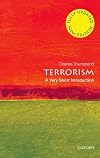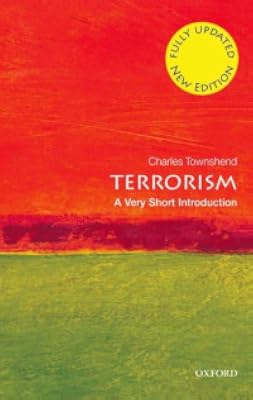
Terrorism: A Very Short Introduction
by Charles Townshend
On This Page
Description
This book charts a path through the outpouring of efforts to understand and explain modern terrorism, by asking what makes terrorism different from other forms of political, military action; what makes it effective; and what can be done about it. It unravels complex central questions such as whether terrorists are criminals, whether terrorism is a kind of war, what kind of threat terrorism represents, how far media publicity sustains terrorism, and whether democracy is especially vulnerable show more to terrorist attack. It examines the historical, ideological, and local roots of terrorist violence, and the success of specific terrorist and anti-terrorist campaigns in the more distant as well as the recent past. show lessTags
Recommendations



Member Reviews
Written almost immediately after 9/11, this 'very short introduction' cannot do much more than give us a basic history of what we like to place under the term 'terrorism' and to express a barely hidden frustration with the war on an abstract noun (Terry Jones of Monty Python fame).
There are two major points being made here. The first is that there is no satisfactory definition of what terrorism actually is except in terms of its political purposes. And the second is that media-driven hysteria around the subject threatens the very fabric of liberal society.
The book also debates whether terrorism as tactic (by whatever definition) is efficacious or not. The author suggests not and yet his examples sometimes tend to tell us the opposite show more especially if we take the long view.
We can agree that most socialist or anarchist terror within liberal democracies was a waste of energy but then the later manifestations of it in the Red Army Faction and similar organisations were somewhat narcissistic and even patronising expressions of middle class outrage on behalf of others.
However, the cases of the Soviet Union, Cuba, China, Venezuela and others tend to show that terror as a tool designed to eliminate opposition in the sea in which revolutionaries must swim did work and that national/socialist regimes did emerge and survive for decades - right up until the present day.
This, of course, is very different from the attempt at an 'ethical' terrorism by the Narodniki although anarchism descended into very unethical behaviours before too long. Whether ethical or unethical, these types of political excitability without a greater strategy certainly failed.
It could be argued, of course, that the failure of the Social Revolutionaries constructed the conditions for Communist ruthlessness as, if we want a symbol of this, Lenin's ideology emerged out of the State murder of his brother. This would certainly be taking the long view.
Townshend does himself great credit by not shying away from the existence of state terror and not only of the communist type. The Western empires have not been averse to it, again as part of a wider strategy of warfare, even if they like to cover it up as 'counter insurgency'.
Townshend could have gone further and deeper down this route but the danger would have been that the purchasing punter might have got confused if this commissioned attempt to explain what was then a new phenomenon to some had moved into Chomskian territory.
He is certainly right that terror within a revolutionary struggle that does not have a national resistance aspect is likely simply to mobilise the resources of the enemy into counter-strategies of great brutality (as in Chile and Argentina) and alienate populations uncommitted to the struggle.
Each case is different but Townshend is particularly good and honest on the cat-and-mouse terror tactics of Israel and the Palestinians where he unravels the self-serving Netanyahu narrative that drives American congressional opinion, a legislature of surpassing lack of sophistication.
In fact, Israel is an example of terrorism working because it was primarily ethnic and capable of being integrated into the survival strategies of an emerging ethnic State. That Jews never truly repudiated the massacres committed on Arab villagers as ethnic cleansing is a blot on their moral reputation.
He also looks at the IRA and ETA as national liberation movements making use of terror as a tactic and he judges, prematurely in the case of the IRA, that they were failures. This is probably true in the case of the Basques with the Basque territory still well locked into the Spanish State mechanism.
However, the Whitehall sell-out by stealth of the Unionists in a trajectory that was perfectly happy to abandon aspects of UK sovereignty in collaboration with the Irish in return for Washington's little scheme to get Ireland into NATO was also partly driven by Irish terrorism.
As each decade goes by the inveigling of Northern Ireland into an eventual referendum to get the Province off the back of the British budget and secure Ireland so that it was no longer a neutralist strategic risk factor in a European War could rely on Irish terror to make that job easier.
If the purpose of Irish terror was to unite Ireland then, although Irish terror did not in itself bring the unification about, the conditions it created have enabled the possibility of their aspirations to be met just as Unionist terror has slowed the process down. In that respect, terror works.
Terror, in other words, is a tool within a much wider political or military game. This is something the Israelis never forgot. When the Nazis called the French Resistance 'terrorists' they were strictly correct if we look at the term neutrally as a description of a 'practice'.
The FLN in Algeria will have watched French terrorism 'working' in this way - as a process linked to politics and conventional or guerrilla war - just as the OAS blunderingly tried to do the same and the Islamist insurgents of the 1990s even more brutally did the same again.
The claim that the 'terrorist' is someone else's 'freedom fighter' is trite because it separates the two as moral categories whereas the actual moral categories are a) the killing of 'innocents' on the one side set against b) the greater aims of, say, national self-determination on the other.
We live with this every day. Ukrainian car bombs are called partisan activity and their terrorist nature is glossed over in the Western media and yet these same Editors froth at the mouth when the same tactic is used by Afghans or Hezbollah on their own soil.
Townshend was also writing at that point where nearly all commentators found themselves thoroughly confused by the emergence of what appeared to be a nihilistic (from a liberal humane perspective) form of radical religious terrorism that looked to a supernatural end.
As always throughout the book he is sensible here, if possibly overly non-committal. Research into Islamic terror was in its early days. Western observers were no more successful in getting into the mind-set of the Islamist than they are today in getting inside the mind-set of a Russian or Chinese.
The overwhelming characteristic of the average Western policy wonk is a staggering lack of imagination which leads to simplistic and disproportionate, indeed hysterical, responses to what is generally far less of a threat to a population than exhausted doctors and truck drivers.
However, Townshend's wise insights into the tactics of Hezbollah suggest that even Islamist fanatics (if we can only get to understand how they think instrumentally) are instrumental in their approach with attitudes no different in this respect from the Narodniki or the Tupamaros.
One of the lessons of the book is that terrorism continues to have its instrumental logic and that we can soon begin to divine when it might be used ineffectively or effectively to achieve very long range ends in association with other strategies - military, political and economic.
The liberal moral outrage at the tactic is justifiable in the abstract but the liberal rarely sits where the 'damned of the earth' (Fanon) sits and easily turns a blind eye to state terror when it acts in his interest. Morality is a tool like any other in the brutal game of power.
Terror strategies tend to emerge when power is disproportionate so it was always likely that America as hegemon would face it because American power was and is disproportionately greater than anything else on the planet. We should really be surprised that there is so little of it.
We might go further and say that, while national liberation strategies (for all the nonsense talked about a Terrorist International in Washington during the Cold War) were located in specific territories, globalisation has created a new West/Rest dichotomy that increases the risks of terror.
Russian analyses of the nature of American power are far from incorrect. Russia has not been entirely isolated because non-Western elites connect with that analysis. The blocs that emerge in fact reduce the chances of terrorism because a countervailing non-Western bloc can imply sufficient resistance.
However, if the resistance bloc is eliminated as a traditional network of powers striving not to be subsumed within the Western imperium, Western dominion creates the opportunities for asymmetric 'terrorist' resistance amongst the powerless and not only overseas.
The same threat exists in the heart of the West from those who feel excluded from the imperium at home. So long as populist ideas and feelings have leg room, terrorism as a tactic is counter-productive but it becomes productive if the national populist or the deprived feel their back is to the wall.
Similarly, the potential unravelling of the cosy consensus between the corporate sector, states and eco-politicians over green issues because of crude energy security and more urgent socio-economic requirements might also threaten the system with what might be called a Green Army Faction,
The point here is that terrorism as a tactic is always a potential threat and increases to the degree that Western society behaves more like the old Russian Empire than the liberal democracy it purports to be - surveillance, social control, hunting down whistleblowers and so forth.
Townshend notes something important - the grim dialectic between terrorism and the media and the way that the media's excitability and hysteria drives public panic far beyond what reason would dictate and so creates inappropriate political decision-making and manipulation.
It could be argued (I would) that the most socially destructive force in Western society is not the potential terrorist but the Editor with his propensity for 'stories', fast news cycles, high emotion, moral posturing and attempts to manipulate power by the back door.
There is nothing we can do about this because liberal democracy defines itself in part by the freedom given to the Press. The benefits of good journalism (where it exists) should theoretically always outweigh the disbenefits although increasingly they do not as serious journalism decays.
Although now out of date by about two decades (especially in regard to Islamic terror), this very short book (139 pages) packs in a lot of information. If it does not do a great deal to help us define what the phenomenon is then that is because the phenomenon is not easily definable at all. show less
There are two major points being made here. The first is that there is no satisfactory definition of what terrorism actually is except in terms of its political purposes. And the second is that media-driven hysteria around the subject threatens the very fabric of liberal society.
The book also debates whether terrorism as tactic (by whatever definition) is efficacious or not. The author suggests not and yet his examples sometimes tend to tell us the opposite show more especially if we take the long view.
We can agree that most socialist or anarchist terror within liberal democracies was a waste of energy but then the later manifestations of it in the Red Army Faction and similar organisations were somewhat narcissistic and even patronising expressions of middle class outrage on behalf of others.
However, the cases of the Soviet Union, Cuba, China, Venezuela and others tend to show that terror as a tool designed to eliminate opposition in the sea in which revolutionaries must swim did work and that national/socialist regimes did emerge and survive for decades - right up until the present day.
This, of course, is very different from the attempt at an 'ethical' terrorism by the Narodniki although anarchism descended into very unethical behaviours before too long. Whether ethical or unethical, these types of political excitability without a greater strategy certainly failed.
It could be argued, of course, that the failure of the Social Revolutionaries constructed the conditions for Communist ruthlessness as, if we want a symbol of this, Lenin's ideology emerged out of the State murder of his brother. This would certainly be taking the long view.
Townshend does himself great credit by not shying away from the existence of state terror and not only of the communist type. The Western empires have not been averse to it, again as part of a wider strategy of warfare, even if they like to cover it up as 'counter insurgency'.
Townshend could have gone further and deeper down this route but the danger would have been that the purchasing punter might have got confused if this commissioned attempt to explain what was then a new phenomenon to some had moved into Chomskian territory.
He is certainly right that terror within a revolutionary struggle that does not have a national resistance aspect is likely simply to mobilise the resources of the enemy into counter-strategies of great brutality (as in Chile and Argentina) and alienate populations uncommitted to the struggle.
Each case is different but Townshend is particularly good and honest on the cat-and-mouse terror tactics of Israel and the Palestinians where he unravels the self-serving Netanyahu narrative that drives American congressional opinion, a legislature of surpassing lack of sophistication.
In fact, Israel is an example of terrorism working because it was primarily ethnic and capable of being integrated into the survival strategies of an emerging ethnic State. That Jews never truly repudiated the massacres committed on Arab villagers as ethnic cleansing is a blot on their moral reputation.
He also looks at the IRA and ETA as national liberation movements making use of terror as a tactic and he judges, prematurely in the case of the IRA, that they were failures. This is probably true in the case of the Basques with the Basque territory still well locked into the Spanish State mechanism.
However, the Whitehall sell-out by stealth of the Unionists in a trajectory that was perfectly happy to abandon aspects of UK sovereignty in collaboration with the Irish in return for Washington's little scheme to get Ireland into NATO was also partly driven by Irish terrorism.
As each decade goes by the inveigling of Northern Ireland into an eventual referendum to get the Province off the back of the British budget and secure Ireland so that it was no longer a neutralist strategic risk factor in a European War could rely on Irish terror to make that job easier.
If the purpose of Irish terror was to unite Ireland then, although Irish terror did not in itself bring the unification about, the conditions it created have enabled the possibility of their aspirations to be met just as Unionist terror has slowed the process down. In that respect, terror works.
Terror, in other words, is a tool within a much wider political or military game. This is something the Israelis never forgot. When the Nazis called the French Resistance 'terrorists' they were strictly correct if we look at the term neutrally as a description of a 'practice'.
The FLN in Algeria will have watched French terrorism 'working' in this way - as a process linked to politics and conventional or guerrilla war - just as the OAS blunderingly tried to do the same and the Islamist insurgents of the 1990s even more brutally did the same again.
The claim that the 'terrorist' is someone else's 'freedom fighter' is trite because it separates the two as moral categories whereas the actual moral categories are a) the killing of 'innocents' on the one side set against b) the greater aims of, say, national self-determination on the other.
We live with this every day. Ukrainian car bombs are called partisan activity and their terrorist nature is glossed over in the Western media and yet these same Editors froth at the mouth when the same tactic is used by Afghans or Hezbollah on their own soil.
Townshend was also writing at that point where nearly all commentators found themselves thoroughly confused by the emergence of what appeared to be a nihilistic (from a liberal humane perspective) form of radical religious terrorism that looked to a supernatural end.
As always throughout the book he is sensible here, if possibly overly non-committal. Research into Islamic terror was in its early days. Western observers were no more successful in getting into the mind-set of the Islamist than they are today in getting inside the mind-set of a Russian or Chinese.
The overwhelming characteristic of the average Western policy wonk is a staggering lack of imagination which leads to simplistic and disproportionate, indeed hysterical, responses to what is generally far less of a threat to a population than exhausted doctors and truck drivers.
However, Townshend's wise insights into the tactics of Hezbollah suggest that even Islamist fanatics (if we can only get to understand how they think instrumentally) are instrumental in their approach with attitudes no different in this respect from the Narodniki or the Tupamaros.
One of the lessons of the book is that terrorism continues to have its instrumental logic and that we can soon begin to divine when it might be used ineffectively or effectively to achieve very long range ends in association with other strategies - military, political and economic.
The liberal moral outrage at the tactic is justifiable in the abstract but the liberal rarely sits where the 'damned of the earth' (Fanon) sits and easily turns a blind eye to state terror when it acts in his interest. Morality is a tool like any other in the brutal game of power.
Terror strategies tend to emerge when power is disproportionate so it was always likely that America as hegemon would face it because American power was and is disproportionately greater than anything else on the planet. We should really be surprised that there is so little of it.
We might go further and say that, while national liberation strategies (for all the nonsense talked about a Terrorist International in Washington during the Cold War) were located in specific territories, globalisation has created a new West/Rest dichotomy that increases the risks of terror.
Russian analyses of the nature of American power are far from incorrect. Russia has not been entirely isolated because non-Western elites connect with that analysis. The blocs that emerge in fact reduce the chances of terrorism because a countervailing non-Western bloc can imply sufficient resistance.
However, if the resistance bloc is eliminated as a traditional network of powers striving not to be subsumed within the Western imperium, Western dominion creates the opportunities for asymmetric 'terrorist' resistance amongst the powerless and not only overseas.
The same threat exists in the heart of the West from those who feel excluded from the imperium at home. So long as populist ideas and feelings have leg room, terrorism as a tactic is counter-productive but it becomes productive if the national populist or the deprived feel their back is to the wall.
Similarly, the potential unravelling of the cosy consensus between the corporate sector, states and eco-politicians over green issues because of crude energy security and more urgent socio-economic requirements might also threaten the system with what might be called a Green Army Faction,
The point here is that terrorism as a tactic is always a potential threat and increases to the degree that Western society behaves more like the old Russian Empire than the liberal democracy it purports to be - surveillance, social control, hunting down whistleblowers and so forth.
Townshend notes something important - the grim dialectic between terrorism and the media and the way that the media's excitability and hysteria drives public panic far beyond what reason would dictate and so creates inappropriate political decision-making and manipulation.
It could be argued (I would) that the most socially destructive force in Western society is not the potential terrorist but the Editor with his propensity for 'stories', fast news cycles, high emotion, moral posturing and attempts to manipulate power by the back door.
There is nothing we can do about this because liberal democracy defines itself in part by the freedom given to the Press. The benefits of good journalism (where it exists) should theoretically always outweigh the disbenefits although increasingly they do not as serious journalism decays.
Although now out of date by about two decades (especially in regard to Islamic terror), this very short book (139 pages) packs in a lot of information. If it does not do a great deal to help us define what the phenomenon is then that is because the phenomenon is not easily definable at all. show less
A surprisingly good VSI. I've come close to losing faith with these things many times, but the cover design and lure of knowledge bring me back. And then things like this justify my decision. Townshend is reasonable and anti-reactionary: his sections on state terrorism are excellent, his sections on non-state terrorists are balanced, and he does a great job of splitting hairs between terror and terrorism, and, most usefully, between war (a coercive, fundamentally physical pursuit) and terrorism (a persuasive, fundamentally mental pursuit). If you use violence to disable enemy combatants, you're at war. If you use it on non-combatants, to change someone's mind about something, you're making terror. If you do the latter, and little or show more nothing else, in order to reach your goals, you're a terrorist.
Also, Townshend writes well enough, and has a terrific ear for other people's phrases, such as PJP Tynan's "men must be aroused... their eyes wounded with the truth, light thrown in terrible handfuls."
On the downside, the final chapter, 'Countering Terrorism,' isn't all that enlightening. show less
Also, Townshend writes well enough, and has a terrific ear for other people's phrases, such as PJP Tynan's "men must be aroused... their eyes wounded with the truth, light thrown in terrible handfuls."
On the downside, the final chapter, 'Countering Terrorism,' isn't all that enlightening. show less
I will probably write a longer review of this book at some time in the future. For now, let me just identify the three principal reasons that I did not like it and why I do not recommend it.
First, the author seems to believe that using lots of "big" or foreign words will give a book a certain academic feel. Before going to law school, I graduated from Northwestern with a political science major, so I've read my fair share of academic works in the social sciences. Some are well-written and engaging; some are not. Sometimes, the use of complex vocabulary helps an author articulate a complex or nuanced point; other times, the vocabulary merely serves as a barrier between the author and the reader. Unfortunately, this book fell into that show more latter category.
Second, the author works so hard to define terrorism (or, more precisely, define what is not terrorism), that, by the end, the reader is left with the impression that terrorism doesn't really exist in any real signifcant way (despite what they see on TV every night). It often seems as if the author has an excuse or explanation for virtually all modern (i.e., post-Russian Revolution) terrorism. Thus, I never felt as if I was getting well-rounded examination of the issue; instead, it often felt as if I was reading an apology on behalf of certain poor misguided people who, in the author's view, never did much real damage, anyway.
Finally (and most troubling to me), was the author's seeming willingness to equate the actions of the US, Israel, and pre-Israeli Zionists to those of Hezbollah and Hamas (in fact, I don't think that he ever even mentioned the PLO, Islamic Jihad, PFLP, or the Muslim Brotherhood). At one point, the author actually praises Hezbollah's "military" campaign and contrasts it to the "indiscriminate" actions of the US and Israel in Lebanon (not the 2006 war). In other words, Townshend appears to live in that alternate universe where wrong it right, evil is good, and blowing up a bus or attacking a Passover seder is acceptable.
For a short introduction to terrorism look elsewhere.
(If I get around to writing a longer examination of this book on my blog, I'll update this review.) show less
First, the author seems to believe that using lots of "big" or foreign words will give a book a certain academic feel. Before going to law school, I graduated from Northwestern with a political science major, so I've read my fair share of academic works in the social sciences. Some are well-written and engaging; some are not. Sometimes, the use of complex vocabulary helps an author articulate a complex or nuanced point; other times, the vocabulary merely serves as a barrier between the author and the reader. Unfortunately, this book fell into that show more latter category.
Second, the author works so hard to define terrorism (or, more precisely, define what is not terrorism), that, by the end, the reader is left with the impression that terrorism doesn't really exist in any real signifcant way (despite what they see on TV every night). It often seems as if the author has an excuse or explanation for virtually all modern (i.e., post-Russian Revolution) terrorism. Thus, I never felt as if I was getting well-rounded examination of the issue; instead, it often felt as if I was reading an apology on behalf of certain poor misguided people who, in the author's view, never did much real damage, anyway.
Finally (and most troubling to me), was the author's seeming willingness to equate the actions of the US, Israel, and pre-Israeli Zionists to those of Hezbollah and Hamas (in fact, I don't think that he ever even mentioned the PLO, Islamic Jihad, PFLP, or the Muslim Brotherhood). At one point, the author actually praises Hezbollah's "military" campaign and contrasts it to the "indiscriminate" actions of the US and Israel in Lebanon (not the 2006 war). In other words, Townshend appears to live in that alternate universe where wrong it right, evil is good, and blowing up a bus or attacking a Passover seder is acceptable.
For a short introduction to terrorism look elsewhere.
(If I get around to writing a longer examination of this book on my blog, I'll update this review.) show less
Ratings
Members
- Recently Added By
Author Information
16 Works 1,032 Members
Series
Belongs to Publisher Series
Reclams Universal-Bibliothek (18301)
Common Knowledge
- Canonical title
- Terrorism: A Very Short Introduction
- Original title
- Terrorism
- Original publication date
- 2002
- First words
- Terrorism upsets people.
- Last words
- (Click to show. Warning: May contain spoilers.)But these histories should help sustain belief that terrorism is no more likely now than it was a century ago to bring about the destruction of Western civilization.
- Original language*
- Englisch
*Some information comes from Common Knowledge in other languages. Click "Edit" for more information.
Classifications
- Genres
- Nonfiction, General Nonfiction, History
- DDC/MDS
- 303.625 — Society, government, & culture Social sciences, sociology & anthropology Social processes Conflict and conflict resolution ; Violence Civil disorder Terrorism
- LCC
- HV6431 .T67 — Social sciences Social pathology. Social and public welfare. Criminology Social pathology. Social and public welfare. Criminology Crimes and offenses
- BISAC
Statistics
- Members
- 240
- Popularity
- 136,240
- Reviews
- 3
- Rating
- (3.32)
- Languages
- 7 — Dutch, English, French, German, Hungarian, Portuguese, Spanish
- Media
- Paper, Audiobook, Ebook
- ISBNs
- 19
- ASINs
- 8