The Cognitive Style of PowerPoint: Pitching Out Corrupts Within, Second Edition
by Edward R. Tufte 
On This Page
Description
Using specific examples, Tufte explains how PowerPoint's templates "usually weaken verbal and spatial reasoning and almost always corrupt statistical analysis," and describes concrete ways to improve content of presentations.Tags
Recommendations


















Member Recommendations
Member Reviews
This was a much more engaging read than I expected it to be. It's not just a cranky old academic complaining about style. He really rips PowerPoint apart. The in-depth analysis of the NASA incident is especially damning. PowerPoints were used in place of technical reports when they were assessing the damage to the Space Shuttle Columbia's wing. Although the evidence did not truly suggest the shuttle would be fine, the takeaway from reading the PowerPoints was that everything would be OK. Instead the shuttle overheated and blew up upon reentry.
This was especially interesting for me, having just recently finished "Understanding Media" by Marshall McLuhan. I could sense McLuhan's ideas underneath Tufte's text. Tufte argues that PowerPoint show more is a marketer's tool for sales pitches, which are not intended to deliver true information. They exist to manipulate the audience. And that is what has become of our scientific, academic and professional meetings. We do not deliver evidence with PowerPoint, we deliver a sales pitch. The result is poor decision making. I'd love to hear both authors thoughts about Twitter (if McLuhan was still alive). This has certainly changed my perception of PowerPoint. show less
This was especially interesting for me, having just recently finished "Understanding Media" by Marshall McLuhan. I could sense McLuhan's ideas underneath Tufte's text. Tufte argues that PowerPoint show more is a marketer's tool for sales pitches, which are not intended to deliver true information. They exist to manipulate the audience. And that is what has become of our scientific, academic and professional meetings. We do not deliver evidence with PowerPoint, we deliver a sales pitch. The result is poor decision making. I'd love to hear both authors thoughts about Twitter (if McLuhan was still alive). This has certainly changed my perception of PowerPoint. show less
I feel so validated by reading this book. For years, I thought it was just me that I could not get past the superficial way data was portrayed on Powerpoint (PP). I could not find any way to aptly analyze data presented in that format. This book helped me to see that it wasn't me, but the style of the data presentation which is so limited by PP. Tufte states that, "PP templates for statistical graphs and data tables are hopeless." He goes on to explain that PP, since it is proprietary, has no incentive for meaningful change, especially since it is essentially a monopoly.
He uses the example of NASA's reliance on Boeing's examination of the Challenger disaster using PP rather than technical papers, which unfortunately underscored the show more danger of the situation encountered by the Challenger team.
The information in this book will drastically change my practice of using and being a recipient of PP presentation from this time onward. show less
He uses the example of NASA's reliance on Boeing's examination of the Challenger disaster using PP rather than technical papers, which unfortunately underscored the show more danger of the situation encountered by the Challenger team.
The information in this book will drastically change my practice of using and being a recipient of PP presentation from this time onward. show less
With all respect to other works of Tufte, this booklet is not convincing. Blaming the tool for its misuse is like saying that hammers are in general weapons...
An Audience Advocate
Finally, an advocate for the audience. In this 28-page essay Edward R. Tufte concludes the convenience of PowerPoint comes at a cost to content and the audience.
Presentations succeed or fail based on their quality relevance and integrity of their content. At a minimum, the presentation format should not harm the content. Yet Tufte, a retired professor of design at Yale University, notes audiences absorb information at higher rates than those presented in the typical PowerPoint Presentation.
For serious presentations, he says, it is useful to replace PowerPoint sides with paper handouts showing words, numbers, data, graphics and images. Presentations should reflect good teaching. Communicate core ideas with show more explanation, content and credible authority.
There is no question that PowerPoint is an aide to those presenters who are inept or extremely disorganized. These people should learn that if they cannot summarize their point in a single sentence. If not, they should do themselves and their audiences a favor by declining the invitation to speak.
For the rest, reliance on this software crutch gives the speaker a false sense of doing well and for audiences to pretend they are listening.
As Tufte concludes, this little dance punctuates the question, “Why are we having this meeting?” show less
Finally, an advocate for the audience. In this 28-page essay Edward R. Tufte concludes the convenience of PowerPoint comes at a cost to content and the audience.
Presentations succeed or fail based on their quality relevance and integrity of their content. At a minimum, the presentation format should not harm the content. Yet Tufte, a retired professor of design at Yale University, notes audiences absorb information at higher rates than those presented in the typical PowerPoint Presentation.
For serious presentations, he says, it is useful to replace PowerPoint sides with paper handouts showing words, numbers, data, graphics and images. Presentations should reflect good teaching. Communicate core ideas with show more explanation, content and credible authority.
There is no question that PowerPoint is an aide to those presenters who are inept or extremely disorganized. These people should learn that if they cannot summarize their point in a single sentence. If not, they should do themselves and their audiences a favor by declining the invitation to speak.
For the rest, reliance on this software crutch gives the speaker a false sense of doing well and for audiences to pretend they are listening.
As Tufte concludes, this little dance punctuates the question, “Why are we having this meeting?” show less
Wow, Tufte is really pissed off at PowerPoint. I agree with his assessment that powerpoint is the wrong tool for conveying technical analysis. And I can see where PowerPoint leads you into traps, but I still think PowerPoint can be utilized by a competent speaker, and those are all the points he didn't try to make.
aside: I like how when he is talking about the average powerpoint slide only having 12 numbers per table, he lists a table comparing powerpoint to other mediums, and the table only has 12 numbers.
aside: I like how when he is talking about the average powerpoint slide only having 12 numbers per table, he lists a table comparing powerpoint to other mediums, and the table only has 12 numbers.
This booklet is excepted from one of Tufte's other books, and is at times a spectacularly intemperate rant against PowerPoint. My view is that software packages are a tool and should used as such. Tufte makes good points as usual, but PowerPoint isn't the villain, i think.
"In corporate and government bureaucracies, the standard method for making a presentation is to talk about a list of points organized onto slides projected up on the wall. For many years, overhead projectors lit up transparencies, and slide projectors showed high-resolution 35mm slides. Now "slideware" computer programs for presentations are nearly everywhere. Early in the 21st century, several hundred million copies of Microsoft PowerPoint were turning out trillions of slides each year. Alas, slideware often reduces the analytical quality of presentations. In particular, the popular PowerPoint templates (ready-made designs) usually weaken verbal and spatial reasoning, and almost always corrupt statistical analysis. What is the problem show more with PowerPoint? And how can we improve our presentations? " show less
Members
- Recently Added By
Lists

Top 10 technology books
11 works; 3 members
Author Information

21 Works 16,771 Members
Edward Tufte is Professor Emeritus at Yale University where he taught courses in statistical evidence and information design. He also served as Professor of Public Affairs at Princeton University
Edward R. Tufte is a LibraryThing Author, an author who lists their personal library on LibraryThing.
Common Knowledge
- Epigraph
- "The English language... becomes ugly and inaccurate because our thoughts are foolish, but the slovenliness of our language makes it easier for us to have foolish thoughts."
- George Orwell, "Politics and the English Langu... (show all)age"
"For a successful technology, reality must take precedence over public relations, for Nature cannot be fooled."
- Richard P. Feynman, "What Do You Care What Other People Think?"
"And not waving but drowning."
- Stevie Smith, poem, "Not Waving But Drowning" - First words
- In corporate and government bureaucracies, the standard method for making a presentation is to talk about a list of points organized onto stylized slides projected up on the wall.
- Last words
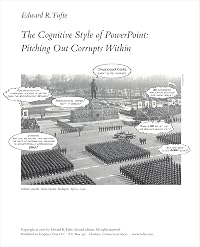
- (Click to show. Warning: May contain spoilers.)It is possible that these speakers are not evidence-oriented, and are serving up some PP Phluff to mask their lousy content, just as this massive tendentious pedestal in Budapest once served up Stalin-cult propaganda to orderly followers feigning attention.
Classifications
- Genres
- Art & Design, Nonfiction, General Nonfiction, Technology, Business
- DDC/MDS
- 005.58 — Computer science, information & general works Computer science, knowledge & systems Artificial Intelligence/Virtual Reality General purpose application programs Presentation Software
- LCC
- P93.5 .T838 — Language and Literature Philology. Linguistics Communication. Mass media
Statistics
- Members
- 801
- Popularity
- 34,663
- Reviews
- 11
- Rating
- (3.89)
- Languages
- English
- Media
- Paper
- ISBNs
- 2