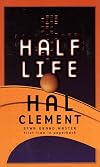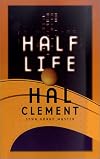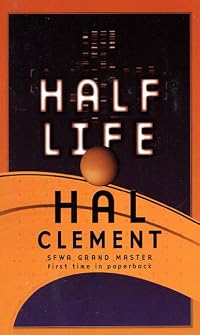
Half Life
by Hal Clement
On This Page
Description
The human race on Earth is in trouble, perhaps facing extinction. A crew of young people travel to the moons of Saturn to investigate the biochemistry of the pre-life conditions there in the hope of discovering something that might save Earth. They race to find answers with death close behind, and gaining. Half Life is pure hard SF adventure, and Clement is at his best.Tags
Recommendations




























Member Reviews
Clement's science fiction really was fiction about science - his day job was as a chemistry teacher, and he was interested in thinking in some detail about the consequences of of life under alien conditions. And sharing that thinking with his readers.
This leads to a particular kind of story that appeals to a particular kind of audience. Premise is all in his novels. What would life be like on a world that rotated so fast its gravity was 200 times greater at the poles than the equator? How would an alien from a much hotter world perceive Earth?
By this standard, Half Life does not overwhelm. The premise is a grim one, but not particularly exotic. A few hundred years from now, new, deadly diseases start to crop up faster than medical show more science can combat them, and humanity's long population growth turns into a decline, with a half-life of just under 70 years. Other species are dying too. Scientific research is placed on a quasi-military footing to try to find a way to halt the decline. The book follows a crew of scientists and engineers prospecting for possibly helpful scientific discoveries on Saturn's moon Titan. Titan is, in real life, a chemically interesting moon, with hydrocarbon lakes under a thick nitrogen atmosphere, and the hope in the book is that exploring the chemistry of such an alien environment might fill in gaps that could somehow help. The jackpot would be to catch a new form of life in the process of evolving from non-life.
The crew does not expect to return to Earth, and mostly suffer from the various terminal illnesses that have been afflicting humanity.
There are adventures, deaths, and injuries; puzzles and discoveries; and (characteristically) very little emotion. The portrayal of Titan is convincing (in some ways the best part of the book) and the landing of the Huygens Probe in 2005 did little to prove Clement wrong.
Even though this is far from Clements' most interesting or cleverest book, I wonder if it isn't one of his most personal ones. He was in his late seventies when he wrote it, and, as he looked around and saw more of his contemporaries dying, it must have felt on a small scale like what all of humanity faced in his book. As an older person living with diabetes, he could probably relate to his characters' challenges with their medical conditions. Also like his characters, he was a curious soul who took great pleasure from finding things out. I hope the last line if his book was true for him:
"They lived happily ever after while they lived." show less
This leads to a particular kind of story that appeals to a particular kind of audience. Premise is all in his novels. What would life be like on a world that rotated so fast its gravity was 200 times greater at the poles than the equator? How would an alien from a much hotter world perceive Earth?
By this standard, Half Life does not overwhelm. The premise is a grim one, but not particularly exotic. A few hundred years from now, new, deadly diseases start to crop up faster than medical show more science can combat them, and humanity's long population growth turns into a decline, with a half-life of just under 70 years. Other species are dying too. Scientific research is placed on a quasi-military footing to try to find a way to halt the decline. The book follows a crew of scientists and engineers prospecting for possibly helpful scientific discoveries on Saturn's moon Titan. Titan is, in real life, a chemically interesting moon, with hydrocarbon lakes under a thick nitrogen atmosphere, and the hope in the book is that exploring the chemistry of such an alien environment might fill in gaps that could somehow help. The jackpot would be to catch a new form of life in the process of evolving from non-life.
The crew does not expect to return to Earth, and mostly suffer from the various terminal illnesses that have been afflicting humanity.
There are adventures, deaths, and injuries; puzzles and discoveries; and (characteristically) very little emotion. The portrayal of Titan is convincing (in some ways the best part of the book) and the landing of the Huygens Probe in 2005 did little to prove Clement wrong.
Even though this is far from Clements' most interesting or cleverest book, I wonder if it isn't one of his most personal ones. He was in his late seventies when he wrote it, and, as he looked around and saw more of his contemporaries dying, it must have felt on a small scale like what all of humanity faced in his book. As an older person living with diabetes, he could probably relate to his characters' challenges with their medical conditions. Also like his characters, he was a curious soul who took great pleasure from finding things out. I hope the last line if his book was true for him:
"They lived happily ever after while they lived." show less
New, fatal diseases started appearing at a vastly faster rate than ever before in the early 21st century, and a few centuries later, humanity has managed only to bring the death rate roughly in line with an increased birth rate again. Science has become a semi-military discipline; it's responsible for the defense of humanity against its greatest threat. Against this background, an expedition is sent to Titan, to study, it is hoped, pre-biotic conditions, and gain an understanding of biological principles from the base up. This may lead to the knowledge that will enable scientists to figure out what has caused the runaway explosion of disease.
The expedition consists of fifty people, both men and women, most of them suffering from one show more terminal disease or another. Twenty-one are still alive by the time they are in orbit over Titan and have their space station operational. This is where the story really starts, and most of the action is discussion. For the most part, the members of the expedition stay in sealed quarters, having no direct contact with each other, and only rarely venturing out physically to the surface of Titan. They operate equipment via waldoes and virtual reality.
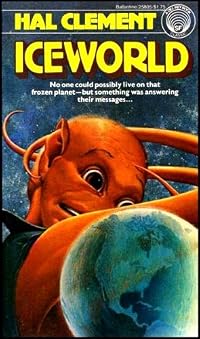
All of this creates a sense of distance from both the action and the characters that's hard to shake. Titan is an interesting intellectual puzzle, and so, sometimes, are the motives of the characters, but I felt little sense of emotional involvement in their problems. Granted that one expects a Hal Clement book to emphasize the intellectual over the emotional; this book seemed significantly more tilted that way than, say, Mission of Gravity, or Iceworld, or Close to Critical. show less
The expedition consists of fifty people, both men and women, most of them suffering from one show more terminal disease or another. Twenty-one are still alive by the time they are in orbit over Titan and have their space station operational. This is where the story really starts, and most of the action is discussion. For the most part, the members of the expedition stay in sealed quarters, having no direct contact with each other, and only rarely venturing out physically to the surface of Titan. They operate equipment via waldoes and virtual reality.
All of this creates a sense of distance from both the action and the characters that's hard to shake. Titan is an interesting intellectual puzzle, and so, sometimes, are the motives of the characters, but I felt little sense of emotional involvement in their problems. Granted that one expects a Hal Clement book to emphasize the intellectual over the emotional; this book seemed significantly more tilted that way than, say, Mission of Gravity, or Iceworld, or Close to Critical. show less
Neither the scenario, nor the basic structure of the mission, nor the resolution feel particularly believable. Still, this book had potential to be pretty good--Clement gives us a reasonably interesting story that offers surprises and makes complex chemistry feel important. Unfortunately I never really cared about what happened to any of the large cast of largely undifferentiated characters.
This book is long on science and engineering details but short on plot and character.
Ratings
Members
- Recently Added By
Author Information

97+ Works 6,372 Members
Work Relationships
Is contained in
Common Knowledge
- Canonical title
- Half Life
- Original publication date
- 1999
Classifications
Statistics
- Members
- 230
- Popularity
- 139,864
- Reviews
- 4
- Rating
- (3.07)
- Languages
- English
- Media
- Paper, Audiobook, Ebook
- ISBNs
- 5
- ASINs
- 3